
On my second day in Yarmouth I headed out to the Chebogue Meadows Wilderness Trail not far from the Hebron Recreation Complex. I had wanted to drive down to the Cape Forchu lighthouse to look for seabirds, but the chilly north wind was uncomfortable and I figured it would only be worse by the ocean so I decided to head inland instead. Chebogue Meadows sounded like a great spot to look for birds and bugs; it was an eBird hotspot, with a whopping 33 species listed before my visit, including many northern-type warblers and thrushes. Interesting to me was the river at the back of the loop visible on Google maps, but what made it especially appealing was an online description of a trail that takes you through 12 distinct habitats via footpaths and boardwalks including softwood forest, a black spruce swamp, a meadow, a hardwood upland, and wetlands.
I didn’t know what to expect as Google maps said it was “closed”. I found the parking area in front of a muddy hydro corridor and initially thought that this was the trail; I could even see an Osprey platform in the distance with two birds in it! Then I found the trail to the right, leading directly into the forest.
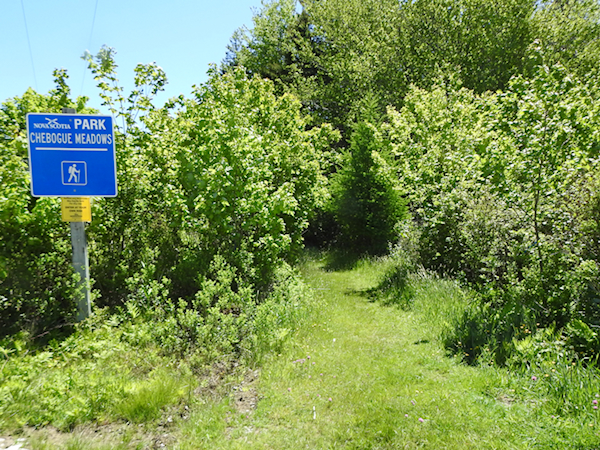
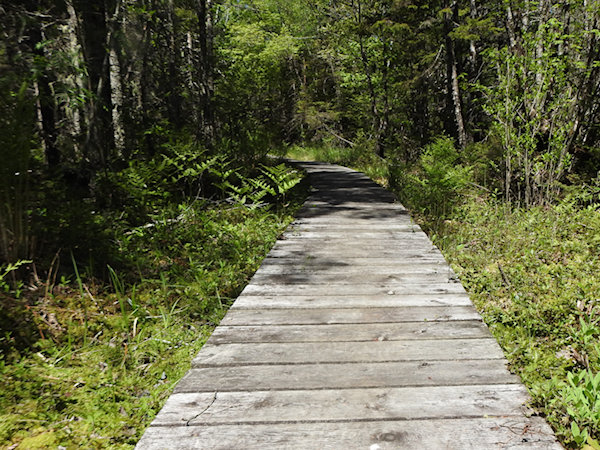
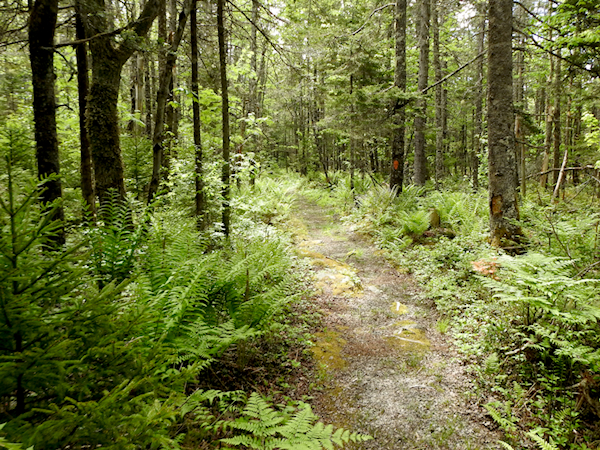
The beginning was an easy walk through typical northern forest habitat reminiscent of Algonquin Park with lots of ferns and spruces. The trail required a few short boardwalks to cross over the wet spots before leaving the woods and entering open areas that reminded me of the bog at Mer Bleue. Only one of the boardwalks had any water below it; the rest were dry.
Some Pink Lady’s Slippers were growing next to the path along with plenty of Bunchberry and Star Flower. I wanted to reach the river at the far end, but didn’t make there on my first visit as I was having too much fun looking for bugs – it was much warmer in the woods than it had been walking around the neighbourhood in Yarmouth earlier and the sun was beautiful.
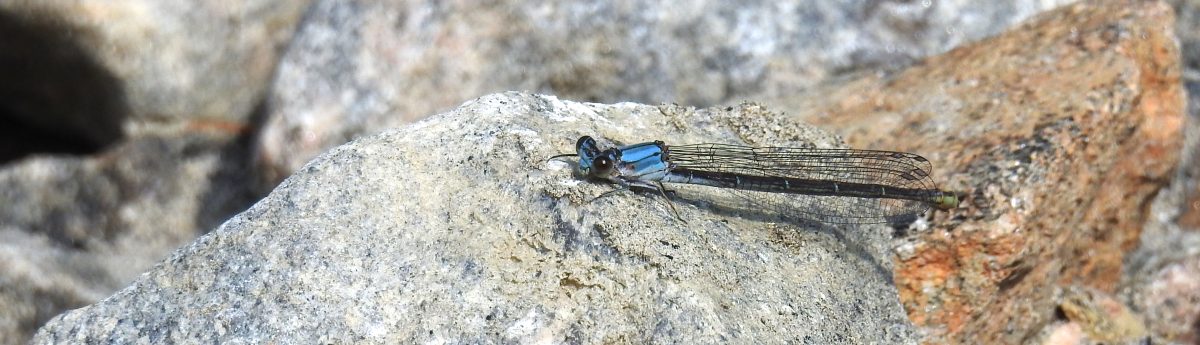
The first odes I saw were forktails – I saw about three different Fragile Forktails on the boardwalk near the muddy patches before I saw my first Eastern Forktail.
Then I scared up a larger dragonfly, the first of the day, from the vegetation growing next to the trail and watched it fly off. Fortunately it landed close enough to the trail to identify it as a Four-spotted Skimmer. I took one sub-par photo to document it in iNaturalist before it flew off again. I found some colourful moths and a new Flower Longhorn Beetle on a bunchberry flower before turning around about 1.5 km from the entrance, having gotten nowhere near the river. Although it was sunny I didn’t see any other dragonflies flying in the openings in the woods until I found a narrow clearing with at least three small dark emeralds flying about. One started swooping low in front of a fern, and just before it landed there I thought to myself that it was just like a Racket-tailed Emerald to land on a pretty, sunlit fern instead of a broadleaf. Sure enough, that’s what the dragonfly did, and with the thick abdomen and slightly flared club I had no reason not to think it was not a Racket-tailed Emerald – until I downloaded my photos and took a good look at them.
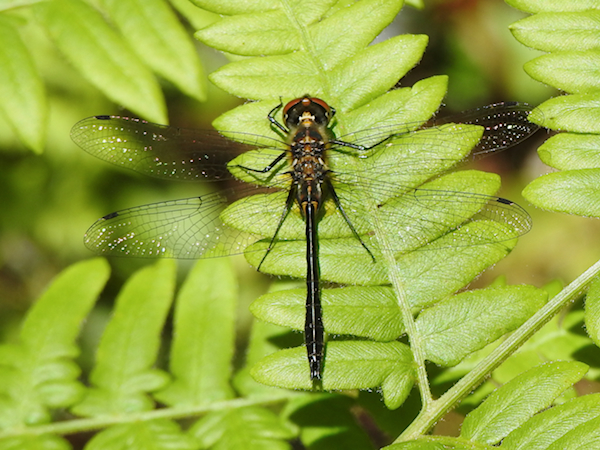
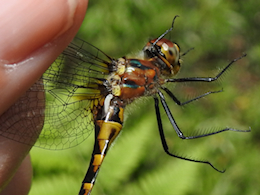
The proportions had me thinking it was a female Racket-tailed Emerald, but the claspers are clearly that of a male. Male Racket-tailed Emeralds have a wasp-thin waist just below the second segment of the abdomen and a rather pronounced club. The Racket-tailed Emerald also has an incomplete yellow collar at the base of the abdomen, with little triangular points at the edge of each side. The triangular points on this fellow were long and narrow. Then I remembered another Maritime species I had hoped to see, the Petite Emerald – which is closely related to the Racket-tailed Emerald. This could not be a female Petite Emerald, as females look more like baskettails with yellowish-orange stripes down the sides. With those claspers it had to be a male Petite Emerald – not a lifer, as I have now seen one on each of my last three visits, but this was definitely the best photo opportunity I’ve had, and the nicest picture I’ve gotten of the male.
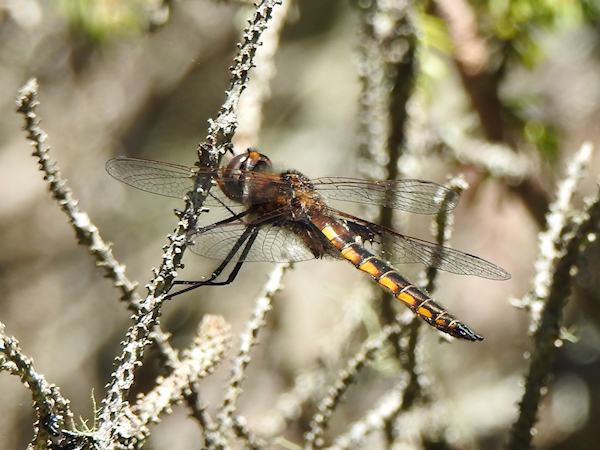
In the meantime, two other emeralds landed in the dead branches of a tree, and I could see that both were baskettails. They were too far to catch, so I figured I would do just what I had done at Sheila McKee and photograph them instead. When I reviewed my photos later I could see the sinuous upper clasper that ruled out Beaverpond Baskettail. I thought it was a Spiny Baskettail…until I realized that the photos also showed a large dark patch at the base of the hindwing. Could it be a Common Baskettail? Or was it the lifer Mantled Baskettail I was hoping for? Unfortunately the angle wasn’t the best for looking at diagnostic features such as the extent of the brown patch on the wing and the shape of the abdominal segments. Still, the black patch does seem reach the base of the hindwing on the left, and the middle abdominal segments seem short, both characteristics of the Mantled Baskettail (Epitheca semiaquea). And Common Baskettail has very few observations in iNaturalist compared to Mantled Baskettail, only 1 out of a total of 7 has been confirmed.
On my way back to the car I heard the pipping of a thrush close to the trail and started pishing. The bird flew into view immediately and I was thrilled to see a Swainson’s Thrush, a species I’d only seen once before in Nova Scotia. By the time I finished my walk I had only 11 bird species, including a pair of Osprey on a nesting platform down the hydro cut, which was a new bird for my Nova Scotia list.
The trail was so intriguing I returned the following day. This time it was a bit cooler and a thick bank of clouds covered most of the sky. I was worried what this meant for finding dragonflies, and indeed it took me a while to find any. There were none in the area where I’d had the two emeralds the day before. However, the northern birds I heard on my way through the forest were wonderful company – two Hermit Thrushes, a Winter Wren, four Blue-headed Vireos, more Northern Parulas, a Magnolia Warbler, a singing Black-throated Blue Warbler whose song sounded like the loose trill of a Palm Warbler ending on a high note – I wouldn’t have known which species it was until I pished him into view! – and four Ovenbirds, one of which I actually saw!
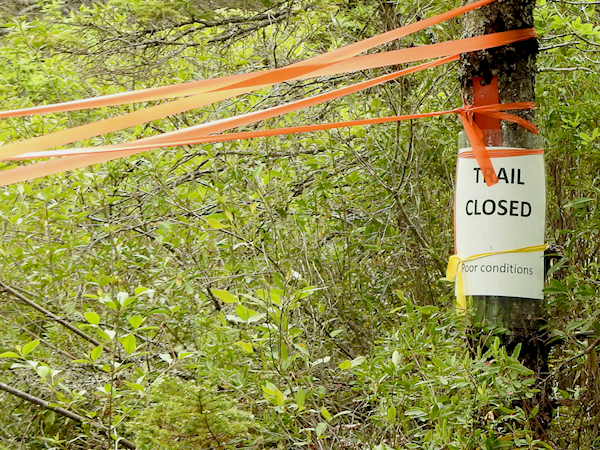
I came across some tape and a “Trail closed – poor conditions” sign at a side trail along the way, but the main trail was walkable, if narrow, and I figured I would keep going until the conditions became too poor to continue.
The woods started opening up and I could hear an Olive-sided Flycatcher singing incessantly across a large open space south of the woods where I was walking. Eventually the trees thinned out and I realized that the open space south of me was the floodplain of the river.
I approached the wooden boardwalk that linked the two sides of the trail and wasn’t completely surprised to see that it was falling into ruin. It didn’t look rotten, so after a quick assessment I decided to walk across. It held, and that’s when I saw my first damselflies of the visit – several Fragile Forktails perching on the wooden boards of the structure.
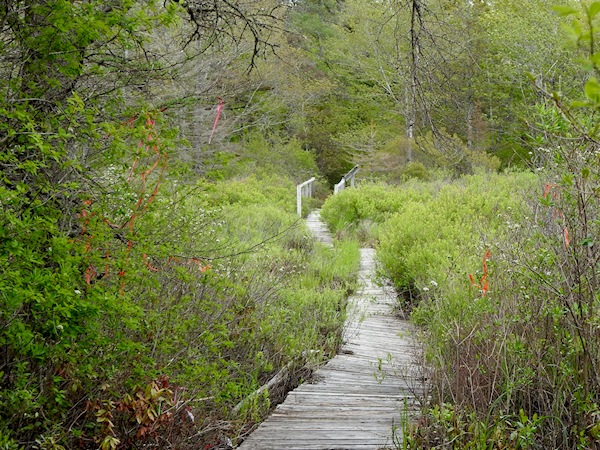
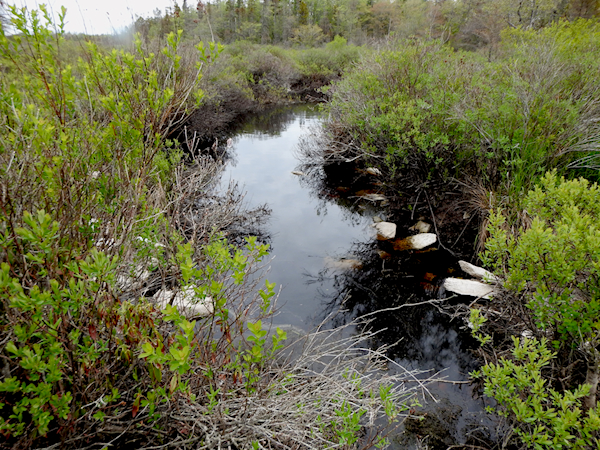
I spent some time gazing up and down the channel, hoping for a spiketail or emerald to come flying along the river, but saw nothing. The vegetation growing on the banks of the river was low and thick, and the river was a small, slow-moving stream that completely filled its small channel…there were few emergent rocks for dragonflies to perch on, and the ones that I could see appeared to be empty.
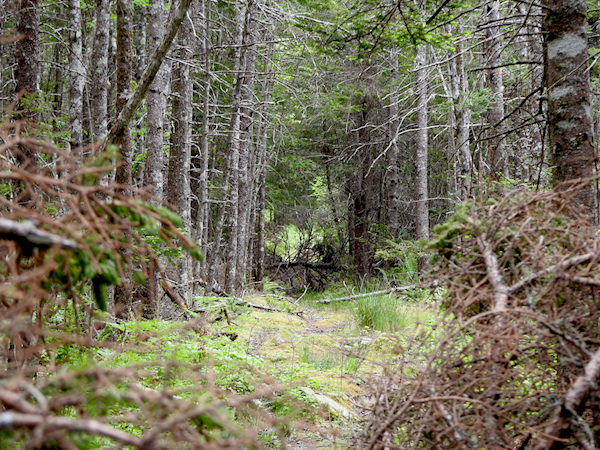
I continued my way across the bridge, heading deeper into the woods. I didn’t get too far before a tangle of fallen trees blocked the way. Although the forest looked mysterious and beckoned me from beyond, I decided to turn back.
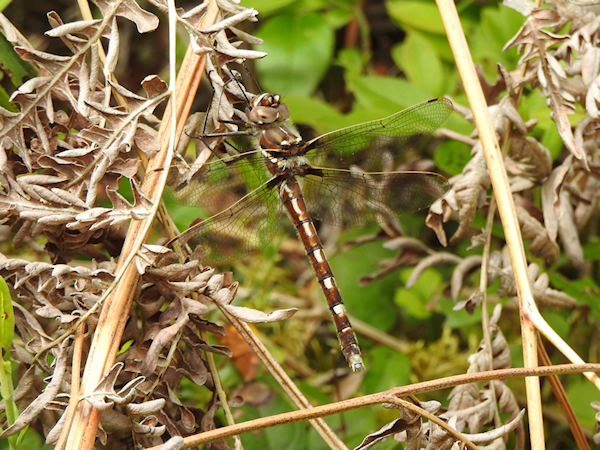
And that’s when I saw a dark, medium-sized dragonfly zip along the trail and land in the branches of a downed tree. I was so taken with the idea of finding a rare emerald that it took me a moment to identify the brown dragon with the white markings as a Stream Cruiser! This was a new dragonfly species for my Nova Scotia list, and I got some great photos while it stayed put on its branch, eating a small bug.
This was a great dragonfly to start the day with. The clouds, too, were breaking up, and I could see a wide band of blue on the horizon. By the time I reached the taped-off trail the sun had come out, and I decided to make the detour and see what I could find. Right away I found myself in an open area with small shrubs lining the trail and only a few tall trees punctuating the vegetation, mainly skinny conifers draped in some sort of pale green beard lichen. Singing on top of one was a Palm Warbler.
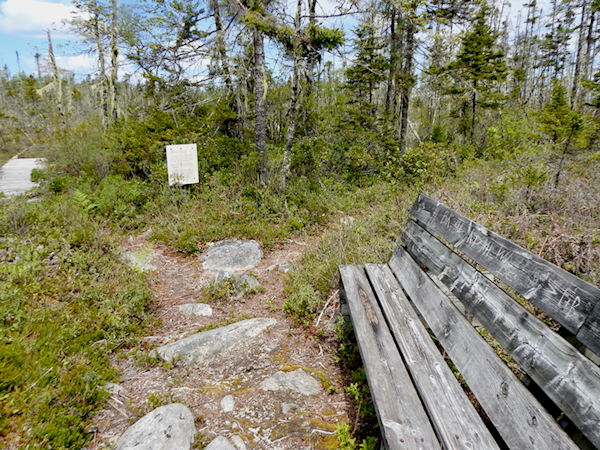
A small path led to a short boardwalk that gazed out onto a neat Tamarack bog. According to the interpretive sign, this low-lying area had once been a pond that started filling with sphagnum and sedges from the margins inward. As the soil developed it began to support trees that could tolerate the wet conditions, particularly Tamarack. The next step in this succession will be Black Spruce becoming the dominant plant.
The sign also mentioned that the bog is presently acidic and low in nutrients; as plants continue to move in, the quality of the nutrients provided by the plant life will increase and support more wildlife.
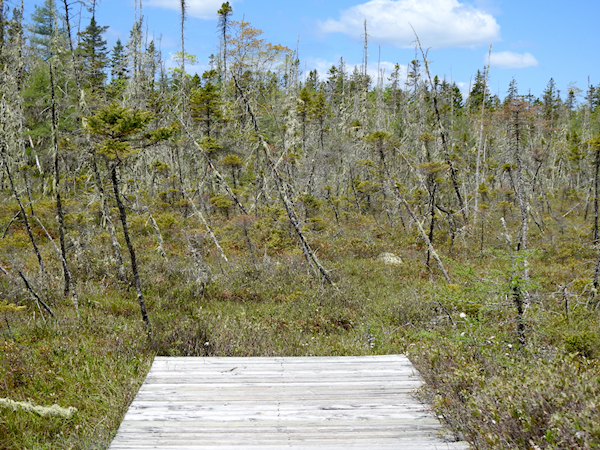
I couldn’t see any water, so I used the handle of my net to test the ground surface. It was dry.
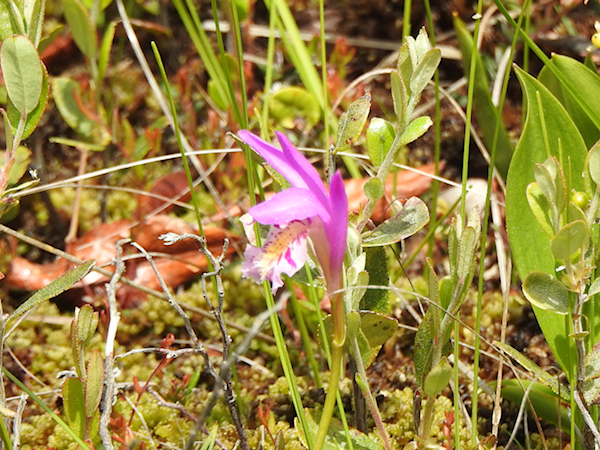
A few pink flowers were growing in the vegetation beyond the platform. One I recognized as Swamp Laurel but the other was a new orchid for me called Dragon’s Mouth (Arethusa bulbosa). This orchid flowers in the summer, each plant producing one bright pink flower that has a whitish pink labellum (i.e. the modified lower lip of the blossom) with a yellow center ornamented with pink spots. This orchid is typically found in acidic, boggy conditions, especially those covered in sphagnum mosses.
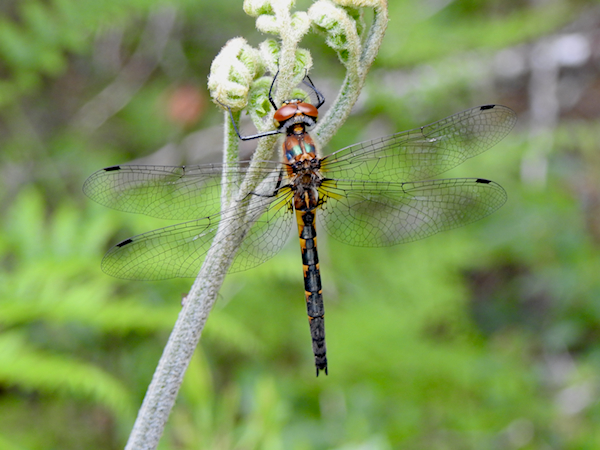
I didn’t see any dragonflies buzzing about the bog and decided now that I had found it and the river that it was time to turn back. I retraced my steps and heard a Dark-eyed Junco on my way back, as well as a couple of singing Purple Finches. A Turkey Vulture soared lazily across the sky. I ended up spending three hours there, walking 5 kilometres (2.5 km each way) and observing a total of 26 species. This brought the total number of species I had observed there on both visits up to 29 and the total species observed at the hotspot up to 41 (up from 33). Best of all, when I reached the same small opening where I’d had the emeralds yesterday I saw one more buzzing about. I waited for a couple of minutes, and then when it approached the same dead tree the baskettails had perched in I swung the net. There was no mistaking the dragonfly I pulled out: it was a female Petite Emerald!
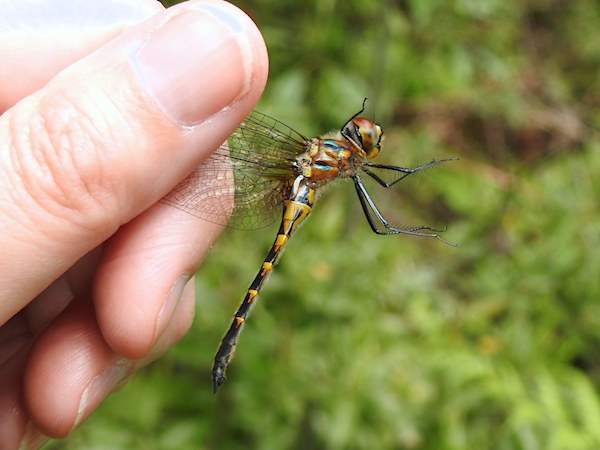
Unlike the male Petite Emerald, the female has yellowish-orange markings down the length of her abdomen. She lacks the yellow thoracic markings of the Somatochlora emeralds and instead is more closely related to the Racket-tailed Emerald, which together are known as the “Lesser Emeralds”. This one was still an immature as her eyes are still brown. Once I was done examining her I put her on a plant and took some photos while she rested.
I finished my walk, happy with my two visits to the Chebogue Meadows Wilderness Trail. Although I’d only found five odonate species – Eastern Forktail, Fragile Forktail, Stream Cruiser, Petite Emerald, and a probable Mantled Baskettail – it was a spot with terrific potential. I will have to add it to my places to visit later in the season, even if it is a bit of a drive from our usual haunt of Kings County!
After I had finished my walk at Chebogue Meadows I drove about 20 minutes north to Whites River Road outside Carleton, NS. After spending some time looking over dragonfly records iNaturalist I realized that this was the closest spot where I could find the uncommon Riffle Snaketail. There were two observations from May 22, 2023 and I hoped to walk the road and, if I was lucky, to get close enough to the water to scan the rocks for dragonflies.
Unfortunately it started clouding up as I arrived. Even worse, the road did not look very public – it looked like a cottage road with trees glowing close to both sides of the road. Signs warned of private property and hidden cameras so I began to feel nervous just driving along it. I came to an open sandy area, got out and started walking around. I did see few dragonflies perching on the ground, and my first turned out to be a clubtail – a Lancet Clubtail.
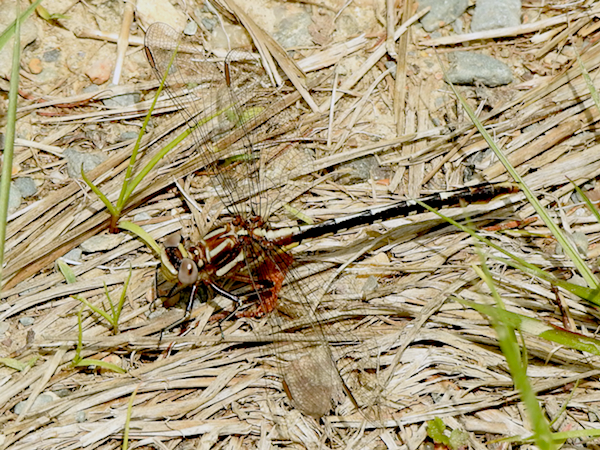
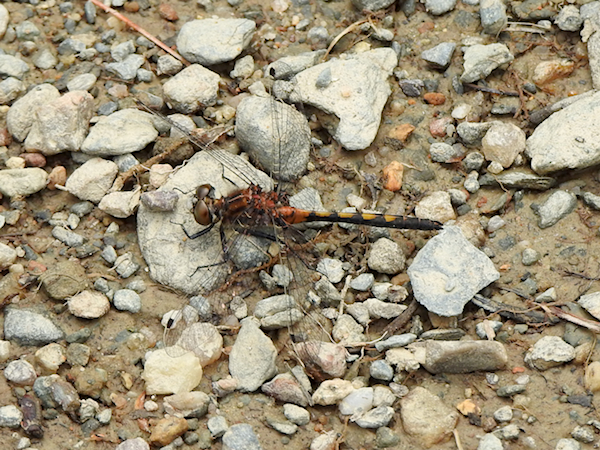
There was at least one other Phanogomphus species in the area which I ignored. Then I saw another dragonfly perching on the ground, this one a Hudsonian Whiteface that was in the process of changing from black and yellow to black and red. You can see the diagnostic light-coloured veins in the dark patch at the top of the forewing closest to the bottom.
Unfortunately there was no public access to the water, so I got back in the car and drove away as quickly as I could. So if you see those two records on iNaturalist you’ll know why they are there!

 OdoNotations