
On our final day in Yarmouth I was ready for a change of scenery. It was a bright, sunny day, but once again the wind made it feel much cooler so I gave up on the idea of driving down Cape Forchu to the lighthouse. I knew it was my last chance to see the ocean and find some ocean birds before leaving for the Valley, but I also knew the wind blowing off the ocean would be cold, and I didn’t have any winter gear with me. I consulted Google, and found a few spots that looked interesting – the Yarmouth County Rail Trail near Arcadia, a tiny community just down the road from the Y-Con Comics convention, and Tusket Falls, which is a little further away and has an interesting walking trail close by. I liked the idea of visiting Tusket Falls for river-loving dragonflies, while the Yarmouth Rail Trail passed by the Chebogue river, which might be good for looking for odes in the vegetation nearby. The Yarmouth Rail Trail actually becomes the Tusket Falls Walking Trail a little further east, too long of a hike from where I planned to access it in Arcadia, but easy enough to drive to once I’d seen enough of the Chebogue River.
After helping Doran prepare for his day at Y-Con, I drove over to Arcadia Station Road and parked at the end, which connects to the rail trail. The trail was a bright, open, well-kept crushed gravel trail with neatly managed vegetation growing just beyond its grassy shoulders. It runs 87 kilometers from Lower East Pubnico to Norwood, passing through woodlands, agricultural fields, lakeshores, and tidal and coastal landscapes. There was sure to be some interesting biodiversity here, and I turned left as I could see a wooden structure that must have been the bridge not too far ahead.

Indeed it was, a small bridge that passed over a small brook about five feet below the surface of the rail trail. Vegetation grew thickly down the slope to the water and along its banks, providing no room nor any sort of bank to stand on. I spent some time on the bridge, gazing at the few exposed rocks and vegetation hanging out over the water, but didn’t see any insects. After I finished examining the brook, I continued in the same direction, flushing a Ring-necked Pheasant as I did. I didn’t find any dragonflies, and after walking about 100 meters I turned around and followed the trail to where it passed by the Chebogue River. This area didn’t prove to very interesting either; the river was embedded in a rusty-red channel with no vegetation and no riverbank to access the water. It looked devoid of insects, so I continued my exploration beyond the river, and back into the woods. The forest was set back far enough that the trail was still sunny and bright; I examined the vegetation along the north side of the trail, where the sun was shining directly. Then I noticed a dragonfly dancing through the air ahead of me. It was large enough to intrigue me, and I waited for it to land. It never did, and I wasn’t able to catch up with it, so it will have to remain a mystery.
Then I saw my first ode in the vegetation: the unmistakable black and metallic green of an Ebony Jewelwing! It didn’t occur to me at the time to wonder why a shady-forest species of moderate to fast-flowing streams and creeks was basking happily in the vegetation close to a slow-moving sterile-looking river. I was just happy to see it!

A little further along I came across a male Lancet Clubtail on the ground. It looked like I was finally entering an area inhabited by a variety of ode species! Then I came to an area where the forest retreated, leaving a damp area filled with ferns and spongy vegetation. The area became dominated by grasses and wildflowers a little further back where the ground was higher. I left the trail to enter it, hoping to find a few more dragonflies. As soon as I did, one flew up out of the grass, circled around, and landed on a twig just beyond the ferns! I noted where it landed, and was surprised to see a brown and blue darner. I moved around the area until I could see the side of the thorax, and the single straight yellowish stripe that identified it as a Springtime Darner!

These are not darners I encounter very often. They like small sun-lit streams, especially those in or close to woodlands. They may also be found in stream-fed ponds, patrolling the area just above the water. My last sighting was a year ago at Morris Island, and I don’t remember the one I saw before that as it was so long ago! It was fantastic to see this species again.
I crossed the clearing and found no other dragonflies, but just inside the tree line I found something even better: a shallow, shaded rocky brook! Although sun was shining through gaps in the canopy I found no other odes in the area; however, a Maritime Garter Snake rustling in the leaf litter turned out to be my only snake of the trip. The habitat looked excellent for odes, but the streamside vegetation was too thick for me to be able walk up or down the stream in either direction to see if another spot would be better. Reluctantly I left, hoping that the stream would approach or cross the trail again.
It did better: it emerged from the wood right beside the trail, where it flowed into a cozy pond before flowing out through two different channels. This was the best dragonfly habitat I’d seen all day, and there were dragonflies and damselflies flying above the water!


I saw a few Eastern Forktails and a Fragile Forktail on the rocks and vegetation close to the shore and perhaps four or five individual dragonflies flying around. They flew low over the water, patrolling up and down the stream until one eventually crossed paths with another and a chase ensued. I waited on the bank for a bit, and after a short time I managed to catch one. It was another Springtime Darner!

I had never seen a Springtime Darner “on territory” before; my experiences have been limited to seeing single individuals hanging up in the trees at Hurdman Park a looong time ago (pre-LRT days) and the one at Morris Island last year that flew in and landed in front of me and Chris Traynor. Although it looks like a mosaic darner (genus Aeshna), it belongs to a different genus altogether and is the only species found within that genus, Basiaeschna. It is a smaller dragon with smaller eyes and simpler wing venation than the mosaic darners, and flies much earlier in the season. The anterior thoracic stripe is straight, and is yellow or whitish-yellow.
This species usually lives near sunny woodland streams and rivers with a gentle current. It also inhabits clear ponds or lakes near forest. Clearly the convergence of woodland stream and open pond was irresistible to these darners, as there were at least four of them cruising along and tangling with each other.
In time I noticed another, larger dragonfly flying out of the woods and over the pond. I was delighted when I noticed the black and yellow markings of a spiketail and eagerly set out to catch it. I waited on the bank of the pond, then realized I had a better chance of catching it along the stream in the woods where the banks were closer together, bringing the spiketail within reach of my net. I returned to the woods, and walked along until I found a way down to the creek. I could extend my net only about half way across the water, and the next time the spiketail flew by it managed to elude me. The creek deeper in the woods looked even narrower, so I repeated this process. Then I waited. And waited. And waited….until I realized the spiketail was ovipositing in the water right in front of me! Spiketails lay their eggs by repeatedly tapping the tips of their abdomens on the water’s surface, bouncing up and down in a small area. I should have reached for the camera in order to at least try and identify it, but I went for the net instead – and somehow missed. The spiketail shot off, and didn’t return. I figured it might take a while for her to return, so I decided to continue my walk, as I could see on the maps that there was a spot further ahead where a large lake came close to the trail. I thought there might be some different dragonflies in that area, particularly if the road to the lake was open to the public.

I passed by another wide open space full of sedges and cattail reeds, and found a small patch of open water close the trail. Some Blue Flag Irises were growing in the area, and I saw a small orange butterfly perching on the deep violet petals and took its photo. Unsurprisingly, the butterfly was a Hobomok Skipper, one of the first skippers to emerge in June. A fresh Four-spotted Skimmer was hunting over the water, repeatedly flying out and returning to the same branch.

The creek emerged from the sedge meadow and meadered toward the woods, which were set back several metres from the trail at this point. I decided to take a quick walk along the creek, although the ground was quite muddy in this area, with what looked like water-filled tire tracks disappearing into the woods. There was no vegetation here at all, and when I came to an open spot where the sunlight broke through I spent some time examining the rocks in branches in the area for perching odes. An Ebony Jewelwing was perching in a small leafy shrub above the water, and I found a Fragile Forktail resting on the rocks in the middle of the creek. There were no large dragonflies, but a Canadian Tiger Swallowtail fluttered about the far bank searching for a mineral-rich spot in which to engage in some mud-puddling. Large yellow swallowtails had been fluttering down the trail most of the morning, though they never stopped long enough for a photo.
I returned to the trail, and when I reached the gravel surface of the road I startled a small clubtail perching on the ground. I saw where it landed, and was unsurprised to see what looked like a male Lancet Clubtail – probably the most common Phanogomphus clubtail in Nova Scotia, if the records in iNaturalist are accurate: Lancet (P. exilis): 156 observations, Dusky (P. spicatus): 33 observations, and Beaverpond Clubtail (P. borealis): 22 observations as of June 1, 2024. However, when I got closer to it I could see that the final segments (S9 and S20) were black, and the top of S8 had a small yellow triangle at the top. This was quite unlike the Lancet Clubtails I’ve seen in Nova Scotia which are chiefly yellow from the top of the abdomen to the final segment. I thought it was likely to be a Dusky Clubtail, but when I later submitted my photos to iNaturalist the AI program didn’t even suggest Dusky Clubtail, just Lancet. Unfortunately the amount of yellow in segments 8 and 10 is variable in this genus of dragonflies, and as my photos don’t show the shape of the terminal appendages very well it will have to remain as a Phanogomphus sp.

I finally came to a small road that led up to Trefry Lake, although when I saw it crossed over a wide wooden bridge I was hesitant to take it as it didn’t look like a public trail. Since there was no one there to say whether it was okay to walk along it, I wandered toward the bridge, scanning the dragonflies flying around me. A few were baskettails of some sort, but what looked like an immature Chalk-fronted Corporal flying ahead of me caught my attention. One dragonfly I was particularly hoping to see was the related White Corporal (Ladona exusta), a robust species with the clear wings of Chalk-fronted Corporal but the bright white abdomen of a male Common Whitetail. I hadn’t realized until recently that it even existed, as it is restricted to sandy ponds and lakes, or heavily-vegetated bogs along the southern half of Nova Scotia and New Brunswick, and the coastal plain of the Mid-Atlantic and New England. I made a mental note to check every presumed Common Whitetail and immature Chalk-fronted Corporal in the Yarmouth area that I saw, and was disappointed when the immature corporal flew out of sight.
The next dragonfly I scared up off the ground turned out to be a female Lancet Clubtail, showing a large stripe of yellow down her abdomen.

Another larger dragonfly caught my attention when it landed in a shrub; I wasn’t sure what it was at first, as it was perching horizontally, but a quick check through my binoculars revealed another Springtime Darner. I have never seen so many of these uncommon darners in one day!

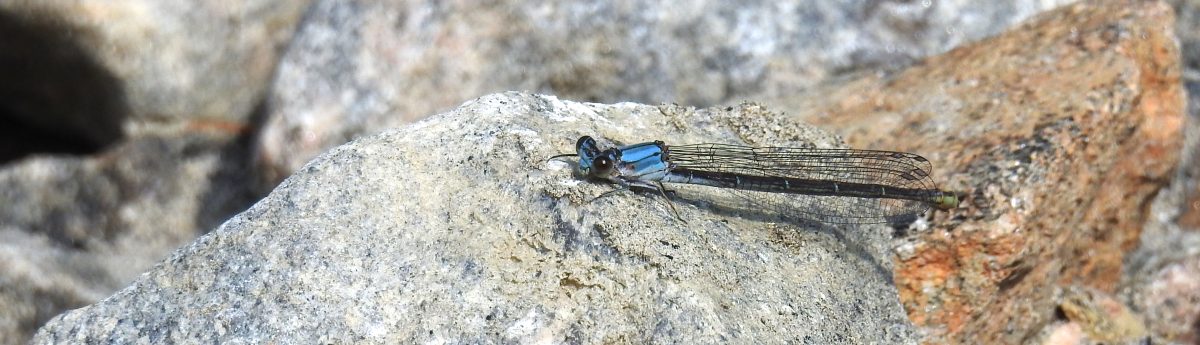
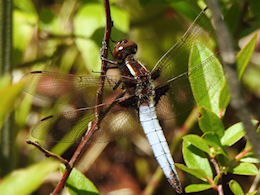
Then a white-bodied skimmer flew by and landed on a branch. I tracked it to see where it was perching, got my binoculars on it…and was thrilled to discover that it had no brown patches in the wings! This was the White Corporal I had been looking for! This is a small skimmer – much smaller than the Common Whitetail which it closely resembles – with two elongated black patches at the base of the wings, two narrow grayish-white stripes on the front of the thorax, and a black-tipped abdomen: the final two segments are entirely dark, with a small brownish-black triangle on segment 8.

Females have a brown thorax with the two grayish-white stripes, and a grayish pruinose abdomen with a thick brown central stripe down the center. Immatures look like small, immature Chalk-fronted Corporals, but have thinner stripes on top of the thorax and longer basal spots on the wings. I did not see any females or immatures in the vicinity. White Corporals live near slow streams, sandy or muddy lakes and ponds, and well-vegetated bogs, particularly those that are acidic and well-vegetated. This corporal has the smallest range of the three corporals, extending along the Atlantic coast from Cape Breton to Delaware (the Blue Corporal, which we do not have in Canada, is a southeastern species).
I continued walking up the road, crossing over the wide wooden bridge and peering down to the thin trickle of water below to look for more odes. I didn’t see any, but just past a bend further up the road I saw a “no trespassing” sign nailed to a tree and turned around. I was disappointed that I hadn’t made it to the lake, but I was getting hot and hungry, so I decided it was time to turn back. As I reached the rail trail again, however, I spotted two or three emeralds flying over the intersection. They all appeared to be baskettails, and it didn’t take me long to net one.

I was stunned to see the large dark patches on the hindwing of the male baskettail…much bigger than the patches on the Common Baskettail we have in Ottawa. However, the size of the patch is variable in both Common and Mantled Baskettails, which is what I was hoping to find. In Ontario, Common Baskettails have a larger basal patch in the north and a reduced (or even absent) basal patch in the south. This agrees with what Paulson says in Dragonflies and Damselflies of the East; according to this field guide, individuals with large wing patches make up all or almost all of the northern populations (and this species ranges from Florida to Cape Breton). The reverse seems to be true of the Mantled Baskettail: individuals in the north have smaller patches than those in the Carolinas, where the dark cells extend to the rear margin of the wing as well as the nodus in the middle. In New Jersey and further north, the dark cells do not reach the nodus or the rear edge of the hindwing. The Mantled Baskettail also has a clear area near the base of the wing, which Common Baskettails with larger wing markings in the same range lack. Paulson notes that this clear space is a useful field mark in the northern and western part of the region, and I could see it clearly in the individual I had caught.

Another field mark to note is the size of the fourth and fifth segments of the abdomen. The Mantled Baskettail has a wider abdomen, and these two segments are wider than they are long with more prominent yellow markings on the side. The Common Baskettail has abdominal segments that are either square or longer than they are wide. Because of the differences in the size of the abdominal segments, the body of the Mantled Baskettail appears to be shorter and thicker than that of the Common Baskettail.
The shape of the claspers requires magnification to distinguish between the two species; the cerci of the Mantled Baskettail appear swollen compared to that of the Common Baskettail but are otherwise similar in shape. I did not view the claspers under magnification while I was still holding the baskettail, but based on the proportions of the abdominal segments and the shape of the brown patch in the hindwings I was pretty sure I was looking at my lifer Mantled Baskettail!
I placed it on a twig and let it be, taking a few photos to show the outstretched wings with the transparent spot near the base. Then I turned around and headed back to the car; I had walked 3 km already just one way! I really wish now that I’d checked my eBird map before turning around, as it appears that there was another entrance to Trefry Lake only about 100 metres further along the trail, where the edge of the lake came almost all the way up to the trail.
On my way back I stopped by the pool of water where I’d seen all the dragonflies earlier. There was still no sign of the spiketail, and a few Springtime Darners were still chasing each other over the water. Both Eastern and Fragile Forktails were sitting on emergent rocks and vegetation, and an immature male Common Whitetail flew in and landed in a shrub. I did some odo-terraforming by placing a branchy stick in the water and waited for one of the flying dragons to come in and land on it. Chris and I coined this term after he realized that if he placed a few branches in the water in the creek in Gatineau Park, dragonflies such as Zebra Clubtails and Dragonhunters would land on the perches to give them a better view of the water (and him a better opportunity to photograph them). If geo-terraforming refers to the process of altering the environment of a planet to make it habitable for life, then odo-terraforming refers to the process of altering the environment to make it habitable for dragonflies!

A couple of Springtime Darners flew past the branch….then ignored it. I waited about 20 minutes, but no other odes even came close to landing on the stick. Eventually I spotted the spiketail again….flying up and over the road this time, well above my head. I was not able to get a good look at it and regrettably had to leave it as unidentified. Although no other new dragonflies flew in to this cozy spot, a few butterflies stopped by, making the wait well worth it. The first was a Silver-bordered Fritillary, a species I hadn’t seen in such a long time that I almost forgot it existed until I saw one at Roger’s Pond last year. The other was an American Lady…not as uncommon as the fritillary, but difficult to find some years as it is a migrant.

I thoroughly enjoyed my walk along the Yarmouth County Rail Trail and wished we had one more day in the area so I could return. The birding was fantastic, too: I saw an Eastern Wood-Pewee singing out in the open and heard an Alder Flycatcher; I heard both Blue-headed and Red-eyed Vireos; I also heard a couple of Golden-crowned Kinglets, a bird that would have been long gone in Ottawa, a Hermit Thrush, a Purple Finch, and a couple of Dark-eyed Juncos calling in the woods. Warblers were varied, too; I counted 10 Ovenbirds, 2 Black-and-white Warblers, 4 Common Yellowthroats, 4 Northern Parulas, 3 Magnolia Warblers, 2 Yellow Warblers, a Chestnut-sided Warbler (which I made sure to see given that the warblers in Nova Scotia sound slightly different from the warblers in Ontario, with many commonalities in their songs), and 3 Black-throated Green Warblers.
Although I never did make it to Tusket Falls, both the Chebogue Meadows Wilderness Trail and the Yarmouth Rail Trail proved to be great spots for a variety of odes, butterflies and birds, making them well worth the visit….and deserving of future visits when we have more leisure time.

 OdoNotations