
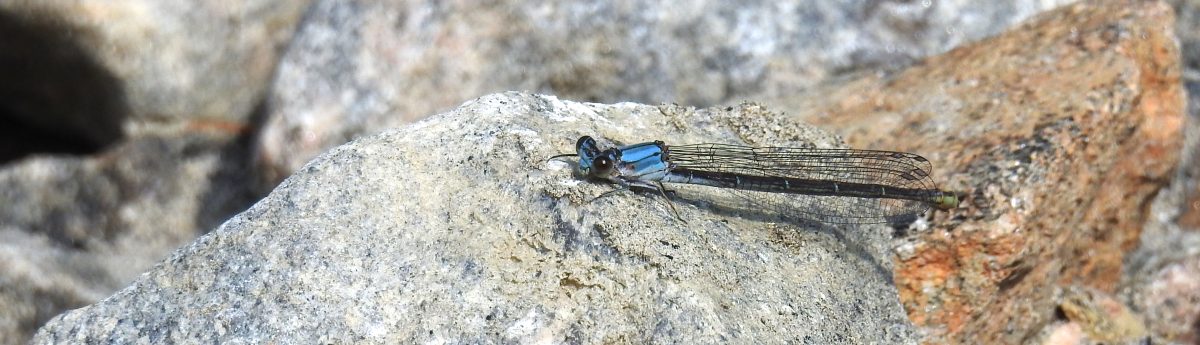

After leaving Mud Lake I went to Sheila McKee Memorial Park to try my luck there. I was hoping that the whitefaces would still be flying, as I wanted to find some fully mature individuals after seeing so many tenerals and immatures right before my trip to the Maritimes, and I was hoping that some clubtails had emerged. It was still sunny, only about 18°C, and while the wind was still blowing, the small clearings in the woods at the top of the escarpment were relatively protected. I didn’t see any odes other than a few Powdered Dancers until I reached the main clearing where the trail leading down to the water branches off to the right. Some smaller dragonflies were perching in shrubs at the edge of the clearing, and I was delighted to find some freshly emerged Blue Dashers – both males and females!
The male Blue Dasher is easily recognized by its black-tipped blue abdomen, yellow and brown striped thorax, white face, eyes that are either green (mature individuals) or red over gray (immature individuals), and wings that are held down and forward at rest. They are relatively new to the Ottawa region, having arrived in 2010 where they quickly became abundant in places like Petrie Island the following year.

As Sheila McKee Memorial Park is a riverside park primarily known for its rocky shoreline along the Ottawa River, I wasn’t expecting to find any Blue Dashers here, let alone in such good numbers…it seemed there was one perching in the vegetation every couple of metres. Blue Dashers make their homes in still-water ponds, marshy bays, and degraded storm water ponds. The river at Sheila McKee is wide, deep, and swift, with a gravel shoreline and no emergent vegetation – quite the opposite of the quiet marshy shores of Petrie Island and Mud Lake. There must be a suitable pond or marsh nearby for there to be so many of them, and it would be an interesting side project to try to track that habitat down.
Female Blue Dashers are usually more difficult to find than males as they – like many dragonflies – spend more time hunting away from the water than patrolling and defending territories along the shore.

Females have the same brown-and-yellow striped thorax as the male, but lack the blue abdomen. Instead, it continues the same colours and pattern as the thorax with pairs of stripes down the top of the abdomen. When I first saw one of these beautiful dragonflies in Ottawa back in 2011, I didn’t know what it was though I recognized it as a skimmer and thought it looked like an immature whiteface.

Altogether I estimate there were between 20 and 30 Blue Dashers, the most I’ve seen in any one place at the same time in recent years!
There were some other goodies around, too, including several large brown dragonflies hunting in the shadows at the edge of the tree-line. I didn’t realize they were there until I startled a couple hanging from the branches of the trees and scared them into flight. I was able to track them down and get good enough looks at them to identify them as Canada Darners. Although these darners usually quite colourful with bright blue, green or yellow markings, a couple, including the one below, appeared much darker with markings in various shades of brown. Colour is influenced by temperature; the cooler it gets, the darker they become. The temperature last night had plunged to 10°C, only rising to 14°C when the sun came out around 9:00, and barely reached 19°C by late afternoon.

There were at least 4 Canada Darners present along the tree-line, and astonishingly, I didn’t need to catch any of them in order to identify them. This fellow landed on the handle of my net while I was holding it!

I rescued another one whose wings had become entangled in several strands of a spider web attached to a branch. With patience I was able to remove the silk webbing, enabling all four wings to flap independently again.

There were several Prince Baskettails present as well – I counted three perching in the branches, and saw at least five more flying high up above the clearings with a swarm of emeralds. I found my first while bending down to photograph a Blue Dasher. When I straightened up, I found myself looking directly at this lovely fellow! Prince Baskettails tend to perch with their abdomen curled upward, differentiating them from other baskettails and hanging dragonflies.

The last brown dragonfly I found hunting along the tree-line was in a shady opening away from the main corridor. It was busy flying in and out of the shadows, and only when it perched to eat something did I get my binoculars on it and identify it as a Stream Cruiser. So far it was turning out to be an impressive day for seeing a variety of odes, and I hadn’t even found any clubtails!

There were other odes around, too. Racket-tailed Emeralds were abundant along the trail and flying overhead with small baskettails that were too high up for me to identify. I saw one immature Widow Skimmer, one female Common Whitetail, a few teneral whitefaces, and one mature whiteface…a male Frosted Whiteface that was easy to identify. Also lurking in the vegetation were about 10 Sedge Sprites and a good number of Powdered Dancers.

I headed down the stairs to the beach where I found more Powdered Dancers and more emeralds flying along the shore and out over the water. I walked down the length of the beach and saw no clubtails, to my disappointment. Then I spent some time trying to catch some of the small baskettails in order to identify them. Eventually I caught both a Spiny Baskettail and a Common Baskettail:


But it was the Blue Dashers that dazzled me, thrilling me with their crisp, bright colours and abundance along the trails. If these dragonflies had been native to Ottawa when I first got into nature I might have become interested in odes a lot sooner! Here are a few more pictures of these brilliant beauties:


These small dragonflies are one of my favourite odes of summer. They have a long flight season, usually disappearing by the middle of September, so they will be around for a while yet. It was a real treat to see so many of them today; it will be interesting to see how this population fares in this location over time.

 OdoNotations