

On June 15th I visited Mud Lake for a morning of birding and ode-hunting. It was about 13°C when I arrived at 8:30, and although it was sunny, the persistent breeze made it feel cooler. Still, there were more odes about than I had hoped for, although at first I saw only a few damselflies (Eastern Forktails, Fragile Forktails and Powdered Dancers) and Dot-tailed Whitefaces. It wasn’t until about an hour into my walk that I came across my first interesting odonate observation of the day: a lilac bush with several dragonflies perching on its branches. It was the Spiny Baskettail landing on an exposed twig that caught my attention, and while I was trying to photograph it a few more dragonflies landed nearby: first a Blue Dasher and then a Prince Baskettail! These large emeralds are the least likely of the baskettails to land, so seeing one perching is always a treat.
Most Prince Baskettails are seen flying low over the water of ponds, lakes, rivers or canals in long, linear flights. Their territories are quite large, which is why you will seldom encounter more than one or two in the same area (such as the ponds at Andrew Haydon Park). They are the only darner-sized dragonfly with multiple brown spots on the wings in our area, making them relatively easy to identify when foraging away from the water – they often feed quite high up, showing the distinct wing pattern as they fly over fields and meadows searching for small insect prey.

A little further along the path I found an American Emerald which landed vertically on a leaf at about head height; it was turning out to be a good day for emeralds! A Common Green Darner perching in the grass was also a nice find. I initially scared him out of the vegetation, then watched to see where he would land.

As I made my way around the south edge of the lake, I noticed more damselflies sheltering in the vegetation along the shore: more Eastern Forktails, Hagen’s Bluets and Marsh Bluets, along with a couple of Fragile Forktails and several Powdered Dancers. Dozens of Dot-tailed Whitefaces were perching close to the ground or on lily pads in the water, and when one landed on the pink blossom of a Bindweed vine I was thrilled, as I couldn’t have asked for a prettier backdrop for the crisp black and white colours of this dragonfly.

I spent some time scanning the lily pads for perching odes and made a few interesting discoveries. The first was a beautiful male Eastern Pondhawk resting on a log. I never encounter these dragonflies in large numbers; although they breed at Mud Lake, I only see them there a couple of times each year.

The second was a large clubtail resting on a lily pad not too far out. There are two large pond clubtails (genus Arigomphus) at Mud Lake: the Horned Clubtail and the Lilypad Clubtail. The shape of the claspers and the colour of the eyes identified it as a Lilypad Clubtail, a fresh male that sat on the lily pad facing away from me, which seems to be typical of this species!

I left the first lookout and headed to the next lookout onto the pond. There I noticed at least two Common Green Darners patrolling the pond, as well as a Racket-tailed Emerald flying over the vegetation along the shoreline. Then the Racket-tailed Emerald landed on a leaf close by – a male with an extremely thin abdomen and thick club at the end.

I headed over to the marshy northeast corner of the pond, which is where I struck gold. The constant breeze blowing across the open lawn meant there were few odes flying out in the open, but when I reached the edge of the clearing I noticed a few dragonflies landing on the broad leaves of the vegetation growing at the base of the trees.

The first was large and bright yellow…I thought it was another Lilypad Clubtail until I got a good look at it and noticed the large yellow structure between the eyes. The high occiput is the best way of identifying a female Horned Clubtail, and this was the first time I had ever been close enough to one of these dragonflies facing me so I could truly appreciate this feature.

It was a female, which are usually more difficult to find than males as they spend more time away from the water, often perching higher up in the tree canopy. Female Horned Clubtails are unique for two reasons: the aforementioned occiput, a broad bilobed “shield” between the eyes, and the tiny pair of black horns emerging just below the inner corner of each eye. Although the horns are much more visible in a profile view, here you can see the one on the left near the top edge of the yellow face.

It was not the only clubtail perching in the vegetation. There were at least three smaller Lancet Clubtails in the area too! These dragonflies look like duller, miniature versions of the Horned Clubtail and are most commonly found along the Ottawa River in our region. They are usually brownish-black with dingy yellow markings, with a slight club at the tip of the abdomen, and like to perch on the ground or low in the vegetation.

There were also a few Eastern Forktails and Powdered Dancers resting on the leaves, too, and one of the forktails was eating an insect with long antennae.

I was thinking about leaving when another large dragonfly flew in and perched on a branch not much higher than my head. It was a Stream Cruiser, one of the dragonflies I look for at Mud Lake each June, though I usually see them patrolling the forest trails near the back of the conservation area.

Then I spotted this Lancet Clubtail perching fairly close to a couple of Powdered Dancers and had to take their picture. One of the things that interests me most about nature is how different species interact with each other. Odonates will eat anything they catch that fits in their mouth, and these Powdered Dancers could easily become lunch for the Lancet Clubtail. I presume they were all too happy to have found such a sunny, sheltered spot to do much hunting while the wind was still blowing.

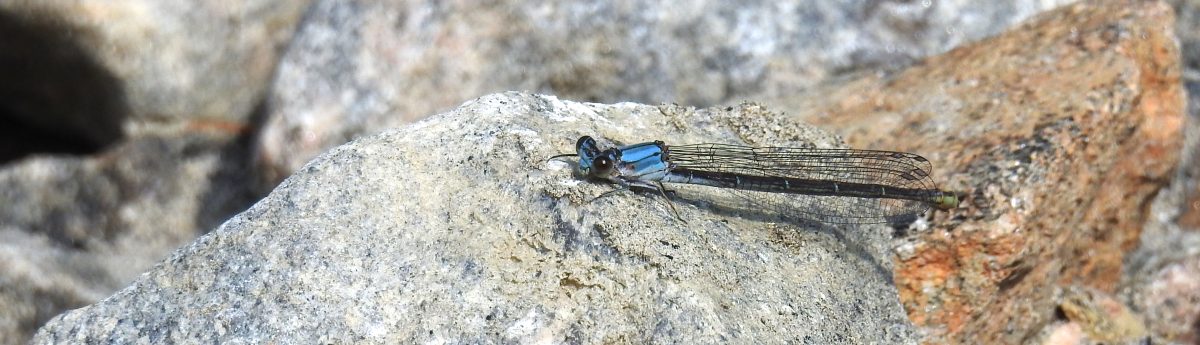
From there I went to check the bay behind the filtration plant but the water was so high there wasn’t much of a shoreline. I pushed my way through the vegetation to the edge of the water and scared up a few Stream Bluets before turning around.
Despite the cooler temperature and stiff breeze I ended up finding 18 ode species at Mud Lake, with representatives from one damselfly family (the pond damsels) and five dragonfly families (darners, clubtails, cruisers, emeralds and skimmers) which is normal for the conservation area. The highlight was definitely seeing so many individuals perching on the sunny leaves where they were relatively protected from the wind, including two clubtail species and the Stream Cruiser. One of the best places to see odonates in the Ottawa area, Mud Lake has shown once again that even in suboptimal weather there is still lots to see!

 OdoNotations