
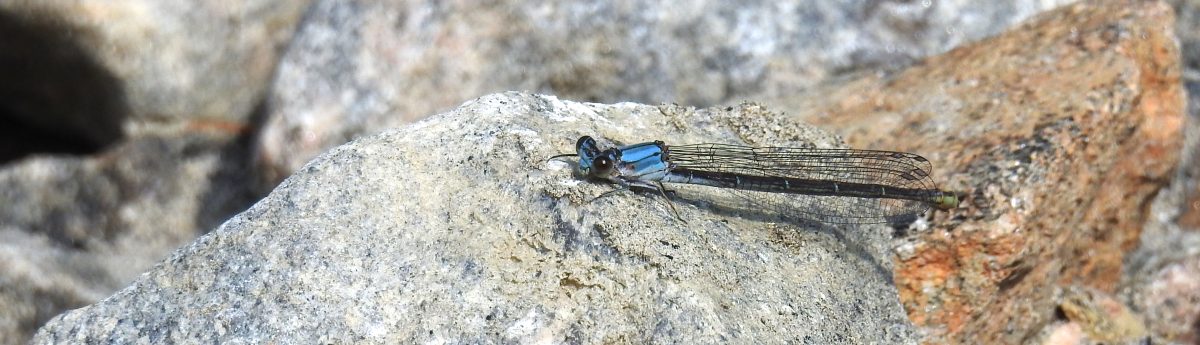
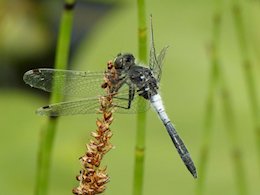
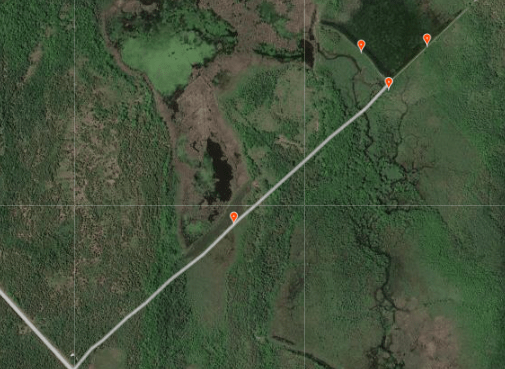
Last year I spent a cloudy Sunday morning in the south end of Marlborough Forest, looking for for new parts of Marlborough Forest to explore as there were very few odonate records on iNaturalist from that area. I visited four places that looked intriguing on Google Map: an unmaintained trail extending beyond Mulholland Road at Harnett Road; a large wetland further south on Harnett Road directly accessible by car; another unmaintained trail beyond Weedmark Road off of Paden Road; and the Paden Road trail itself. I had hoped to have time to explore Heaphy Road on the western boundary, as Google Maps shows it running through another big wetland and crossing over a large creek before encountering more wetlands. I wasn’t sure what the creek looked like in this area, whether it was a slow, deep, muddy, meandering waterway like the Jock River or if it was a narrow, rocky, fast-flowing stream like those I had seen recently in Nova Scotia. Fast-flowing waters provide habitat to a different variety of odonate species than the slow-moving streams and marshy ponds that make up much of Ottawa county, and I was hoping that there was a fast enough flow to attract jewelwings, clubtails, and perhaps even a spiketail. So far all that had been recorded in that area was Sedge Sprite, Common Whitetail, Dot-tailed Whiteface, and Common Green Darner, all very abundant and widespread species in Ottawa.
The day was supposed to be a mix of sun and cloud, though by the time I arrived around lunch time there was a thin haze of cloud covering the sky with the sun occasionally shining through. It was warm enough, but not too hot with no humidity; I encountered tons of deer flies but no mosquitoes. There was a complete halo around the sun, which, in conjunction with the thin veil of clouds, looked quite eerie; however, these halos are common, forming when tiny ice crystals in the high, thin cirrus clouds act as prisms by refracting and reflecting the light. Usually the halo is white, but sometimes there may be some faint colours within it. It was so unusual that I aimed my camera up toward the sky and tried taking a few photos on different settings. It was quite difficult as I couldn’t check to make sure the sun and halo were in focus, and only two of the three photos succeeded. The colour is a bit off in this image:

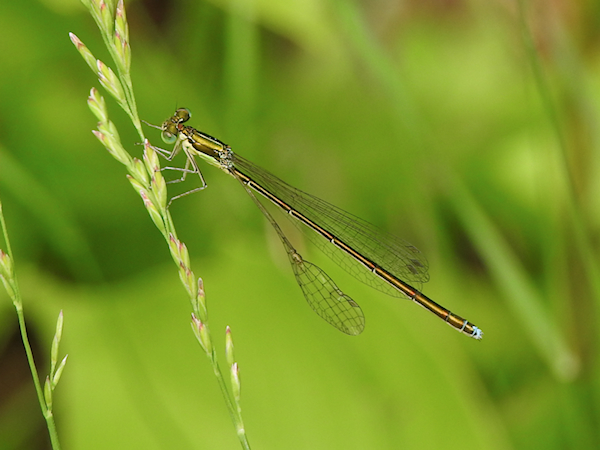
The first part of Heaphy Road traversed through open areas and thick deciduous forest. I heard a Chipping Sparrow in the open area and Wood Thrush and Black-throated Green Warbler in the woods. The first ode I saw was a couple of tiny Sedge Sprites in the vegetation.
Then, in the first open area I encountered my first dragonflies: Blue Dasher, Dot-tailed Whiteface, and Chalk-fronted Corporal. While the latter two species are very common in Marlborough Forest, the first is not; I can’t recall ever seeing one at Roger’s Pond or along the trails north of Roger Stevens Drive, and this is the first record in iNaturalist. That surprised me; there is so much of the open, vegetated wetland habitat in Marlborough Forest that they prefer. I will definitely have to keep an eye out for them at places like Roger’s Pond and the big marsh along Trail E4!
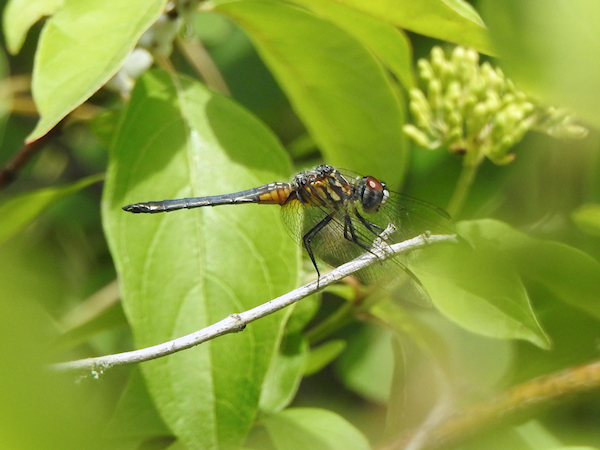
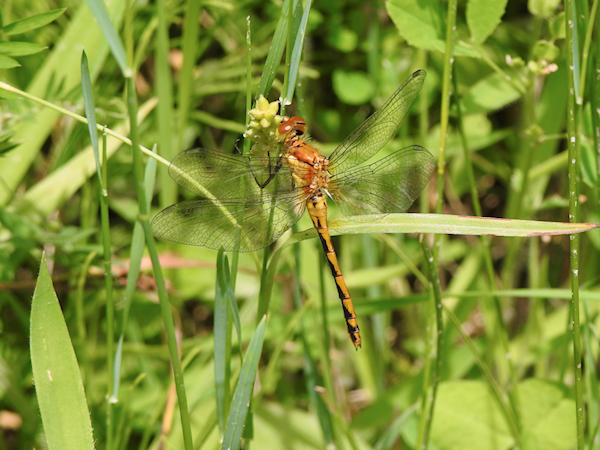
I saw a dragonfly flush from the trail ahead of me, and when I viewed it with my binoculars I was able to identify it as a clubtail. I tried to slowly move closer to it, but it flew off into the trees before I could get close enough to form an opinion on what it was. I was surprised to encounter my first meadowhawk of the season, a fresh yellow black-legged one that is likely a White-faced Meadowhawk but indistinguishable from Cherry-faced Meadowhawk in the field. Meadowhawks are abundant later in the season, and the Autumn Meadowhawk is the last odonate on the wing here in Ottawa, so I wasn’t too happy to see one before the first official day of summer!
The only other species I saw in the first open area was Racket-tailed Emerald, a few of which occasionally snapped up the deer flies circling my head or rested on broad green leaves in the sun. The trail then dipped down through a dark woodlot, and when I came out the other side I could see the marsh ahead. I was happy to see that the water was almost completely open; it was not choked with cattails or Phragmites the way some of my favourite trails near home are.
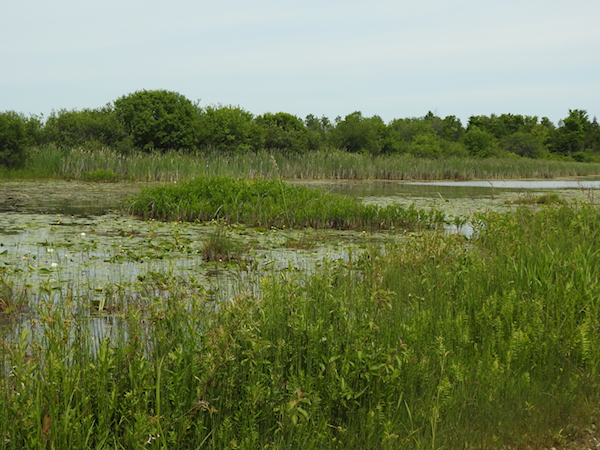
I almost expected to find a couple of swans swimming majestically in the background, but the only waterfowl present was a Wood Duck that flushed as I walked by and a Great Blue Heron that flew up out of the vegetation at the back a bit later.
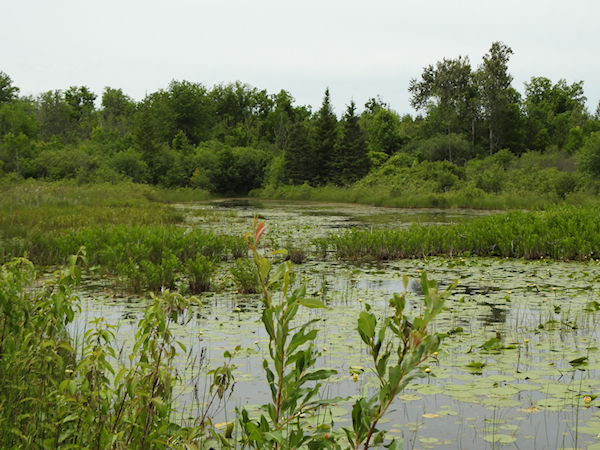
There was much more odonate diversity here. In the reeds at the edge of the road I saw two black and blue damselflies drifting among the vegetation. The first was an Aurora Damsel, a species I am always happy to see as the males are so dapper with their bright yellow spot on the thorax.
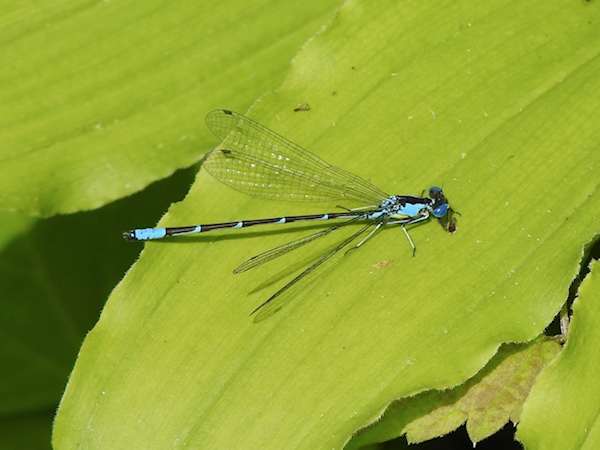
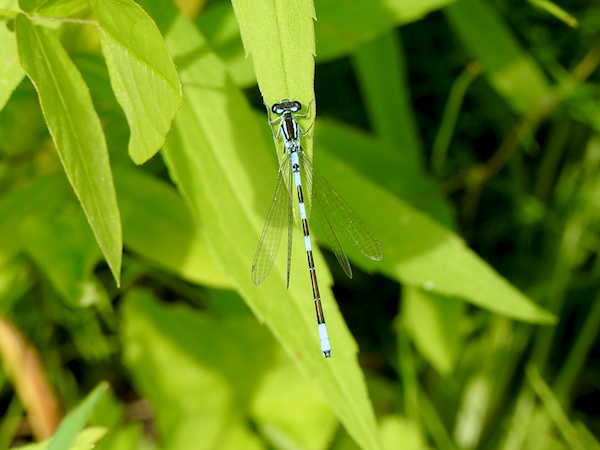
The second was a Taiga Bluet, usually the first damselfly – or even the first odonate – I see in the spring. The large black area toward the tip of the abdomen – two and a half segments – and the slightly spread wings are key features to look for in this distinctive bluet.
The trail marched next to the pond for a good distance, allowing plenty of views of the bugs on the water. Racket-tailed Emeralds zoomed constantly above the water, occasionally hovering in front of me face-to-face so I could see their bright green eyes. Other dragonflies found the lily pads much more to their liking, including one male Eastern Pondhawk, a Dot-tailed Whiteface, a few Frosted Whitefaces, and a few Chalk-fronted Corporals. There were also a few Frosted Whitefaces in the reeds and sedges growing along the shore:
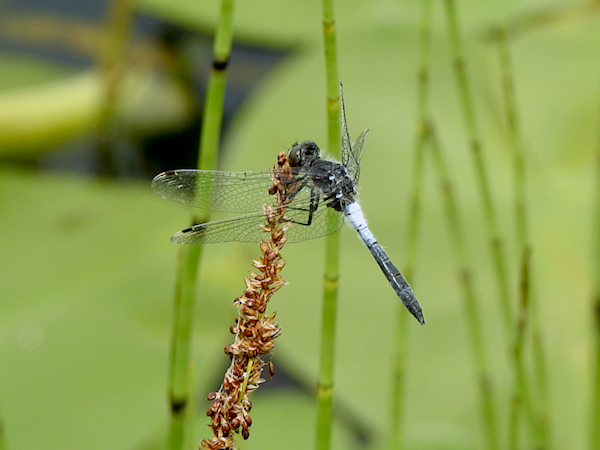
Other skimmers present included several Four-spotted Skimmers, most of which only briefly perched on a twig or branch in between bouts of chasing other dragonflies away, and a single Twelve-spotted Skimmer that also briefly joined the chase.
Once I had seen all of what there was to see at the pond I continued on my way. The trail passed through another dark woodlot, a large clearing, then a smaller woodlot before reaching the stream. I found a single Fragile Forktail, a single Eastern Forktail, and two Hagen’s Bluets (netted and identified using a hand lens) along the way.
One and a half kilometers into my walk I reached the bridge. Two large orange blocks had been placed at either end, although it seemed as though they weren’t placed there to act as barricades. The bridge itself was covered with a patchwork of plywood, which made wonder about the structure beneath it and the supports holding the whole thing up. It looked untrustworthy, and as I couldn’t get down to the banks of the stream to see what kind of shape the underlying structure was in, I decided not to cross. There was a reason why there had been a “Trail Closed” sign at the trail’s entrance, and the bright orange blocks were a solid clue as to why. I figured the bridge was probably strong enough to hold a person’s weight (especially a small person like me), and that the City was trying to prevent ATVs and dirt bikes from using it, but I didn’t want to chance it.
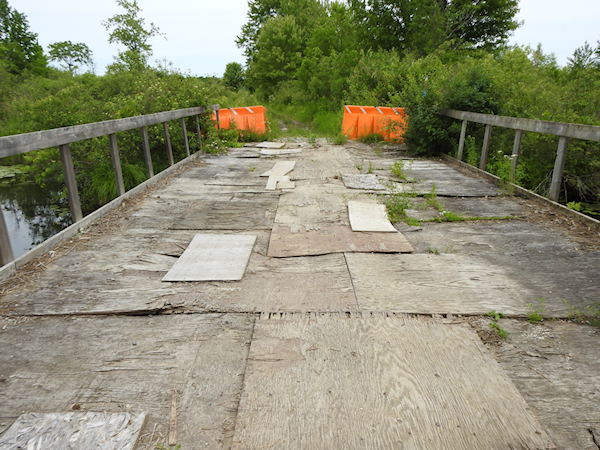
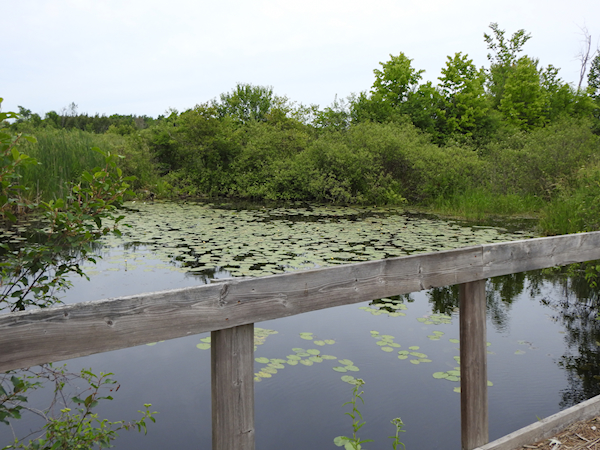
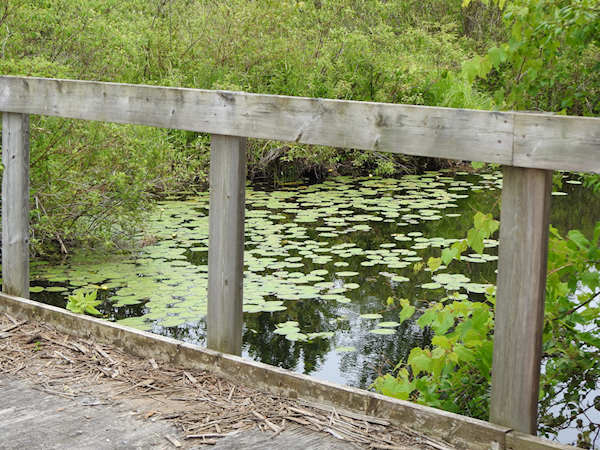
Brassils Creek itself was wide and sluggish – a smaller version of the Jock River, except I couldn’t detect any current. I tried to get down to the water, but found only one small path with a tiny lookout almost entirely blocked by tall vegetation. There didn’t appear to be any bank I could get down to. I didn’t detect any ode activity here, either, except for one female Eastern Forktail near the approach to the bridge. Perhaps it was simply the lack of sun; the wispy clouds had thickened enough to blot it out.
I didn’t see any reason to linger at the bridge, so I turned around and headed back. The only species I added to my list was a Common Whitetail resting on the trail on the way back.
Altogether I found 16 species, not including the unidentified clubtail near the beginning of the trail. While the open pond looked interesting for birds, the Heaphy Road trail didn’t seem to offer anything new or different in terms of ode species – there were no unusual emerald species, no spiketails, no cruisers, and no intriguing stream clubtails. Of course, visiting this area on different dates throughout the season may produce different results, but I considered this visit a success in confirming the habitats present and observing at least the typical species that one would expect to find there.
- iNaturalist. Available from https://www.inaturalist.org. Accessed June 17, 2024. ↩︎

 OdoNotations