
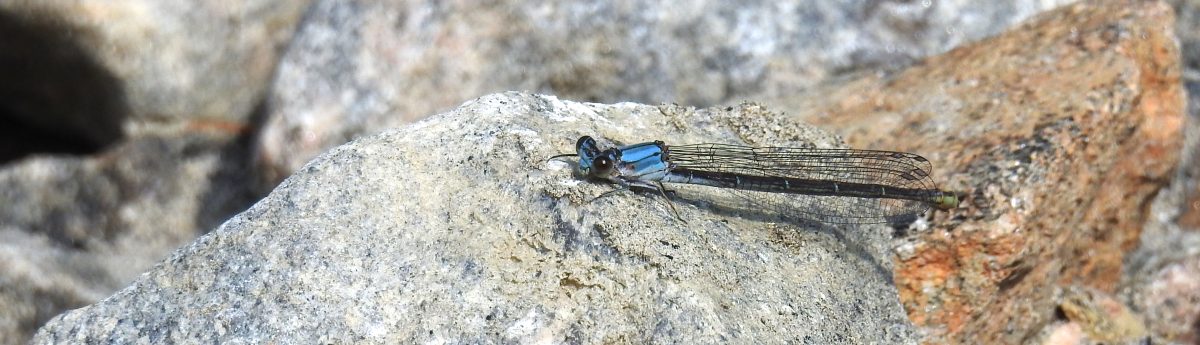

After a couple of wonderful outings the previous weekend, I was looking forward to heading back out to the west end to Sheila McKee Memorial Park to see if any new dragonflies had emerged. However, the weather was most uncooperative – it rained almost the entire weekend. So I took Tuesday morning off work instead, as it was forecast to be both warm and sunny…the temperature had already reached 20°C by 7:00am. My goals were still to look for rarities such as the Mustached Clubtail reported there on May 24, 2021 and the Arrow Clubtail reported there on June 24, 2021. I knew the Arrow Clubtail would be almost impossible, as it is very rare in our region, but as the Mustached Clubtail had a few sporadic reports from Remic Rapids on both sides of the Ottawa River I thought I had at least a shot of finding that species….long though it might be!
The sky was pure blue when I left, and the day’s high forecast was to be a sunny, humid 29°C – perfect weather for dragon-hunting. I left just before 9:00 so I would miss the worst of the rush hour traffic and arrived about 10:20. Being a workday, there were only two other cars in the parking lot when I arrived, and I saw no one on the beach by the time I got there.
I saw my first dragonflies in the first sunlit patch of woods leaving the parking lot. A male Common Whitetail drew my attention with its bright white abdomen, but as I stepped forward to take a look another dragonfly flew up from my feet and landed on a large branch. It was the black and yellow of a fresh clubtail, and as I drew closer to it I identified it as a Black-shouldered Spinyleg, a terrific start to the outing!

These large dragonflies are quite pretty, especially when they are fresh – they start out brilliant yellow and become duller over time, eventually turning olive-green. They are relatively common along the Ottawa River in places like Morris Island and Mud Lake, though I usually don’t see them perching on the shore often at Mud Lake – they prefer the large rocks out in the water behind the ridge. I was so taken with it that I followed it around for a bit to take a few photos from different angles.

I headed over to the first large opening where I found an immature Widow Skimmer, a male Common Whitetail that had not yet turned pruinose, and several Racket-tailed Emeralds. A few darners were still present, and all the ones that I found perching – at least four – turned out to be Canada Darners. One even landed on me, an event that is becoming quite common this year!

A few Sedge Sprites and a single Fragile Forktail were also lurking in the vegetation, as were a large number of Powdered Dancers, but the number of Blue Dashers had dwindled to a handful. I decided to head directly down to the water, encountering a few more Black-shouldered Spinylegs perching on sunlit leaves in the woods along the trail.
The water had risen since my last visit; the beach was very narrow, so it didn’t take much time for me to scan the boulders and vegetation for perching odes as I walked its length.

There were more Racket-tailed Emeralds and a few baskettails flying here, and the only one I caught turned out to be a Spiny Baskettail. I came across a few more Black-shouldered Spinylegs perching on the ground and was beginning to feel discouraged about finding anything new or interesting. Then, finally, I spotted it: a smaller clubtail resting on a sunny leaf nestled close to the base of the escarpment. It was duller in colour than the bright yellow Black-shouldered Spinylegs, green rather than yellow with pretty green eyes. The spots down the length of the abdomen were tiny – a sight which made me realize that this was not a common species. In fact, it looked just like the Mustached Clubtail I was hoping to see!
I approached it cautiously in order to take a few photos from above. I took three, and as I was getting ready to catch it, a Powdered Dancer flew in and engaged in a slight skirmish with the clubtail JUST as I was starting to bring down my net. It flew off, never to be seen again!

The Mustached Clubtail belongs to genus Hylogomphus, also referred to as bantam clubtails. Six species are found in eastern North America, and all are similar in that they live in clean rivers and streams, perch horizontally on leaves, and are smaller and stockier than most other clubtails. Males have oval-shaped clubs while females have smaller, rounded clubs. Both have limited green markings on the abdomen, typically consisting of small streaks in females and dots in males. There are only two species in Ontario, Mustached (H. adelphus) and Green-faced (H. viridifrons), but they both look extremely similar – unfortunately a side view or a front view of the face is necessary to distinguish them. However, it is doubtful whether the Green-faced Clubtail is found in eastern Ontario. There are two known sites in southwestern Ontario, and the Algonquin field guide further notes that it is found along the Rainy River in northern Ontario. It is not on the Ottawa checklist, so I am reasonably confident that this is the more common Mustached Clubtail.
Thrilled with the find, I headed back toward the stairs to return to the top of the escarpment. Along the way I found a Black-shouldered Spinyleg with damaged wings resting on the ground. I caught it to take a look, then let it go. Fortunately it was able to fly. A dragonfly that can’t fly can’t eat (they catch all their food on the wing), and a dragonfly that can’t eat is a dead dragonfly.

As I climbed the stairs I noticed movement in a sunny spot along the side of the cliff. It was there I found a Stream Cruiser hunting. It was nice to know that they are relatively easy to find here, as they are hit-and-miss for me at places like Mud Lake and Morris Island.

Once I reach the top of the escarpment I followed the narrow corridors until I reached a huge clearing near the western border of the park. I had never been to this part of the park before and was delighted to find a large, oblong clearing with a clump of trees in the middle of it. The grass was mown but there was a well-worn trail crossing to the woods on the other side. Here I found a good number of skimmers including more Widow Skimmers, Common Whitetails, Blue Dashers, and even a few Halloween Pennants! This was another species I did not expect to find here.

I saw two more Black-shouldered Spinylegs, bringing my total up to eight, and a few more Racket-tailed Emeralds flying over the lawn as well.
Not long after that my camera battery died, which was not terrible as it was about time to leave anyway. I did see one Eastern Pondhawk on my way back to the parking lot and couldn’t take a photo for iNaturalist, though I did include it in my Odonata Central list.
Altogether it was an amazing outing. I was thrilled that my search for the Mustached Clubtail at Sheila McKee Park paid off, as I had thought my chances of finding one were fairly slim. Seeing so many beautifully fresh Black-shouldered Spinylegs was a thrill as well.
Hopefully there is still time to find an Arrow Clubtail, though this dragonfly is rare along the Ottawa River. There are only two records in the Ottawa region, one from Sheila McKee Park (June 24, 2021) and one from Pinhey’s Point (July 6, 2023) just down the river. Unfortunately both individuals were tenerals with damaged wings, which probably explains why they were found; like its fellow Stylurus species the Elusive Clubtail, this species tends to disappear into the tree tops after emergence. For all we know they might be present in good numbers, but difficult to see given their preference to perch well out of view, beyond the reach of a dragon-hunter’s net.
Clubtails are fascinating dragonflies; I will definitely be visiting Sheila McKee Park again in the near future to look for more, and hope next time to fit in a trip to Pinhey’s Point as well!

 OdoNotations