
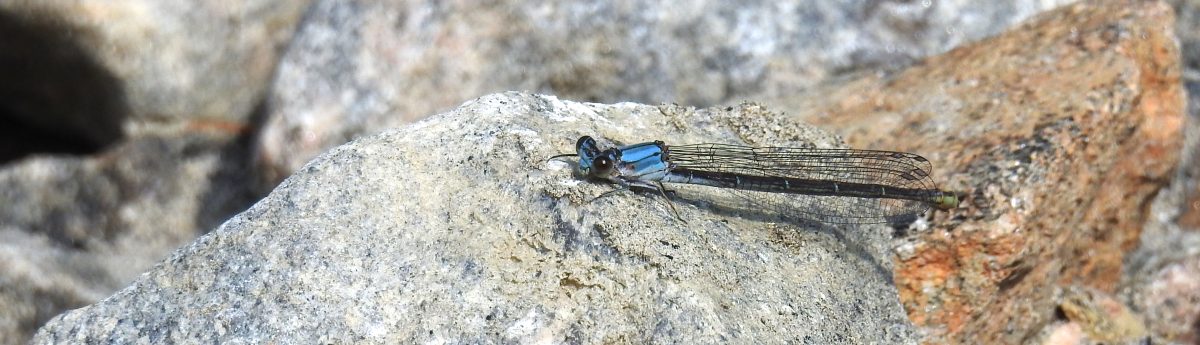

I’ve seen large numbers of emeralds (Spiny Baskettails) emerging at Mud Lake and skimmers (species unknown) emerging at Roger’s Pond. These mass emergences were thrilling, but not surprising given how I often I see large numbers of adults of both types of dragonflies feeding together before dispersing – swarms of baskettails flying up and down trails, and large groups of Chalk-fronted Corporals and Dot-tailed Whitefaces resting on various perches close to the water. Clubtails are not usually found in swarms or large groups (they are perchers rather than fliers, so a swarm would be particularly unusual), so I never thought I’d see a large emergence of members of this dragonfly family. That changed with my Canada Day visit to Sheila McKee Park.
The first emerging clubtail caught my eye when I saw what looked like two nymphs on the rocky beach grappling with each other. Closer inspection revealed it to be a nymph trying to break free of its larval shell so it could complete its transformation. It seemed odd to me that it was on the ground – all the baskettails I’ve seen emerging had crawled up onto the branches of the shrubs at the water’s edge, and all of the skimmers had crawled up the stems of the short grassy vegetation lining the trail at Roger’s Pond. The only place I’ve seen clubtail exuviae is on the trunks of the large trees behind the ridge at Mud Lake or on rocks within the water in Gatineau Park. It looked to me that this fellow had walked out of the water and couldn’t wait to get to a safe spot before bursting out of the shell. It was a clubtail, the only nymph I can identify with confidence because it is the only type of dragonfly with widely-separated eyes.
Dragonflies usually climb up vertical surfaces so that when they break out of their larval shell, gravity pulls them backward and lends them the weight needed to pull them free. Without gravity, the struggle to achieve freedom is much more difficult, and often results in death – they cannot feed in this precarious state, they cannot fly, and they are vulnerable to birds, weasels, and other predators ambling along the shore looking for an easy meal. That was the situation I found this fellow in, and I couldn’t bear to watch it struggle. I picked it up and gently pushed the shell away from it, and the newly-born teneral was able to break free.

The dragonfly righted itself, but stayed put in my hand as its wings began to unfurl. I realized I had an amazing opportunity to document its transformation as its body slowly began to extend to its full size. The video below shows four minutes of the process of the wings slowly extending.
This process is driven by the dragonfly’s circulatory fluid (known as haemolymph) pumping throughout its body and filling the veins of the wings, enabling them to extend to full size.

It only took a few more minutes for its his abdomen to fully extend – here you can see it is now longer than the wings. Shortly after this he fluttered his wings, then flew out over the river on his maiden flight. I watched him anxiously as I wasn’t sure how well he could fly before his body had fully hardened. Eventually he turned and flew back to the shore, then disappeared into the trees where he’ll be safe until his body fully dries and hardens.

The larval shell he left behind, now called an exuvia, was still resting on the ground. Here you can see the hole just above the wings where it burst out of the skin.

Shortly after I found another clubtail on the ground that had partially broken free of its larval skin. Sadly, this one had perished before it was pull itself entirely out of its shell. Unfortunately, such a fate is common in dragonflies, and after that I spent more time scanning the ground watching for other emerging nymphs that might need a bit of assistance.

The next clubtail I found on the ground had been successful in breaking free of its shell, and had lost the pale translucence of freshly emerged tenerals that makes them so difficult to identify. I believe this is an Elusive Clubtail, but one that had suffered damage during the process of emergence as its wings were too twisted and warped to fly.

As its name suggests, Elusive Clubtails are seldom encountered as adults as they spent most of their time hanging in trees rather than perching on rocks. They belong to a group of clubtails known as “hanging clubtails” – genus Stylurus – that hang from the leaves and branches of trees vertically rather than perching horizontally. I only find them on the ground when they are in trouble: the first adult Elusive Clubtail I ever saw was an adult had two of its wings on the same side torn in half and couldn’t fly. The second was being attacked by a wasp which had pinned it to the ground until I shooed the wasp away.

Next I saw a nymph making its way up the beach. It’s rare to see nymphs on land as this stage only lasts a brief time once they leave the water…mere minutes. I moved this one to a rock close to the base of the escarpment so it could complete its emergence in safety out of the wind….although it was sunny and warm, with temperatures about 25°C, there was still an insistent north wind blowing.

I went to check on it later, and found that it emerged safely with no damage to the wings.

The next clubtail I found had already emerged safely on the beach – you can see the empty exuvia beneath it. It didn’t need any help from me.

Still, I didn’t want it to get stepped on by the people or dogs on the beach, so I carried it to the same rock where clubtail #4 was emerging. It is not recommended to handle a dragonfly just after emergence, as its body is still soft and easily damaged. I did not pick it up by the wings as I would with a mature adult – instead I got him to crawl onto my hand by placing a finger between the two front legs below its body, then waited for it to climb up onto my hand.
The last clubtail I found on the ground was walking along the beach as if out for a stroll. I scooped it up with my finger, and it too climbed onto my hand.

I only managed to take a few photos before it flew off. Like the first clubtail, it headed out over the water for quite a distance before circling back to fly into the trees.

The thoracic pattern indicates they are all members of genus Stylurus, of which Elusive Clubtail is the one most commonly seen along the Ottawa River in the city of Ottawa. The other potential species they might be include Zebra Clubtail, Arrow Clubtail, or Riverine Clubtail, all of which are rare. If I’d had time to capture one and watch the club fill out and its body darken and gain a more definitive pattern, I would have known for sure. However, it seems more likely than not that they are all Elusive Clubtails, which was amazing in itself – I couldn’t imagine a more perfect way to end such a perfect day of dragon-hunting than helping a few of these uncommon dragonflies fly their way to freedom.

 OdoNotations