

I have been spending time on iNaturalist lately, looking at historical records of various odonate species and checking what species have been seen around Ottawa recently. This search stemmed from an interest in seeing whether there were any new locations or new records for the Eastern Red Damsel and Amber-winged Spreadwing, two species that used to be common at Bruce Pit but aren’t any longer. The Amber-winged Spreadwing is a relatively hefty species that inhabits various bogs, lakes and ponds, preferably those which do not contain fish. It’s been a good ten years since I’ve seen one at Bruce Pit, and the only other place I’ve seen one in Ottawa is at the Mississippi Snye in 2021. To my surprise one had been reported in Kanata not too far from home: Bill Teron Park in Kanata North. Named for the developer who initially designed Kanata to be a garden city existing in harmony with nature – no straight roads or cookie-cutter houses, while preserving rock outcroppings and areas for parks – it is a delightful pocket of the same rocky, wooded ecosystem found at South March Highlands hidden within an urban setting. There is a small pond here, with the usual dragonflies being seen at the water or along the nearby trails: Chalk-fronted Corporals, Dot-tailed Whitefaces, Common Whitetails, Autumn Meadowhawks, Common Green Darners.
I parked at Kanata Centrum and crossed Kanata Avenue to take the stairs up a steep wooded slope. At the top I found myself on a sunny, open trail with rocky openings that looked like miniature alvars. I followed the trail until it plunged into the forest again, and found a side path leading to the water. It looked like something out of the deep south, a pond entirely surrounded by trees and vegetation with no shoreline. The pond level must have been high, for there was no bank, just a gradual slope that led down into the vegetated water from where the trail emerged from the woods.

I scanned the vegetation in the water, but kept getting distracted by some lovely brownish-orange skippers alighting on the Swamp Milkweed growing near the entrance to the clearing. A few were Dun Skippers with a faint crescent on the underside of the wing; the brighter ones were something different, and I recognized the bright line across the middle of the wings though I couldn’t immediately name the butterfly. When I got home iNaturalist reminded me of the name – Dion Skipper, one of the species whose larvae feed on sedges, which I have only seen at South March Highlands before. They inhabit open marshes, bogs and swamps where the territorial males perch late in the morning or afternoon to look for females.
I saw a few dragonflies, along the shore, including a pair of Belted Whitefaces in a mating wheel, a Twelve-spotted Skimmer, a Dot-tailed Whiteface, and a lovely White-faced Meadowhawk.

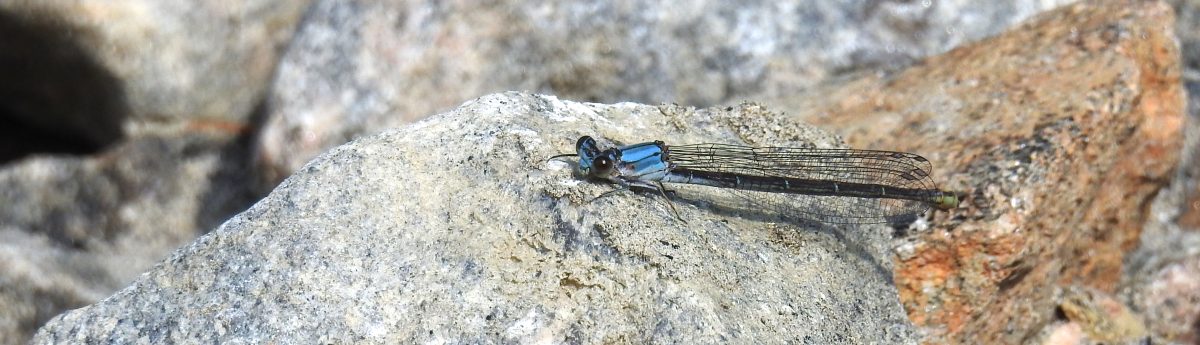
Then I spotted a damselfly navigating its way through the reeds about five or six feet out into the water. When it landed I got my binoculars on it – it was a spreadwing! I took several photos, enough to identify it as the Amber-winged Spreadwing I’d been hoping to find: the amber tint was visible in some photos, as were the stubby lower claspers in others. It is one of the few spreadwings whose thorax turns entirely blue with pruinosity as it ages, and males develop a bluish-gray pruinosity in the final two segments as well. This blue colour, as well as its size, makes it easy to see flying along the margins of the ponds it inhabits.

A second Amber-winged Spreadwing was flying in the emergent reeds as well, making my visit twice as successful as I had hoped for! These large damselflies are more likely to be seen flying over the open water and along shorelines than other spreadwings, a behaviour that can alert an observant dragon-hunter to its presence. Most other species are not as active, often just moving from one perch to another over short distances while hunting.
I decided to visit one other storm water pond in the area to assess its suitability for odonates, a nice-sized one at Robert Gray Park on Maritime Way, but found no way down to the water. As a result I only managed to photograph an Eastern and a Fragile Forktail in the grass along the trail running at the top of the embankment, though I saw a Common Green Darner and Twelve-spotted Skimmer flying over the water as well. A few unidentified bluets were perching in the vegetation close to the water, but as I was unable to get close enough to catch them they will have to remain a mystery.


From there I went to Bruce Pit. I wasn’t expecting to find any Amber-winged Spreadwings there, but when I started walking through the water to get to the northwest corner of the pond I saw a large spreadwing fly by me. It landed on a stem where I noticed it was eating something, allowing me the chance to get close to this unusually wary damselfly.

It, too, was covered with pruinosity indicating that it had been on the wing for some time. I decided to catch it, and was amused to watch it keep eating whatever tasty morsel it had caught.

Amber-winged Spreadwings are such lovely damselflies that it saddens me that they aren’t more common. I was thrilled to discover that they are still alive and well at Bruce Pit, and can be found at the Bill Teron Park pond in Kanata as well. Given their preference for small bodies of water containing emergent vegetation, it would be a fun project to visit some other storm water ponds in the area to see if they have shown up there.

 OdoNotations