
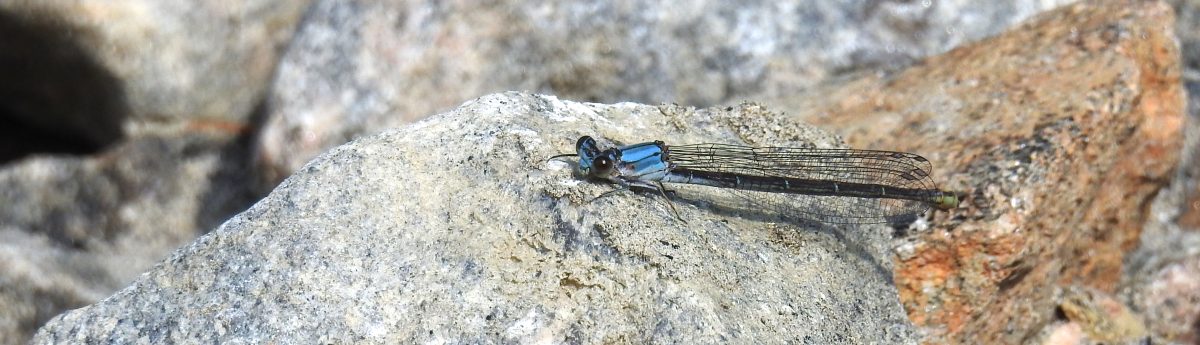

On July 15th I went to Jack Pine Trail at lunch to look for dragonflies. I was hoping to find some Brush-tipped Emeralds, a species I hadn’t seen there since 2019. I have not visited Jack Pine Trail much in the past five years for a variety of reasons, including closures during the pandemic lockdowns and after the derecho of May 2022. However, the main reason is that I stopped looking for them there after I began visiting Marlborough Forest during the pandemic and saw how common the Brush-tipped Emeralds were on all the trails there. Unfortunately Marlborough Forest is a little bit too far to visit on a lunch hour, but Jack Pine Trail is nice and close. It can be good for baskettails, and it’s the most reliable spot in the area for Arrowhead Spiketails in mid-June. I’ve also had Slaty Skimmer there and two unidentified clubtails that I never got a good look at before they flew off. I usually find something interesting there when I visit, and was hoping to do so again today.
It was partly cloudy when I arrived, with the temperature somewhere north of 28°C. I usually take the left-hand loop at Jack Pine Trail to go straight to the stream at the back, but today I went right. Just before the boardwalk I found a tiny Fragile Forktail flying around, looking like a small green dot floating through the vegetation.

I crossed the first boardwalk without seeing anything interesting. Then, when I reached the woods on the other side I noticed a couple of large, dark dragonflies flying up and down the trail. I tried to catch one, but it zoomed off into the woods; then the other hung up in a tree in front of me! I grabbed a few photos, then looked through my binoculars to see what it was. I was expecting it to be a Canada Darner, our most common darner, but the straight yellow stripe on the thorax and the final black segment of the abdomen revealed it to be a Black-tipped Darner instead! This species is much more common on the Quebec side of the river; I only see the occasional one here in Ottawa, and never in a swarm. This is the first time I’ve ever seen one in Stony Swamp.

I thought the other darner was gone, but after I finished photographing the Black-tipped Darner and started walking away I came across another one still patrolling the woods. The sun was coming out, and when it landed I could see it was a Canada Darner. This is the mosaic darner I see most often in Ottawa, not just in Stony Swamp. The deep notch on the thoracic stripe of its abdomen helps to confirm its identity.

I headed to the alvar next, a good place to find dragonflies hunting for food. I’ve seen many baskettails and emeralds soaring in the sky, darners patrolling various pathways of their own design, and meadowhawks hunting from perches both low and high. There were a few meadowhawks out today, mostly fresh yellow ones as well as a few mature males. I netted a couple of yellow females to see if I could find a Cherry-faced Meadowhawk, but they were all White-faced Meadowhawks.

Female meadowhawks are best identified by the shape of the two lobes of the genital plates on the underside of the abdomen. While Ruby Meadowhawks are no longer believed to inhabit this region, there is still considerable similarity between female White-faced and Cherry-faced Meadowhawks, both of which have yellowish faces instead of the gleaming white or reddish-brown faces of their male counterparts. In the female White-faced Meadowhawk, the lobes of the genital plate both taper to a point pointing toward the tip of the abdomen. In the female Cherry-faced Meadowhawk, the lobes both turn outward, resembling a pair of crescents placed back-to-back. When I turned this female over, the lobes both clearly pointed straight toward the tip of the abdomen.

I headed along the straight trail through the marsh through the back, then into the woods. There I found yet another darner flying along the trail, large and dark and keeping entirely to the shadows. I waited for a few moments to see if it would fly by close enough for me to catch it; it did not, but it landed in the branches of a tree close by where I identified it as a Shadow Darner, my third darner species of the day! I wasn’t able to get any great photos due to the challenging lighting, but this one shows the tiny greenish spots along the length of the abdomen that is distinctive to this species. It is because these spots are so small that the darner appears so dark in flight.

I was thrilled to have identified three different mosaic darner species, not something easily accomplished in Stony Swamp – I’ve gotten lucky at Bruce Pit at once with a four-darner day (Lake Darner, Green-striped Darner, Shadow Darner and Canada Darner) on September 9, 2019, but such days are the rare exception.

 OdoNotations