

Marlborough Forest is always a fun place to visit, and after failing to find any Brush-tipped Emeralds at Jack Pine Trail earlier this week I decided to go to the E6 trail and Roger’s Pond this morning to see if I could find any of these unique Somatochlora emeralds there. Unfortunately that was not to be the case, but I had a great time and found a nice selection of odes while I was there. At Trail E6 I found many of the usual species, including Racket-tailed Emeralds, Frosted Whitefaces, and White-faced Meadowhawks.
This Band-winged Meadowhawk in the first open area (what I think of as the “butterfly meadow”) was a surprise to see. While I see them frequently at Roger’s Pond, this was the first time I have seen one here.

From there I went to Roger’s Pond, and it made me feel a bit sad to walk through the open cedar woods without the swarms of Chalk-fronted Corporals and baskettails that patrol here early in the season. I saw a few Racket-tailed Emeralds, but the best dragonfly before reaching the pond was a male Common Green Darner that was flying over the trail and then landed in a dead tree close by! A Canada Darner was also zipping along the little side trail before the entrance to the pond and hung up in a tree, but not gloriously out in the open sunshine the way this fellow was perching!

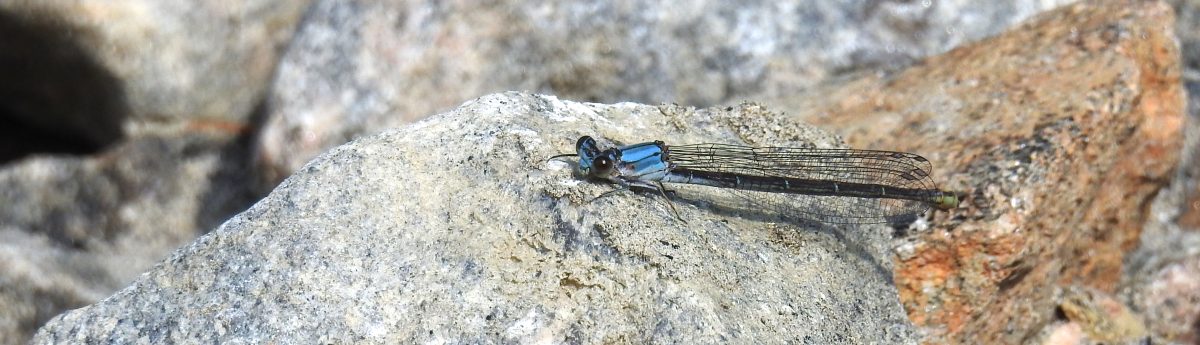
There was much more activity at the pond. I caught both Marsh and Hagen’s Bluets, and noticed that nearly all the dragonflies along the path were skimmers: meadowhawks, a few old whitefaces – including Dot-tailed and Frosted Whiteface – Twelve-spotted Skimmers, Common Whitetails, and a few Widow Skimmers.

The most abundant odonate by far was the White-faced Meadowhawk. This species is very common from mid-July to September, at which time it begins to wane and the Autumn Meadowhawk takes its place as the most abundant odonate. I didn’t see any of those yet, nor did I see any that looked like Cherry-faced Meadowhawks so I’m assuming that the majority were White-faces.

It was great to see a few fresh-looking Frosted Whitefaces as they are usually on the decline by mid-July.

I wasn’t planning on walking all the way to the bridge over the stream at the back, but I did head into the meadow to look for flying emeralds. A couple of Racket-tailed Emeralds were all that remained of the large emerald swarms that hunt here in June; I didn’t see any baskettails or Brush-tipped Emeralds. However, the reddish patterned wings a small pennant fluttering in the grass along the trail caught my attention. Calico Pennants used to be very common here, though I haven’t seen any here in years. I wistfully hoped that this pennant signaled its return, but on closer examination I observed the reddish-orange banded wings of a Halloween Pennant instead of the candy apple-red spotted wings of a Calico Pennant. This was the first one I’ve seen here, though I’ve had one at Trail E4 in Marlborough Forest before.
It’s always fantastic to find a new species in a familiar area, not only increasing the biodiversity but providing insight into the health of the ecosystem: the more species that thrive at a particular water body, the higher the water quality. Dragonflies spend several years underwater as nymphs, and both they and the aquatic organisms they feed on need clean water to survive.

After I returned to the pond I saw something large and dark zoom just above the vegetation along the shoreline and land in the reeds at the corner of the pond. A quick look through the binoculars revealed it to be a Slaty Skimmer, a species I’d only seen once here before. I hurried toward it, but it took off before I could photograph it. I scanned the area but was unable to refind it.
I did notice something else that was interesting while scanning the water: a few small dragonflies were perching on top of the emergent stalks of vegetation in the bay. The first one I noticed was a male Eastern Amberwing with bright orange wings. I wasn’t surprised to see this species here as I had observed a female not too far from the water on July 18, 2019; a second male was flying over the water, which seemed to indicate that a small population was becoming established here.
The other dragonfly was a beautiful red Calico Pennant – not, as I first assumed, another Halloween Pennant! I used to see this species regularly at Roger’s Pond up to about 2012, but have only seen one here once in the past four years, a single individual on June 15, 2020. Hopefully they are becoming common again – this is a lovely dragonfly that glitters bright golden yellow or candy apple red depending on the age and sex. I wasn’t able to get a great photo of one as it was quite a ways from the shore and holding its wings flat (much like the Eastern Amberwing).

As I was watching the small, colourful skimmers out in the bay I saw the Slaty Skimmer flying along the shoreline again! It chased another dragonfly away before landing on a twig above the water. I got close enough to take one photo, and then it was off and chasing another dragonfly! I had first seen this species here a year ago on July 30, 2023, also a lovely blue male in almost the exact same location. It was great to see another one here!

Altogether Marlborough Forest was a very colourful place for dragonflies today, from the pink and green Common Green Darner to the deep blue of the Slaty Skimmer and the bright red of the Calico Pennant. Although the days are getting shorter and species are starting to disappear – the baskettails and Chalk-fronted Corporals are gone until next season – there is still a good variety of dragonflies around as we head deeper into the second half of the month.

 OdoNotations