
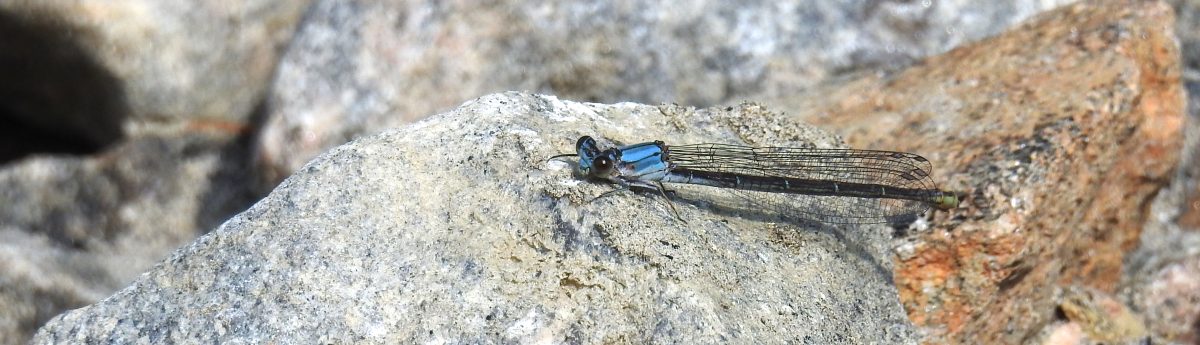

On August 4, 2020 I was surprised to find a Violet Dancer on a dirt trail at the Eagleson ponds. The closest place I’ve ever seen this species to home is out near Morris Island, so it was a shock to find one practically in my own backyard. Then in 2022 I found a few near the Jock River behind the former Richmond sewage lagoons. This suggested where the one at Eagleson might have come from – still a fair distance for a tiny damselfly, but not insurmountable if the winds are blowing the right way. I didn’t expect to see another one there any time soon; if anything, Powdered Dancer was next on my list of species I expected to show up there, because they are much more abundant and widespread along the Ottawa and Rideau Rivers than the Violet Dancer, and breed at the same location on the Jock River behind the former Richmond sewage lagoons. However, when I took a walk there on July 16 after work, it was the first odonate I found, resting on the rocks near the bridge.

The official name of this species is Variable Dancer (Argia fumipennis), named because its three subspecies look very different from each other. The clear-winged violet form, Argia fumipennis violacea, is the most widespread of the three; this form has been given the name Violet Dancer. The dark-winged violet form of the southeast, Argia fumipennis fumipennis, has black wings and is called the Smoky-winged Dancer. It is found between North Carolina and Georgia, and as far west as Mississippi. The third form, Argia fumipennis atra, found in Florida, has been called the Black Dancer because of its black body and black wings. The Variable Dancer is the only odonate in North America whose subspecies have been given common names.
I was happy to see it, hoping that it might become common here one day. The Violet Dancer is one of my favourite damselflies; its body is lavender with black markings, and the tip of its abdomen is a striking baby blue colour. It is unique in its range; no other odonate has its violet colouration.
I spent some time walking around the ponds, looking for Eastern Amberwings and Orange Bluets, the latter of which are more easily found later in the afternoon. I found five male Orange Bluets on lily pads close to shore; there may have been more as there were a lot more lily pads covering the water than there had been even two years ago. Eastern Amberwings were present as well, with four males perching on the vegetation or skimming over the water as they chased one another out of their territory.

I was surprised to count at least ten Blue Dashers perching on the vegetation in the pond as well, all of which were male. I also found a female in the vegetation above the lawn, rather than on the water; this was the first one I’d seen here, and was a good sign that this population would continue into the future.

Other sightings included a Fragile Forktail, several Eastern Forktails, and a Common Green Darner flying above the water. I found a bluet in the vegetation and was happy to see it; I see bluets here in small numbers, usually perching on lily pads where I can’t catch them. When I examined this one with my hand lens I was delighted to identify it as a Tule Bluet. It is distinctive with its long black patches along the abdomen that take up more than half of each segment. This was the second one I’ve seen here at the Eagleson ponds, making a great day for finding second-time sightings.

That theme continued a few days later when, on July 20th, I stopped in at Sarsaparilla Trail around lunch time. There wasn’t much flying around the clearing so I proceeded straight to the boardwalk. I found several bluets in the vegetation close to the water, and when I caught and examined a few they turned out to be Marsh Bluets, a very common species here.
At the boardwalk I saw a male Twelve-spotted Skimmer fly by, followed by a male Common Whitetail. At least three Common Green Darners were patrolling the little inlet by the boardwalk as well. In the vegetation above the water I saw a Dot-tailed Whiteface and a Belted Whiteface, the most common whitefaces in Stony Swamp.

A male Eastern Pondhawk was in its usual position on the log beyond the boardwalk, and a small number of Blue Dashers, all male, were hunting by the water and waiting for females to pursue.

A few damselflies were lurking close to the water: more bluets, two Fragile Forktails, and a couple of Sedge Sprites. One of the bluets, a male, was resting on a reed sitting on the water. It looked more black than blue, and when I checked it with my binoculars I identified it as a Skimming Bluet! One of our smallest bluets, it ranges from 21 to 29 mm (0.8 to 1.1 inches) in length. The abdomen of the male is mostly black, except for segments 8 and 9 which are blue. The final segment is entirely black, which is unique in the bluets of our region…only the Turquoise Bluet, a more southerly species, shares this trait. Other distinctive field marks are the blue streak of colour in their brown eyes and the wavy blue mark on the side of segment 2. I usually do not get close enough to Skimming Bluets to see these field marks; I’ll have to catch one someday to study them.

This species prefers small, clear streams and vegetated ponds and lakes, as it normally perches on lily pads and other floating vegetation (such as the reeds above, giving you a sense of how small it is). This is only the second one I’ve seen at Sarsaparilla Trail; my previous sighting was a male sitting in a shrub near the boardwalk on August 14, 2023. The pond is so large, with only one access point at the boardwalk, that it made me wonder how many more I might find if the boardwalk covered a larger part of the shoreline.
While I had been photographing the perching dragons and damsels, at least one Racket-tailed Emerald, and possibly more, had been flying in and out of the little inlet and over the boardwalk. I tried several times to catch it, to no avail; then finally it landed on a vertical reed only a few feet away from me! It was a male, as evidenced by the thin abdomen terminating in a thick club.

One of the Fragile Forktails also landed on a reed close to the boardwalk. It’s interesting to compare these two black and green beauties; the tiny Fragile Forktail, which is the same size as a Skimming Bluet at 21-29 mm, is slightly more than half the length of the Racket-tailed Emerald, which at 37-43 mm in length is one of our smaller dragonflies.

It always amazes me how you can visit the same place a number of times and see a different suite of species each time, with new ones turning up regularly. Even better is when that new species turns up a second time or even a third, either because a new population is establishing itself, or one has already existed in a part of the habitat inaccessible to humans and is just now expanding and making itself known. It wouldn’t surprise me if the Skimming Bluets are already established at the pond at Sarsaparilla Trail given how much of it has not been surveyed for odonates, while I suspect the Violet Dancers at the Eagleson ponds are vagrants from somewhere close by. The Tule Bluets might be either breeders or vagrants; although I see a decent number of bluets at the ponds in the summer, many of them are too far out on lily pads to identify. Only time will tell!

 OdoNotations