

Last year on August 5th Chris Traynor and I headed up to La Vérendrye Wildlife Reserve just beyond Grand-Remous, Quebec to look for the Common Sanddragons that had been discovered along the Desert River (Rivière Désert) in 2016. We were too late in the season to find any, but had a marvelous time watching dragonhunters and catching darners. We made a pact to return the following year earlier in the season, and on July 21st Chris, Sophie Roy and I finally fulfilled that pact. The sky was spattered with more puffy, white clouds than I would have liked, showing little blue at first, but the further north we drove the clearer the sky became. The temperature was perfect, about 24 or 25°C, with only a slight amount of humidity that really only made the temperature start to feel too warm later in the afternoon, but a fresh breeze kept us cool enough. We were in high spirits because even if we missed out on the sanddragons again there were sure to be enough interesting birds and bugs to make the journey worthwhile. And of course, the rushing rivers and waterfalls of Quebec are beautiful in their own right.
We drove directly to the small beach, not stopping to catch any darners this time. There were none flying yet, and it was clear that an immense logging operation was under way. The road was a bit wider than we remembered, with sandy banks rising about a metre on both sides, making it apparent that all the vegetation growing next to the road had been clear-cut. When we gazed down the little side roads, the roads were bare sand and all the vegetation had been removed from the shoulders there as well. We could see large open areas and stacks of trunks inside the clearings, all that was left of the nature that had been torn from the ground. The place had changed so much that we did not recognize the track we walked down on our first visit; when we looked for it we couldn’t find it.
We arrived at the beach and Chris made his way there first while Sophie and I were still getting organized. When we joined him a few minutes later he gave us the thumbs up: the Common Sanddragon was there! This species has short legs which prevent it from hanging from trees or in the vegetation like the “hanging” clubtails (genus Stylurus), so it is most often encountered perching horizontally on the sandy beaches and rocks of the rivers it lives in. We crept down toward the water, spotting a single small dragonfly sitting on the wet part of the sand with its head facing toward the water. I snapped one photo from a distance before it shot off, flying out over the water before returning briefly. I snapped a second photo but was not able to get much closer; Chris said it would return, so Sophie and I settled ourselves on wooden planks near the water’s edge and waited for it to return.

And waited.
We contented ourselves watching the tiger beetles running along the sand and the Powdered Dancers that joined us on the wooden boards for a brief time. A few butterflies flew in, including an American Lady, a Red Admiral, a Common Wood Nymph, and a Great-spangled Fritillary that particularly liked Sophie and landed on their arm!

Then Chris returned and said there was a Dragonhunter at the next sandy area along the river. I asked him if there was anything else worth checking out, and he said a couple of Violet Dancers. I decided to make my way over to the next beach (the one where we spent our time on our previous visit as the first spot had been taken over by a group of people). In the vegetation along the trail I found a female Ebony Jewelwing resting on a sunny leaf.

I saw the Dragonhunter on his rock and one Violet Dancer on the sand. The Violet Dancer is the subspecies of Variable Dancer found in our region, and it is always a thrill to see the lovely lavender-coloured male – I couldn’t resist taking a few photos.

So far Powdered Dancers were the most common ode on the beach; there was no sign of the Common Sanddragon. The clouds were thinning by then and a few darners and at least one Prince Baskettail were foraging high above the river. I spotted a darner zipping along the river at about head-height. It seemed to have a fair number of spots, and just as I was focusing on it with my binoculars the Dragonhunter flew out and attempted to catch it! I was unsure as to whether it had caught the darner, but then I saw it fly up to a branch high up in a spruce tree and observed the darner clutched within its grasp! From my photos it looks like that it had predated a Canada Darner, which is a large dragonfly in its own right.
As we were having no luck on the main beach, Chris wanted to try to make his way up to a sand bar beyond the bridge on the other side of the rapids. He did a quick exploratory visit and said that although it was a bit difficult getting there – he actually slipped and fell into the water but managed to save his camera, his phone and his car keys – there was a sanddragon over there and at least one Fawn Darner patrolling the shoreline. We could get there one of two ways once the trail through the woods petered out: by taking the rocks in the water or continue bushwacking through the woods. I opted to try the latter route, and although it was a bit difficult, we eventually came out to a small pretty channel of water strewn with rocks.

The island that separated the small channel from the main channel consisted of larger rocks and the sand bar Chris had mentioned. The Common Sanddragon was sitting on the sand by the water at first, and by creeping up on it I was able to get some better photos!

Unlike the first sanddragon this one was quite loyal to its territory. Although we spent some time photographing it, then disturbing it as we made our way over the rocks to the sand bar, then photographing it again, it always returned to the same small section of the beach.

Despite the word “Common” in its name, it is one of the rarer dragonflies in its range. It is considered imperiled (N2) in Canada, imperiled (S2) in Ontario, and critically imperiled (S1) in Quebec. It has a limited distribution in these provinces, preferring sandy-bottomed streams, rivers, and shallow lakes where is it often seen resting on rocks, logs, or the sand itself. Like most clubtails it has a dark body with yellow markings down the abdomen; the club is small, and tipped with distinctly white claspers, a colour not usually found in clubtails (the Eastern Least Clubtail being the exception in our region). Its eyes range from green to brown, and its overall colouration helps it to blend in with its surroundings.

While watching the sanddragon I had become aware of more large darners and Prince Baskettails flying over the river, and at one point a Swift River Cruiser began zigzagging back and forth over the rocky channel. I dearly wanted a photo as I have not photographed one in a long time but it refused to land. I went back to the island and a few minutes later I saw a large dragonfly flying directly toward me; I swung my net and snapped up the king of clubtails himself, a Dragonhunter! This is one species that doesn’t need to be caught in order to be identified; I would rather it was a Swift River Cruiser or a darner, but it was still pretty thrilling to hold one in my hands.

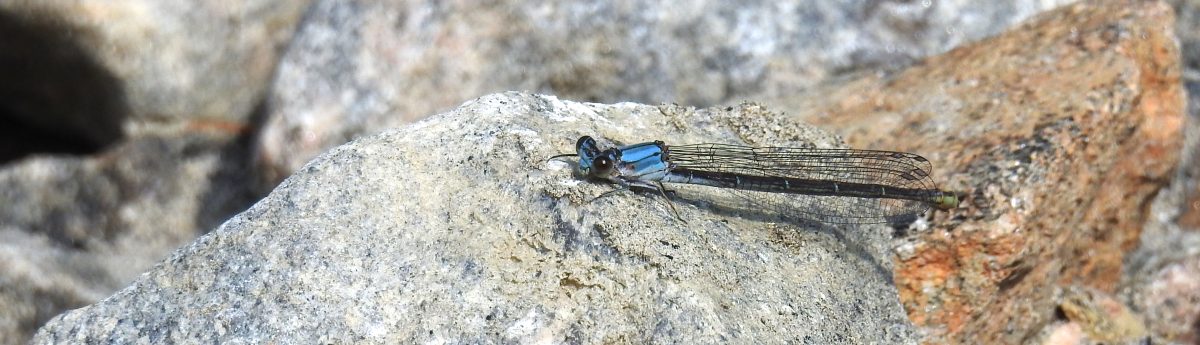
I thought I saw the Fawn Darner cruise by along the shoreline, but other than that the only odes I identified were two Stream Bluets in tandem in the vegetation.
It was a beautiful spot, and I was reluctant to leave but time was slipping away and there was one other place Chris wanted to check. This was a smaller stream (Riusseau Germain, or Germain Creek) that ran beneath the only side road along the way to the main road. When we got out of the car I could see that the stream was well beneath level of the road, and that the only way down was by scrambling down the boulders piled up against the embankment and over the huge culvert.

There wasn’t much of a bank to walk along, and at first I wasn’t inclined to scramble down the water’s level, but Chris pointed out a snaketail sitting on a rock on the little bit of shore next to the embankment.

Snaketails are beautiful dragonflies in the Gomphid (clubtail) family that are so rare in the Ottawa 50K study area that they fall off my radar entirely. They live along swift, clear rocky streams and rivers and, like the Common Sanddragon, have short legs which are suited to perching on the rocks and sandy shores of their environment. The thorax is bright green in all of our eastern species, reminiscent of the thorax of an Eastern Pondhawk or Common Green Darner, while the abdomen is brown or black with whitish or yellow markings down the top and on the sides of the club, giving it a strongly patterned appearance. This colouration helps them to blend in with the vegetation; the green thorax becomes indistinguishable from the leaves while the abdomen resembles a sun-dappled stick. Males have a larger club than females, and some species have large clubs while others have only a slight club.
Snaketails are so named because the males have undulating claspers at the tip of the abdomen which are often described as “snake-like”. It has also been said that their name comes from the repeating patterns on their abdomens which resemble those of a snake. They are uncommon to rare, making them highly desirable among ode-hunters. So when Chris pointed out the snaketail sitting on a small rocky sandbar at the edge of the culvert neither of us knew what species it was. We took a few distant photos, then assessed the steep pile of rocks that led down to the water. Chris immediately found a way down, and I took my time, moving down in a seated position as I was worried about losing my footing while weighed down with my camera and binoculars. It was much easier than I had hoped, and to my delight the snaketail was sitting in the same spot by the time I got to the bottom of the slope.

The only snaketails I have seen in eastern Canada are the Rusty Snaketail at Algonquin Park and the Maine Snaketail in Gatineau Park. I’ve also seen Pale Snaketail in the Jasper National Park. The Rusty Snaketail has a patterned pinkish-brown abdomen, while the Pale Snaketail has a black abdomen with prominent yellow spots down the length of the abdomen. The Maine Snaketail is a darker snaketail, with narrow yellow dorsal streaks from segment 3 to segment 7 and only small yellow lateral spots on segments 8 and 9. This snaketail had T-shaped yellow spots from segments 3 through 7 and dorsal yellow spots as well as lateral yellow spots on segments 8 and 9. The only three possibilities in our region are Extra-striped Snaketail, Riffle Snaketail and Boreal Snaketail, and Chris ruled out Riffle Snaketail based on the shape of the dorsal spots and the black cross-stripe on its face.
That left Extra-striped Snaketail and Boreal Snaketail. We needed a good look at the side of the thorax and the claspers, and the snaketail obliged by sitting perfectly still. When it felt the need to fly off, it always returned to one of the three rocks sticking out of the water. Like the sanddragon, at one point the snaketail landed right in front of me! It wasn’t until we got home and examined our books and photos and concluded it was a Boreal Snaketail – a new species for all three of us!

Chris spotted another dragonfly sitting on a larger rock further down the creek and when I looked with my binoculars I noticed the tell-tale rings of a Zebra Clubtail! Chris managed to get a few photos but it flew off down the creek before I could get there. In the meantime, the snaketail had flown into some vegetation. I tracked it down for a few more photos.

While I was watching the snaketail, Sophie and Chris called out that they had just fished a dead Common Sanddragon from the water. They were just on the other side of the creek than me – which they said was colder than the Desert River; I didn’t have my sandals on and didn’t wish to wade in the shallow water in my hiking shoes, so I wasn’t able to compare temperatures – and brought the sanddragon over so I could photograph it in my hand.

They thought that the sanddragon had been knocked into the water after a mid-air collision with another dragonfly. I was awed to hold this beautiful creature, so rare in Ottawa just a few hundred kilometers south, yet seemingly common along the rocky shores and sandbars of the Desert River and Germain Creek, and took a few photos in my hand.

Then it twitched; its abdomen curled against my hand. I held my breath, waiting to see if it would become stronger and flutter its wings. I told Chris that it wasn’t dead, and we placed it in a sunny spot to warm up. Unfortunately it hadn’t moved by the time we finished our explorations 10 or 15 minutes later, so we left it to its fate cradled in the warmth of a leaf.
We clambered up to the top of the road, where more darners were flying high above us, unreachable. At that point we returned to the car, and settled in for our drive back to Ottawa, enthusiastically discussing all the wonderful insects we had seen and debating the ID of the snaketail until we could get home and compare our photos to the species in our field guides.
It’s not often that I get two lifer dragonflies in one day; just the possibility of getting one lifer makes any potential trip so far away exciting! There are so many fantastic streams and waterfalls and wetlands to explore in Quebec that I wish I had the time and means to travel there more often during the summer. Who knows what other fabulous wildlife awaits?

 OdoNotations