
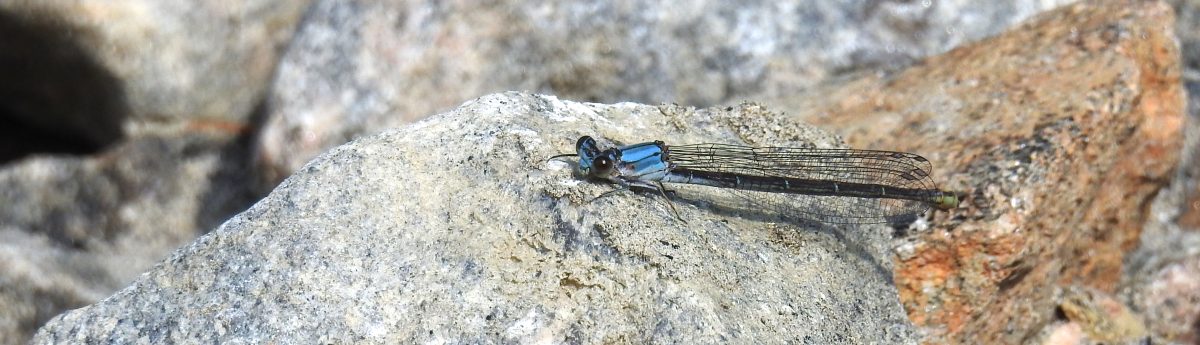

The Amber-winged Spreadwing at Bruce Pit wasn’t the only good find there on July 14th. Back on July 6th I’d found a different sort of amber-wing: an Eastern Amberwing, one of our smallest dragonflies. I’d also found and photographed a Halloween Pennant, a species I’d seen flying over the water last year but hadn’t managed to find perching. I observed both species on the slope between the fence and the edge of the pond, and both were new for my Bruce Pit list. I asked Chris Lewis if she had seen either species there before, and she told me she had seen Halloween Pennant there in the past, but not Eastern Amberwing – no surprise there, since this is a relatively new addition to the Ottawa area. When I headed over to Bruce Pit after finding the Amber-winged Spreadwing at Bill Teron Park on July 14th, it was to see if I could find any more Eastern Amberwings or Halloween Pennants and get some better photos.
When I arrived I walked through the vegetation along the slope to get to the north end of the pond where I could access the water. I found a few neat bugs along the way, including a Goldenrod Crab Spider and a Monarch caterpillar.
I approached the water at the north end of the pond, but it was high – much higher than it had been a week ago. It had been hot this past week, so I was hoping that the water level would go down. There was no exposed shore in the corner at all, and I had to be careful where I walked in my boots so as not to put my foot down into a deep pocket of water. I started seeing a few bluets, and caught a couple of Marsh Bluets. As I proceeded through the water I saw an old Four-spotted Skimmer – one of the latest I have ever seen, if not the latest – as well as the Amber-winged Spreadwing and a Frosted Whiteface.

A male Common Whitetail was resting on a branch above the water, while numerous Common Green Darners and Twelve-spotted Skimmers chased each other above the shore of the pond. I spent some time peering at the emergent vegetation in the water to see if any damselflies were resting there, and spotted some Azure Bluets. Unlike the ones at the Bill Mason Center, I have never seen them in the vegetation on the shore.
A couple of medium-sized dragonflies at the top of the stalks of vegetation caught my attention. When I saw the bright red colours of the dragonflies I knew they could be only one species – the Calico Pennant, an uncommon species that is not always easy to find. There were four in total, and I was surprised to see them because I’d never heard of them being here, and had just confirmed Halloween Pennant the week before – I don’t usually see these two species inhabiting the same body of water. I grabbed a few shots, happy with the discovery. From a distance if the colour isn’t clear due to poor lighting, or if they are yellow tenerals, they can be distinguished from the Halloween Pennant by the smaller spots in the middle of the wing that do not extend all the way from the leading edge to the trailing edge.

I tried to catch the Common Green Darners flying around but had no luck, so I returned to the shore to check out the southwest corner – the one Bob, Chris and I used to visit before the Phragmites and cattails took over. I wended my way into the sunny clearing where Chris Traynor and I had seen a Lake Darner last year and found another new dragon: this one also a deep blue with yellow on the thorax! I’m not sure why I’d never seen a Blue Dasher here before, as the habitat seems quite suitable, but when it landed awkwardly on top of a stalk of vegetation I took the opportunity to document it.

This was not the only individual I found – I counted at least six of them around the pond, including a male harassing a male Eastern Pondhawk below the bridge! I asked Chris Lewis about this species as well, and she had never seen one there before either – so the Blue Dasher is another new species for the Bruce Pit Odonate list! It’s great to see this species doing well and expanding to various ponds and wetlands in the area. The pondhawk, incidentally, was another new species for me at Bruce Pit, as was a Skimming Bluet resting on a lilypad near the bridge; I can’t recall seeing a pondhawk here before even though it’s just the sort of pond they like – well-vegetated with many floating plants. Both species are, however, on Chris’s list.
I made my way back to the toboggan hill, pausing to photograph a fresh female Fragile Forktail sporting a black and blue thorax and green and black eyes.

As I checked the vegetation growing on the slope, I spotted something with orange wings fly by! I saw where it landed, and when I located it with my binoculars I realized it was a male Eastern Amberwing – one of my targets! I only managed a few photos before it flew off, never to be seen again, but they were better than my previous photos so I was happy. I later saw two additional male Eastern Amberwings perching on vegetation near the mouth of the creek, and it was intriguing to think that the single male I had seen the week before wasn’t a random vagrant but perhaps a member of a new colony!

A Widow Skimmer was also hunting insects among the flowers, and when it landed on this Viper’s Bugloss I thought the pretty blue flowers made for an interesting setting.

I returned on July 26th to see whether the amberwings and pennants were still around. I found a Blue Dasher and both Autumn and White-faced Meadowhawks on my way to the water, and a Twelve-spotted Skimmer hunting in a shallow area of the pond among a thicket of reeds and other emergent vegetation. I waded out into the northwest corner of the pond to see what might be perching on the thin stalks of vegetation in the open water and found a female Azure Bluet resting on a twig. While it is common to see the males on the water, this is the first time I’ve seen a female.

Two male Eastern Amberwings, one Calico Pennant and at least three Halloween Pennants were present on the water too; while the Amberwings and the Calico Pennant were a bit too far out to photograph, one Halloween Pennant was nice and close. They are named for their tendency to hold their wings up where they flutter in the wind, unlike other skimmers which hold them flat out to the side or swept down in front of the face.

The usual Twelve-spotted Skimmers danced with the usual Common Green Darners, taking turns chasing each other around the pond. I saw a pair of Common Green Darners in tandem, the female’s abdomen submerged in the water while she deposited her eggs into the vegetation.
Once I was done viewing the odes on the pond, I returned up the toboggan slope toward the trail where I startled a small, brownish dragonfly perching among the wildflowers. Fortunately I saw where it landed and was happy to see a female Eastern Amberwing! I was able to approach it and get some much better photos than the ones I had taken of the males out on the water.

It was great to see that the two pennant species and Eastern Amberwings were still present in good numbers at Bruce Pit. Their colours really brighten up the pond, and I always enjoy finding new species at a much-loved location. Chris has 52 species on her official list, so this brings the number of species observed there to 54. Her list also includes several species I haven’t seen there including Orange Bluet, Stream Bluet, Variable Darner, Black-tipped Darner, Lilypad Clubtail, Dusky Clubtail, and Common Baskettail. As I usually don’t start visiting Bruce Pit until about July it would be great to visit next May and June to try to find some of these species, as well as to look for other early dragonflies such as Beaverpond Baskettail and Racket-tailed Emerald, which are not on Chris’s official Bruce Pit list. This is why repeated visits during the entire season are important – species that fly earlier or later in the season may be missed.

 OdoNotations