

Sheila McKee Memorial Park has been such an amazing spot for odes this year that when the weekend called for not one, but TWO clear days, I decided it was worth going back for a few hours and looking for more clubtails. I arrived around 10:00, and as usual a dragonfly had claimed the first sunny opening in the woods as its territory – however, unlike the Common Whitetail, Racket-tailed Emerald, and Black-shouldered Spinyleg of my previous visits, this one was a brilliant green Eastern Pondhawk actively darting around and landing on different leaves. I took one terrible photo of it sitting on a leaf above head-height, facing me. This was the only pondhawk I saw, so I’m glad I got a photo for iNaturalist.
I decided to check the beach first while the sun was shining directly on it, heading first to the area where Chris and I had found the emerging Elusive Clubtails. I startled a single Black-shouldered Spinyleg, but fortunately it landed only a short distance away and I was able to snap a photo. I scanned the green vegetation that grew among the tumble of boulders at base of the escarpment in case a rare Mustached Clubtail or Arrow Clubtail was perching on a leaf, and saw none. Neither were there any emerging clubtails on this visit. The only other dragonflies I saw on the beach were a large unidentified dragonfly zipping out over the water, a darner zigzagging high above the beach, and a Halloween Pennant zooming over the large fallen tree near the end of the beach.

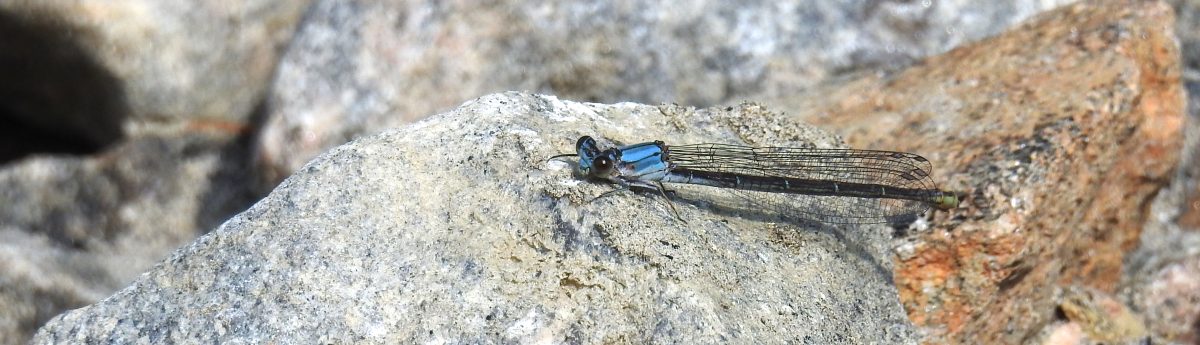
I did, however, come across an intermediate-type bluet, and identified it as a Tule Bluet based on the pattern of colour alone. The only other intermediate-type bluet found in eastern Ontario is Alakali Bluet, a very rare and local species that occurs on large lakes and rivers in central and northern Ontario. The Alkali Bluet is not on the Ottawa checklist of dragonflies, updated in 2017, and was not found in Algonquin Park at the time of the printing of the first edition of the Algonquin field guide, though it claims that this species was collected north of the park at Lake Nipissing and reported from Frontenac County. A review of iNaturalist shows only three reports of this species in Ontario, all from the Lake Nipissing/North Bay area. Perhaps it’s worth catching some of those Tule Bluets on the Ottawa River after all!

I left the beach and climbed the stairs to check the corridors awash in sunlight – once again I saw very few dragonflies. A slight breeze stirred the air that had been filled with emeralds and baskettails only a few weeks ago and the leaves where Blue Dashers no longer perched. Powdered Dancers, as usual, were numerous. I stirred up a number of these damselflies in various stages of pruinosity, including fresh brown males and females, blue females, and older white males whose pruinosity had painted over all the colours of their youth. I found one blue-type bluet, possibly a Marsh Bluet, but was not able to catch it.
Meadowhawks had replaced the whitefaces and Widow Skimmers perching in the vegetation – I saw mostly Autumn Meadowhawks, with a few yellowish black-legged individuals that were likely White-faced Meadowhawks. At the meadow I saw two darners flying across in the open space and found – finally – a couple of Blue Dashers and a Common Whitetail in the same shrubby area where I’d had so many skimmers on my previous visits. I checked the clump of trees growing in the middle of the meadow and saw another Blue Dasher. There were no Halloween Pennants present here; nor did I find any Black-shouldered Spinylegs. I found some interesting beetles flying around the edges of the meadow, and stirred up a darner I did not see, likely hanging from a branch in the shade, that flew out of the shadows and landed on my chest. I attempted to catch it by placing the rim of the net against my body, but it flew out through a small gap at the side. This is at least the fourth darner that has landed on me or my net this year at Sheila McKee Memorial Park – something that I find quite bizarre!
By the time I finished investigating the edges of the meadow and the group of trees in the center, only two darners were flying around, one careening about the meadow only a few feet above the ground, the other flying slowly near the patch of trees in the center. I saw the second one land and hurried over to it, managing to locate it hanging in a small opening. I snapped two quick photos of its dorsal side, and was about to move around to the side to check out the thoracic stripes when it flew off. My photos turned out surprisingly clear, showing a female with small paired blue spots with a noticeable gap between them down the abdomen, and an entirely black tip. I thought it was a Black-tipped Darner, but it was identified as a Lance-tipped Darner on iNaturalist. After looking at my books and some images of the two species online, I took a closer look and noted that the cerci – the two blade-like appendages at the tip of the abdomen – appeared rounded, like two rabbit ears. The Black-tipped Darner has cerci that look like blades. Also, there is a blue diamond-shaped mark on top of segment 2 – rather than a diamond, the Black-tipped Darner has a thin line here. Female Lance-tipped Darners often have entirely black tips, though the males do not.

After photographing the Lance-tipped Darner I turned my attention to the single darner still buzzing over the field. It was flying at about shoulder height, and I tried to position myself in its path to catch it. It was flying fairly consistently over one section of the meadow, and sure enough, it came close enough for me to snap it in my net. I was unsurprised to find a Canada Darner, the most common Aeshnid species at Sheila McKee Memorial Park. It was a blue form female, coloured to look like the male.

I also caught a green form female Canada Darner on my way out of the park; it is hard to say which one is lovelier!

After I finished photographing the darners in the meadow I left via the closest sunny corridor. I hadn’t gotten very far when I spotted two darners tangling together beneath a couple of bare overhanging branches in the shade of the trees growing on the north side. I saw them both hang up in the same shrub and got my binoculars on the first: another blue form Canada Darner. I glanced at the second, prepared to see another Canada Darner, but when I saw the thorax my brain shorted-out briefly: there were no stripes! I had never seen an Aeshna darner species without stripes. Then it hit me: it wasn’t one of the usual mosaic darners, but something much rarer: a Mottled Darner!

Rather than stripes, the thorax has two large irregularly-shaped splotches separated by two smaller spots in between. The first (anterior) splotch is curved forward at the top and resembles a hook with a thick base; the second splotch is wedge-shaped, resembling the shape of South America in some individuals or an ice cream cone in others. This mottled thorax, often a pale blue, yellow, or green, makes it one of the easier mosaic darners to identify. It also has a black cross-stripe on its face and a series of dark blue spots along the top of abdomen that are large and pointed near the tip and get smaller and flatter toward the thorax. In this individual, the top of the hook is very close to the base of the wing

The Mottled Darner prefers the shallow bays of large, reed-fringed lakes, marshes and bogs with open water, and small, clear lakes rich in emergent vegetation such as water lilies and Broadleaf Arrowhead. It hunts in openings in wooded areas, often perching on the trunks of trees while it waits for prey to fly by. Adults hover over and patrol shorelines and wetlands low over the water, with afternoon being their favoured time (though they may do so any time of day).

After identifying it through the binoculars I approached it very carefully to get some photos. While the side of the dragonfly was directly in the sun, the dorsal side was entirely in shadow. It was a female as evidenced by the two blade-like cerci at the tip of the abdomen.
The Mottled Darner was a lifer for me – this species is considered “very rare” according to the Ottawa checklist, with a flight season from mid-June to mid-September. The checklist also notes that it has only been found on the Ontario side of the OFNC circle (a 50 km-radius circle centered on the Peace Tower). I reviewed the observations for the OFNC study area on iNaturalist, and sure enough there were only two sightings in Ottawa as of 2024, the other sighting being at the mouth of Constance Creek along the Ottawa River in September 2019, and none in Gatineau. It is certainly not a species that I expected to see casually hang up in a tree in front of me, but then Sheila McKee Memorial Park has been a terrific spot for finding unexpected species.

 OdoNotations