
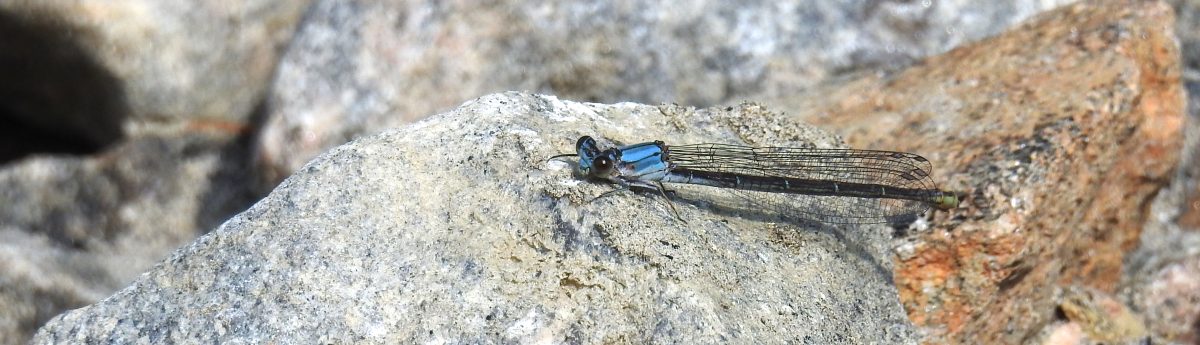
We only had one night on P.E.I. (which we spent at a hotel in Summerside across from the harbour) so we didn’t do a lot of hiking or exploring. We spent the day we arrived touring the western side of the island, where I thoroughly enjoyed the birds and views of North Cape, and the day of our departure exploring the eastern half. It wasn’t until the second day that I saw any odonates – we visited the Anne of Green Gables Museum and the birthplace of L.M. Montgomery, had lunch in Charlottetown, then drove across the island to East Point before catching the ferry at Wood Islands to Nova Scotia. When we reached the museum I immediately decided not to join my dad and step-mom on the tour: there was a pond on one side of the driveway, and a small marshy wet spot on the other. I could finally do some ode-hunting!

There were no dragonflies at the marshy pond, but I did see several damselflies. I only identified two species – Eastern Forktail and Northern Spreadwing, both of which were perching in the vegetation above the water.

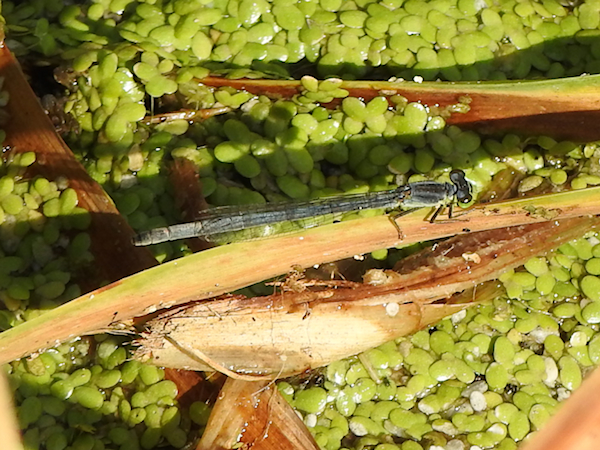
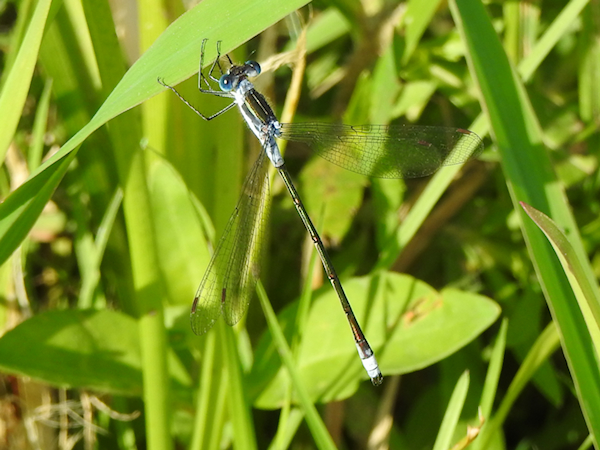
There were only two Eastern Forktails, but quite a few spreadwings. I was only able to identify one from my photos (I managed to photograph it from the right angle to show the teeth of the cerci, AND they happened to be in focus) so it is possible that there was more than one species here. My observation of the below spreadwing on iNaturalist was rated as research-grade due to the supporting photo of the cerci. The identifier, Guy Lemelin – an experienced ode-hunter in Quebec – also noted that the color of its eyes conforms to most of the Northern Spreadwings in the Northeast, as does the appearance of the thorax and the almost dark superior part of the abdominal segment 8. While I did not know that colour could be used to separate the similar-looking Northern and Sweetflag Spreadwings, I have noticed that Sweetflag Spreadwings in the Ottawa area often have three fully pruinose final segments, though I am not sure how reliable this is.
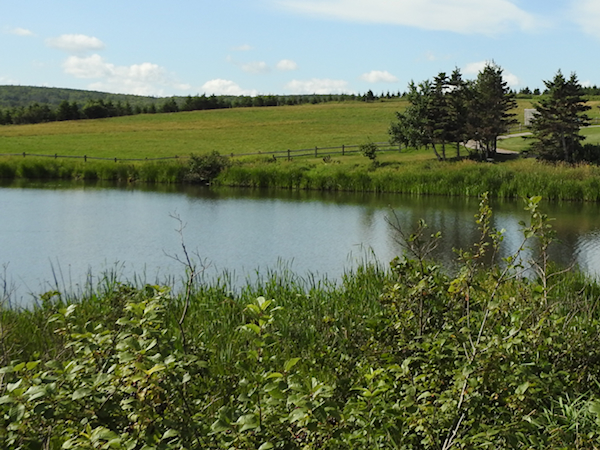
Once I was done checking the marsh for odes I walked over to the pond, which was fringed with tall vegetation and had no path around it. The pond, called Campbell’s Pond on Google Maps, is famously known as the Lake of Shining Waters in the Anne of Green Gables novels. I finally found a few dragonflies here – one was a White-faced Meadowhawk, while other meadowhawks had reddish faces and dark legs. It wasn’t until I saw this photo that I realized they were Saffron-winged Meadowhawks – the yellowish leading edge of the female gives it away. These were the only odonates I was able to identify in P.E.I.

The only other odes I saw in P.E.I. were at East Point. Unlike its counterpoint at the opposite end of the island, the white and red lighthouse is situated on top of a cliff which was fenced off from the sea and the surrounding land. There was no spit, no trail along the shoreline, nowhere to wander. However, there were some grassy areas next to the parking lot where I saw some darners hunting. The grassy areas were fenced off, so it must have been private property. I would have really liked to have caught one as I had yet to record any darners in P.E.I.

It was a bit disappointing to record only four species on the island; however, we didn’t really spend any time in good odonate habitat. Hopefully this is something I can rectify on a future trip, as a number of species recorded on iNaturalist would be lifers for me, including Little Bluet, Sedge Darner, Subarctic Darner, Lake Emerald, and Ski-tipped Emerald; and there are a sufficient number of Seaside Dragonlet observations to make me think it is relatively common on the west side of the island.

 OdoNotations