

We left P.E.I. via ferry, crossing from Wood Islands to Caribou after dinner. It was dark by the time we arrived at Seabank House in Pictou, a beautiful Victorian bed-and-breakfast overlooking the harbour that looked like something out of a Stephen King movie. In reality this 1854 building was quite charming inside, featuring spacious rooms, stained glass windows, and a grand staircase. This was our favourite accommodation of the trip (not including the AirBnB we stayed at in the Annapolis Valley). We stayed in the Hummingbird Suite with its two canopy beds, and enjoyed a breakfast of Eggs Benedict and fruit and yogurt the following morning. I was hoping to go for a walk along the harbour and look for sea and water birds for my county list before we left, but it was quite foggy outside and I couldn’t see much so I skipped it.
We spent most of the day on the road, heading north to Cape Breton Highlands National Park. We drove past Baddeck up to a motel just inside the park near Ingonish. Our motel was right on the water, and I went for a walk after getting settled. There were a good many birds on the grounds, including Northern Parulas, two Yellow-rumped Warblers, Dark-eyed Juncos, and a pair of White-winged Scoters right near the shore; they were much closer than the ones we see in Ottawa.
The next day we began our sight-seeing tour of the Cabot Trail. We stopped at a couple of places to take in the scenery, including Jigging Cove Lake, but the trail was too steep for my Dad so just my step-mother and I descended the trail to check out the lake. The best bird here was a Boreal Chickadee out in the open, as well as a couple of Blue-headed Vireos, Golden-crowned Kinglets, and a Magnolia Warbler. At the lake I saw a Great Blue Heron as well as several Saffron-winged Meadowhawks in tandem! I caught a male and photographed a female ovipositing in the shallow water below me.


There was one stop on our Cape Breton tour that was absolutely a must-see for me: the Bog Trail near French Lake. My mentors, Bob Bracken and Chris Lewis, had visited this trail on August 23, 2007 during their East Coast trip and, when I told Chris that we would be stopping there, she described it as “a neat place, with a very short and user-friendly boardwalk”. Although she and Bob didn’t have their nets, they observed Canada Darner, Variable Darner, Black-tipped Darner, and several Zigzag Darners. This sounded like a terrific spot to see some odes, and as the Zigzag Darner would be a lifer for me, there was no way I was going to miss the chance to visit this bog.

The main feature of the trail is the boardwalk winding over the highland plateau bog, with Boreal and taiga forest nearby. Expected wildlife include, according to the park website, orchids, colourful dragonflies, green frogs and occasionally moose. iNaturalist lists additional species of interest, including bog-loving butterflies such as Bog and Dorcas Coppers, Brown Elfins, and Silver-bordered Fritillaries; Hudsonian, Belted and Crimson-ringed Whitefaces; Spotted Salamanders; Wood Frogs and Mink Frogs; Spruce Grouse; Lincoln’s Sparrows; Evening Grosbeaks; and White-winged Crossbills. It forms a 0.5 km loop at an elevation of 410 m. The boardwalk reminded me a lot of the one at Mer Bleue, except it felt much wilder. Most of the boardwalk traversed an area with low-growing vegetation, but it did pass one area fairly close to some conifers. The birds were very quiet…I heard one Boreal Chickadee and that was it.

Unlike Mer Bleue, however, there were many open pools of water close to the boardwalk. Here I saw a number of spreadwings perching on emergent plants and several much larger darners patrolling above the water. I didn’t see anything that looked like a Zigzag Darner, which is a small darner with brown eyes, a thin blue zigzag on the side of the thorax, and a heavy black marking on top of the face that looks like a mushroom planted on top of a semicircle right above a thin black cross-stripe. I spent some time waiting for one of the darners to come within reach of my net; when I finally caught one it turned out to be a Variable Darner! This was a new dragonfly for my Nova Scotia list, and it was a beautiful fresh male.

A little further along I came across another pool of water with several darners flying along the shoreline and over the boardwalk. It took a while for one to come close enough to net, but this time I pulled out a Black-tipped Darner. This was not the first one I’ve seen in Nova Scotia, but it is one I rarely see in Ottawa so I still quite happy to see it.

The Bog boardwalk was a fantastic spot. I had a fabulous time watching the dragonflies (and damselflies) that inhabited the bog, and quite happily talked to all the people – including a naturalist from Ontario! – who asked me what the net was for. I would have really liked to have completed a second circuit to look for those elusive Zigzag Darners, but my dad was eager to be on his way and so I said farewell to this wonderful ecosystem.
Our last night on Cape Breton Island was spent at Duck Cove Inn at Margaree Harbour. It was a nice room, though there wasn’t much property to explore; it overlooked the Margaree River where we saw a huge flock of about 40 Common Mergansers swimming upriver – a new bird for my provincial list.
After leaving Cape Breton we headed southwest toward our next destination, an AirBnB on Loon Lake in Kings County. Once again my partner Doran found an amazing place for us on a lake with three bedrooms and a balcony looking down at the water. We arrived at the lakeside cottage before Doran who would be driving in from Ontario later that day and, after we hauled all our gear inside, I went exploring. There weren’t as many odes around as I would have liked, likely due to the chiefly overcast sky; all I found were an Eastern Forktail and a female Cherry-faced Meadowhawk in the vegetation along the dirt road.

I caught the meadowhawk and turned her upside down in order to take some photos of her sub-genital plates. The outwardly-curving tips were visible with magnification.


I found a couple of meadowhawks perching on the ground close to the shore; a close inspection revealed these to be Saffron-winged Meadowhawks. The face is a very dark reddish-brown, the legs are black with brown stripes and the black marks along the abdomen do not form the jagged triangles of a Cherry-faced Meadowhawk.

The sun came out the next day, which was our last day at the cottage. I finally started seeing a few more odes around the property, including a male Eastern Forktail and a Slender Spreadwing.

Along the road I discovered a few meadowhawks in the vegetation: I wasn’t surprised to see the Autumn Meadowhawks; the Band-winged Meadowhawks were a delightful surprise.

After leaving the AirBnB we spent a night on Brier Island before travelling south to Yarmouth, where I finally got to see the lighthouse – during our visit in the spring I kept putting it off because of the cold wind and because I wanted to look for dragonflies instead! The drive was beautiful, and I was glad we were able to spend some time here exploring.
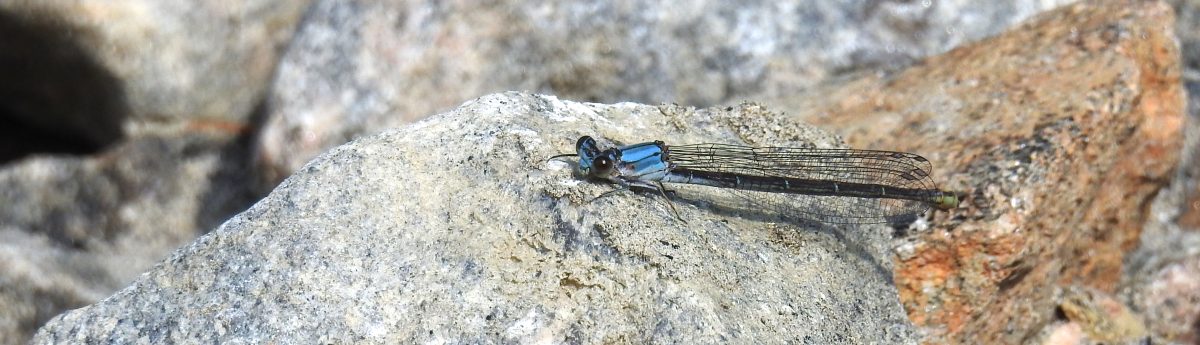
We came to a large pool of water – a pond? A tidal pool? – between the lighthouse and the shore which drew me like a magnet. There was a bit of vegetation growing at the edges, not much, but enough to attract some bluets.

They were all the intense deep blue colour of the Familiar Bluet, and my photographs of the claspers confirmed their identity. I wasn’t expecting to see any damselflies at a pond next to the ocean, so this was a treat!

I was so taken with these damselflies that I didn’t spend any time exploring the rest of Cape Forchu; however, the scenery was gorgeous right where I was, and I enjoyed the views of the lighthouse and the rocks

Those were the last odes of the trip. We spent that night in Digby, took the ferry back to Saint John, and drove home from there. Although it wasn’t the kind of trip I would have planned if I were by myself or with other birders/nature lovers (I would have spent more of my daylight hours hiking, exploring, and photographing nature, and less time driving) I was happy to have spent the time with my dad and step-mother, whom I don’t see often enough. We all had a fantastic time and can’t wait until our next big trip – hopefully to Newfoundland in a couple of years!

 OdoNotations