
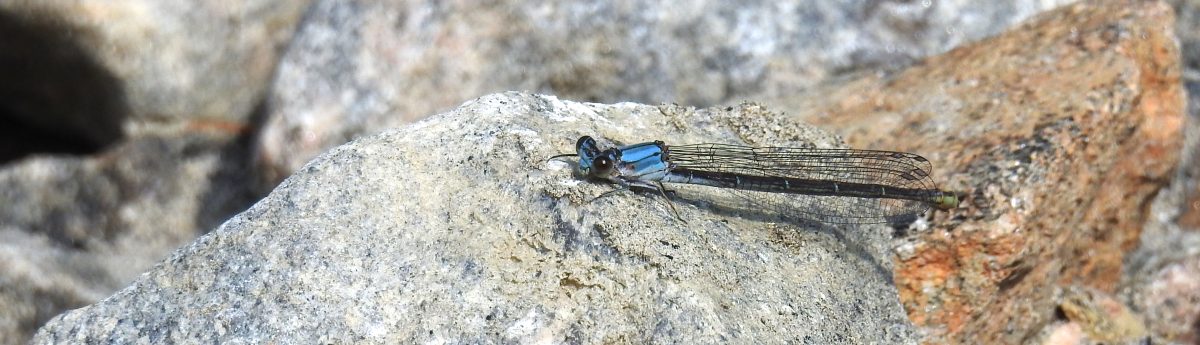

Today I went to Bruce Pit to see if anything was still flying around the edges of the pond and the field at the back. When I was here last weekend, there had still been three meadowhawk species and six damselfly species (Slender Spreadwing, Spotted Spreadwing, Azure Bluet, Familiar Bluet, Fragile Forktail and Eastern Forktail) still present, as well as an unidentified darner in flight over the water. With only two days left in the month I wasn’t expecting much, and indeed the wet vegetation at the edge of the pond yielded only three damselflies on this visit: Slender Spreadwing, Spotted Spreadwing, and Familiar Bluet. I also saw White-faced and Autumn Meadowhawks, but the Band-winged Meadowhawk from last weekend was gone.
I was pleasantly surprised when I saw at least two large darners zipping along the edge of the shore, especially when one flew low to investigate the reeds close to where I was standing. My net shot out, and the next thing I knew there was an angry buzzing sound coming from inside. I had caught a darner, and I was not really surprised to find a male Canada Darner inside.
The Canada Darner is the most common and widespread of all our mosaic darners, followed by the Lance-tipped Darner. If there is a darner flying up and down a trail somewhere close to water, chances are it’s a Canada Darner. Look for the notch on the side of the first thoracic stripe with the thin, backwards-pointing flag – darners with a deeper notch are likely to be Lake Darners, darners with a small ripple instead of a notch are most likely Lance-tipped Darners, and darners with a deep notch and a thick flag are likely to be Green-striped Darners (especially if the thoracic stripes are green while the spots on the abdomen are blue).

A little later a second darner came along, and landed in the reeds right in front of me! It was too busy eating a fly to pay much attention to me as I crept closer and closer to take a photo. The first thing I noticed was that it was missing part of one of its hindwings.

I couldn’t tell which species it was was from this angle, and as it was so docile it was a simple matter of sweeping it up with my net to find out. It was another Canada Darner, but a female. What was interesting to me is that the second thoracic stripe has a rounded indent toward the bottom, while the second thoracic stripe of the male is intact.

I was hoping to see some more darners, so I cut across the weedy slope of the hill toward the southern edge of the pond. I flushed a large dragonfly from the vegetation, and tracked it until I saw where it landed. My first view was of the head and thorax peaking out from behind the leaf it was clinging to. Its wing covered the thoracic stripes, and at first I wasn’t sure what I was looking at. Either the stripe was actually a pair of spots, or the veins of the wings made it appear so. I walked around for a better view, eventually realizing that the stripe actually was a pair of ovals, making this the first Variable Darner I’ve seen on the Ottawa side of the OFNC study area!

It seemed content to perch on its leaf in the sunshine, so I decided to catch it. However, as soon as I got within range it flew off, landing close by. I cautiously approached it again, and for a second time it flew off. Fortunately it didn’t seem much interested in any long-distance flights, and when it landed a third time I was able to catch it.
Up close it was beautiful, a green or yellow form female with the characteristic broken spots of its scientific name (A. interrupta). Some populations have a thin straight line instead, which is why they are called Variable Darners. You can also see the dark line across the face, one of the few species in our area with this distinctive field mark.


Like all mosaic darners, it was very large. Interestingly, Chris Traynor had one at Bruce Pit a few years ago – a blue male with an interrupted first thoracic stripe, also in September. When I checked with him he advised that he had seen his on September 18, suggesting a fairly good window for seeing them after the middle of the month. Chris Lewis noted that while most of her records of this species are from Gatineau Park, she has seen a couple in Ottawa. Her early date for Variable Darner is August 4th in the Morris Island Conservation Area, and her late date was September 4th in Kazabazua, Quebec. Looks like my record stands as the latest date for this species – even after checking iNaturalist to see if anyone else had reported this species after September 28th!
I found one more darner on the slope – a Common Green Darner which also landed where I could see it. It looked quite pretty nestled among the goldenrod, though my photo doesn’t do it justice.

From there I headed to the meadow at the back of the pond. I was disappointed at first that there were no darners flying around. Then, while walking through the grass, I startled one that flew a short distance and then landed again. It was a female Shadow Darner, and she wasn’t much interested in flying, either – she stayed on her perch while I walked around her, photographing her from the top and sides. The dorsal view showed a long brown abdomen with very narrow blue spots and missing appendages. The side view showed the classic thin green stripe that resembles a walking cane. This image, taken at an angle, shows a bit of both.

I’d already been incredibly lucky on this visit – it’s not often that I manage to catch three darners, let alone one that is relatively uncommon. Then, just as I was approaching the bridge, I found yet another darner flying along the path in the shade of a large tree. When I caught it it turned out to be another female Shadow Darner, and I photographed her in the hand mainly to show the dark amber wings – something that sets her apart from the other mosaic darners.

I can’t recall the last time I managed to successfully catch this many darners on the same day – perhaps they were a bit sluggish given that it is quite close to the end of the season for them, even though the weather was perfect: sunny and 22°C. With the forecast showing the warm weather continuing into the beginning of October, it will be interesting to see just how long the darners and other odes will be on the wing!

 OdoNotations