
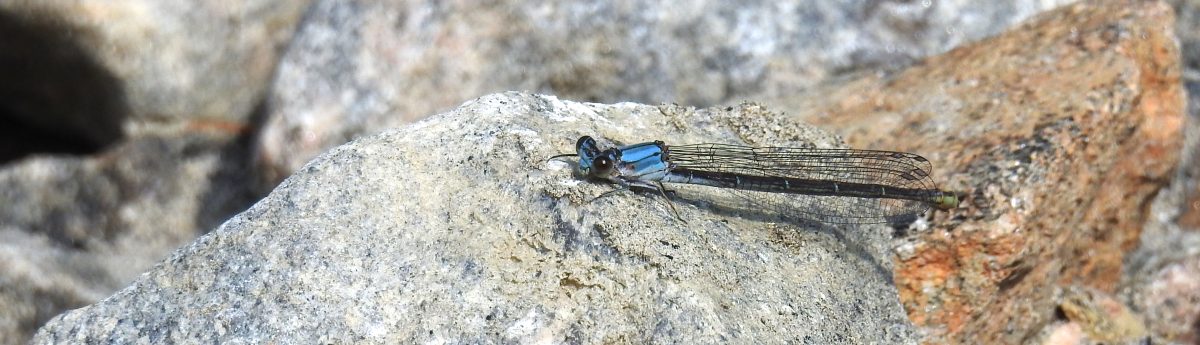

Another ode season is over. Ottawa had some beautiful warm weather during the month of October – there were 26 consecutive days where the daytime high reached 9°C or above (between October 1st and 26th), tying for the 5th longest streak on record. As a result of the warm weather, I thought this would be the year I’d find more species flying later. Our first frost of the season occurred on October 16th with an overnight low of -1°C; this is a week later than the average first frost date. Then a warm spell hit late in the month – October 30th reached a ridiculous high of 22.2°C and October 31st hit 23.9°C, the warmest such days since records began in 1872. The month was mostly dry, with very little rain until the 29th.
November was cooler, though daytime temperatures remained above zero throughout the entire month. It’s not the day-time high that limits the dragonfly season in Ottawa, however; rather, it’s the nighttime lows falling below freezing. While the latest-flying dragonfly, the Autumn Meadowhawk, can withstand a few light frosts, a hard frost will kill both it and the flying insects it feeds on even if subsequent days reach double-digits. November 2nd and 3rd were both below -3°C, while November 9th and 10th were both below -2°C. A string of subzero nights after November 11th followed by warmer but cloudy, windy or wet days after November 20th ended the dragonfly season for good.
In 2023 I observed 8 species during the month of October, so I was happy when I found 9 species in October 2024 – new this year were Spotted Spreadwing, Slender Spreadwing and Fragile Forktail, which I thought were good candidates for October-flying species last year but somehow never managed to find. I missed Northern Spreadwing and Tule Bluet, both of which were found at Bruce Pit last year right at the beginning of the month.

Below is a summary of the species seen in October 2023 and 2024, including the number of observations in October 2024, the last date they were seen in 2023, and the last date they were seen in 2024. An “observation” means a species photographed at one particular trail or conservation area on one day – it does not refer to the total number of individuals seen, but rather the number of locations at which they were seen regardless of date. For example, I might photograph one Common Green Darner at Andrew Haydon Park and another at Shirley’s Bay the same day; these count as two observations, even though there may have been large swarms at each place.
| Species | 2024 Observations | 2023 Last Date | 2024 Last Date |
| Tule Bluet | 0 | October 2, 2023 | Sept. 9 |
| Northern Spreadwing | 0 | October 2, 2023 | Sept. 12 |
| Slender Spreadwing | 1 | Sept. 30, 2023 | October 5 |
| Familiar Bluet | 1 | October 2, 2023 | October 5 |
| Fragile Forktail | 1 | Sept. 30, 2023 | October 5 |
| Eastern Forktail | 1 | October 4, 2023 | October 5 |
| Shadow Darner | 1 | October 4, 2023 | October 6 |
| Band-winged Meadowhawk | 2 | October 4, 2023 | October 21 |
| White-faced Meadowhawk | 3 | October 6, 2023 | October 21 |
| Spotted Spreadwing | 5 | September 30, 2023 | October 21 |
| Autumn Meadowhawk | 11 | November 4, 2023 | November 16 |
Unsurprisingly, 62% of all observations belonged to three species of meadowhawk: Autumn, White-faced and Band-winged, accounting for 16 observations out of the 26. Both Band-winged Meadowhawk sightings were at the ditch next to the Lime Kiln Trail parking lot. I found Spotted Spreadwing in only two places: at Sarsaparilla Trail on October 4th, and at the Eagleson storm water ponds on October 6, 13, 19 and 21. The remaining observations were single observations of five different species.

The Shadow Darner was seen at the Eagleson ponds, flying in an open area by the water’s edge on October 6th. It flew a repeated circuit between the water, over the reeds, and up to the bike path where it runs behind the soccer field; unfortunately I didn’t have my net and couldn’t catch it to identify it. It seemed determined to stick to its chosen path, and just as I was deciding to go back to my car for my net it landed in one of the evergreens beside the path where I was able to photograph it and confirm its identity.
The early October warmth resulted in extended flight seasons and new latest-observed dates for two new species, the Slender Spreadwing which is listed as flying until mid-September; and Fragile Forktail which is listed as flying until late August. It has been my suspicion that Fragile Forktails are not only more common than previously believed, but also have a longer flight season than previously believed. This is because they are so small and difficult to see, the males being all black except for a bit of green on the head and thorax, and the pruinose females closely resembling female Eastern Forktails. It wouldn’t surprise me if the Fragile Forktail had a similar flight season to the Eastern Forktail, from early May to early October.

I also beat my previous year’s record for latest known dates for three species: Shadow Darner (by two days on October 6th), Band-winged Meadowhawk (by 17 days on October 21st!), and White-faced Meadowhawk (by 15 days, also on October 21st). These are all species not known to fly in October according to the Ottawa checklist, however, Chris Traynor had a White-faced Meadowhawk on October 24th one year, so mine is not the latest date on record. While I also saw Familiar Bluet and Spotted Spreadwing later this year than I did last year, they are known to fly into mid-October and late October respectively. I will have to keep searching for those species in future Octobers to see if they, too, have benefitted from the climate change.

In November I found a few Autumn Meadowhawks around the parking lot and boardwalk at Sarsaparilla Trail on November 6 and 8th, which was the last in a string of days above double-digit temperatures. On November 9th I went back and found three sunning themselves on the rocks in the parking lot. The high that day was only 6°C. Visits to Shirley’s Bay, Mud Lake, Andrew Haydon Park, and the parking lot of Lime Kiln Trail later that week proved unproductive, and when I returned to Sarsaparilla Trail on a cloudy day on November 15th I thought that the dragonfly season was finally over. It seemed that Chris Lewis’s late date of November 18th, set in 2016 when she found one along NCC Trail at P10, would stand for another year.
Then November 16 warmed up to a sunny 12°C. I thought the Bruce Pit Parking lot might finally be open but it wasn’t. I parked along Cedarview, put my boots on, and walked down to the water. Along the way I startled one dragonfly into the air, and saw another fly by in tandem. The meadowhawks were still flying! I explored the wet areas between the northern slope and the pond and saw perhaps 6 or 7 meadowhawks in total, including another pair in a mating wheel. I was so thrilled to see them that at first it didn’t occur to me that this was probably my latest date for seeing them.

The following day was cool and overcast so I spent the morning birding. I didn’t see any dragonflies and decided not to return to Bruce Pit when I got back home at lunch time, especially as the parking lot was still closed. Monday was also supposed to be cloudy, but Tuesday looked sunny and warm – at least 10°C – and that was the day I had to work downtown. It was also the 19th day of the month, so any dragonflies found that day would hold the record for the latest date on record in both Ottawa county and the Ottawa 50K circle. The only place I could reasonably hope to find a meadowhawk in the downtown area is the river at Hurdman, or perhaps even Strathcona Park, but in the end I just stayed inside. That was effectively the end of my odeing season, although Chris Traynor did find an Autumn Meadowhawk on November 19th at the Fletcher Wildlife Garden, setting a new record for the latest date in the Ottawa region! With climate change a reality, it seems possible that Ottawa – one of the top 10 coldest capitals in the world – may soon have dragonflies flying in December, something that once seemed impossible.

 OdoNotations