
I’ve been spending time on iNaturalist again, updating my list of odonates found at various places around Ottawa and making a list of target species that others have seen that I have not. Bruce Pit was of particular interest to me, as Chris Lewis had sent me her personal list of species last summer; I was missing quite a few species she had seen (though I had found others she had not). Between her list and those listed in iNaturalist, I counted nine regular species that I was missing from my personal list: Black-tipped Darner, Harlequin Darner, Dusky Clubtail, Lilypad Clubtail, Common Baskettail, Prince Baskettail, Emerald Spreadwing, Orange Bluet, and Stream Bluet. One reason is that I usually don’t visit Bruce Pit early in the dragonfly season when some of these species are flying, while another is that sometimes when I visit I only check one or two areas. As a result, I planned to visit the conservation earlier in the season and see if I could find some new species for my personal list.
My first visit of the year occurred much earlier than usual – on May 25th, more than a month before I usually start visiting. I did not proceed directly to the water as I usually do later in the summer, given the nesting Red-winged Blackbirds. Instead, I walked to the back of the conservation area, seeing my first ode when I found an immature Dot-tailed Whiteface perching on the ground. I followed the trail to the east side of the pond, noticing a few Silvery Blues and Festive Tiger Beetles along the sandy path.
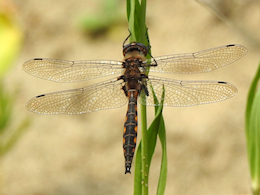
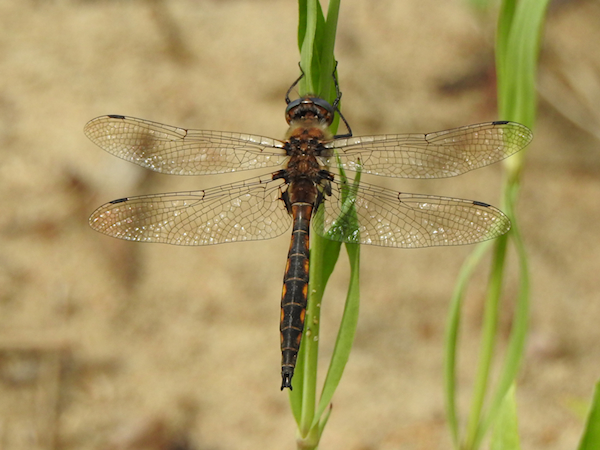
It was at the back that I saw my first emerald flying over the water. It looked like a baskettail, but I wouldn’t be able to confirm which one unless I caught it….or it landed. I took a swing when it came close to me, but missed, and it flew off over the pond. When it didn’t return I left the water, and continued around the pond to the bridge. Nothing was flying there, so instead of continuing up to Cedarview Road I turned around and headed back the way I came. I thought I would check the water again to see if I could find the emerald…and it was there again, flying over the channel. This time when I swung my net, I caught it and pulled out a male Beaverpond Baskettail, a species that wasn’t on any Bruce Pit list!
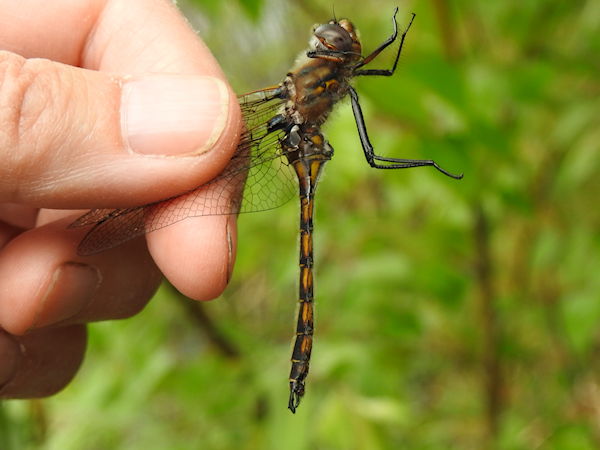
It was a thrill to catch one – I have been seeing more Spiny Baskettails than Beaverpond Baskettails these days, particularly in Stony Swamp, and don’t recall the last time I saw a Beaverpond Baskettail close to home. I carefully placed the dragonfly on a branch and took some photos of him perching.
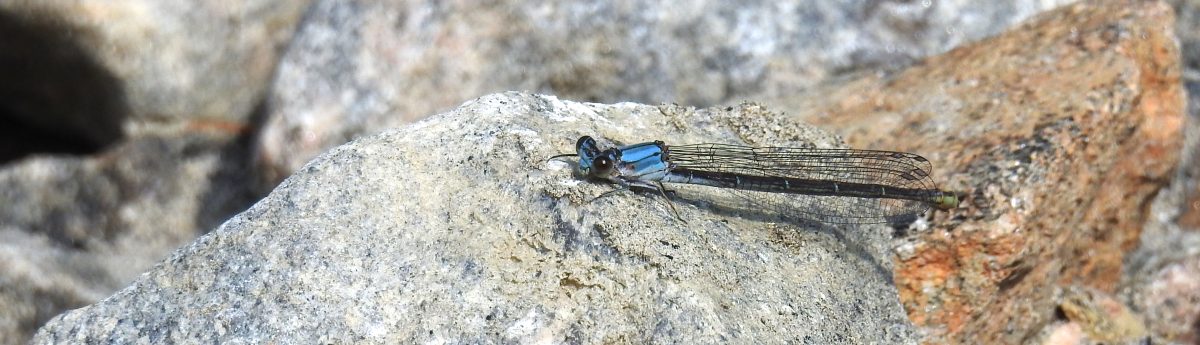
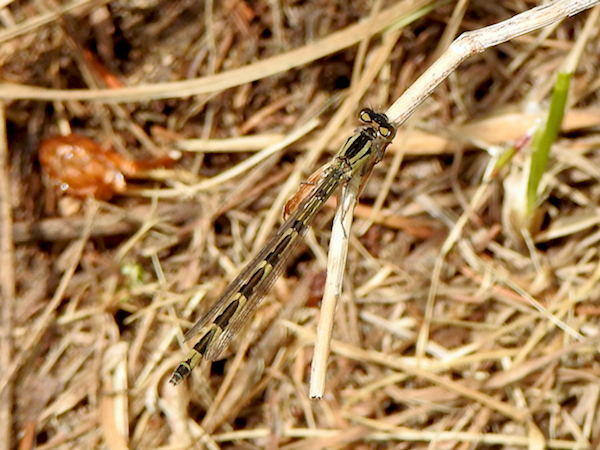
On my way back to the car, I finally spotted a damselfly resting on the ground beside the asphalt path. It was yellowish-brown with black markings; an immature bluet of some sort, and striking with the rocket-shaped pattern down its abdomen. It blended in with the dead grass so well that it occurred to me that if they didn’t turn electric-blue at maturity, I would probably never see one!
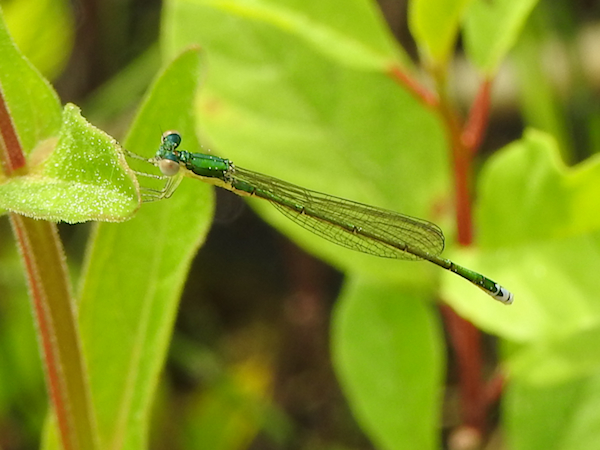
My partner and I spent the first week of June in Nova Scotia, so I wasn’t able to return to Bruce Pit until June 8th. This time I checked the water at the bottom of the toboggan hill and found some Dot-tailed Whitefaces, a Fragile Forktail and my first Sedge Sprite of the year. The blackbirds grew agitated as I approached the shore of the small “beach” in the northwest corner, so I didn’t make it right out to the water’s edge.
I followed my footsteps from two weeks earlier, this time finding nothing flying at the water at the back. Then I reached the bridge. I made my way to the water beneath it, hoping to find some odes resting on the lily pads there. Instead I found more emeralds flying. A couple were patrolling the creek where it emptied out into the pond, while two more were flying around an open area on the slope. I made my way over just in time to see one dragonfly hang up on a branch close by. It was another male Beaverpond Baskettail!
I peered down at the water, trying to find more dragonflies, and that’s when I saw one perching on a leaf above the creek – I would not have noticed it if I had descended the slope all the way to the water’s edge. It was a clubtail, and hoping it was the Lilypad Clubtail that had shown up on Chris Lewis’s list, I got my binoculars on it before taking some photos. The shape of the claspers clearly identified it as a male Horned Clubtail rather than a Lilypad Clubtail, but as it was my first clubtail at Bruce Pit I was excited to find it!
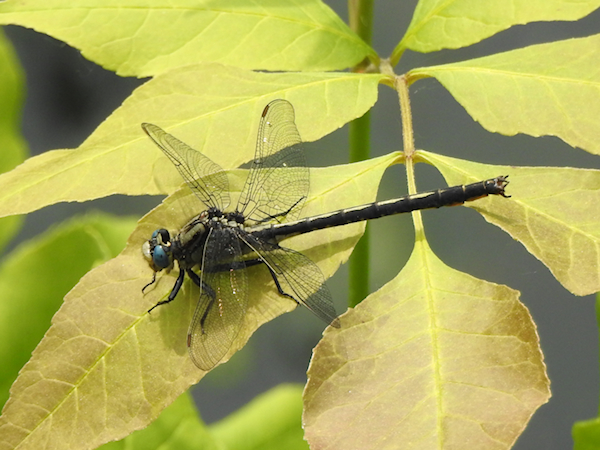
A denizen of small, marshy ponds and lakes, slow streams, and rivers with mucky bottoms and floating plants, it shouldn’t have surprised me to find one here as Bruce Pit is the epitome of this environment. Lilypad Clubtails also live around ponds and very slow streams with abundant aquatic vegetation such as lilypads on which they like to perch, so it is possible that they may be here, too.
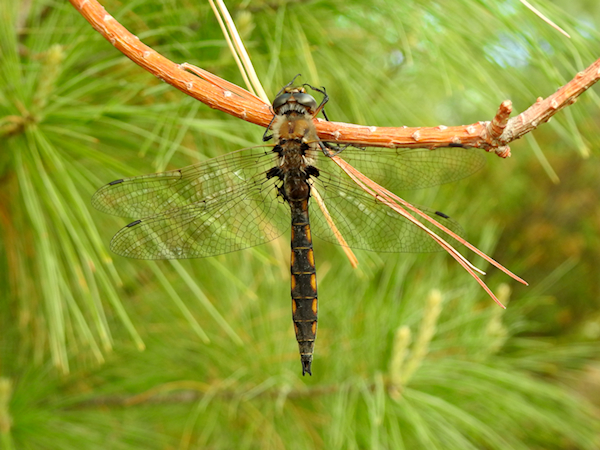
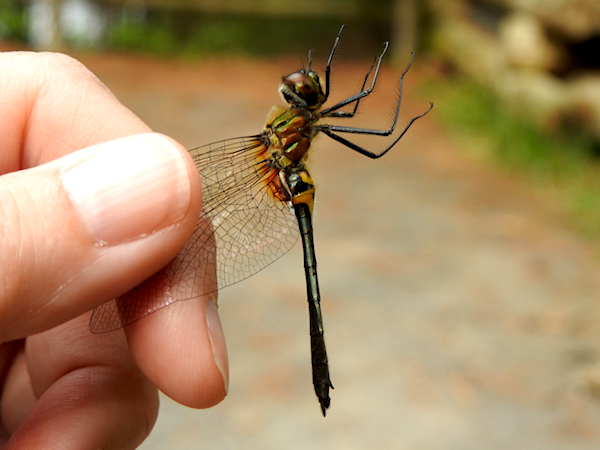
A Common Green Darner flying over the shoreline was the only other ode species, so I decided to continue on my way. As I was heading back to the car I spotted another emerald flying over the open path. When I caught it it turned out to be yet another new species for Bruce Pit, and one that should have been recorded long before this: a Racket-tailed Emerald! This species is very common around Ottawa and in Stony Swamp, which is why it surprises me that I haven’t had any here previously.
Even though I didn’t find any of my target species, I was happy to add three entirely new species to the Bruce Pit list. Hopefully further visits will turn up some of those targets, or perhaps something else even more rare!

 OdoNotations