
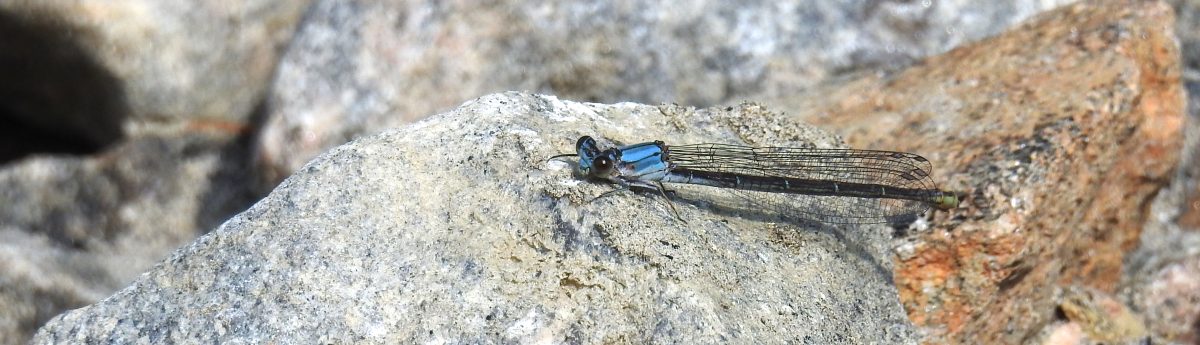
On Saturday, June 14, 2025 Derek Dunnett and I led a combined birding and dragonfly outing at Murphy’s Point Provincial Park for the Ottawa Field-Naturalists’ and McNamara Field Naturalists’ Clubs. It was restricted to 20 people for carpooling purposes (the park roads are quite narrow for parking) and 18 showed up altogether. Unlike our trip last year, the weather was perfect: cool and sunny in the morning, hot and sunny in the afternoon with a hint of a breeze. Our targets this year included Cerulean Warbler (which had been heard singing earlier in the week), Blue-winged Warbler, and Golden-winged Warbler, while our odonate targets included the diminutive Elfin Skimmer and various stream odonates. Last year the trip had been postponed several times due to rain, and we missed the Blue-winged Warbler, Golden-winged Warbler, and Elfin Skimmer as by the time we had visited (July 7) it was late in the breeding season and the weather for ode-hunting (thickly overcast in the morning) was less than ideal.
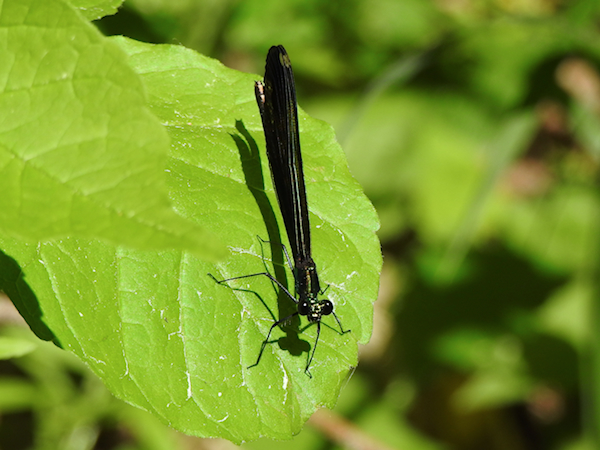
The earlier visit meant we had a better chance of seeing and hearing our targets, and when we started at 9:00 am, we headed into the woods along a section of the McParlan House Trail to listen for the Cerulean Warblers. Our chances of seeing these warblers was slim, as they prefer to forage and sing high up in the canopy, and the leaves were fully out. Most woodland birding in the summer consists of ear-birding, and we studied the song of this bird before heading out. I brought my net in case we saw any interesting odes in the woods, and it wasn’t long before we started seeing Ebony Jewelwings perching on sunlit leaves along the trail.
We didn’t have any luck with the Cerulean Warbler, although we heard American Redstarts (and saw a lovely male singing right above our heads), Ovenbirds, and Red-eyed Vireos. We also found two Yellow-bellied Sapsucker nests when we heard the begging sounds of the nestlings in two different tree cavities; we then waited to see what species came in to feed them. The only other species of note was an Eastern Wood-pewee, which is another difficult species to spot in the forest – it is heard far more often than it it seen.
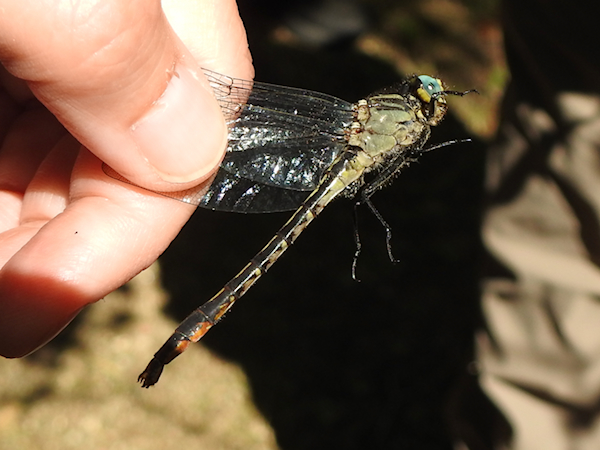
We approached the creek, and as we passed through a sunny, open area along the trail I spotted a clubtail resting on a leaf. It was one of the pond clubtails, and although my first instinct was to photograph it, I caught it so I could show the group. It turned out to be a Lilypad Clubtail, one of the few I have found away from the water instead of resting on a lilypad in a pond!
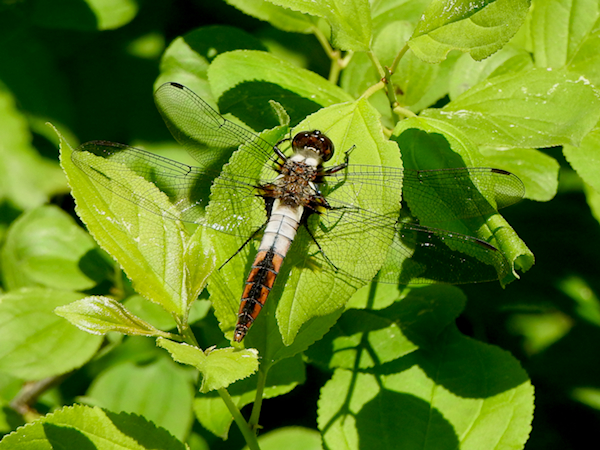
As soon as we got back to the parking lot at Lally Homestead we heard the song of a Blue-winged Warbler coming from the field behind us. We walked down the road and eventually found a Golden-winged Warbler, but no Blue-winged Warbler. As these two species hybridize, we couldn’t even be sure that it was a Blue-winged Warbler singing, as hybrids often sing their song. We ventured about halfway down the Silver Queen Mica Mine Trail, listening mainly for warblers. There were lots of Dot-tailed Whitefaces perching and Racket-tailed Emeralds flying down the woodland trail, as well as some Calico Pennants and a Common Baskettail in an open area – these were more plentiful flying above the road and parking lot than along the wooded trail. We also saw a few Blue Dashers and Chalk-fronted Corporals, including this interesting male – it has developed some pruinosity on the top of the abdomen but the remainder has not yet turned black and still shows its teneral colours.
Although we saw a male and female Scarlet Tanager and heard several warblers, neither the Blue-winged nor the Golden-winged Warbler put in an appearance. We headed back to the parking lot to eat at the picnic tables near the Lally Homestead ruins, and once we were done, headed back up the trail to look for the diminutive Elfin Skimmers near the bunkhouse at the Silver Queen Mica Mine.
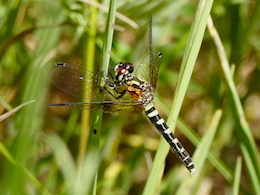
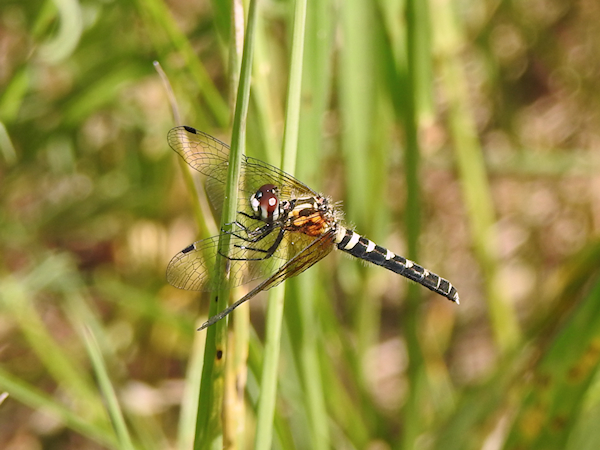
Derek and I had joked about finding our target in 10 minutes this time so we could move on to another area, but that is exactly what happened: he found one resting on a colourful quartz rock embedded in the ground and called me over, but it flew before I could get there. I asked the group to spread out and search the long grasses adjacent to the trail, and it wasn’t long before Derek called me over to point out another Elfin Skimmer. This time she stayed put.
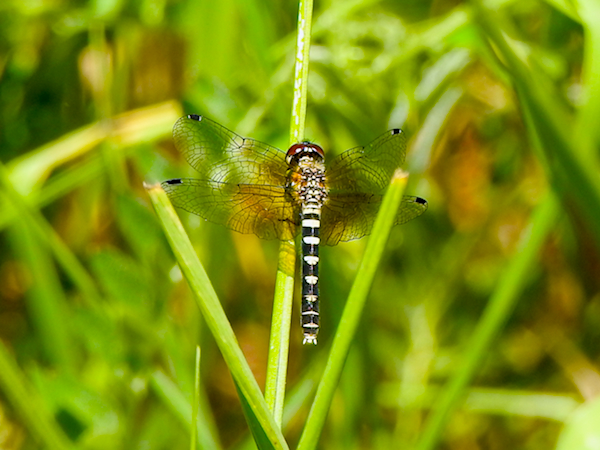
She was tiny, but I swept her up in my net without hesitation so I could show the group just how tiny she is. Astonishingly, her body is shorter than the shortest damselflies (sprites and forktails) in our area, as evidenced by the one I saw next to an Eastern Forktail.
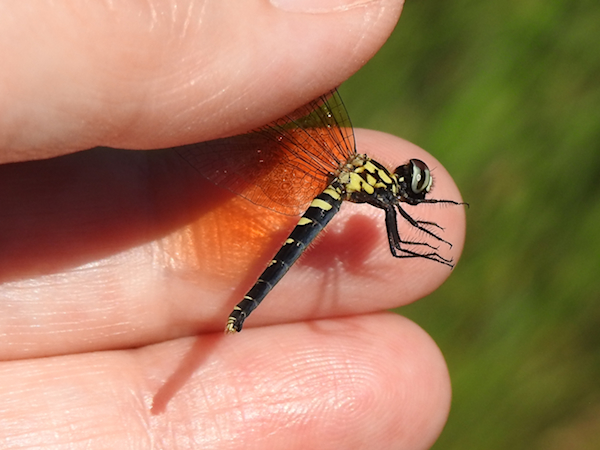
Then I spotted a male in the grass and pointed him out. Unlike the wasp-like yellow-and-black females, he was a very pale blue…as is the case with many skimmers, the male Elfin Skimmer develops a pale grayish-blue pruinosity over most of its body as it ages. It also lacked the amber tint at the base of the hindwings that the females have. Interestingly, teneral males and females are both lime green when they emerge!
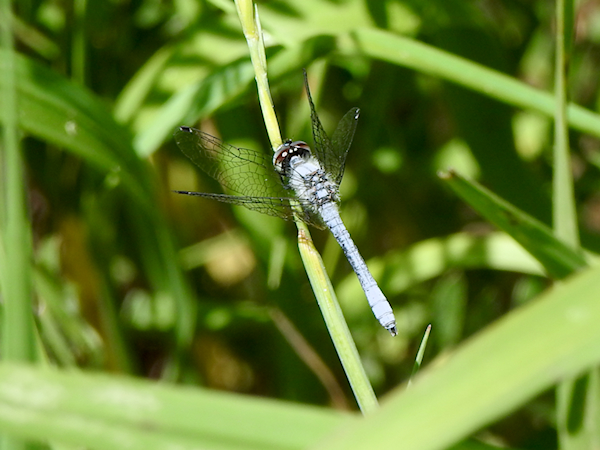
Elfin Skimmers breed in sphagnum bogs, shallow pools within fens, and sandy lakes where they may be found around seepage areas filled with sedges. Males spend more time perching in the vegetation at the water, while females often hunt for food in drier areas. Interestingly, there is no appropriate bog or fen habitat nearby, and their breeding habitat is unknown. However, this population has been consistent enough in this one grassy part of the Silver Queen Mica Mine Trail that they must be breeding somewhere close by. Altogether we saw two males and four females, which made the outing a success.
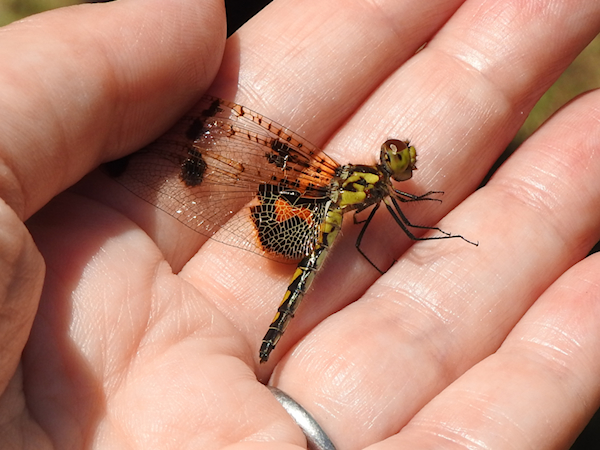
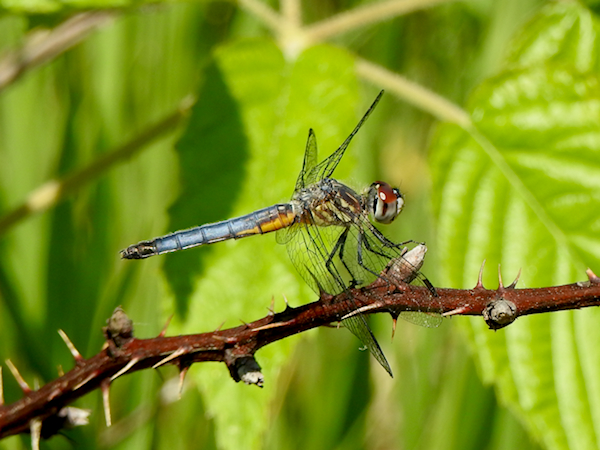
There some other interesting dragonflies in the area, including a Calico Pennant which I caught, and a Blue Dasher perching on a thorny branch which made for an interesting photo – the thorns were quite large compared to its small body!
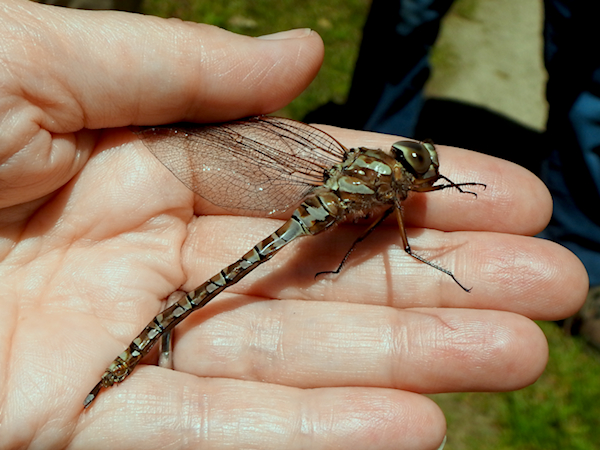
On the way back we saw a grayish mosaic darner flying along the trail. Then it landed on the shirt of one of the participants – my Point Pelee roommate Marni, in fact! – and I gently swept it off of her and caught it with my net. It was a Canada Darner, one of the first mosaic darners I see every year. (Note how large it is compared to the Elfin Skimmer in my hand above!)
After leaving the Silver Queen trail we visited the marshy habitat of Black Creek along the Lally Homestead Trail. We didn’t see any new odes there, though an American Bittern standing out in the open was a lifer for one of the group. There were plenty of Racket-tailed Emeralds and Common Baskettails flying around, and when I checked the vegetation for damselflies I was surprised to see mostly Fragile Forktails – at least eight or nine compared to two Eastern Forktails!
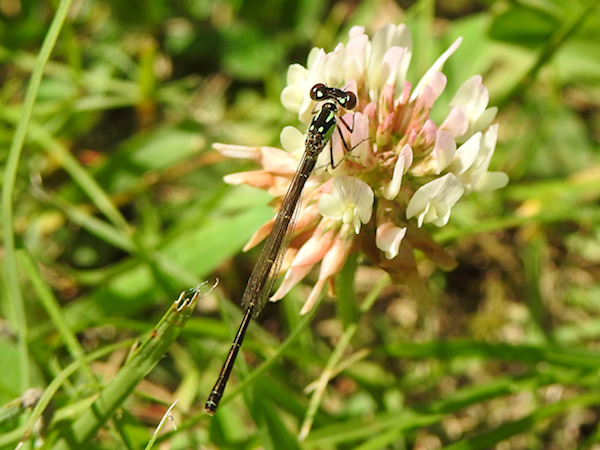
A Four-spotted Skimmer perching above the water was great to see, as was a male Eastern Pondhawk with a half-black abdomen. It looks like some black substance had gotten on his body given the small blue areas showing through in some spots.
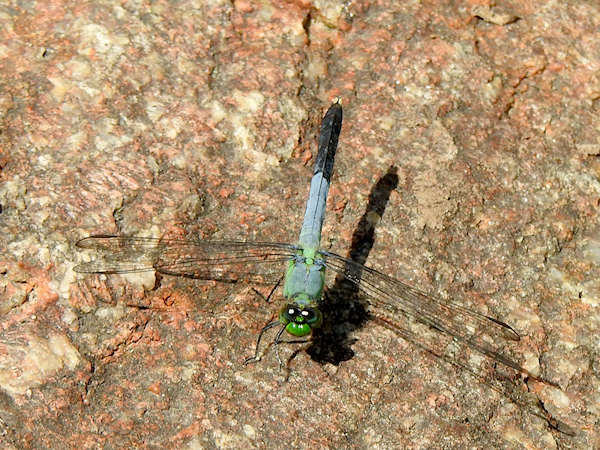
On our way out I spotted a different emerald species – an American Emerald – perching on a leaf in the sunlight.
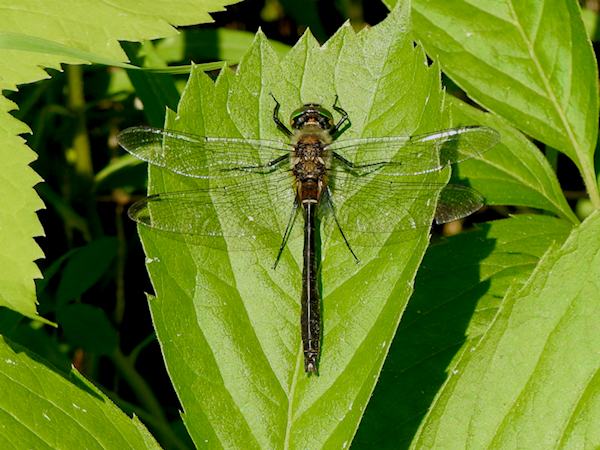
Our next spot was the bridge on Black Ance Point Road where we had seen the Dragonhunter last year. Unfortunately we didn’t see any clubtails, but there were plenty of Ebony Jewelwings, a few teneral whitefaces, Chalk-fronted Corporals – including one sharing a rock with a Common Whitetail, and something brown flying over the calm water below the bridge. I suspected it was a Stream Cruiser but it was too distant to make out any details.
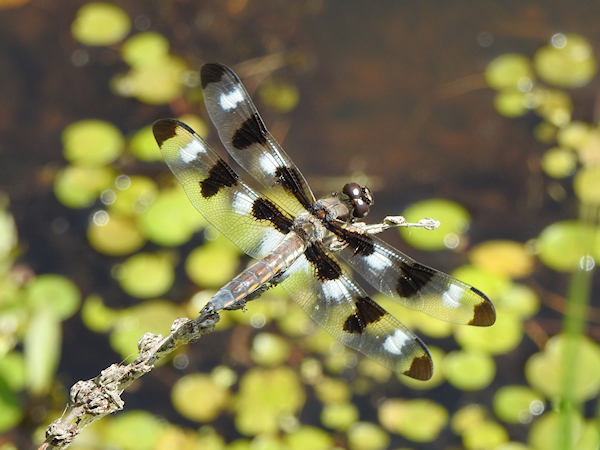
Derek said that there was another bridge further up, so we walked up Black Ance Point Road for a while. We came upon a small marshy pond with a lovely Twelve-spotted Skimmer hanging over the water.
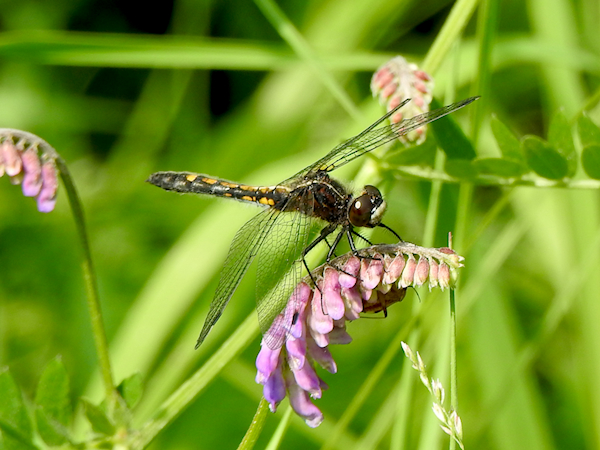
Nearby a Dot-tailed Whiteface was perching on some Purple Cow Vetch.
We were running out of time and didn’t see the bridge, so we turned around and headed back. Janet met us along the way and we piled into the van and headed to the park store for ice cream (I highly recommend the Chocolate Fudge Brownie!). When I was finished eating I walked to the edge of the lake behind the building to look for damselflies perching on the lily pads. I wasn’t sure whether the Orange Bluets would be out but they were, with five sitting in the sun. One lily pad held a male and female Orange Bluet in tandem.
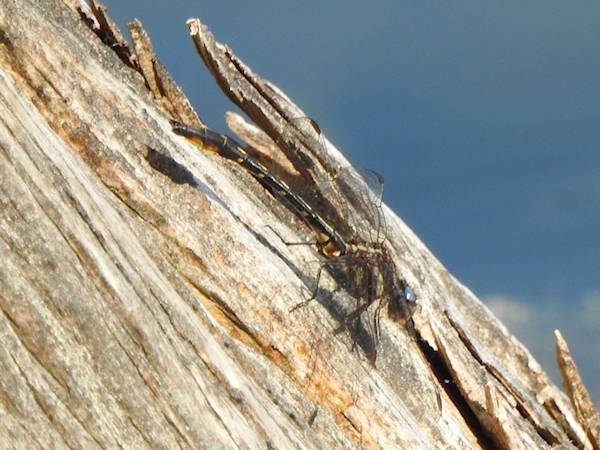
I didn’t see any mature Violet Dancers, but to my surprise a clubtail landed on a stump sticking out of the water near a Chalk-fronted Corporal. It appeared to be a Phanogomphus species, possibly a Dusky Clubtail. It was facing the water so I couldn’t approach it from the front, nor was it close enough to the shore for me to catch.
It was fantastic to return to Murphy’s Point Provincial Park a little earlier in the season and to enjoy such a warm, sunny day. Although we never did get to the bridge along the McParlan House trail, I was thrilled that the Elfin Skimmers were on site and easy to find. It was a great day, but the best part was seeing so many people who were equally interested in dragonflies as well as birds!

 OdoNotations