
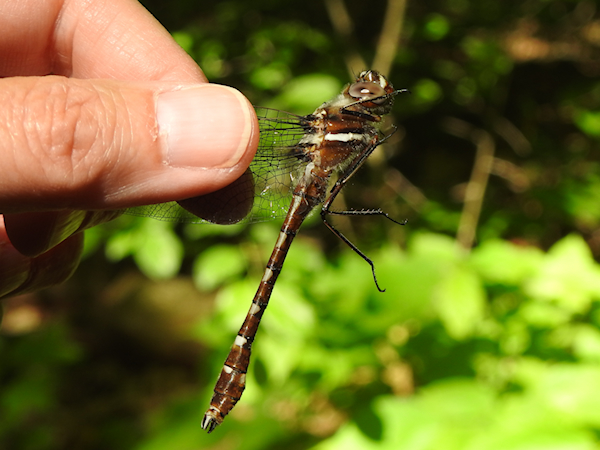
The Uhler’s Sundragon is an early-flying member of the emerald family that is apparently more easily found on the Quebec side of the OFNC study circle. However, iNaturalist shows a few records from the Quyon ferry dock along the Ottawa River, so one of my goals was to spend some time visiting places like the ferry dock, Sheila McKee Memorial Park, and Fitzroy Provincial Park to look for it and other river odes, including the uncommon Mustached Clubtail. I’ve only seen the Sundragon twice, both times in Nova Scotia, and in the same habitat – medium-sized- rocky forest streams flying over the gentle pools of water either at the top or bottom of a waterfall. Fortunately their patrols take them along the shoreline, and I was able to catch two in 2024 and one earlier this year. My goal was to see one in Ottawa, and I had high hopes for finding one at Fitzroy Provincial Park as there are two small rivers running through it that I wanted to check.
Chris and I met at my place, then I drove us to Sheila McKee park where I was hoping for whitefaces, emeralds, Mustached Clubtails and Stream Cruisers. The first dragonfly we found in a sunny clearing was a Stream Cruiser on patrol, and I caught it as it zipped by.
When we reached the open corridors we started seeing emeralds flying through the air: Racket-tailed Emeralds about 5 to 10 feet above the ground, and baskettails much, much higher up. I saw Common and Prince Baskettails as well as some that were likely Spiny Baskettails. We scanned the edges of the corridors and the large meadow but saw no Blue Dashers or whitefaces – just a Twelve-spotted Skimmer and several pennants. I thought they might be the Halloween Pennants I’d seen here last year and was surprised when they turned out to be Calico Pennants, a species I did not have here last year.
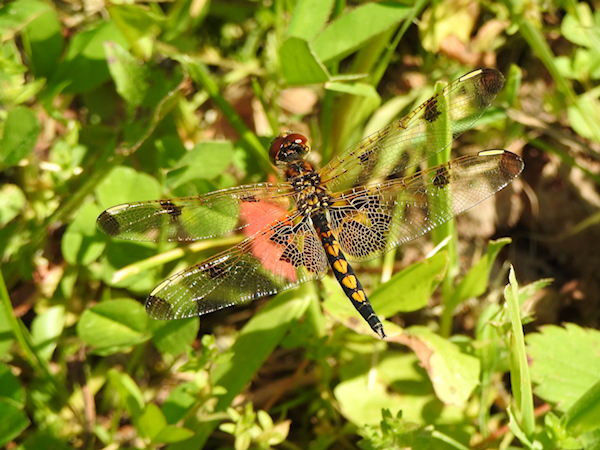
Given that both pennants breed in marshy or open ponds and lakes with emergent vegetation rather than the Ottawa River, the logical explanation is that they emerge somewhere close by – Constance Lake, maybe? – and do not always disperse to the clearings of Sheila McKee park. It’s a good reason for returning throughout the season and over many years. Although we looked, we couldn’t find any bright red mature males.
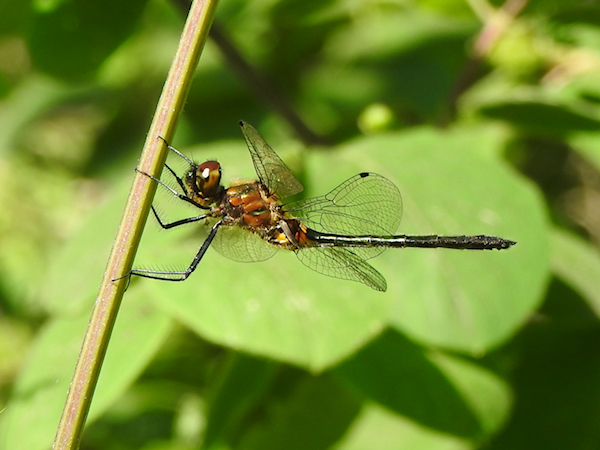
The large emerald swarm above the meadow enticed us to stay, but we had little luck in catching them. Chris had better luck than I did, as his net has a longer reach, but we caught both Spiny and Common Baskettails. At least one or two dragonflies looked suspiciously like one of the larger Somatochlora emeralds but we were not able catch them. I did not see anything that looked like a Brush-tipped Emerald, one of the small Somatochlora emeralds that I’d found here last year on July 1st. However, we did find a Racket-tailed Emerald posing nicely when it landed in front of us.
When it became clear that a lot of time and effort needed to be spent to catch the emeralds, I suggested we head down to the beach to look for Mustached Clubtails instead. When we got to the bottom of the jumble of rocks that forms the stairs Chris started checking the vegetation and immediately found a male! I couldn’t believe it was that easy! I grabbed a few shots of the top of the dragonfly, then tried to position myself where I could get a photo of its distinctive face and the black stripes for which it is named.
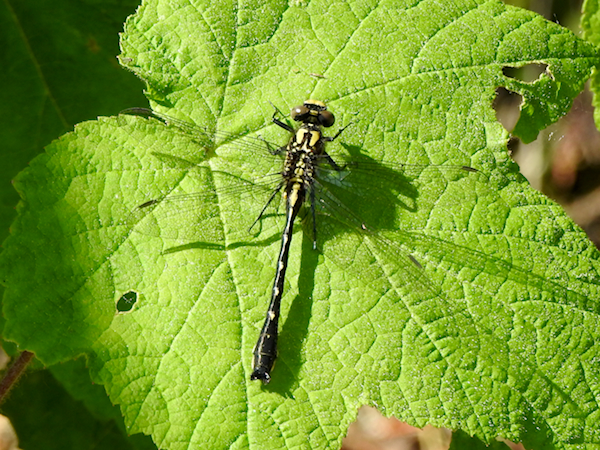
It flew before I was able to get a decent shot of the face, landing in the leaves of a small shrub just above head height. Chris stayed with it for a bit while I wandered along the shore for a bit, looking for other clubtails and emeralds and finding only a few more Racket-tailed Emeralds.
We turned around and headed down the beach in the opposite direction. It was full of people, but most paid us no attention as we scoured the vegetation. Chris was walking closer to the base of the escarpment than I was, and when we came to a shrub he stopped on one side, and I stopped on the other for we each found a small clubtail resting on a leaf! Chris said his was facing me, but the one I saw was facing the left so we had two different individuals! I only saw the one, and as it was about head height, I was able to get some great pictures of its face showing the distinctive black markings. I didn’t get a classic shot from the top, but from what I could see it was a female.
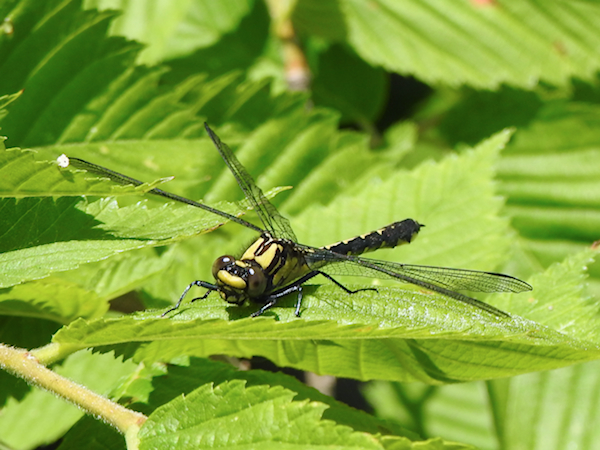
Mustached Clubtails are described as “common small river clubtails” in the Paulson field guide Dragonflies and Damselflies of the East, though they aren’t really common in our area – the Ottawa Checklist describes them as scarce and local. They live in streams and rivers with currents that can vary from slow and lazy to swift with rocky riffles, usually with sand or mud bottoms. Males are often found resting on rocks close to the water’s edge or perching on the leaves of trees and shrubs up to about six feet. During the hottest part of the day, both sexes may leave the water to perch on broad leaves in nearby sunny clearings.
Pleased with our success, we headed over to the Quyon ferry dock, the site of my first ever Cobra Clubtail sighting and supposedly the home of the Uhler’s Sundragon. We spent some time walking up the shore and found some teneral clubtails, a few Common Baskettails, and a couple of dragonflies zipping over the water and along the shore. It took some time to identify them as Springtime Darners, my first sighting of the year. Unfortunately none of the darners or baskettails came close to the net, so I had to leave without being able to iNat anything other than a Northern Water Snake swimming below the surface of the river.
We debated whether we should head to Morris Island or Fitzroy Provincial Park next, but I still thought the additional river and creek habitat of Fitzroy might hold some interesting species. I paid at the gate and and asked which areas of the park had the best river access. The park wardens recommended the Carp Trail, a one-kilometre loop that follows part of the Carp River. Eagerly we set out, and found the trailhead next to the bridge over the Carp River. We followed the trail until the forest floor descended to the same level as the water, then began walking along the shore instead. It wasn’t the prettiest river – it was a dirty brown colour and choked with grasses or sedges that lay flat against the surface. There were some rocks in a few places, but those on the shore looked the uniform gray of dried mud. It looked like the water had been higher at one point, for the mud close to the water was very slippery – I almost fell a few times. There was a large island close to the shore, and Chris and I spent some time walking around and watching for odes.
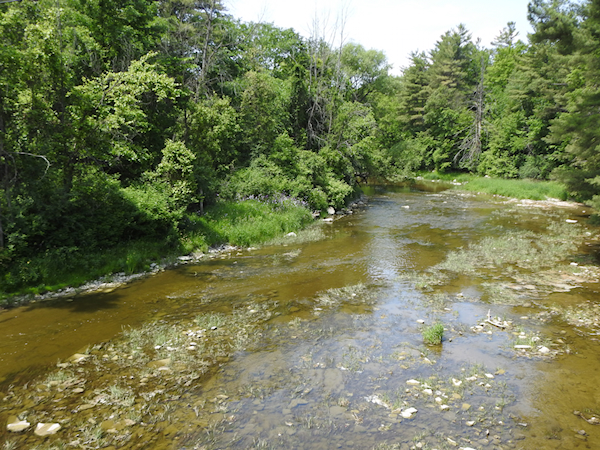
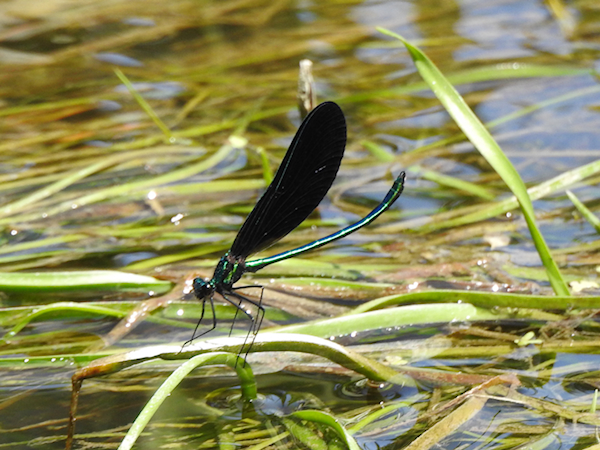
There were lots of Ebony Jewelwings in the vegetation, their black wings snapping like velvet butterfly wings as they perched. Powdered Dancers were common, and two Common Green Darners chased each other up and down the middle of the channel. I saw one Eastern Pondhawk, and then something big flew in and landed on a rock, head pointing down. I saw the green eyes, but before I could take a step closer or get a sense of what it was it flew off.
Common Baskettails were abundant in the park, but then we saw something bigger and bluer patrolling the mouth of the channel between the island and the shore. There were two of them, and I spent several minutes trying to catch one, eventually identifying them as Springtime Darners. With patience I was finally able to snap one up.
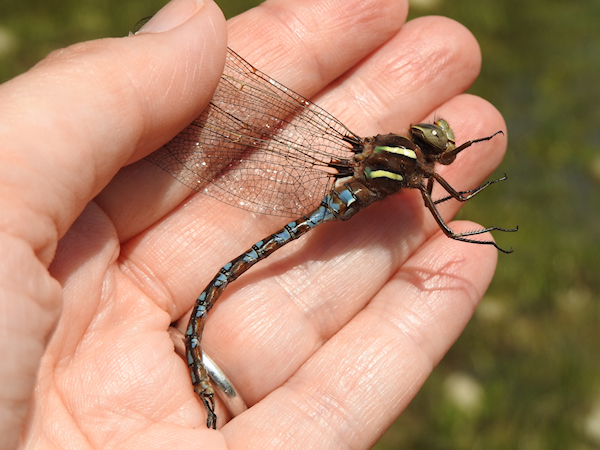
Like most darners, Springtime Darners feed while flying and only rarely perch. In the past I’ve been lucky to see a few land close to me – including the one at Morris Island a few years ago and the one at the Yarmouth rail trail last year – but these ones were not interested in landing at all. I placed the one I had caught on some vegetation but was only able to take one photo before it flew off.
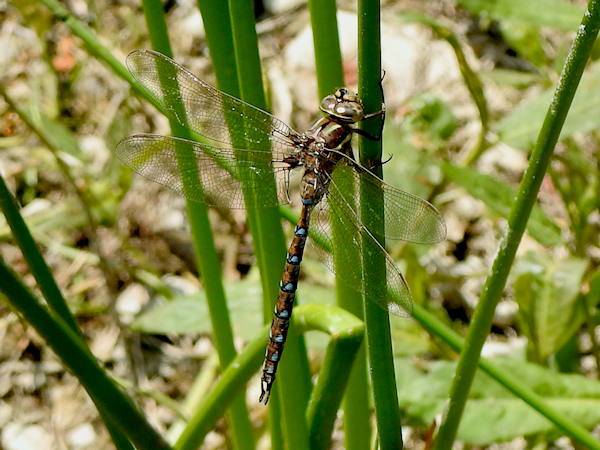
We crossed back to the mainland and started following the bank of the river. It was slippery and muddy in a few spots, but easily navigable in most places. When we came to the spot where the island ended and the small stream merged into the main channel both Chris and I spotted another darner patrolling the river about five feet above the water. It was larger than the Springtime Darners, and a lighter shade of blue. Watching it tweaked a memory from several years ago, a similar day early in the season when I had spotted a darner in the Morris Island parking lot. I caught it and Chris Lewis confirmed it was a Cyrano Darner. Just as I was getting ready to voice my suspicion Chris said that it was likely a Cyrano Darner. We spaced ourselves along the edge of the bank to try to catch it with our nets. It seemed to know this and often hovered just out of reach, flying up and down the middle of the channel except when it decided to chase after a Common Baskettail or Stream Cruiser. Neither of us managed to catch it, but Chris did get an in-flight photo that clearly identifies it as a Cyrano Darner.
After that we made our way to where the Carp River emptied into the Ottawa River, passing large clearings filled with ferns and some swampy land that looked like it might hold Swamp Darners in season.
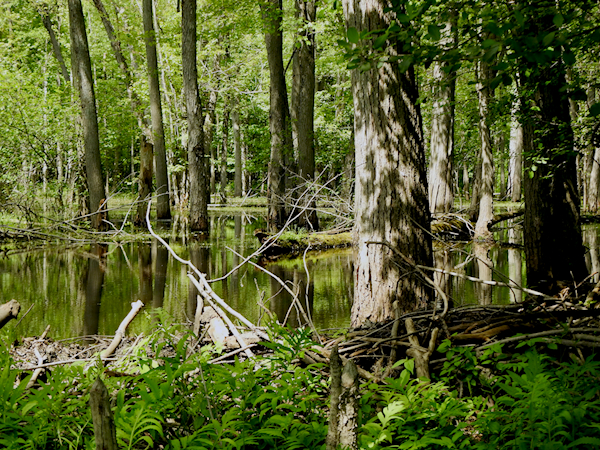
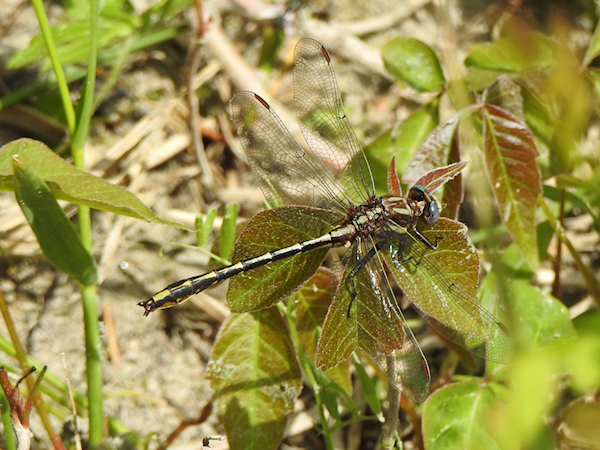
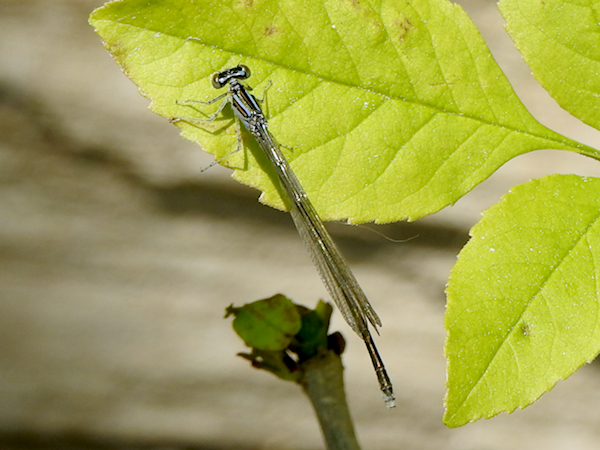
Near the Ottawa River we found a few Eastern Forktails and Stream Bluets in the vegetation, and several Lancet Clubtails perching close to the ground. Many of the clubtails were tenerals that flew up into the trees as we walked through the ferns to see if any larger clubtails were present. Some, however, were adults with their full colour.
Although it had been my plan to check the beaches of the park as well, by the time we returned to the trailhead I was tired and hot and ready to call it a day. But what an amazing day, finding Springtime Darners and Mustached Clubtails and my first Cyrano Darner in 10 years! Fitzroy Provincial Park is well worth the drive, and I can’t believe it took me this long to visit!

 OdoNotations