
It’s mid-June, which means the season is flying by and soon some of the early-season species will be gone. I’ve been trying to get out every chance I get, but uncooperative weather and a busy work week after my vacation meant that I wasn’t really able to get out until earlier this week for some intensive dragon-hunting. I worked from home Monday and Wednesday, and with the weather finally turning warm and sunny, a couple of lunchtime outings this week in Stony Swamp resulted in some surprisingly good dragonflies!
On Monday I visited Jack Pine Trail with one goal: to see if any Arrowhead Spiketails were flying. Some emeralds would be nice, too, as well as any spreadwings or cruisers, but the spiketail was my target species. Jack Pine Trail is the most reliable location for it in the west end, and when present I only seem to find it during the second or third week of June. The official checklist of Ottawa says it is present in the region between early June and early July, so I had high hopes of finding one.
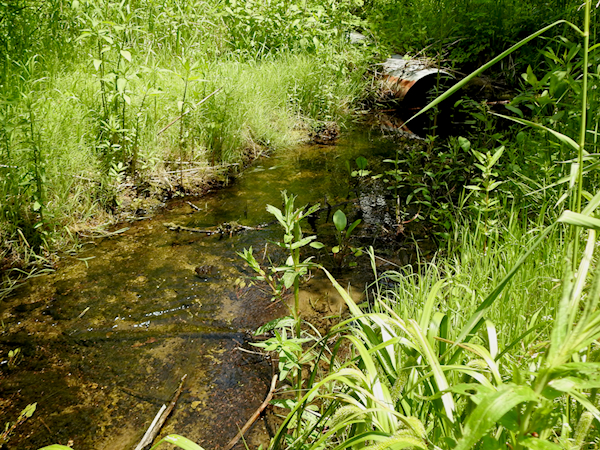
I didn’t have a lot of time to spend there on my lunch break, so I hurried toward the stream at the back of the trail without stopping to photograph any butterflies or flowers that caught my eye. The Arrowhead Spiketails are usually found either perching in the vegetation in the open areas surrounding the stream or flying up and down the creek, so once I reached the entrance to the fourth loop I slowed down and scanned the shrubs and cattails along the trail. I didn’t see any dragonflies, so I made my way to the small stream and waited for the spiketail(s) to come flying down the stream. Sure enough, after less than 10 minutes I saw one cruising over the water toward me, then fly up over the trail and so it could continue its way down the other side. When it didn’t come back, I decided to make my way through the dense vegetation to see if I could find it perching – and got lucky when I spotted it hanging from a bare branch right over the water.
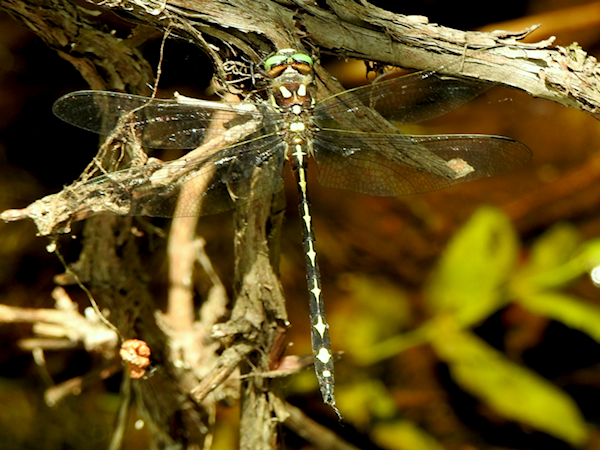
It’s not a long stream – according to Google maps it drains the large marsh within the interior of the middle loop and empties into another marsh or pond so deep in the woods that I’ve only attempted to locate it once – but despite being short, it must provide the perfect habitat for this species as I have been seeing them since 2014, and they were recorded there a few years before that. The short length of the stream makes them relatively easy to find, though I am not always successful. I was happy to have found this one so easily on a quick lunch break.
I had more time to look for insects on my way out, stopping to photograph a Racket-tailed Emerald, a White Admiral and an emerald moth I’d seen once before called the “Bad-wing Moth”.
Two days later, on Wednesday, I returned to a different area of Stony Swamp despite a thinly overcast sky. I once found an Arrowhead Spiketail at the Beaver Trail and so I headed there to see what I could find. When I reached the open area near the platform and boardwalk leading toward Lime Kiln Trail I started searching the vegetation in earnest, as this is where I had found the spiketail perching back in 2018. I didn’t see any dragonflies there, but one found me at the start of the boardwalk leading to the observation platform – it was patrolling the intersection and flew so close to me that I was easily able to net it. It turned out to be a Harlequin Darner, my second ever for Stony Swamp and first for the Beaver Trail!
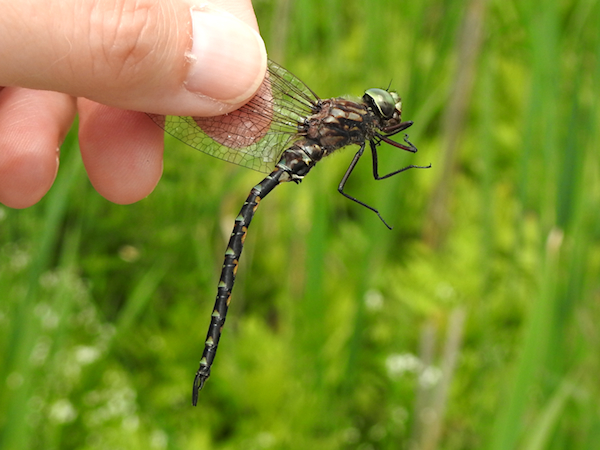
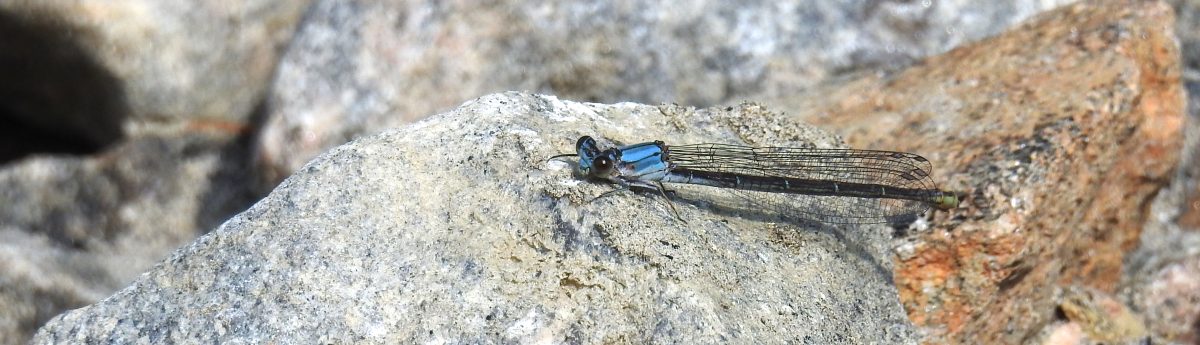
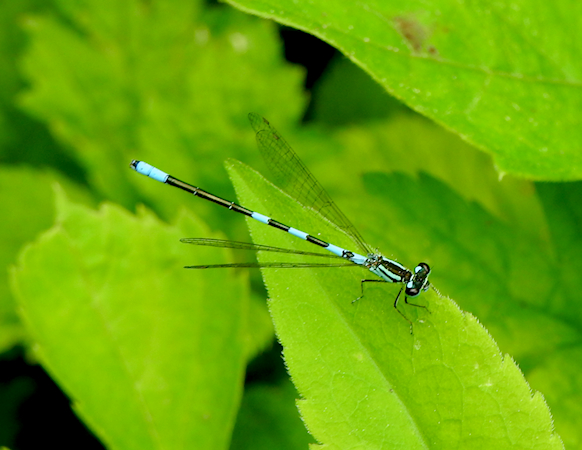
The only other one I’ve seen in Stony Swamp was at Sarsaparilla Trail on May 24, 2024, and that’s where I headed next after failing to find any other odes at the Beaver Trail. I found a good number of Sedge Sprites in various open areas along the trail and caught a blue-type bluet near the boardwalk that turned out to be a Hagen’s Bluet. The usual Taiga Bluets were present as well, with many distinctive males perching on the broad leaves of the low-growing vegetation near the boardwalk entrance. They have more black than blue along the abdomen, including three-and-a-half black segments together near the end, and typically perch with their wings spread slightly open like an Aurora Damsel or spreadwing.
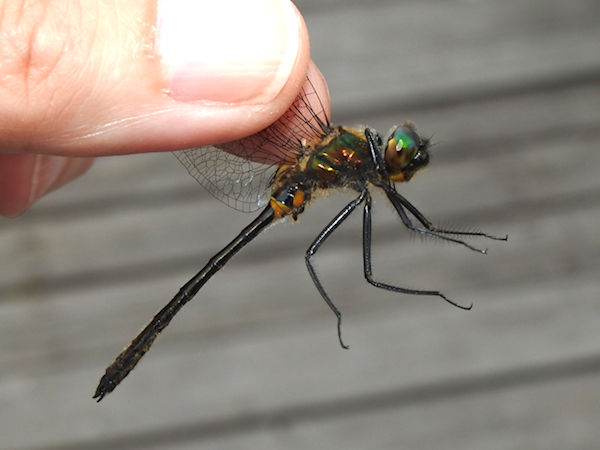
From there I went to the rickety boardwalk to scan the bit of open water on the north side. The usual Chalk-fronted Corporals and Dot-tailed Whitefaces were present at the water, along with a couple of Four-spotted Skimmers. A pair of Belted Whitefaces were perching on a flattened reed in a mating wheel. At least three Racket-tailed Emeralds were patrolling the open water, and when one flew down the boardwalk toward me I caught it for verification.
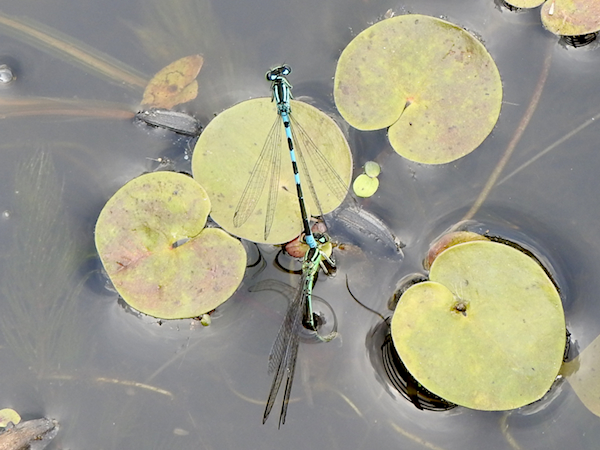
At water level, a pair of Taiga Bluets in tandem were depositing eggs into vegetation below the surface. Half of the female’s abdomen was fully submerged; notice how green she is compared to the male (which is also more of a greenish-blue colour itself than the true blue of the Enallagma bluets).
The best ode of the day, however, was a clubtail that flew in and landed on the boardwalk. Clubtails are not common in Stony Swamp; I have only ever seen three individuals here: a Lilypad Clubtail at Sarsaparilla Trail back in 2016 and two unidentified clubtails at Jack Pine Trail which flew off before I could get a good look or photograph of them.
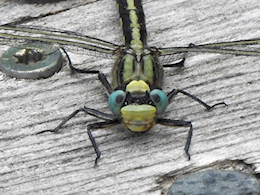
This female, however, was most obliging by not only landing out in the open where I could see her, but also by staying when I raised my camera. The head-on view left no doubt as to her identify with that high, shield-like yellow occiput between the eyes – it was a Horned Clubtail and my second clubtail species of Stony Swamp!
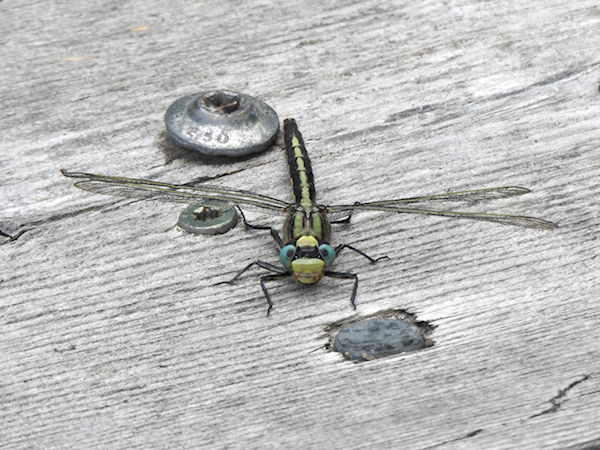
When I leaned over her to get a photo of the top of her abdomen, she flew a short distance away, facing away from me and giving me the opportunity to get close enough for that dorsal image. You can still see the large yellow occiput which shows a shallow notch – the occiput in the female Lilypad Clubtail is short and straight with a slight bump in the center.
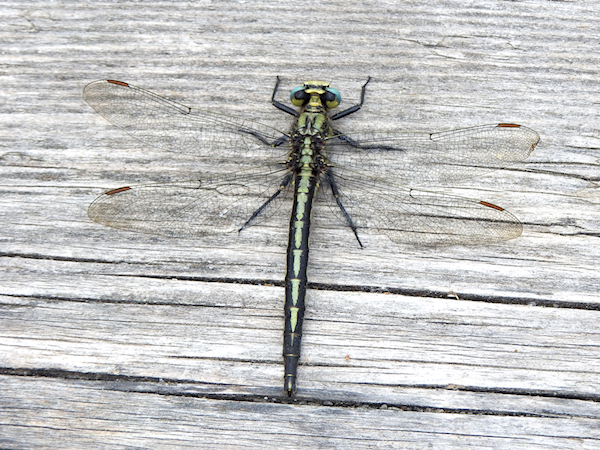
I was thrilled to have found a new dragonfly for the Beaver Trail and a new species for Stony Swamp on the same day. This is one reason why June is one of the most rewarding months for ode-hunting in our region – the diversity of species present is amazing with a large number of species on the wing, and they turn up in the most unexpected places!

 OdoNotations