
This weekend promised to be the hottest one of the year – over 30°C with humidity that made being outdoors feel like being smothered in a wet sheet. I went out early Sunday morning to Sheila McKee Memorial Park, hoping to find more clubtails and perhaps an interesting darner or emerald. As it was already 10:00 when I got there, I went down to the beach first because I thought it would get more crowded later and because the sun hits the shoreline at the base of the escarpment early in the morning – a vital factor when looking for uncommon dragonflies sitting on sun-drenched leaves.
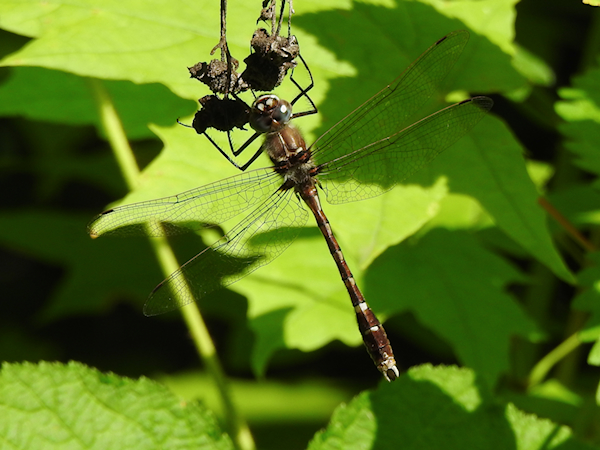
I was hoping to find some dragonflies and Powdered Dancers in the clearings along the way to the stairs, but the sunny lawns were quiet – I found only a Stream Cruiser hanging from a branch, a species which seems to be found more easily here than anywhere else.
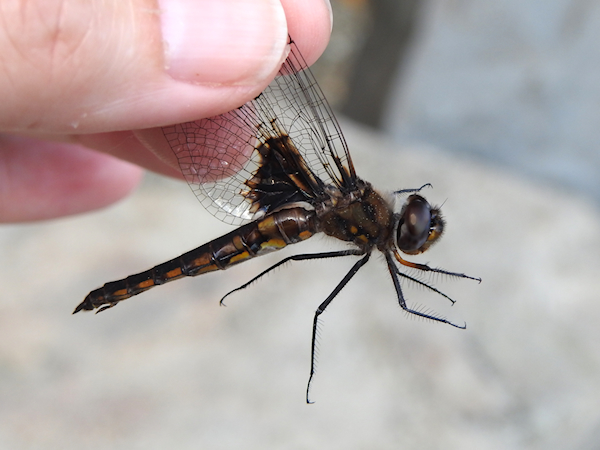
When I descended the staircase the first thing I noticed were all the emeralds flying around – Common Baskettails mostly, with a few Prince Baskettails and Racket-tailed Emeralds as well. They were flying tantalizingly low above the broad boulders that formed the base of the stairs, and I stood on one of the steps waiting for them to fly within reach. I was hoping to catch a Prince Baskettail, the largest of the four local baskettail species and the most easily identified in flight by the dark spots on its wings. One came close, and I swung – and missed.
There were many more Common Baskettails flying around, and it didn’t take long to catch one.
I walked down the beach and found only a few Racket-tailed Emeralds flying in the sunny areas at the base of the escarpment. There were no Brush-tipped Emeralds and no damselflies whatsoever. Eventually I scared up a large clubtail perching on the rocky beach, but when I looked down to turn my camera on, it flew off and was gone by the time I was ready to snap a photo.
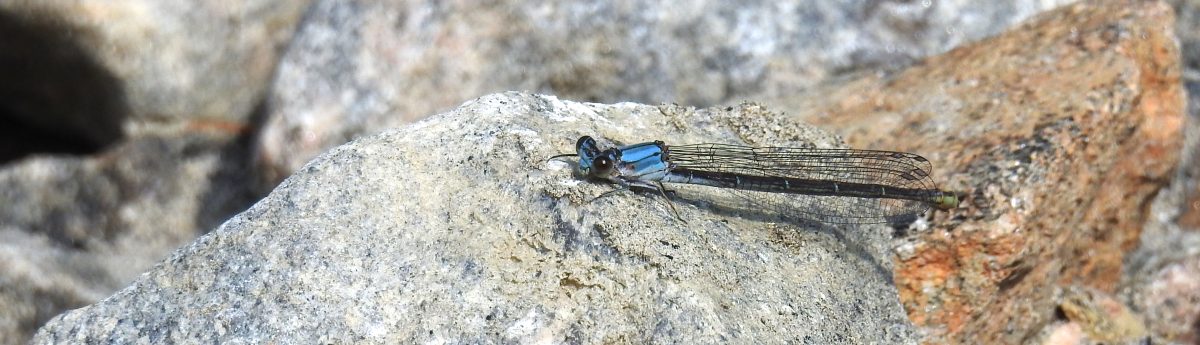
I turned around and headed north on the beach. Again there were no dancers – they usually emerge in late May so it was a bit a late for them. I’d already seen one at Fitzroy Provincial Park this season so I knew they were around – I wasn’t sure why none had emerged here, unless it was because of the cooler water temperatures of the Ottawa River than where I had seen one along the Carp River.
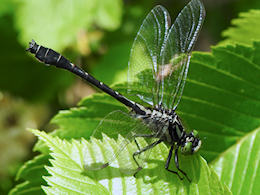
Then I spotted a clubtail on the ground with lovely emerald green eyes. I thought it was a Cobra Clubtail at first until I got close enough to see the small size and the pattern on its abdomen. It was another Mustached Clubtail, proving that our discovery last weekend wasn’t a fluke – they are definitely breeding here and inhabiting this tiny stretch of shoreline!

A little further along I found larger clubtail, this one with more yellow along the top of the abdomen and brownish eyes – a Midland Clubtail, one of my favourites. It was very fresh, and very tame as I took several photos from above. The colour of the eyes and the bright yellow of its markings indicate it hasn’t been long since it emerged; the eyes will eventually turn turquoise.
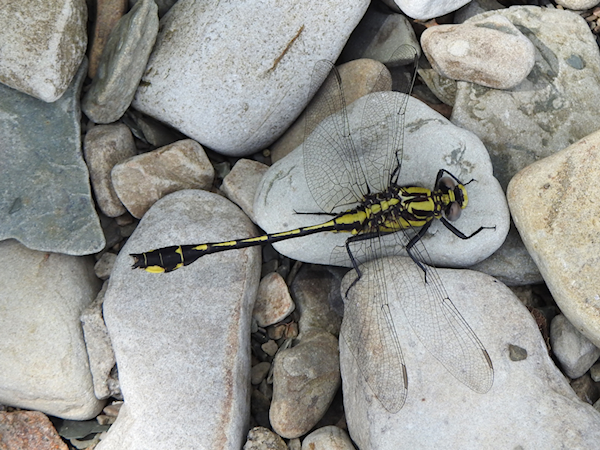
A Lancet Clubtail caught my attention next – brown in colour, with brighter yellow markings than the Mustached Clubtail down the length of its abdomen. It is smaller than the Midland Clubtail and perhaps a touch larger than the Mustached Clubtail. The club is noticeably smaller, even absent.
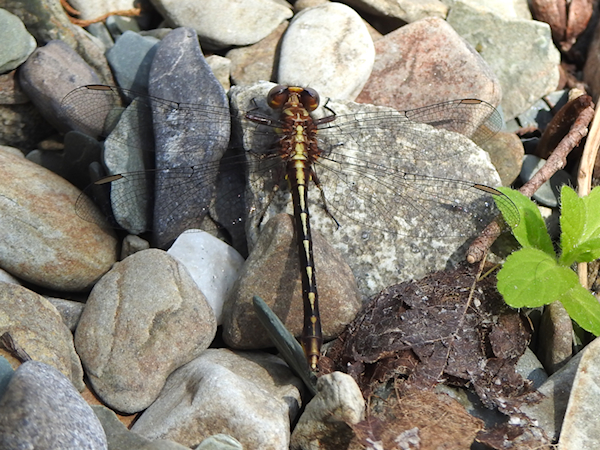
This one is a female, and it wasn’t until recently that I learned that the female Phanogomphus clubtails have a distinct enough occiput to help distinguish them in the field. This photo shows the yellow structure between the eyes having a relatively straight edge. The occiput in the Ashy Clubtail is convex-shaped; the male Dusky Clubtail also has a convex-shaped occiput, while the female Dusky Clubtail has a wavy occiput according to Paulson’s Dragonflies and Damselflies of the East. The female Lancet Clubtail is mostly straight and may have a slight notch according to the Minnesota Dragonflies website; this site also describes the female Dusky Clubtail’s occiput as “tiara-shaped” – higher in the center with depressions on either side.
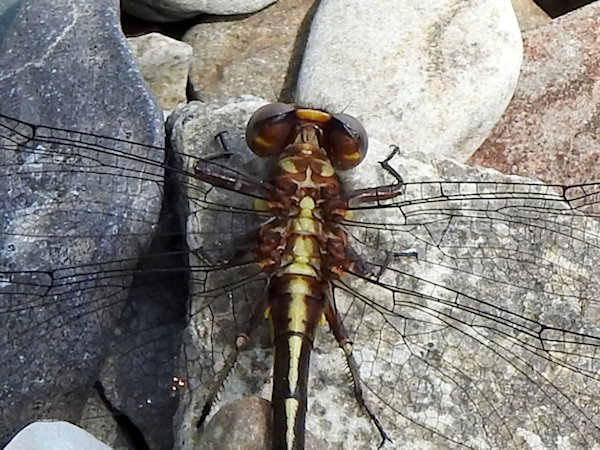
I walked further west along the river, seeing fewer clubtails, and fewer emeralds, too. Then I spotted a dragonfly fly out of the shrub and land on a nearby cedar tree. I only managed a couple of photos before it flew to a different shrub, this one also with broad green leaves. It was too high in the shrub to photograph, and I was certain it was another Mustached Clubtail even though I couldn’t see the face. I carefully caught it, and examined its pale green face heavily marked with black stripes. There was no question that it was a Mustached Clubtail.
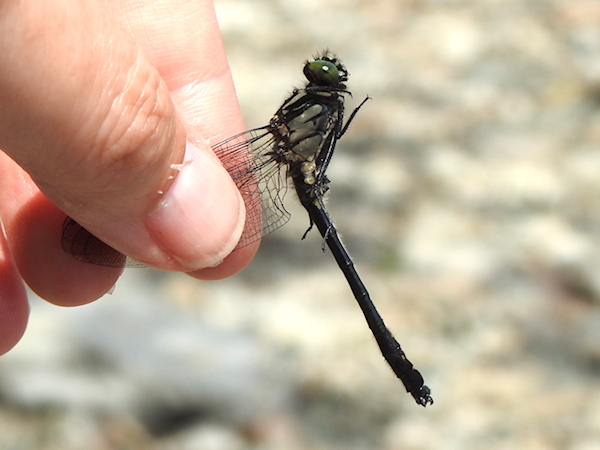
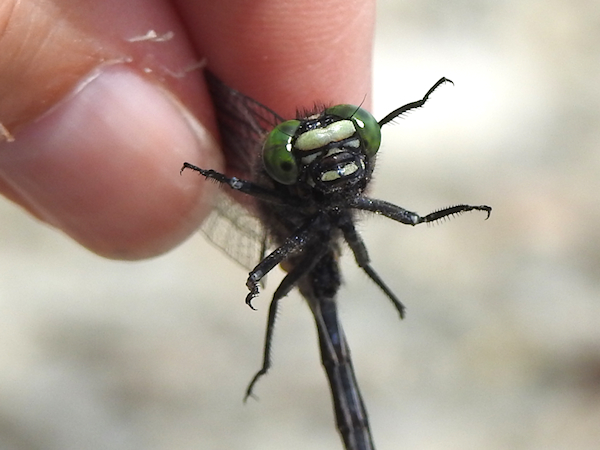
I wanted to get a photo of the markings down the abdomen, but couldn’t do it from the angle I was holding the wings. I tried to hold it by the legs instead, and just as I took a photo it bit me! I felt it nibbling on my finger with its needle-like jaws and quickly released it. This is not the first time I’ve been bitten by a dragonfly – it has happened a few times when pulling one out of the net – and like all the previous times, this one didn’t break the skin or hurt much. Dragonflies will only bite as a last resort when they feel threatened, and as long as you keep your fingers away from their mouths when handling them you will be fine. I don’t often hold them by the legs because I’m afraid of causing damage; next time I’ll have to remember that the damage can go both ways!
Fortunately the dragonfly didn’t go far. I was able to track it down in a blossoming shrub where I’d seen some White Admirals earlier, and finally got some photos I was happy with.
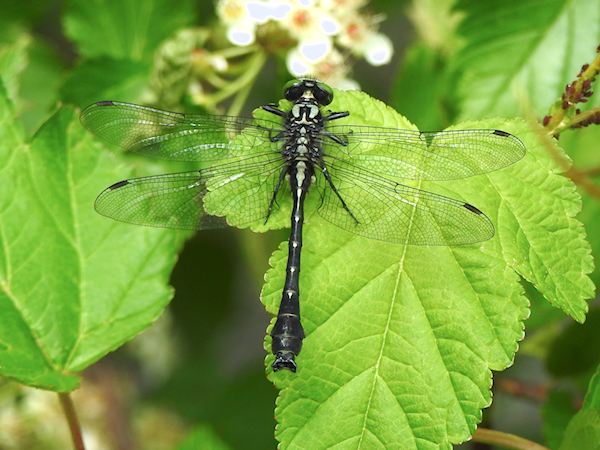
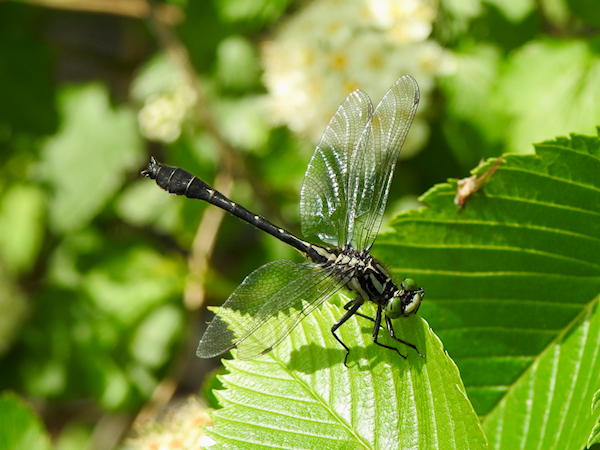
I was happy to get so many clear photos of this very uncommon species. I didn’t find any other species along the shore, so I headed up to the open meadow at the top of the escarpment to look for skimmers and emeralds. There I found more Racket-tailed Emeralds and Common Baskettails, as well as a perching Prince Baskettail, but no other emerald species.
I saw several darners, but couldn’t find any species other than Canada Darner. Around the edges of the meadow I found a couple of Four-spotted Skimmers, a few Sedge Sprites, a Widow Skimmer, and three Blue Dashers. There were no pennants or Eastern Pondhawks on this visit.
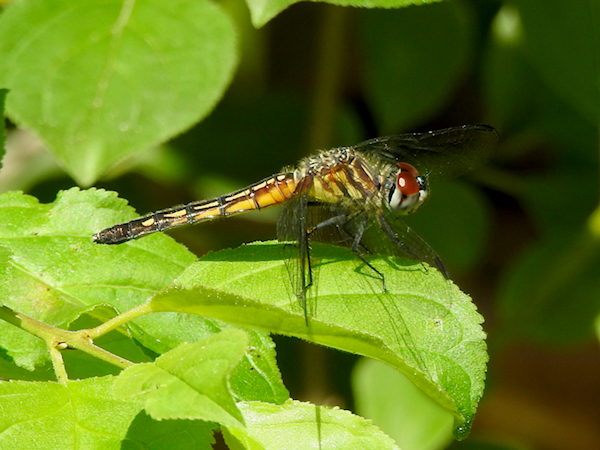
Altogether it was a fabulous visit. I was particularly thrilled with finding two Mustached Clubtails….even if one did end up nipping me!

 OdoNotations