
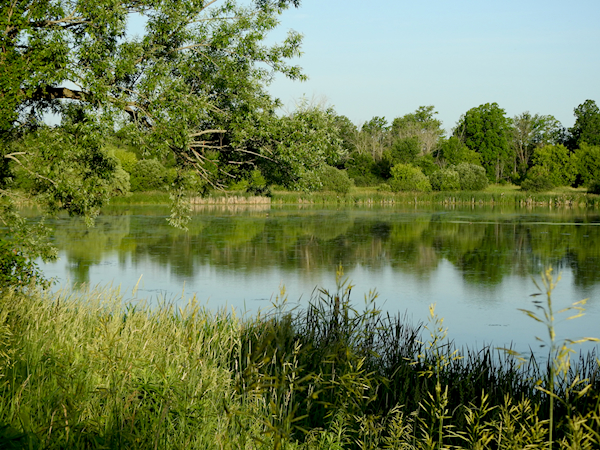
I often visit the former Richmond Lagoons (now called the Richmond Conservation Area) around late June or early July to look for spreadwings, as this is one of the best places to find five or six different species. It’s one of the few places I can find Lyre-tipped Spreadwings easily, and in 2023 I found another difficult-to-find species here, the Emerald Spreadwing. Both spreadwings are listed as “uncommon” in the Ottawa checklist, but the Lyre-tipped Spreadwing is also designated as “local,” having a special preference for shallow marshes and vegetated ponds completely in the open, particularly those that often dry up during prolonged droughts. While the Lyre-tipped Spreadwings typically disappear with the water, they are also quick to appear in temporary flooded areas such as farm ponds, gravel pits, and artificial ponds. While Emerald Spreadwings also inhabit densely vegetated, shallow wetlands, they can be common in shrubby or forested areas a distance away from their breeding ponds. Emerald Spreadwings are not usually successful in wetlands where predators such as fish or dragonflies are common, which may explain why they can be tough to find.
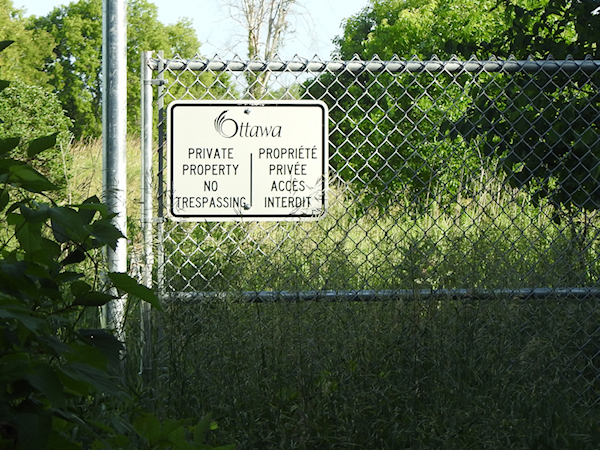
As usual, I started my walk by leisurely scanning the tall grassy vegetation along the berm. The path was neatly mowed and easy to walk, unlike some of my previous visits last year. I would have enjoyed walking around all three lagoons, but a new fence blocked off access to the middle and third cells where the grass grew wildly beyond. A “no trespassing” sign had been posted by the City.
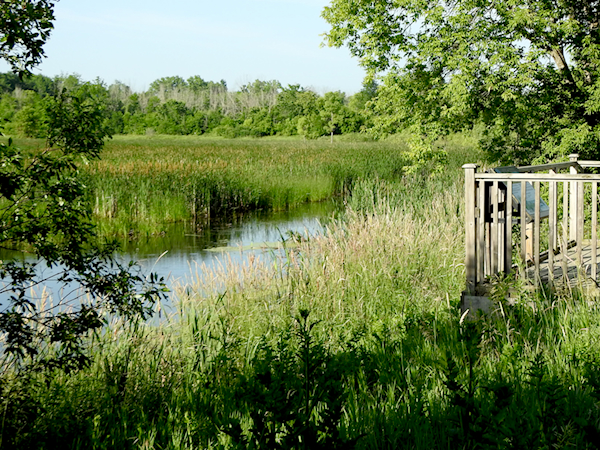
The first cell used to be completely open when I started birding here back around 2008; it has slowly filled with vegetation over the years. It used to be excellent for shorebirds in the fall when the water is low but now is better for breeding rails and Marsh Wrens.
The middle cell is more of an open pond and usually hosts plenty of geese and ducks during migration, with the occasional diving ducks joining the dabblers. I saw a single Common Green Darner flying over the water but no large skimmers; I would have expected to see one or two Twelve-spotted Skimmers here. It is difficult to get to the water as the slope beneath the vegetation is quite steep, so I wasn’t able to see what species might be hanging out near the shore.
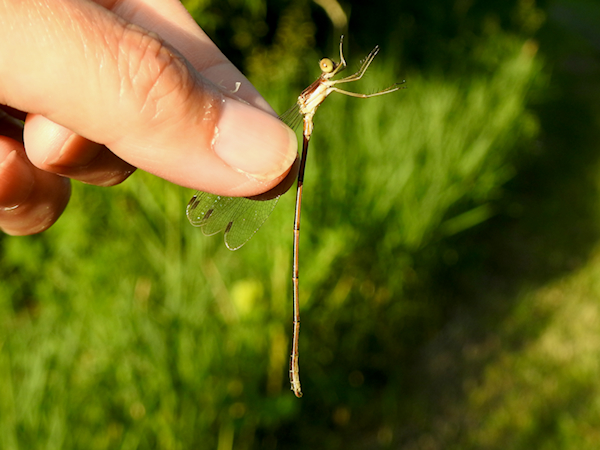
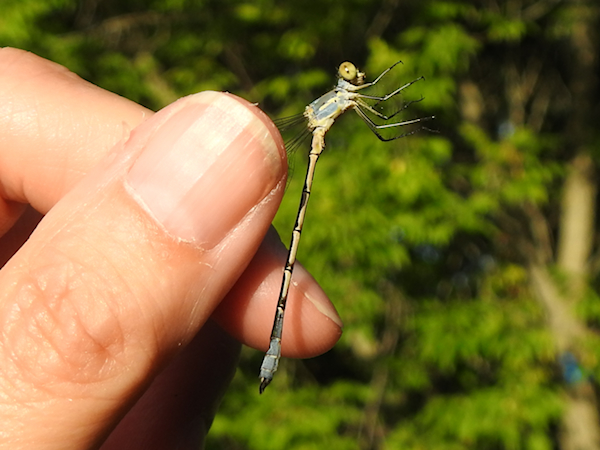
One of my previous visits had turned up dozens of Sedge Sprites, Eastern Forktails, and a small number of Fragile Forktails in the vegetation along the berm; today, however, there were only a handful of Sedge Sprites and Eastern Forktails present. I saw several spreadwings in the vegetation and tried to photograph a Slender Spreadwing perching on the stem of a plant; it flew off before I could, so I swept it up with my net before it could go very far. In this image you can see that the wings are only about half the length of the abdomen, and that the abdomen is indeed very thin. The rounded ends of the wings are white as well, another field mark that differentiates them from other species. Slender Spreadwings are very common around vegetated ponds and have a long flight season, often flying late into September.
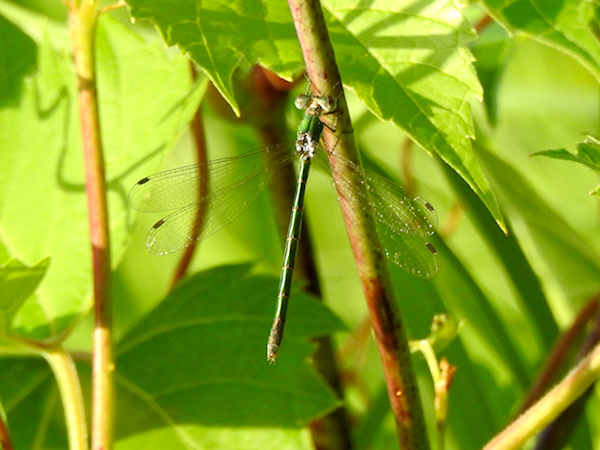
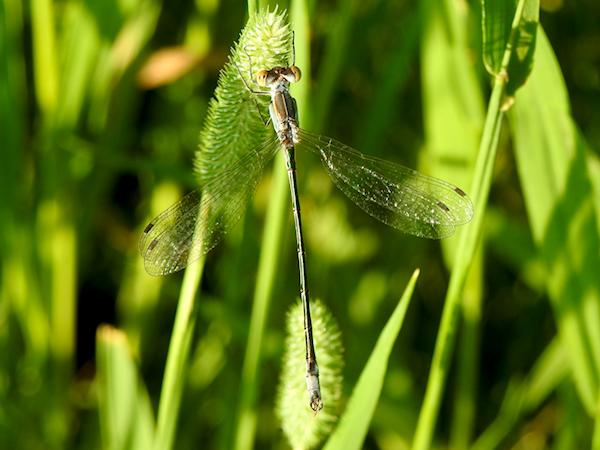
A little further along I found two Emerald Spreadwings, their thick bodies metallic green in the sunlight. I usually find these spreadwings in the vegetation away from water; one year I found about half a dozen in Stony Swamp in a dry clearing nowhere near the closest pond! Other Emerald Spreadwings have been found in wet roadside ditches. Except for the group in Stony Swamp I usually don’t see more than one or two in any one spot.
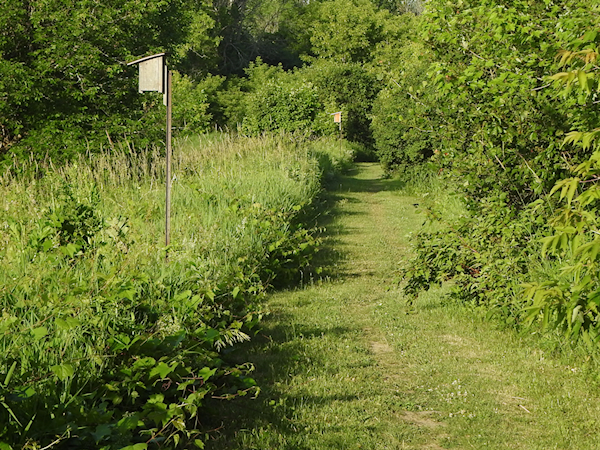
I continued on my way toward the forest at the back of the trail. I was thankful that the mowed path was wide with no Wild Parsnip hanging over the trail; the Richmond Conservation Area can be thick with this tall, phototoxic plant in July, and while I could see a few plants growing back from the edge of the path, there were few yet in bloom. Just brushing against this plant can cause skin burns and blisters upon sun exposure.
I found a couple male Northern/Sweetflag types and only managed to catch and identify one: a Northern Spreadwing whose teeth on the upper claspers were the same size, with the two teeth appearing close together.
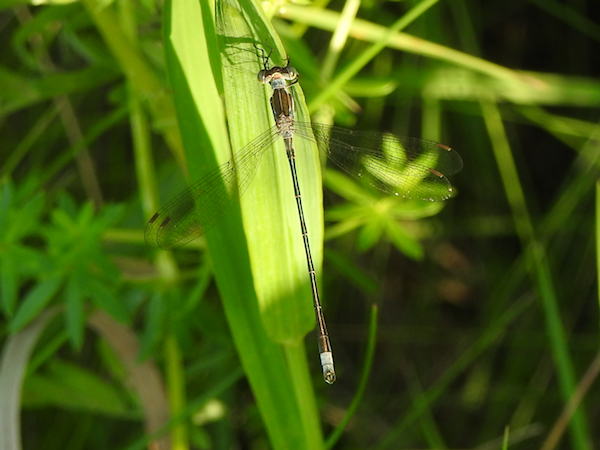
It wasn’t until I reached the back of the berm that I saw my first Lyre-tipped Spreadwing. I usually find them spread out around the first cell and along the open trail toward the forest. The males are one of the hardest to identify if you don’t get a magnified view of the claspers, and one of the easiest if you do. Each paraproct (lower clasper) is shaped like an “S,” and the two mirror each other with the tips diverging. Otherwise this species resembles the Northern and Sweetflag Spreadwings with a dark abdomen and pruinose white tip.
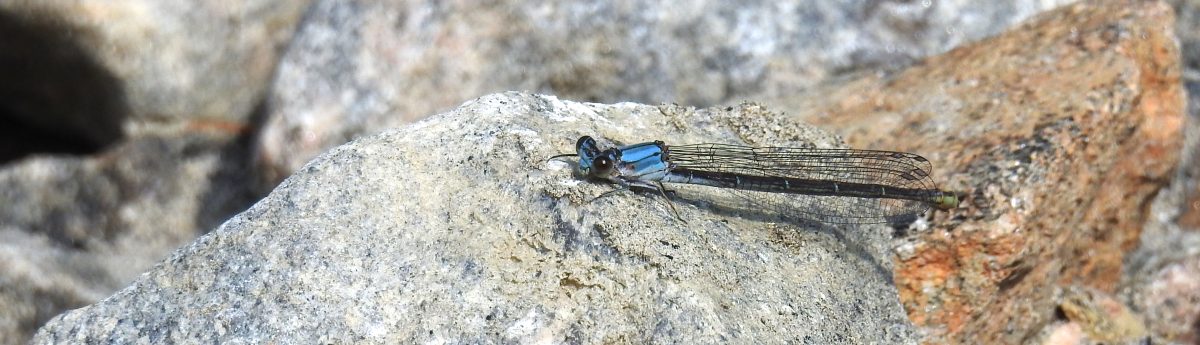
I was eager to look for Violet Dancers near the river and headed through the thick stand of pines behind the sewage lagoons to the riverside path beyond. I’ve also seen Skimming and Stream Bluets along the trail that runs next to the Jock River, but of the three species I only managed to find a small number of Stream Bluets.
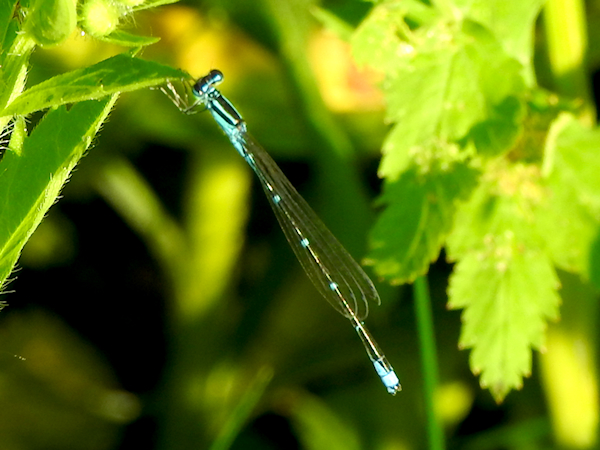
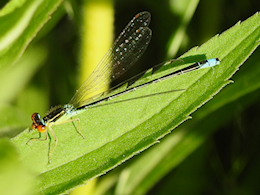
I was also curious as to whether any interesting creek dragonflies were breeding in the Jock River, which was quite rocky along this section but still had a substrate mostly made up of mud. It did not look very clean, either, so I wasn’t surprised that I didn’t find any dragonflies. The water was low, leaving a navigable bank exposed along the edge, so I made my way along the shoreline as far as I could. I didn’t see any dragonflies, nor any dancers or Skimming Bluets. When I spotted a couple of damselflies perching in the green shrubs along the shore, I didn’t expect much – the first was an Eastern Forktail, but the second was a Rainbow Bluet…I would know those dark orange eyes and yellow thorax and legs anywhere!
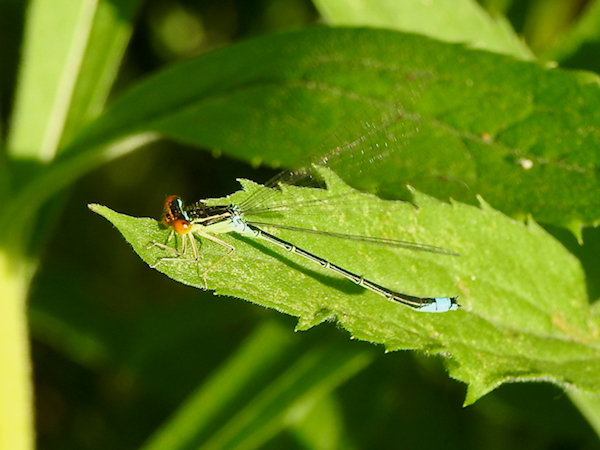
This is one of my favourite damselflies, and it’s always great to find them in a new spot. Although this section of the stream was more wooded than their typical habitat – they prefer slow streams, rivers, and ponds along river courses with an abundance of emergent vegetation in more open country – it reminded me a bit of the Jock River further northeast where I’ve found them at Terry Carisse Park, where the riparian habitat consists of a relatively thin line of tall trees growing right along the river bank. I’ll have to return later in the summer to look for the Violet Dancers and see if these guys are still around!

 OdoNotations