
If you had told me it was possible to see more than a dozen Prince Baskettails hanging from the pine trees like early Christmas ornaments, three perching Swift River Cruisers (including two in a mating wheel), a perching Springtime Darner, an ovipositing Cyrano Darner, an emerging Dragonhunter, four additional clubtail species, a dozen Brush-tipped Emeralds, about 50 Widow Skimmers, and an Arrowhead Spiketail all in a single day here in the Ottawa region, I am not sure I would believe you. That kind of day is so rare in Ottawa that I would would assume that you were engaging in a particularly fanciful daydream. However, on the Quebec side of the river many things are possible. Part of it is due to the scenic geography – the deep, rocky lakes, rushing streams, and variety of marshes, swamps and bogs carved out of the Canadian Shield provide a fantastic variety of habitats. Part of it is due to the untouched wilderness outside of the Gatineau area – there are no cottages lining the shore, no subdivisions full of manicured lawns, no pesticides and insecticides to wreak havoc on insect populations. These two factors make it an excellent place to see a variety of odes – especially along the Ottawa River, a major dragonfly habitat of its own.
It was Chris who mentioned that the snowmobile bridge near Morris Island was open, and once I saw a picture of it I was immediately intrigued. Could we really just walk across a bridge and be in Quebec? Apparently we could, so when we discussed places to go on Sunday it was the first choice for both of us.

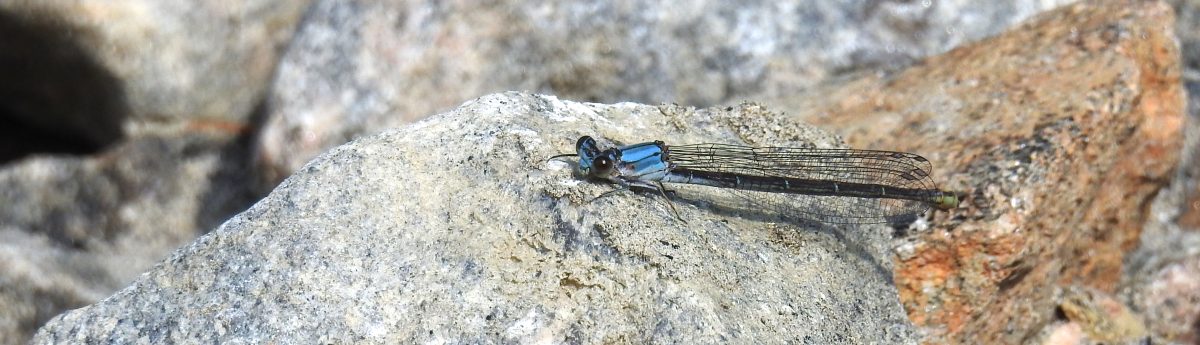
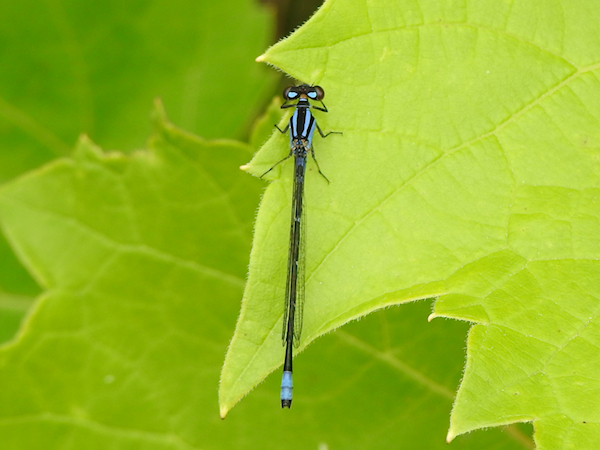
The trail starts on Morris Island Drive just outside the entrance to the conservation area. Parking consists of a wide spot on the shoulder. The day started out cloudy but we met early to a stop in at Jack Pine Trail to look for Brush-topped Emeralds and the Arrowhead Spiketails. Unfortunately it wasn’t warm enough yet for anything to be flying – the emerald corridor, as I now call it, was empty – so we continued on our way to the West Carleton Rail Trail and the longest snowmobile bridge in the world. A stop in at the Mississippi Snye was productive for Eastern Pondhawks, Prince Baskettails, a Skimming Bluet, and an unidentified spreadwing too far out in the water to catch. I was thrilled to see the Skimming Bluet perched on a leaf near the parking area; normally I see them on lily pads on the water too far out to photograph!
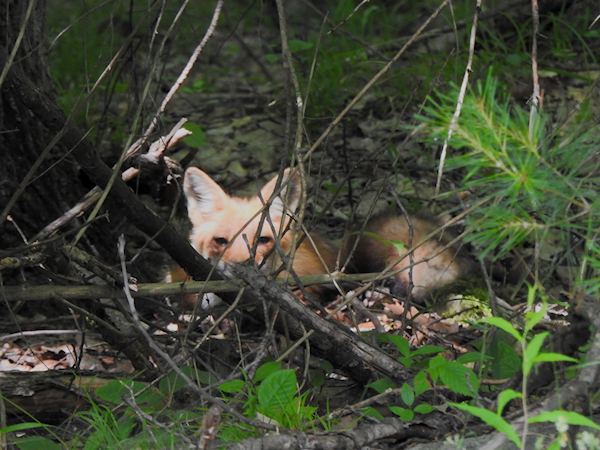
By the time we left the sun was finally breaking through the cloud, and it was finally feeling warm, though humid. A fox ran out onto the road in front of us before hunkering down in the woods, probably to escape the heat.
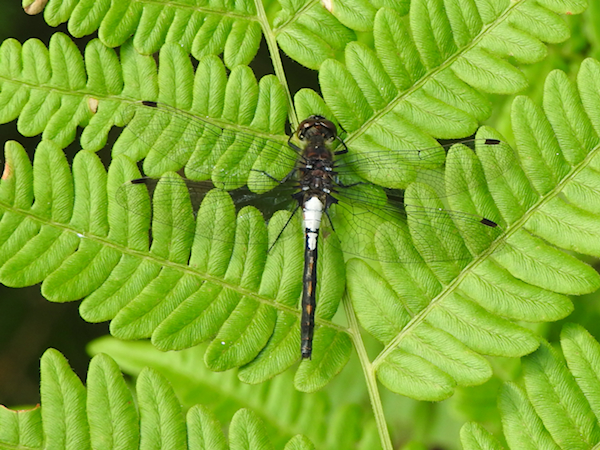
When we got out of the car the first thing I saw were several sets of black wings resting in the grass, all of which belonged to about half a dozen Widow Skimmers. As we progressed we saw several Racket-tailed Emeralds flying up and down the trail, a couple of Eastern Pondhawks on the ground, and a Frosted Whiteface on a fern looking particularly fresh.
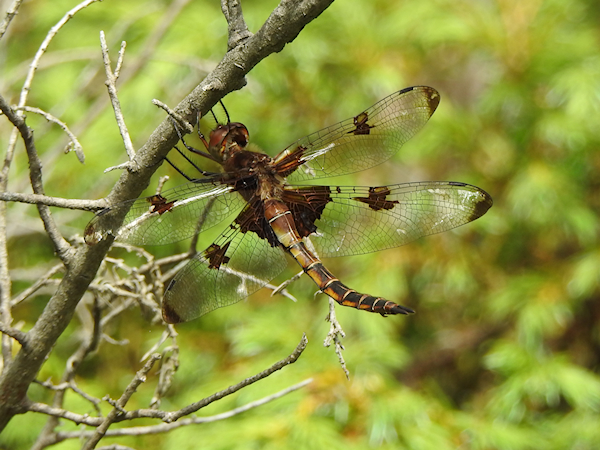
Chris also saw a couple of Dragonhunters perching in the trees. The Dragonhunters were too high up to get a decent photo, and Chris was confident that we’d get a better look at another one. Then he spotted something better perching in a shrub at about shoulder-height – a gorgeous Prince Baskettail! These dragonflies don’t usually like to land, but when they do it’s usually at the top of a tree in the shadows. This one was not only perching out in the open, it was doing so completely exposed in a leafless shrub!
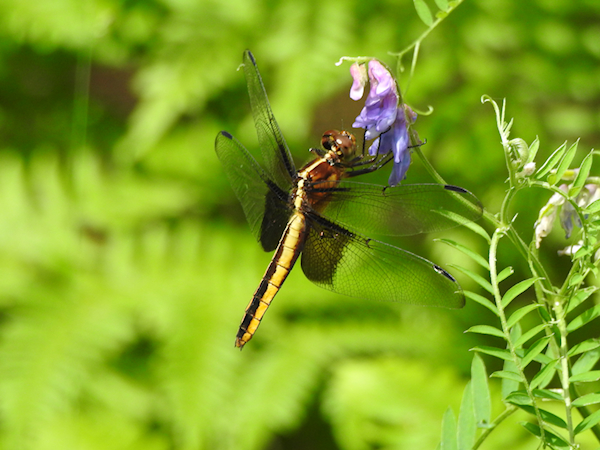
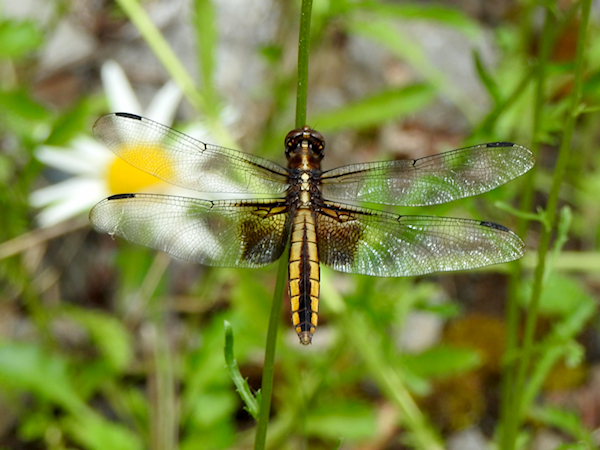
A Slaty Skimmer resting on the top of a branch caught my attention -it was yellow instead of blue, and I thought it was a Widow Skimmer until I realized it lacked the black patches at the base of its wings. The immature Widow Skimmers were numerous, and we found more than a few perching in picturesque locations, such as this immature individual dangling from a cow vetch blossom and others in an area full of daisies.
There weren’t many damselflies around, but when I started seeing Powdered Dancers resting on the gravel trail I began to suspect we were nearing the water. Sure enough we rounded a bend and the bridge came into sight – a magnificent structure of 0.5 kilometres according to the sign next to it.

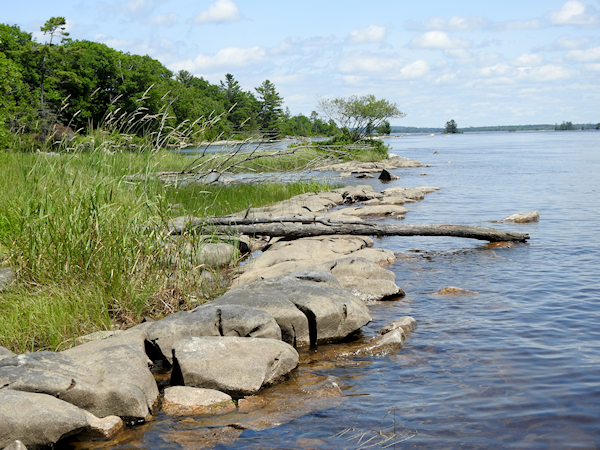
There was a huge cloud of Zebra Caddisflies swarming the air and the trees along the shore, along with a few Prince Baskettails and Racket-tailed Emeralds hunting them high above the bridge. We spent some time peering down at the rocks to look for clubtails resting along the waters edge but saw none, nor could we get close to the water due to the steep bank and the cottages located along the shore. We had seen the “no trespassing” signs all along the rail trail; while the trail was public, the surrounding land was all privately owned.
We crossed the bridge, spotting a White-tailed deer on the far bank that spooked when we got too close. There was a steep bank leading down to a little inlet on the western side of the bridge, and we scrambled down the bank to take a look. We didn’t see any clubtails, but I found a few skimmers – Widow, Four-spotted and Twelve-spotted. Apparently the Widow Skimmer was new for my Quebec list.
We headed back up to the trail, which had much more vegetation growing through the gravel than the Ontario side. At first Chris only wanted to go to the sign but when I said I had seen a stream on Google maps we decided to keep going. This was an excellent choice as soon we were seeing a perching Canada Darner and a fast-moving Swift River Cruiser zooming along the trail. I netted the darner on the tree so I could ID it.
The deer flies were terrible, and Racket-tailed Emeralds kept us company for most of the walk. Several Common Whitetails and an occasional Slaty Skimmer were perching on the ground or in the vegetation, but they were nowhere near as helpful as the emeralds.
Then Chris spotted the first Clubtail, a Cobra Clubtail resting on a leaf.
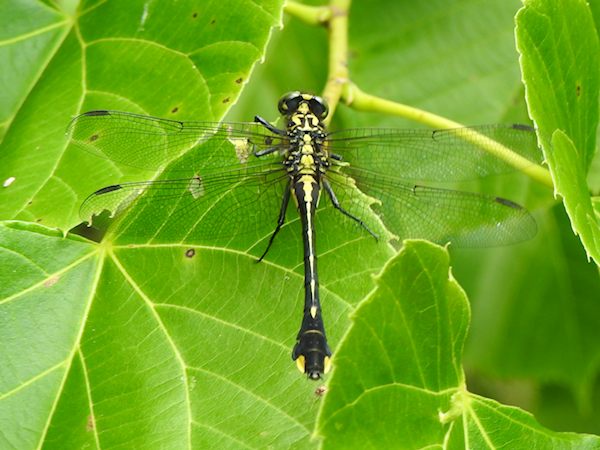
That was the first good dragonfly of our walk, and one we had hoped to find. Things got even interesting when we got to the “stream”, which turned out to be two small inlets meeting the base of the raised snowmobile trails directly opposite each other. One was surrounded by forest and full of emergent vegetation and had at least one darner patrolling the surface; the other looked like a lake in Algonquin Park with boulders descending to the water on one side and rock cliff jutting up from the other. The boulders looked like a good spot to stop and eat our lunch so we slid down what looked an otter slide and made our way to the water’s edge. Chris saw what looked like a mink but I missed it.
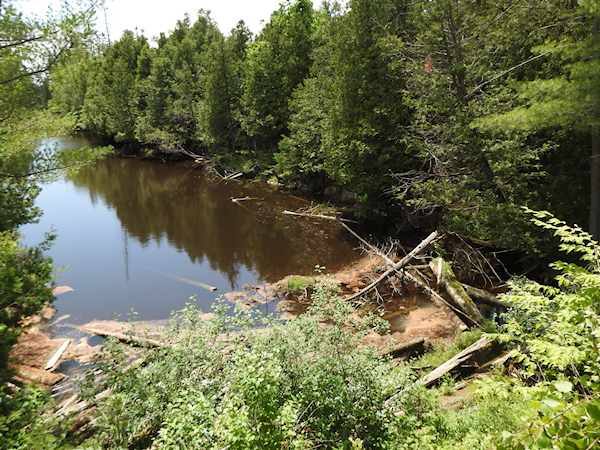
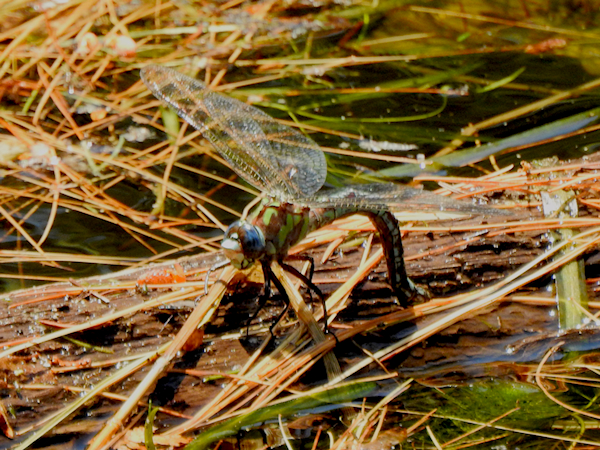
While we were eating we saw the usual Lancet Clubtails and Violet Dancers perching along the shore. A few large dragonflies were zooming over the water; they looked like baskettails to me until one landed on a floating mat of vegetation and started laying eggs on a floating tree branch! It was a darner, but too far to identify it to species with binoculars alone. Both Chris and I photographed it, and when I reviewed my photos I could clearly see the thoracic stripes. It was not one I was familiar with, so we speculated that it might be a Cyrano Darner. Sure enough, that was exactly what it was! As a result that little inlet will forever be known to me as “Cyrano Cove”.
We didn’t think it could get much better than that, but on our walk back we encountered a Black-shouldered Spinyleg on the ground.
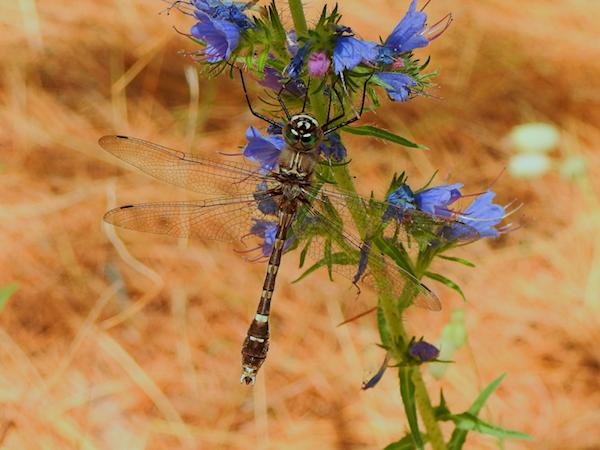
Then, once we were close to the bridge we saw a Stream Cruiser perching on the vibrant blue flowers of Viper’s Bugloss. Dragonflies perching on flowers are fairly uncommon, though skimmers are the most likely ones to do so. I’ve never seen a dragonfly on such colourful blue flowers before, nor have I ever seen a Stream Cruiser on any sort of flower before! Both Chris and I were thrilled with our photos.
Then another large dragonfly flew past us and hung up in a tree not far from the Stream Cruiser. It was a Swift River Cruiser, a species that does not like to land very often, making it a two-cruiser day! Chris got some amazing photos, but mine did not turn out so well.
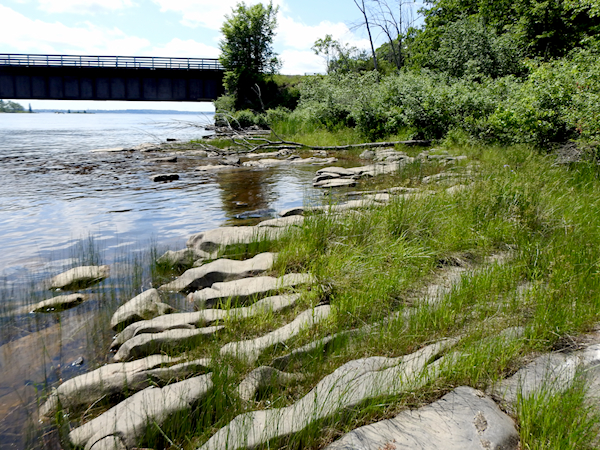
From there we returned to the bridge. Chris noticed a way down to the water on the east side, and although the path was steep we managed to clamber down the narrow, gravelly trail until we reached the river. Almost immediately he observed a bright green teneral that had just broken free of its outer shell. The large size and unique colour meant it could only be on species, a Dragonhunter!
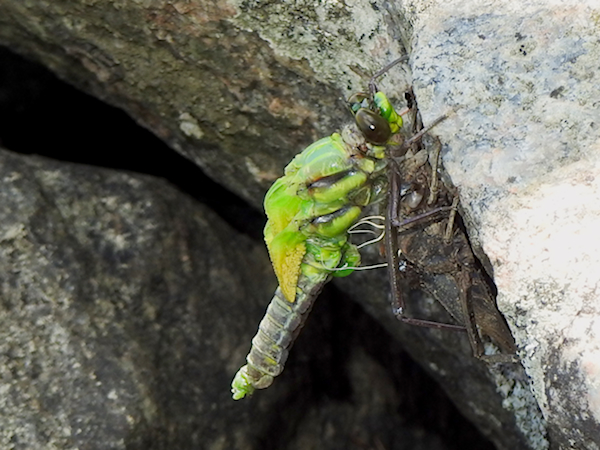
We decided to spend some time walking along the shore while we waited for the Dragonhunter to extend to its full size. We found several Powdered Dancers along the rocks at the water’s edge but not much else.
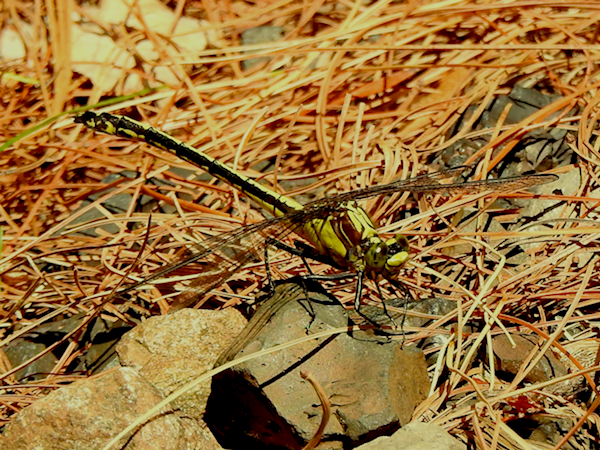
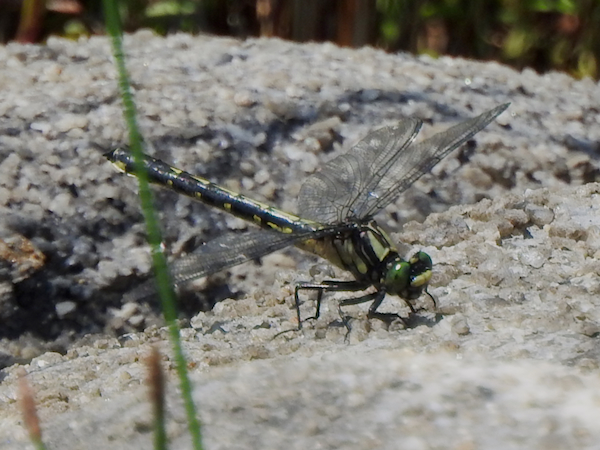
We spotted a small clubtail obelisking on a rock. I started taking pictures and attempted to get closer; there was a large area of soggy sedges between us. Chris thought it was a Phanogomphus species (i.e. Lancet or Dusky Clubtail) so I abandoned the attempt and returned to the shore. It wasn’t until I got home and reviewed my photos that I identified the clubtail as a female Mustached Clubtail! The female has larger yellow spots along the side of the abdomen than the male, and longer yellow streaks on top.
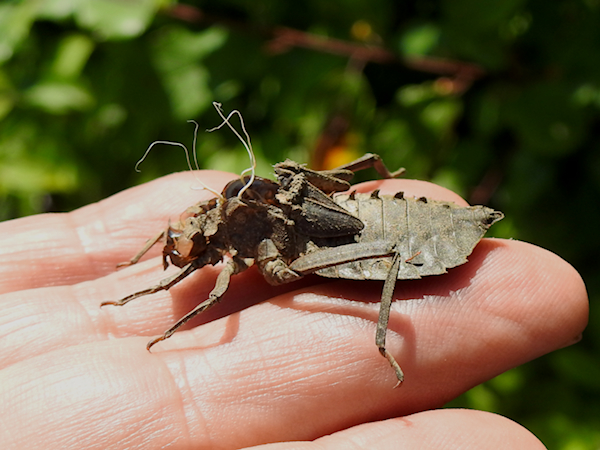
We returned to check on the Dragonhunter and found that both its abdomen and wings had almost inflated to full size. Chris picked up the exuvia so we could examine it. Note how large it is on his fingers!
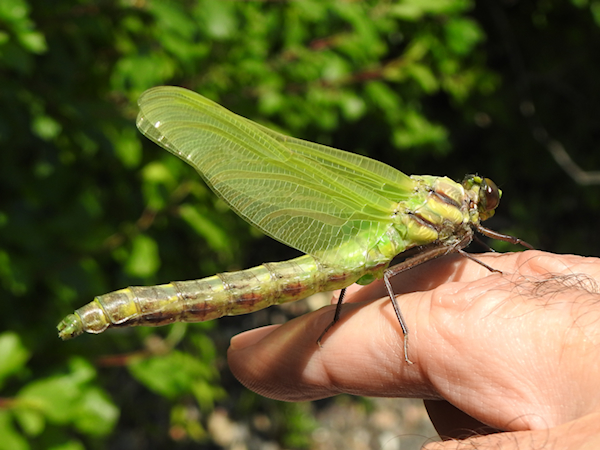
He was concerned about how much the bright, young Dragonhunter stood out against the rocks – easy pickings for a hungry predator since it would still take some more time before it could fly. He carefully got it to crawl up onto his hand and moved it to the vegetation where it would blend in with its surroundings.
Chris led the way back up to the trail where he noticed a small darner land in a shrub along the slope. It was a Springtime Darner, our third darner species of the day.
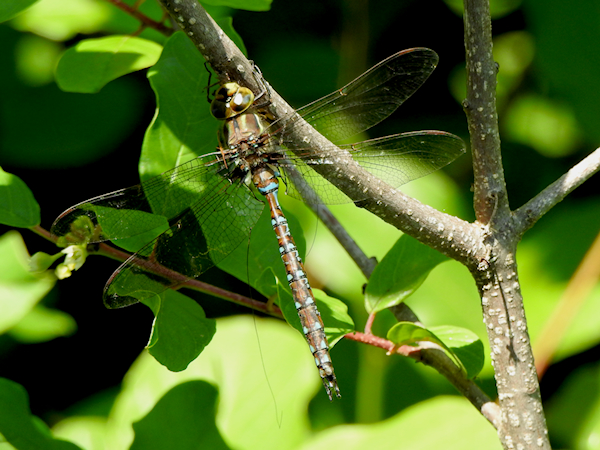
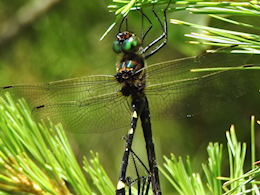
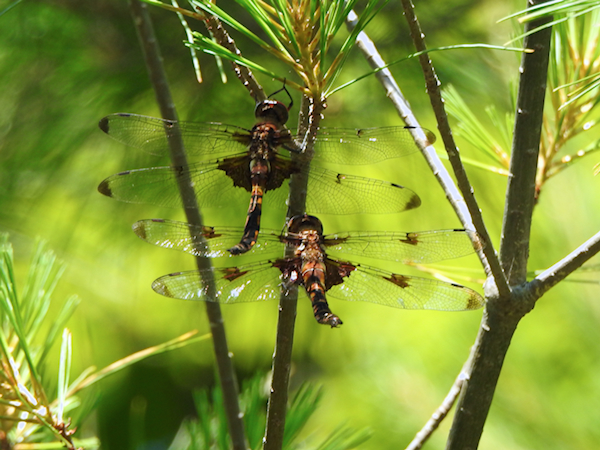
We didn’t think we’d see much on the walk back to our car, so we walked at a faster pace….we couldn’t have been more wrong. There were several Prince Baskettails flying overhead, and I’m not sure who noticed the first one land in a pine tree, but once we stopped to look at it we quickly found more in the same tree, and Chris noticed even more in the neighbouring tree! Altogether we counted at least 20 in the two trees and flying overhead! They must have emerged fairly recently given how shiny their wings were, and given that none of the ones I photographed showed the green eyes of a mature adult.
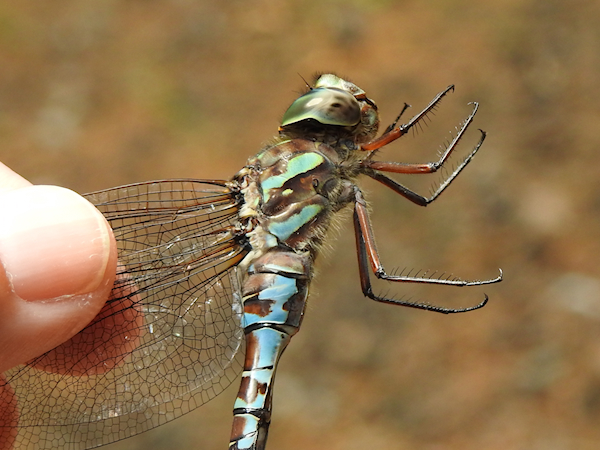
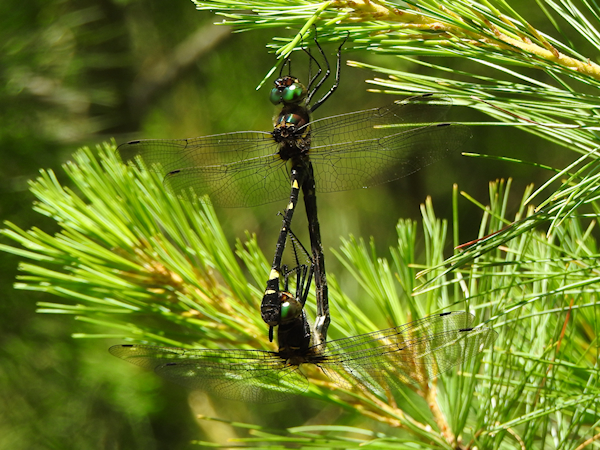
Not much further along the trail, we came across another amazing sight: a pair of Swift River Cruisers in a mating wheel! Swift River Cruisers spend much of their time on the wing and don’t seem to hang up as much as their close relatives, the Stream Cruisers. I don’t see this species as often as the Stream Cruiser to begin with, so it fantastic to find them perching right at eye-level.
Like many dragonflies, their eyes are green at maturity. Males and females are slightly different in appearance: the male has a thin black abdomen with a few yellow spots near the top and bottom and a medium-sized club at the tip; females have a thicker, unclubbed abdomen and a row of yellow spots along the top of the entire abdomen. Both sexes have a large yellow spot on segment 7 which is visible in flight.
Seeing both cruiser species perching was a highlight of the day. The only dragonfly family not seen on our outing was the spiketail family, those wooded stream-loving dragonflies who require the most specialized habitats. It was worth it to head back over to Jack Pine Trail after our outing to look for this final family, as more dragonflies were sure to be flying in the heat and I had just seen an Arrowhead Spiketail the day before.
We checked the stream crossing along the fourth loop, to no avail; however, when we returned to the main loop and spent some time at the culvert there, one flew down the stream and landed on a thin twig in front of us! Unlike the one I’d seen the day before, its abdomen was bent near the tip.
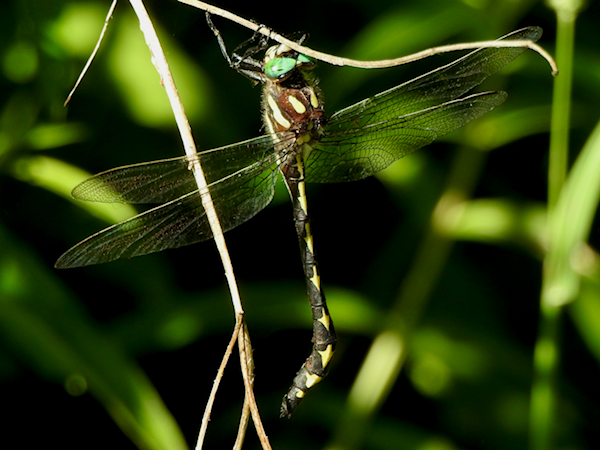
We also saw several Brush-tipped Emeralds flying up and down the trail…I caught a male and a female so Chris could examine them up close. There must have been a dozen in total along that section of the outer loop, making for another excellent emerald day at Jack Pine Trail. We were also intrigued by a large mystery emerald zooming up over the path before disappearing toward the trees. Although I tried with all my might to will it to return, it never did.
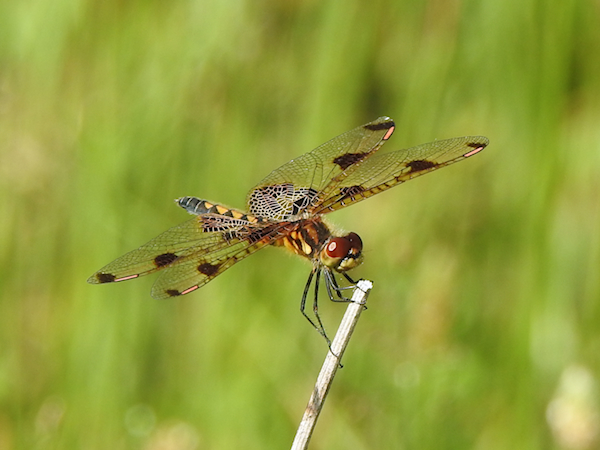
We headed to the alvar next in the hopes of seeing some more emeralds on patrol. We found a Calico Pennant instead, a species I hadn’t seen at Jack Pine Trail until this year.
The only other species I photographed there was a Canada Darner – not much else was flying.
By the time we left it was going on 4:00 and we had been out all day. I ended up photographing 28 species, with one mystery emerald and one mystery spreadwing neither photographed nor identified. It was an absolutely amazing day – we both enjoyed exploring a new place, seeing some uncommon species, and finding representatives of all six local dragonfly families in one day!

 OdoNotations