
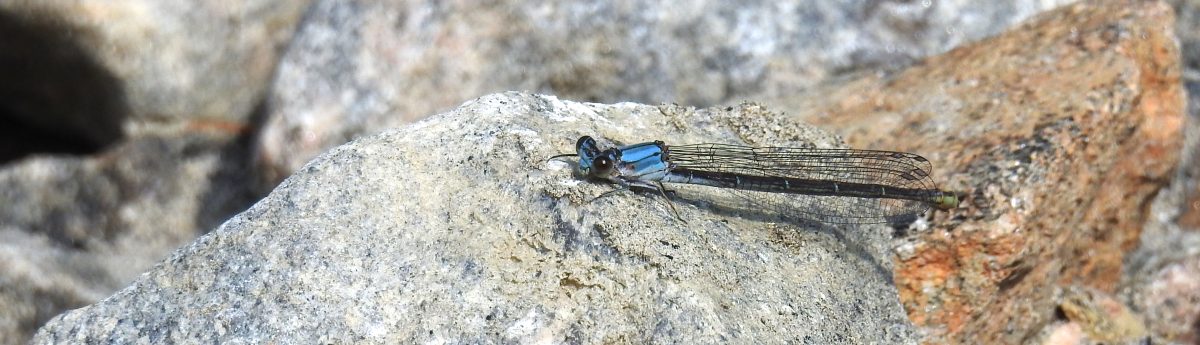
I haven’t spent much time at Terry Carisse Park this year, as I’ve had other projects and priorities demanding my attention and limited ode-hunting time. However, in May I received an email from a blog reader in Montreal named Pierre who was interested in trying to find a particular damselfly species – the Rainbow Bluet – which he and his wife had tried to find last year, without any luck, in known areas of Ottawa. He was interested in visiting Terry Carisse Park after reading my blog posts and messaged me in late May for the details, hoping these small, colourful damselflies would be easier to find this time around. I told him the best places to find them in the park (at the canoe/boat launch at the north end of the park and in the sunny vegetation at the top of the river bank along the south end) and told him to let me know how it went. I didn’t expect to hear from him until after his visit, but received another message on June 12th asking if I had been there recently. I hadn’t – I’d spent the previous two weekends in Nova Scotia, and the weather on my remote-work days has been too lousy to go look for odes. But when I saw the forecast for the following day – sunny and warm – I decided to head on over to see if I could do some pre-scouting for him ahead of his weekend trip.
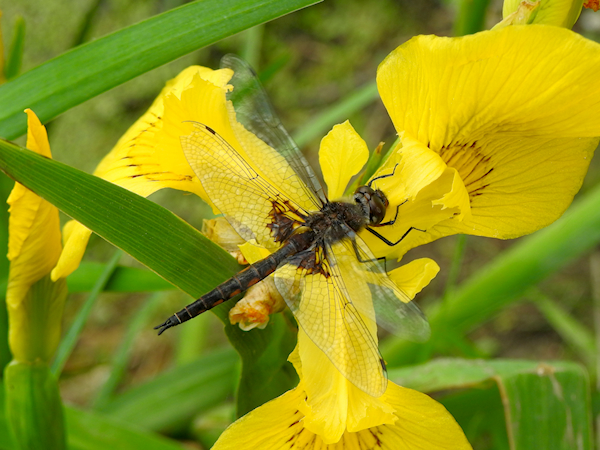
I drove over after I finished work, starting my reconnaissance with a walk down to the water at the northern end of the park. I looked for the Elegant Spreadwings but found none; the vegetation they like to perch on is very sparse this year. However, I found two Common Baskettails patrolling the area, easily identifiable by the large brown patch at the base of their hindwings. I caught one of them so I could enter the observation into iNaturalist; it was a male.
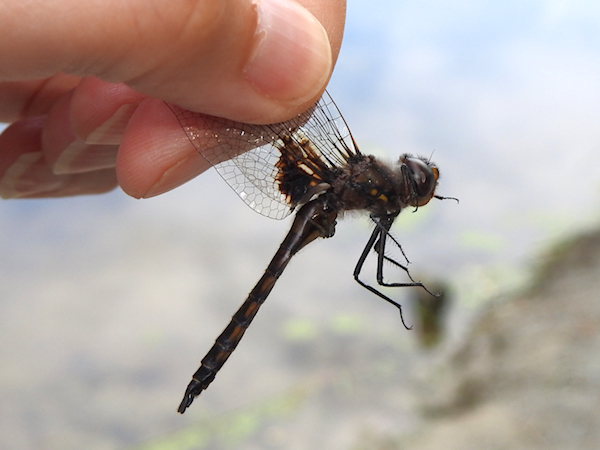
There were some lovely – but invasive – Yellow Irises growing nearby, and I placed the baskettail on the flower when I was done. Native to Eurasia and northern Africa, the Yellow Iris is a perennial aquatic plant that was brought to North America to decorate ponds and water gardens in the 1800s. The plant easily reproduces via seeds and underground rhizomes, and has since spread to many wetlands in southern Ontario, including in treed and open wetlands, along the shores of lakes and rivers, and in flood plains. The rhizomes form very thick mats which make it difficult for native plants to grow, often changing wetlands to drier habitats which affect the native wildlife. It should be removed where found, though care must be taken when handling the plant as all parts of it can cause skin irritation.
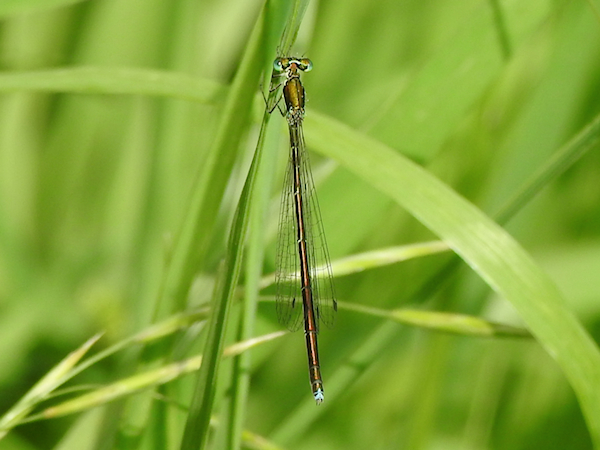
From there I checked the shore by the dock; however, there was nothing flying there so I continued my way along the edge of the park. I had better luck searching the vegetation growing along the edge of the lawn, finding the usual Fragile and several Eastern Forktails, including this mature female.
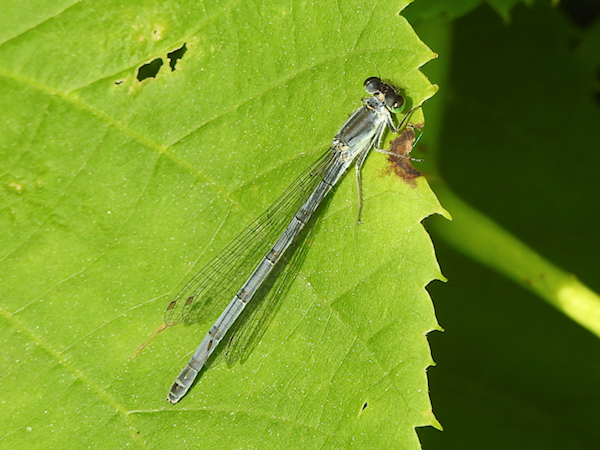
Sedge Sprites and Stream Bluets were also present. This is a female Stream Bluet, which can be more difficult to identify than the males; note the two black triangles on top of segment 9 followed by an entirely blue 10th segment. The black abdomen marked by thin blue rings and the narrow blue occipital bar connecting the eyes are found in both sexes and distinguish them from other bluet species.
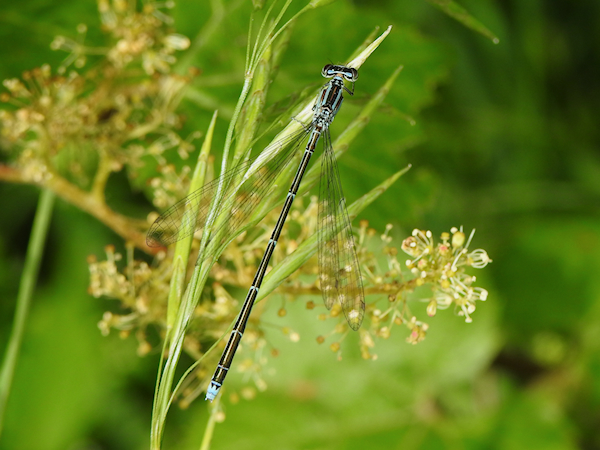
The Sedge Sprite is much smaller and metallic green in colour. Unlike the bluets, it has no shoulder stripes or spots on top of the eyes.
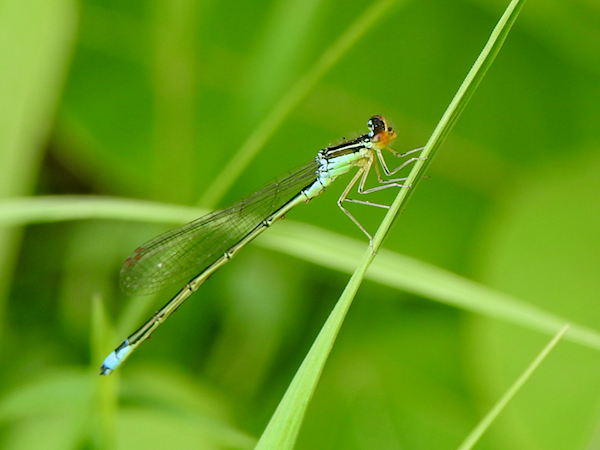
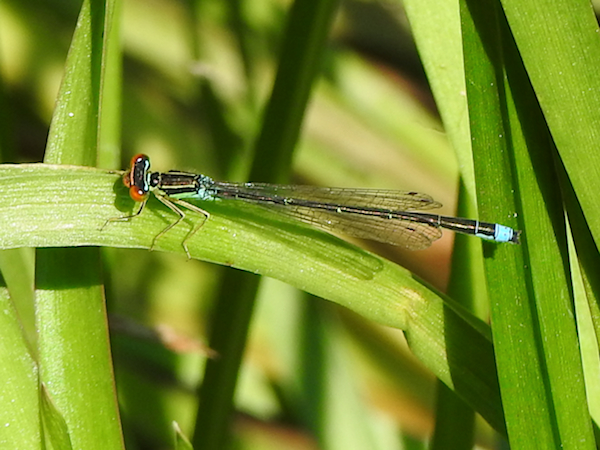
When I got to the opening onto the river about two-thirds of the way down the park I finally found two Rainbow Bluets, a male and a female. It made me happy to be able to confirm they were still present to my Montreal correspondent; I watched them for a bit trying to get some decent photos. Only the male cooperated. When I wrote to Pierre later that night, he was glad to hear the news and told me he would be visiting this weekend to look for them.
I heard from Pierre again on Monday. He did indeed visit Terry Carisse Park on the weekend where he and his wife had multiple views of the Rainbow Bluet (mostly males) as well as both Fragile and Eastern Forktails…however, he did not see very many blue bluets.
Despite their early arrival, they didn’t see any Rainbow Bluet until 11:00am, once the day warmed up. Then they found some in the two openings I directed him to, as well as in the grass at the south end of the park. He was happy he didn’t have to descend the slope to the water level because he found it awkward to stand there in the mud at an angle. He said his views of this beautiful, unmistakable bluet from the top of the bank were perfect, and that they were thrilled to see it! He ended his note by saying that the trip to see that beautiful species was really worth it (despite the numerous mosquitoes… finding those is never a problem!). It is always nice to hear from my readers, but even nicer when they successfully find a tiny bug I’d written about! It is often difficult to relocate a rare bird let alone a damselfly the size of a toothpick, but at least the Rainbow Bluets at Terry Carisse breed there and emerge in good numbers, making this spot quite reliable for other Rainbow Bluet hunters!
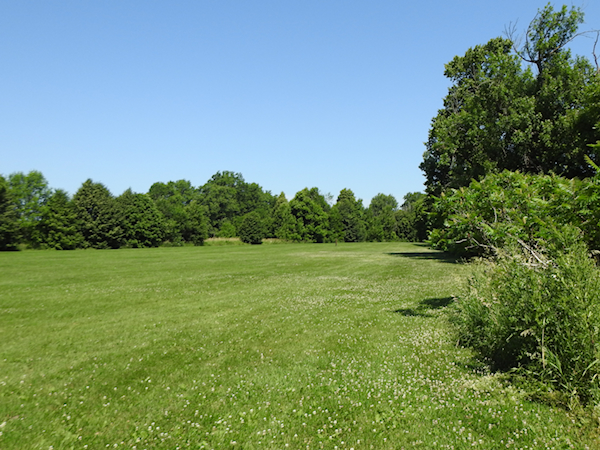
vegetation along the right
I made one additional visit to Terry Carisse Park on the last day of June. On this visit the Stream Bluets outnumbered the Eastern Forktails (15 compared to 5) while no Fragile Forktails or Skimming Bluets were seen. I checked the vegetation along the edge of the lawn and again only found two Rainbow Bluets. It made me glad that Pierre had been to see a lot more than I did on either one of my visits.
Only after I finished checking the vegetation did I head to the lookout at the north end of the park. Along the way I saw a Prince Baskettail flying too high above the lawn to catch. When I reached the water I found a Common Whitetail and Twelve-spotted Skimmer in the reeds across the bay; the whitetail eventually flew out over the water and landed on a leaf close to where I was standing. I scanned the stems of the aquatic vegetation for the Elegant Spreadwings but again found none; what little vegetation there was still sparse and the stems barely reached above the water on most of the plants.
However, I was startled to see a Common Green Darner hanging from the leaf of one of the plants, both sets of wings curling as a result of a difficult emergence. The exuvia was hanging from the same leaf, indicating that the darner had been there for some time.
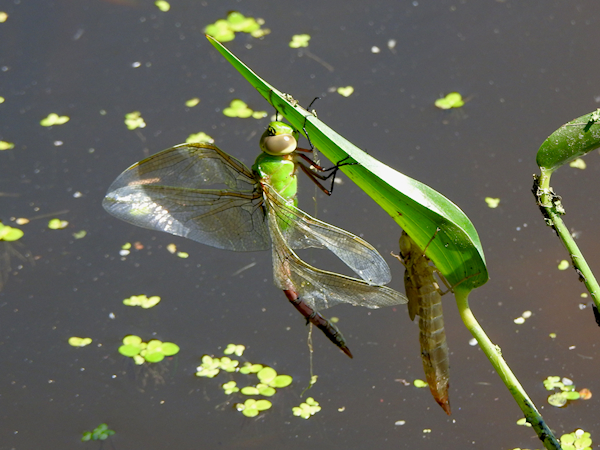
It appeared to be unable to fly, and I didn’t like the thought of leaving it there to fall into the water. If it couldn’t fly it was doomed in any event, but I used my net to scoop it up so I could examine it. That was when I saw the extent of the damage. It should of been king of the skies, but the wings could not be straightened, nor could it move them.
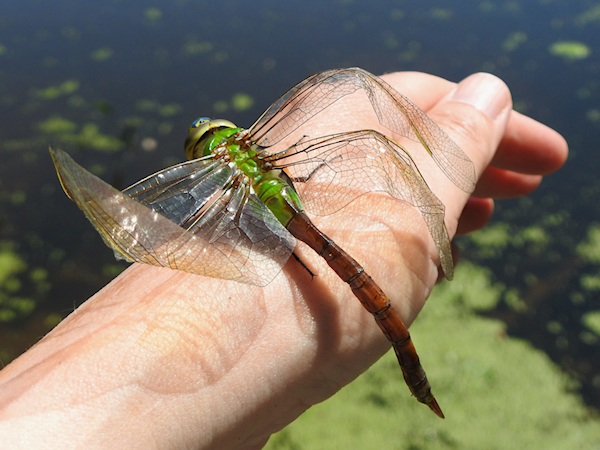
I placed the damaged insect on a leaf to await its fate. Interestingly, this the second Common Green Darner I’ve seen in recent years that had emerged with damaged wings. I’ve never seen any other darner species with this issue.
I was glad to get back to Terry Carisse Park again this year and help Pierre find the Rainbow Bluets; however, it was disappointing not to find any Elegant Spreadwings or even any Skimming Bluets or Orange Bluets, two other species that make this spot worth a quick visit. I should go back and make one more effort to find them before it gets too late in the season, but the season is moving along fairly quickly (how is June over already?!) and there are still so many places I would like to check while ode season is at its peak!

 OdoNotations