
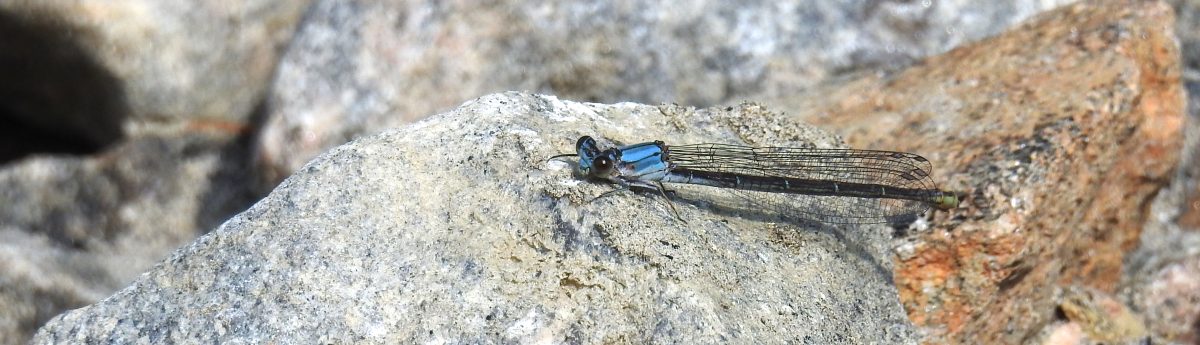
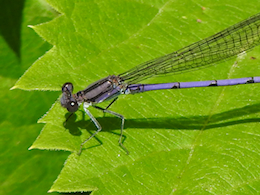
On July 5, 2026, I visited Bruce Pit briefly hoping to find some spreadwings, amberwings, and pennants along the northeastern corner of the pond. The water of the pond was finally low enough to have a shoreline again; however, I didn’t spy any perching pennants or Azure Bluets, as there were no stalks of vegetation emerging from the water for them to perch on. Disappointed to find little of interest at the pond, I decided not to head to the bridge or the meadow at the back and drove over to the Richmond Conservation Area instead – I’d had a fabulous time on my previous outing there, and was certain to see more there than at Bruce Pit!
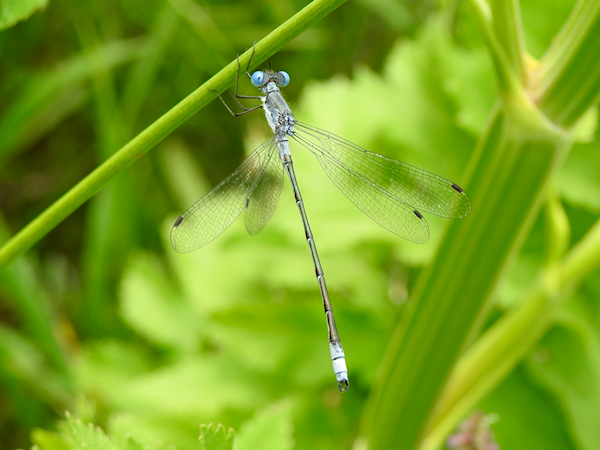
I didn’t spend much time looking at damselflies in the thick vegetation along the berm; however, I did see three Slender Spreadwings, one Lyre-tipped Spreadwing, and one Sweetflag Spreadwing which I photographed in the vegetation, then caught and identified in the hand.
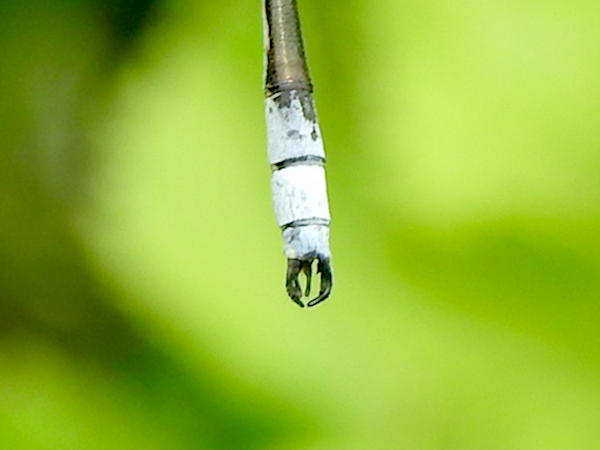
A close-up of the appendages shows the teeth of the cerci. The distance between the basal tooth (the one closest to the body) and the distal tooth (the one furthest from the body) is quite long, and the distal tooth is much smaller and blunter than that of the Northern Spreadwing. It is so small it is not even visible here due to the angle, but the sharper, larger tooth of the Northern Spreadwing would be visible.
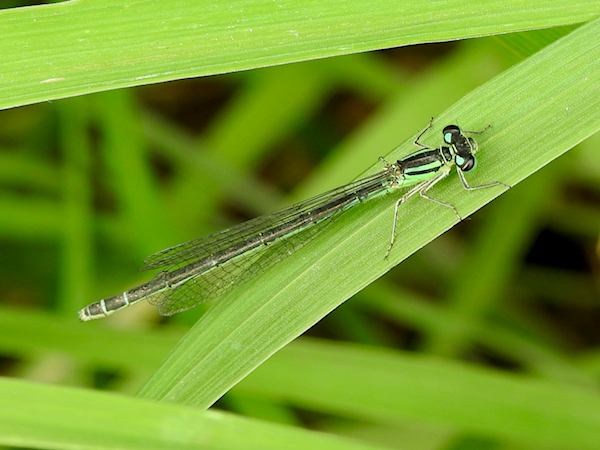
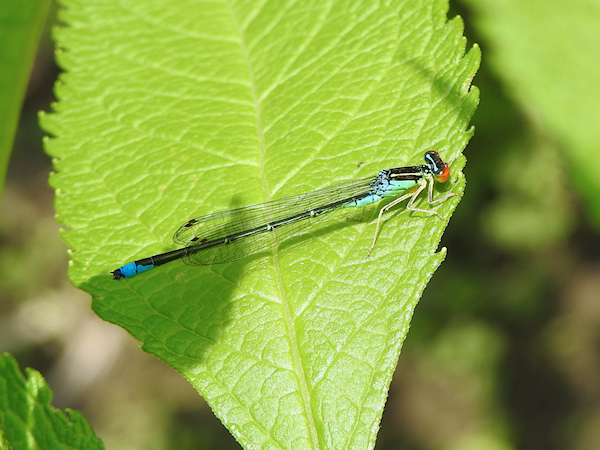
A particularly dark damselfly caught my attention, and at first I wasn’t sure what it was…it looked like either a Fragile Forktail with solid shoulder stripes or an Eastern Forktail missing the blue tip at the abdomen. When I noticed the large blue eyespots I realized it wasn’t a forktail at all, but a bluet…a female one. There is only one species I’m aware of that had such a green thorax, and I identified it as a female Taiga Bluet. This is normally a spring species that I don’t see often past the end of June, but it’s not my latest date…my personal record is July 13th at the South March Highlands back in 2019.
I noticed two Twelve-spotted Skimmers and a Common Green Darner flying over the lagoons. There weren’t many other odes around, except for a few teneral meadowhawks, a single Sedge Sprite, a single Fragile Forktail, and a single Eastern Forktail. I followed the trail behind the lagoons, making my way through the woods toward the river. I took the left-hand trail though the pine forest and followed it to the small, sunny lawn next to the houses that back onto the river, and there I noticed a few damselflies perching on the broad leaves of the plants growing at the base of the pine trees. The more I looked, the more I found – there were several Stream Bluets and Powdered Dancers all enjoying the sunshine.
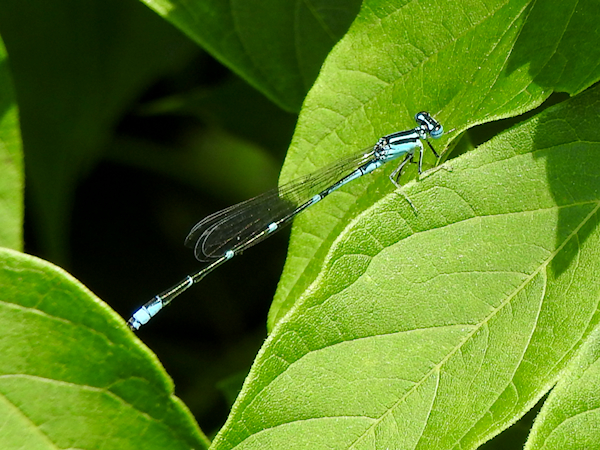
Like Eastern Forktails, Powdered Dancers come in three colour forms. Immature male Powdered Dancers are brown with black stripes on the thorax and a black abdomen tipped in brown; the brown areas turn white with pruinosity as they age, with the dark thoracic stripes showing through the white, waxy substance, making them the only black and white damselfly in our region.
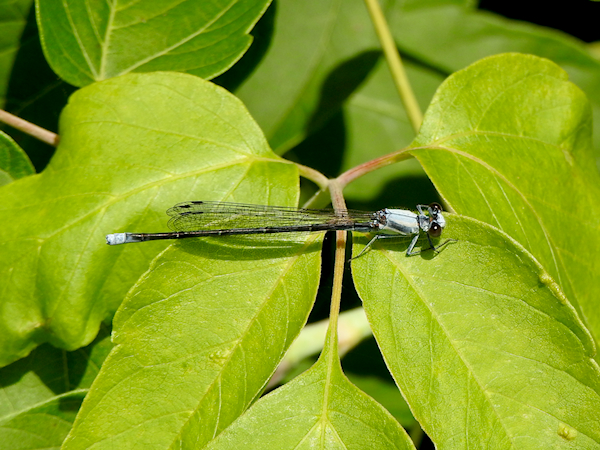
Females come in two colour forms, one with a blue head and thorax, and one with a brown head and thorax. The tip of the abdomen is brown in both cases; the blue form female has a dark abdomen, while the brown form female has an abdomen which is dark along the sides and light brown on top.
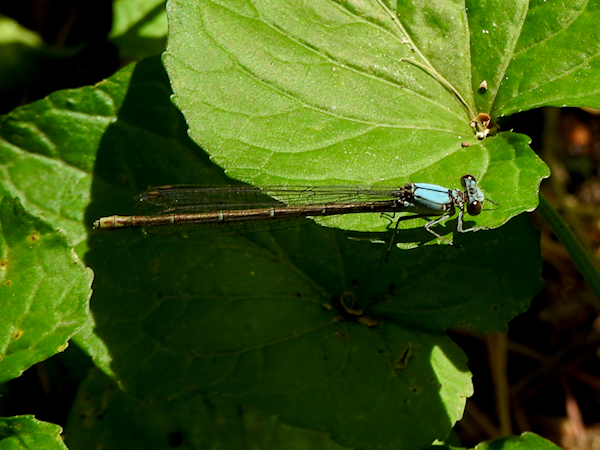
To my surprise there was another type of dancer in the same area – a pair of Violet Dancers in tandem! This is my favourite damselfly as it is the only purple one in our area…there are other purple damselflies in North America, notably the Kiowa Dancer (Argia immunda) and Lavender Dancer (Argia hinei) in the southwestern United States. I was especially delighted to see the female, as I have never knowingly seen one before – they are brown, quite similar to the female Powdered Dancer.
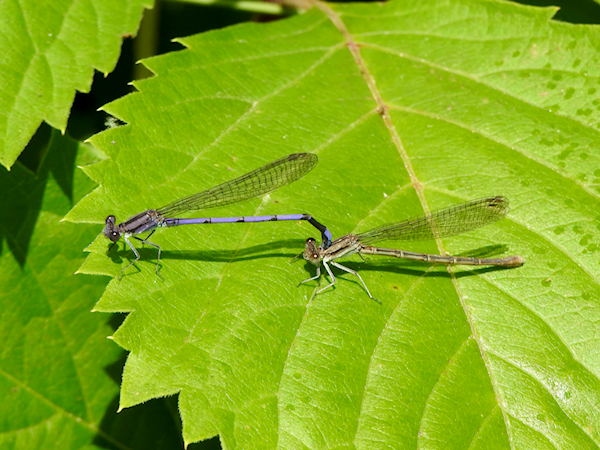
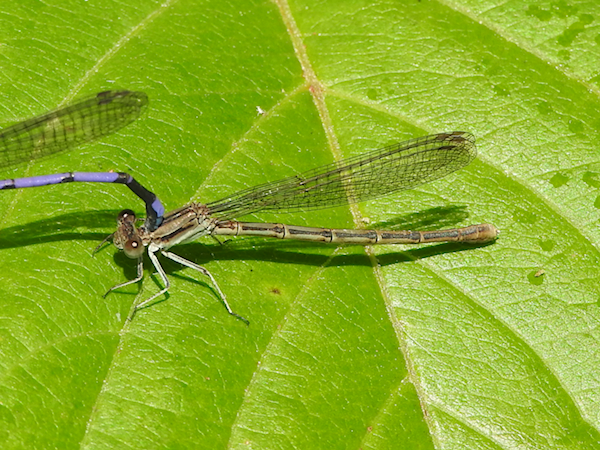
However, a close look at the female Violet Dancer yields two interesting field marks that do not appear on the female Powdered Dancer. First, the black shoulder stripes on the thorax are forked. This is a field mark I’d read about, but never really understood as the “fork” is not obvious. Upon close examination of this female, it appears that the bottom of the black fork is quite thick, while the top of the fork is very thin, hardly visible at all. I find it more apparent in looking at the brown area surrounding the fork; it has a hooked appearance, like an upside-down “J”.
The second distinguishing mark which I did not know before is that the sides of the brown abdomen have long black dashes that end in a bulbous shape. In comparison, the sides of the female brown form Powdered Dancer are black, with a dark brown streak running down the top of the abdomen. This made me wish I had gotten a photo of the female brown form Powdered Dancer for comparison – another time!
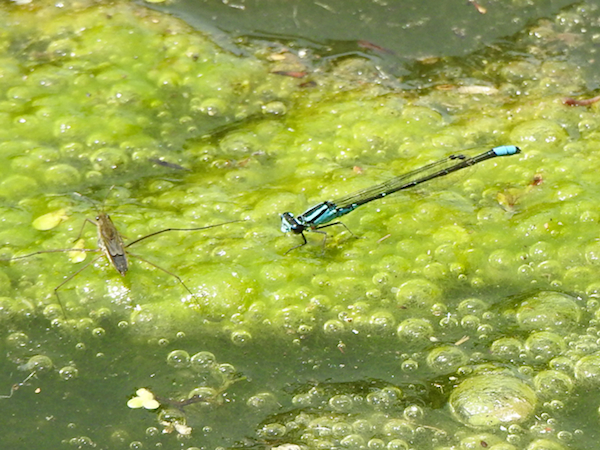
After photographing the dancers I headed to the river and made my way to the area where I had seen the Rainbow Bluets on my last visit. There was more floating vegetation in the water this visit, and I found some damselflies perching on it! The first was a Skimming Bluet, a species I had not been able to find on my last visit.
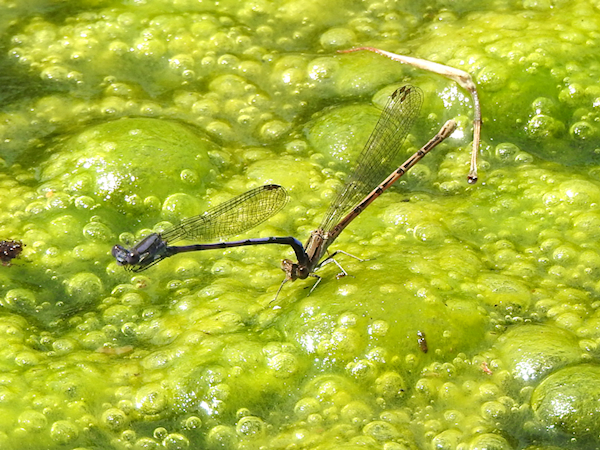
The second was another pair of Violet Dancers in tandem. Presumably the female was just about to lay eggs (or perhaps had just finished); eggs are deposited into emergent stems or floating vegetation while the female’s abdomen is curved downward to make contact with same. Males contact-guard the female, remaining in tandem with her to prevent other males from mating with the female. I had never seen males of this species interacting with females before, so it was a thrill to watch them!
There were more Powdered Dancers along the river, and I found two male Rainbow Bluets in the shrubs on the bank. I was happy to see that they were still here.
Once again the former sewage lagoons proved a great place to find a variety of spreadwings and pond damselflies. It’s the closest place to me where I can reliably find Violet Dancers, and having another spot for Rainbow, Skimming, and Stream Bluets is nice, too. It makes me wonder if there are other species here that I haven’t found yet – such as the Elegant Spreadwings further along the river at Terry Carisse Park. I’ll have to keep an eye out for that species in the future!

 OdoNotations