
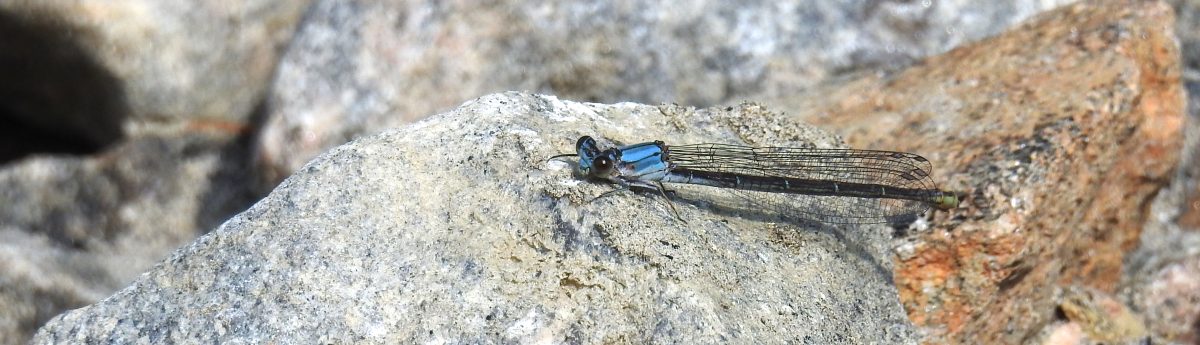
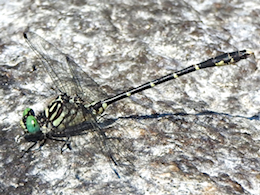
Last winter while looking up various clubtail sightings on iNaturalist I was surprised to find a couple of rocky creek-loving species at Blakeney Rapids just outside of Ottawa County: Mustached Clubtail, Eastern Least Clubtail, and Rusty Snaketail. These are all species I associate with the small, rocky streams of Quebec, and I was startled to see that they could be found on this side of the Ottawa River. Both the Rusty Snaketail and Eastern Least Clubtail, the two species I most wanted to see, had been observed on July 4, 2023, so I made it a point to visit the first weekend of July in 2025.
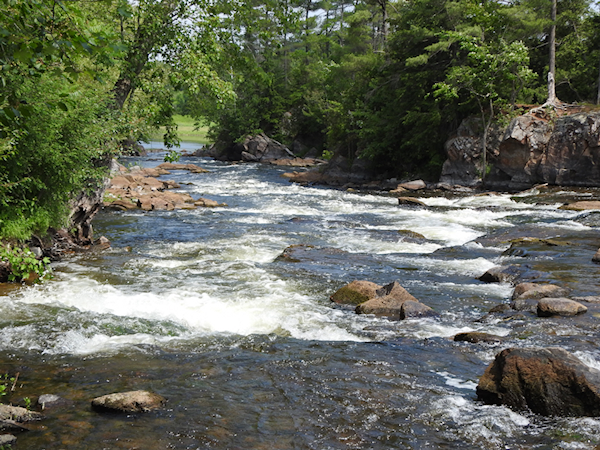
Blakeney Rapids is a small, beautiful park on the Mississippi River in Lanark County, and I have been there a few times in the past: first with Bob Bracken, Chris Lewis and Mike Tate in 2012 and 2013, once with Chris and Mike in 2015 and finally with Chris on June 25, 2016 in our “Wild Ode West” adventure. The target of those early trips was the Rapids Clubtail, an endangered species in Canada which had been found in a few different places along the Canadian Mississippi River including Pakenham and Almonte. The river was high on our first two visits, with only a few rocks providing perching habitat in the middle of the rushing river, so we weren’t able to venture out and find any of the unique clubtails we were hoping to find. It was much lower on my visit in 2016, however, we had no luck finding any clubtails then. When I made plans to visit this year, I was advised to check with Ken Allison, a fellow naturalist in the Almonte area to see what the water level was like before making the drive, and to my delight he told me that there were plenty of emergent rocks in river with a few hosting distant clubtails. As it was supposed to be another sweltering day, I headed out early to try to beat the heat and humidity.
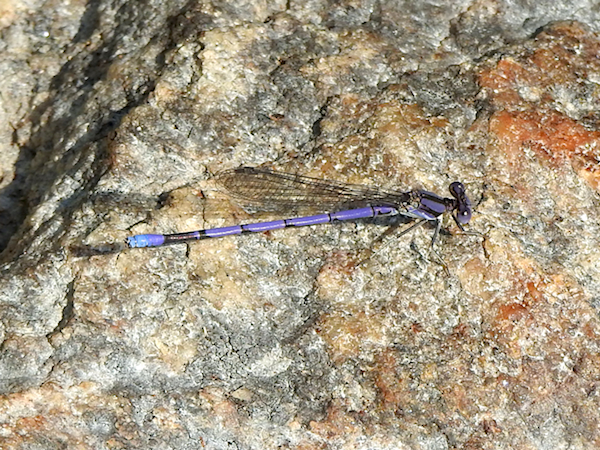
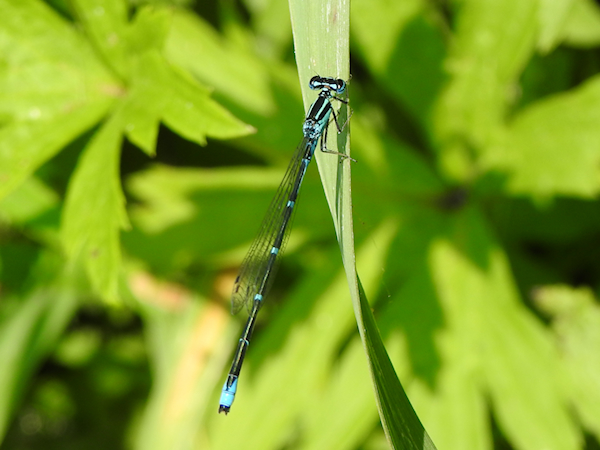
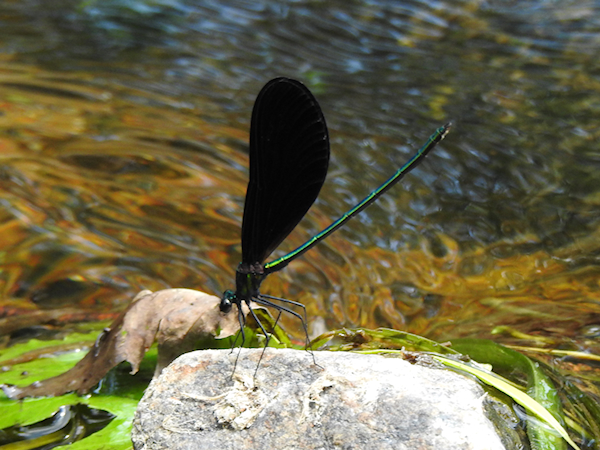
It was bittersweet returning alone. I proceeded directly to the water’s edge just beyond the parking lot to scan the rocks. As Ken had mentioned, water levels were low enough that I could see the faces of several emergent rocks that might entice a dragonfly looking for a scenic spot to bask in the sun. As I checked the river I found the usual damselflies on the rocks and in the vegetation along the shore: Stream Bluets, Powdered Dancers, Ebony Jewelwings and this lovely Violet Dancer beside the water.
I scanned the river with my binoculars but didn’t see any large clubtails resting on the rocks. The water looked so cool and refreshing, and after watching the currents closely and checking the depth I decided to take my socks off and go wading in with my hiking shoes. It would mean wearing wet shoes for the rest of the outing, but that thought didn’t deter me. I jammed my socks in my pockets, rolled up my pants, then carefully entered the river, using the handle of my net to help my balance as I walked toward the mouth of one of the small channels that runs through the woods.
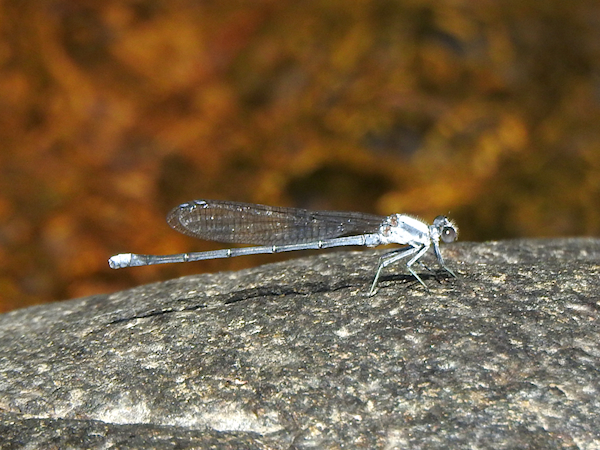
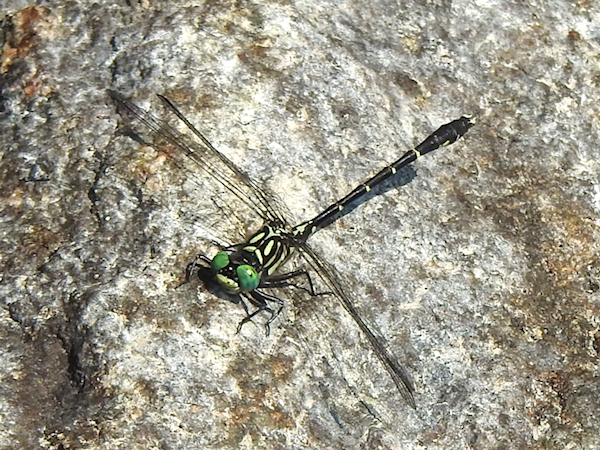
The water was heavenly. I photographed a few Ebony Jewelwings and Powdered Dancers, then waded deeper into the water. When I reached the mouth of the first side channel side channel I saw two small odes perching on adjacent rocks, each with a striped appearance! A quick check with the binoculars confirmed my suspicion: they were both Eastern Least Clubtails, the smallest clubtail in our region! I’ve seen this species in Quebec and Nova Scotia, and now Ontario was the third province where I’ve seen it. I slowly moved closer to the rocks and took some photos.
This one is obelisking to try to reduce the sunlight and therefore the heat reaching its body. Some dragonflies, particularly skimmers and clubtails, adopt this posture to stay cool when temperatures soar. The small size of this dragonfly combined with the white claspers are diagnostic, making identification easy.
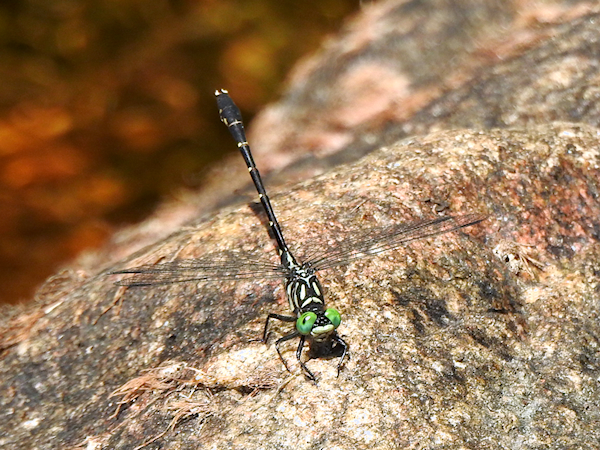
I watched them for a while as they chased the damselflies that landed on the same rock away, then noticed a third Eastern Least Clubtail on a rock further down the channel. I noticed a fourth when I waded to another channel behind the first one; this made at least four males on territory, waiting for females to fly by.
I didn’t see any large dragonflies perching on any of the rocks so I returned to the shore to assess my next move. I recalled being able to look over the water at the top of the rapids from the other side of the bridge and crossed the road in water-logged shoes to get there. There was a parking area there and a wide space along the shore where I could view the flat, calm water before it descended over the rapids. I saw quite a few large dragonflies zipping by and was delighted.
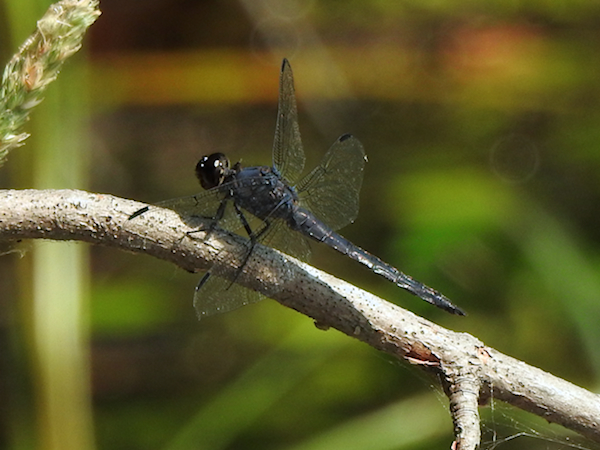
To my right was a small, shady, marshy bay with some emergent vegetation. Beyond that was another slab of rock that protruded further out into the water, and beyond that a mass of sedges where even more dragonflies were flying and perching. After failing to identify anything other than a Common Green Darner flying over the water I made my way to the slab of rock, carefully following a small, worn footpath edged in poison ivy. I paused to watch the damselflies fluttering over the shady bay, observing Fragile Forktails, Eastern Forktails and more Stream bluets; then a large dragonfly flew in and landed on top of a stick! It was a lovely dark Slaty Skimmer, a species I didn’t recall seeing here before.
When I reached the slab I noticed a couple of rocks near the middle of the river with odonates perching on them. One was a male River Jewelwing softly fanning his wings: the other was a Dragonhunter! He kept flying out after various dragonflies that passed overhead, though these chases looked more like territorial disputes than a serious attempt to catch anything.
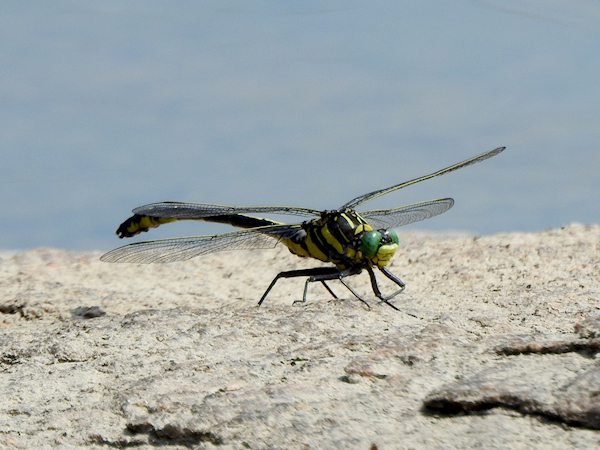
I saw Widow Skimmers and Twelve-spotted Skimmer passing by, as well as more Common Green Darners. In the reeds I saw a few more Slaty Skimmers and a male Eastern Pondhawk, and one large, distant dragonfly on a rock might have been a Black-shouldered Spinyleg. I found it interesting that the habitat here was so different from the rapids below the bridge, with a few different species preferring the still water and emergent vegetation to the water churning over the rocks.
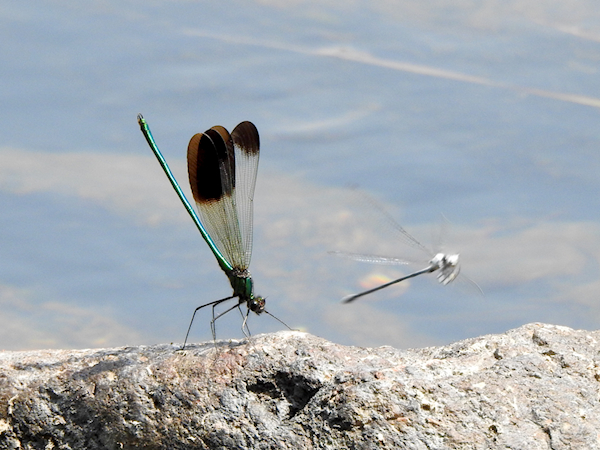
Once I’d had my fill of watching the odes on the calm side of the bridge I returned to the park. This time I followed the trail through the woods, stopping to search for odes at every lookout and finding no more clubtails. I crossed a couple of quaint wooden bridges as I made my way to the water below the rapids, hoping to find the spot where Chris and I had rested on our 2016 visit. It didn’t take long to get there, and when I found a suitable rock I sat and ate my lunch under the hot summer sun. A River Jewelwing sat on a rock close by, and I spent some time watching him and a Powdered Dancer that landed on the same rock.
A a few Common Green Darners and a single Swift River Cruiser flew over the calm water below the rapids. When I was done eating I returned back to the area near the parking lot to check for perching clubtails one last time. I saw two Eastern Least Clubtails on the rocks, both of which flew off when I approached them for a few more photos. I got some better photos of the Ebony Jewelwings and Eastern Forktails then headed back to land to drain the water from my shoes before proceeding to the next spot on my list, the Mill of Kintail.
I happened to look up at the sky then and saw some huge black clouds darkening the sky to the west. Rain looked imminent, so instead of travelling on I returned home, getting caught in a downpour but pleased with my solo visit nonetheless. This was the most species I had ever seen there, with most odonate families represented. I knew Chris would have loved it too and felt her loss keenly every step of the way. Some places just aren’t the same without her.

 OdoNotations