
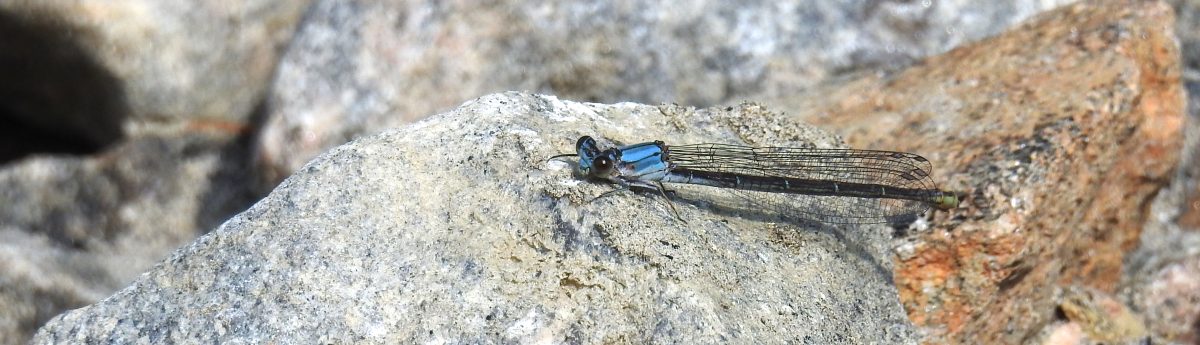
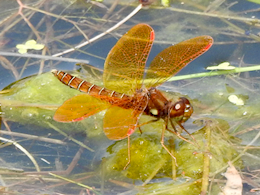
A day without seeing a dragonfly is like a day without chocolate – sure, it’s completely survivable, but utterly lacking in joy. I had to work downtown on both the Wednesday and Thursday after Canada Day, and decided to go for a lunchtime walk along the canal to the river on Wednesday to see if I could find any weekday odes. I’d seen Prince Baskettails and Common Green Darners flying up and down the canal, and a Midland Clubtail on the rocky shore behind Parliament Hill many moons ago, so the downtown core is not completely devoid of odonates. Still, I wasn’t expecting much, and got lucky on Wednesday when I saw first a Common Green Darner flying by, then a Prince Baskettail. Then something small fluttering above one of the mats of vegetation caught my eye – a female Eastern Amberwing ovipositing in some floating vegetation! After a few more minutes of watching, I saw a pair of males fly by. I waited for several minutes for one to land but they never did.
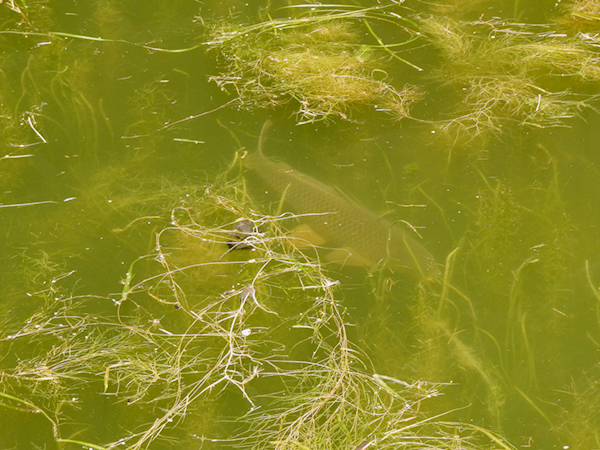
The canal is pretty gross-looking these days. The water is murky, and it looks like someone has been dropping bags of lawn clippings into the water along with the occasional shoe and empty bottle. I don’t even want to know how the dead pigeon got there; at least the dead fish I saw floating belly-up made a macabre kind of sense. A few lily pads were picturesque, but they were generally small and few in number. The mats of vegetation were larger, though they did not appear sturdy enough to hold the weight of a dragonfly – almost all of the mats consisted of clumps of vegetation floating just below the water’s surface.
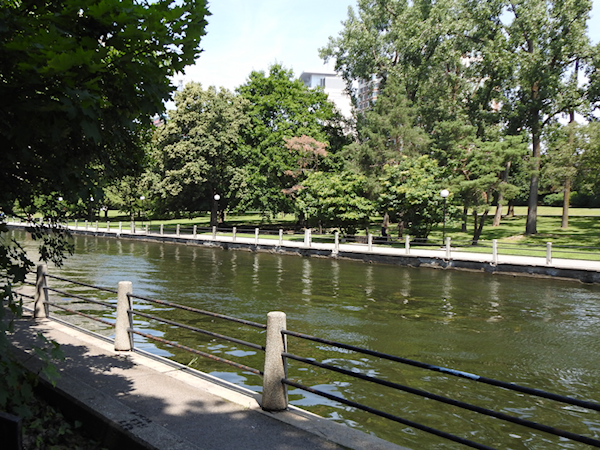
Then I saw a pair of Common Green Darners in tandem ovipositing on a floating reed or stick. They were close enough to have gotten some beautiful photos, but as I only had my cell phone camera all the photos I took were lousy. I had thought about bringing my camera for a lunch-time walk, but as it was supposed to be 35 degrees with the humidex I figured it would be too unpleasant to go out. A Skimming Bluet and two Eastern Forktails (including a female ovipositing in the vegetation) completed the outing, making it a five-species outing: not bad for a short section of the canal between Confederation Park and the Rideau Street bridge! I followed the canal all the way to the Ottawa River and saw…nothing.
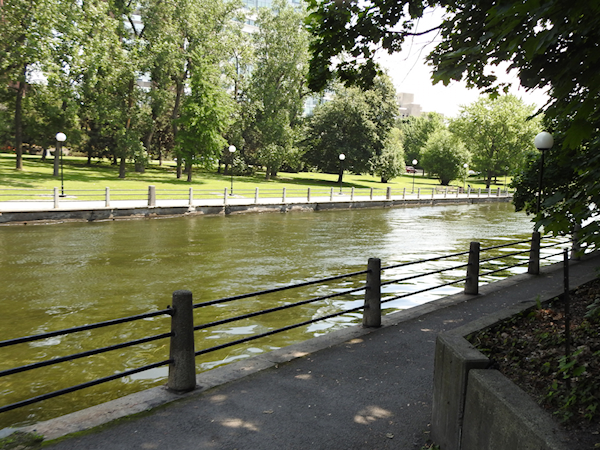
I brought my camera on July 3rd, although heavy showers in the morning made me rethink this decision. However, the sun came out late in the afternoon, so instead of walking up to the Parliament LRT station after work I followed the canal to catch the train at the Rideau LRT station instead. I was hoping to see the same species for better photos to upload to iNaturalist.
I wasn’t too disappointed. A patrolling Common Green Darner and fly-by Eastern Amberwing were still present, though I was able to get photos of neither. While there were no Eastern Forktails present that I could see, I counted at least four male Skimming Bluets, including one resting on a piece of paper floating along the canal.
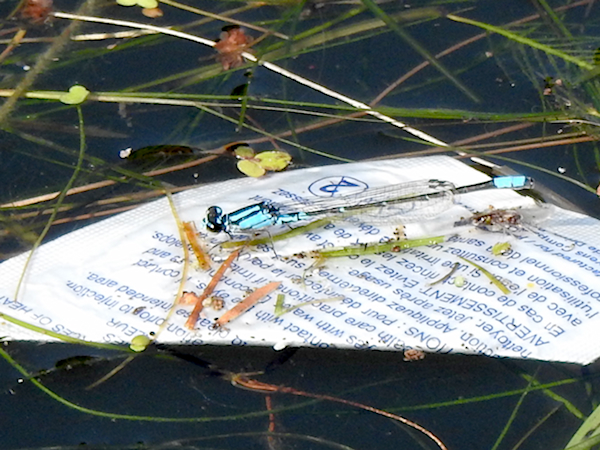
When I saw the small damselfly with the orange thorax resting on a mat of vegetation I did a double-take. It wasn’t a female Eastern Forktail, for the tip of the abdomen was also orange. It was an Orange Bluet, a species I had not expected to find here!
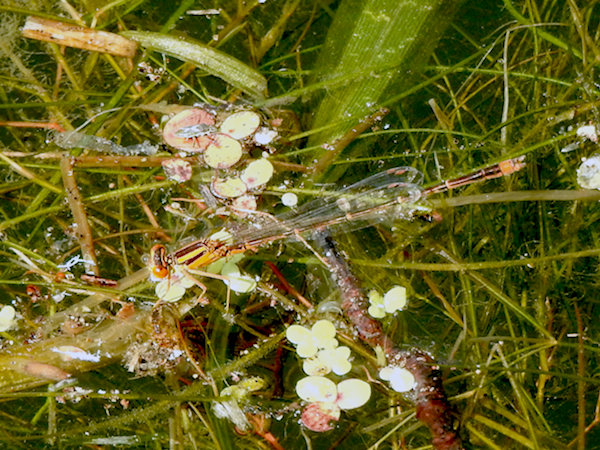
I scanned other patches of vegetation and saw more Orange Bluets…males here and there, and a few pairs in tandem! Almost every mat seemed to contain at least one Orange Bluet, and I counted 25 by the time I reached Wellington Street!
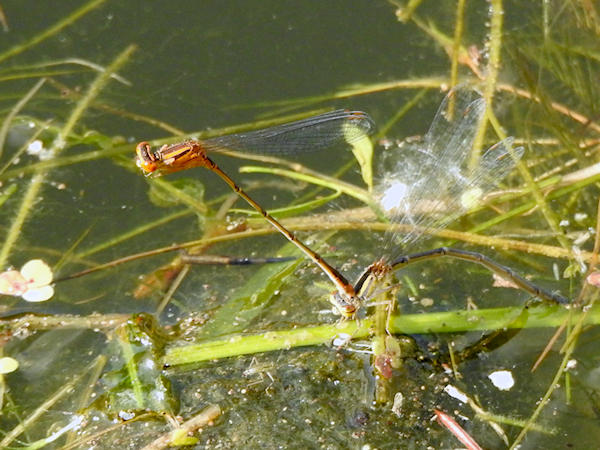
I was amazed to see so many Orange Bluets right in Ottawa’s downtown core, especially after it took me so long to find them anywhere outside of Petrie Island. However, given their tolerance of pollution it is perhaps not surprising that they are most abundant ode species on the canal.
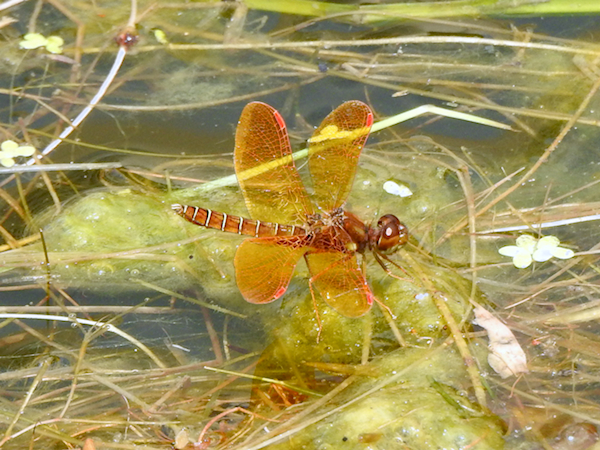
I returned a week later, on July 10th. I didn’t see anything new – the usual Common Green Darners (at least four) and Prince Baskettails (two patrolling different sections) were flying over the water, while I found about half a dozen Eastern Amberwings, including one female ovipositing and five males chasing each other out of their perceived territories or perching on the mat of vegetation. Chris Traynor says they are now something of a canal specialty, as he sees them at the café at Patterson Creek all the time, along with Blue Dashers and Common Green Darners.
Damselflies included two Skimming Bluets, two Tule Bluets, and four Eastern Forktails. I didn’t encounter any Orange Bluets, likely because it was too early in the day – they prefer to emerge later in the afternoon, when the shadows are much longer.
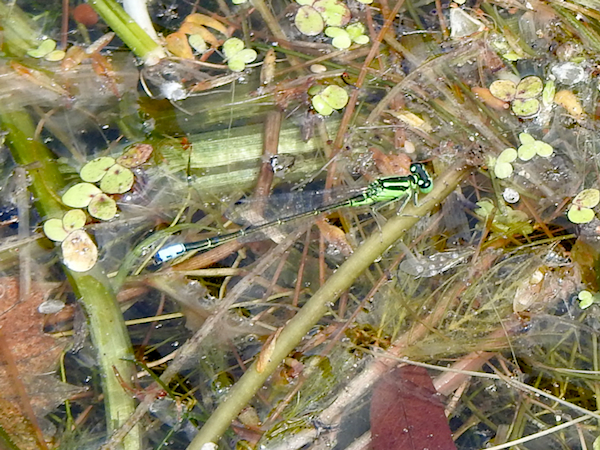
One of the Skimming Bluets I photographed was quite interesting – it had a divided shoulder stripe, making it look more like a Fragile Forktail. The blue tip on the abdomen confirmed its identity as a bluet rather than a forktail. Skimming Bluets prefer to breed in slow, clear streams with plenty of lily pads and emergent vegetation for them to rest on.
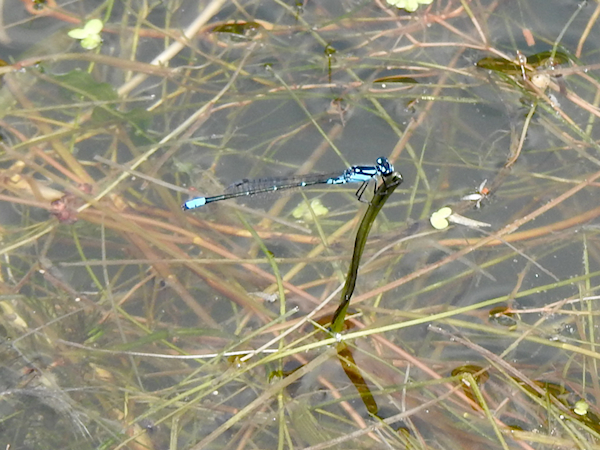
I was happy to find a pair of Tule Bluets in tandem, with the female ovipositing into a submerged strand of aquatic plant matter. The males of this species have more black than blue along the abdomen, with increasing amounts of black from the third segment to the seventh segment. I usually have difficulty identifying the female bluets, so it was fantastic to see one ovipositing with the male contact-guarding her.
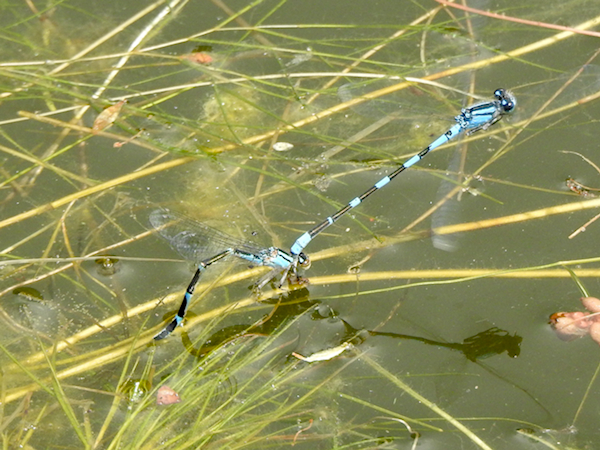
The following day was more of the same, with the exact same six species seen. However, this time I managed to find a pair of Common Green Darners in tandem and photographed them while the female was laying eggs in the plants below the surface. I saw three others flying around; who knew that the canal was such a hotspot for this species!
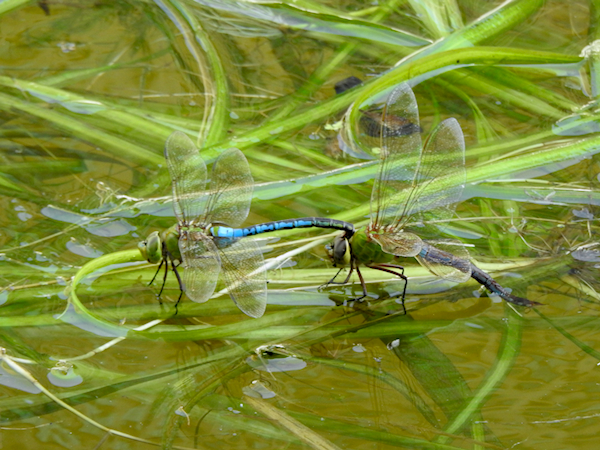
There were also two Prince Baskettails and six Eastern Amberwings, a dozen Eastern Forktail, seven Skimming Bluets, and six Tule Bluets! Once again I found a pair of Tule Bluets in tandem, and got a better photo of the female.
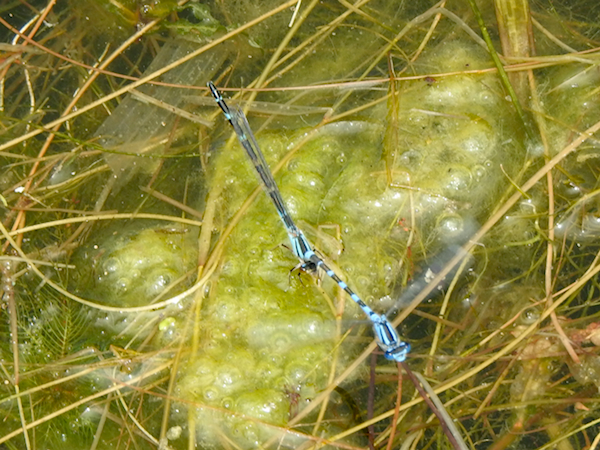
I also saw a male blue-type bluet with more blue along the abdomen than the Tule Bluets. I did not get clear enough photos to identify it, though it is most likely to be a Familiar Bluet. Without a net to catch it, however, I can’t be entirely sure.
I was amazed by the number of odonate species living and breeding along the canal: three dragonflies and five damselflies, including the unidentified blue-type bluet, all seen during a few short weeks in July. The canal is not the most suitable habitat for odonates that need clean water and emergent vegetation, with all the pollution that makes it way into the canal from litter, rainwater run-off, and the heavy volume of motor boats during the summer. It made me wonder what other species might be present earlier in the season – another project for next year!

 OdoNotations