
I don’t see Swift River Cruisers very often, and even when I do, I seldom get the opportunity to catch or photograph one. I used to see them fairly regularly at Mud Lake, but now it seems the best place to see them – aside from my recent outing to Quebec with Chris Traynor – is Sheila McKee Memorial Park. However, even here I only see them in flight, either far out on the water or soaring high above the trees with the Prince Baskettails. Swift River Cruisers love feeding in large, sunny clearings near the rivers they breed in, dancing in the sky with graceful twists and turns too rapid to follow with the eye. They do, however, perch fairly regularly, though I have never seen one doing so at Sheila McKee Park. As such, I have not been able to enter any of my sightings into iNaturalist as photographing them is next to impossible while they are in flight.
I started my visit on July 13th by scanning the beach for large clubtails, as usual. Unfortunately the water was really high and there was not much of a beach at all, leaving very little room for a hungry Cobra Clubtail or Midland Club to sit and watch for prey.
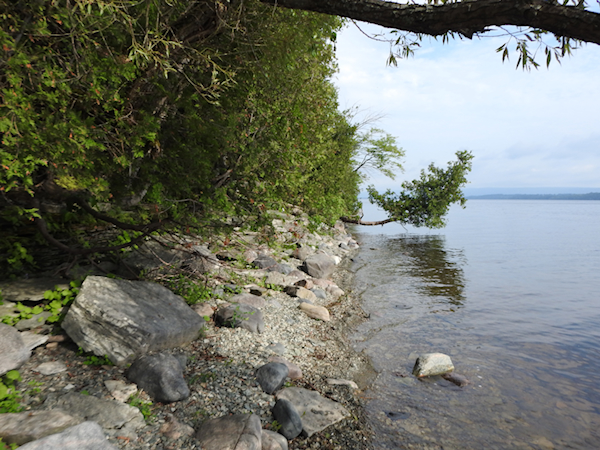
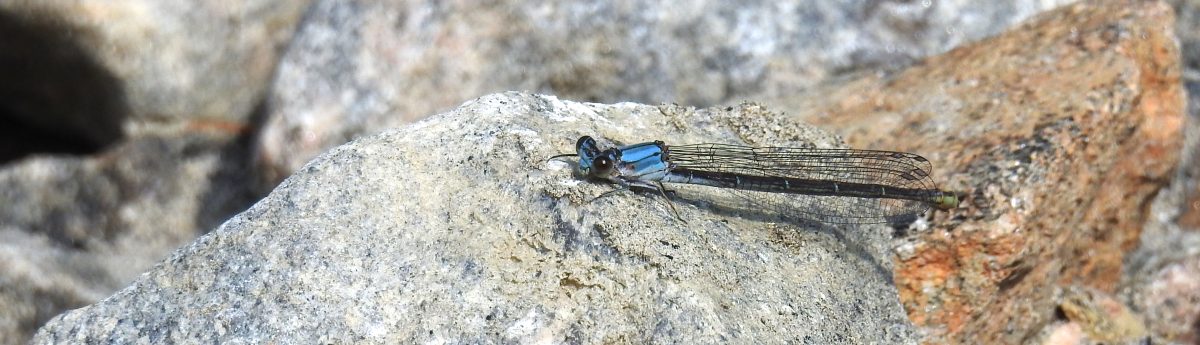
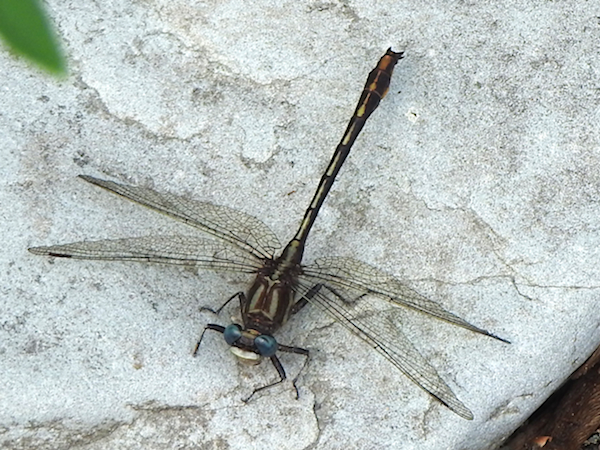
I was lucky to see a few Powdered Dancers and a Violet Dancer on my walk along the shore; this was the first time I had ever seen a Violet Dancer here, and it flew off too quickly to get a photo. The only clubtails I saw on the gravel shore were three Lancet Clubtails, as the only large clubtails present were flying too far out over the water to identify. The Lancet Clubtail was the first clubtail I ever saw, and when I first saw it I thought it was an immature whiteface of some sort given the yellow lines down the abdomen and white face. However, I’d never seen a whiteface with blue eyes; I was thrilled when Chris Lewis identified it for me as a Lancet Clubtail. Since then I’ve found them frequently along the Ottawa River.
With little to see at the water’s edge, I climbed the wooden staircase to check out the sunny corridors for odonates. A Stream Cruiser flew by quickly along the shaded trail, its white spots discernible as it zoomed past at about knee height. I made my way to the first large sunlit corridor, and saw another dragonfly fly past at about shoulder height. This one appeared larger and darker, with a large clubbed abdomen and a bright yellow spot close to the tip. I immediately recognized it as a Swift River Cruiser, and it was flying low enough to catch! I watched it fly up and down the trail, then swung my net wildly when it passed within reach. At first I thought I had missed it, then heard the sound of its wings buzzing inside the net!
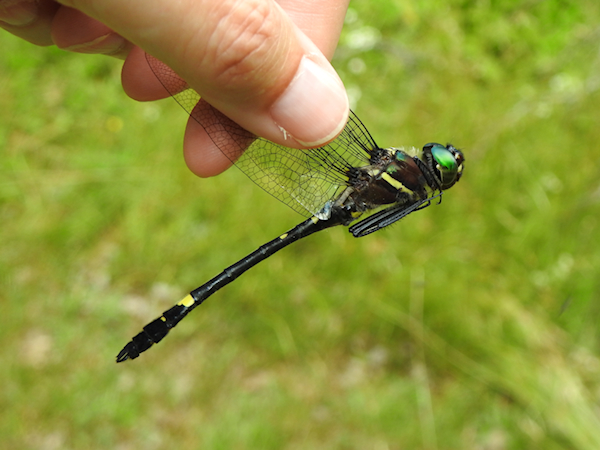
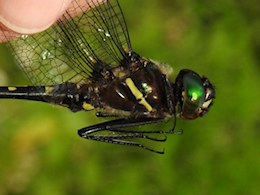
It has been a long time since I’ve held one of these in my hand, so I spent some time examining it. The eyes were a beautiful metallic green – my favourite colour of dragonfly eyes! – and the single yellow line down the side of the thorax was the only burst of colour except for a few small dots and one large one along the top of its abdomen. This is a male, based on the large club and the claspers at the tip of the abdomen; in addition, it lacks the small, paired yellow spots on segments 5 and 6 just above the large yellow spot on segment 7. My mentor, Chris Lewis, always referred to the large yellow spot as its “tail-light,” a fitting description as it is quite visible in flight!
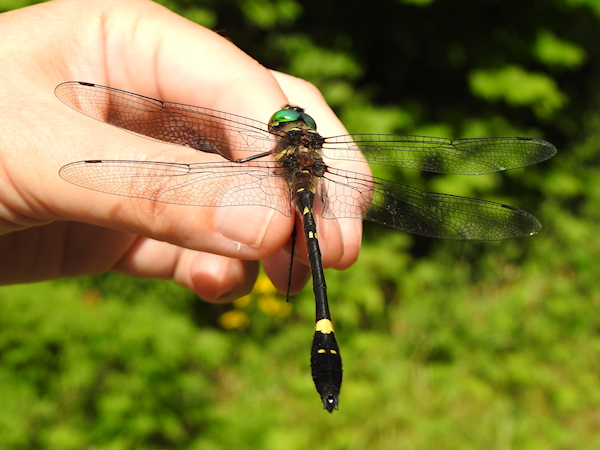
Of the five species of river cruiser in eastern North America, the Swift River Cruiser is the most common and widespread, and it is the only one is found in Ottawa, where it is unmistakable. The only other river cruiser in Ontario is the Royal River Cruiser (Macromia taeniolata) which is found only in southern Ontario with most records from west of London. That species is larger than the Swift River Cruiser, is clubless, and tends to prefer larger, slower rivers and wooded streams than other cruisers.
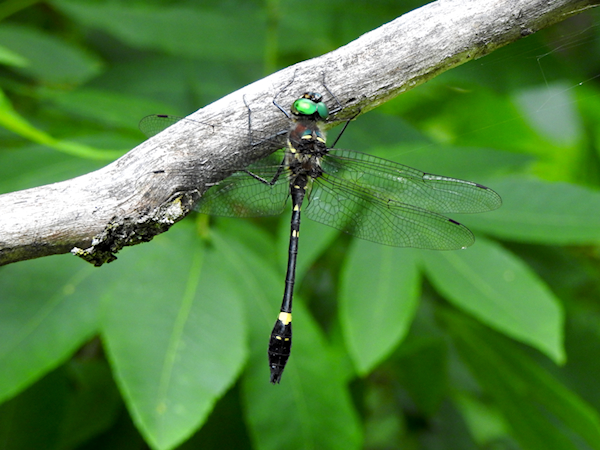
Once I finished examining it, I placed it on a branch where it stayed long enough for a few photos. They perch vertically, much like darners, and often hang up in shrubs and vegetation to feast on prey they have caught on the wing.
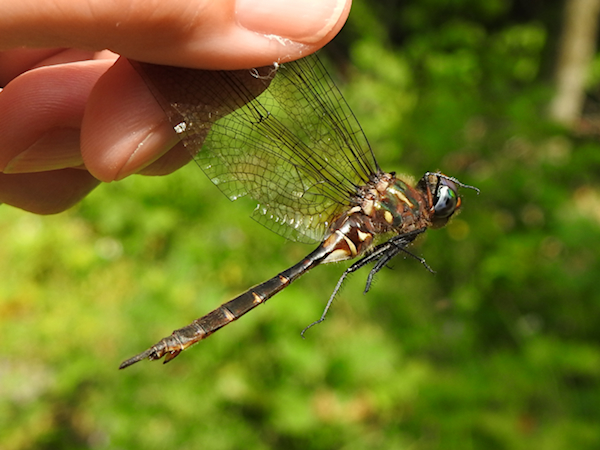
Thrilled with the catch, I was reluctant to move on but wanted to spend some time in the meadow. A few emeralds were patrolling the corridors, much reduced in number from my visit last month…I saw a couple of Racket-tailed Emeralds fly by fairly close, and at least two Prince Baskettails much higher up. One of the emeralds caught my eye, and I swung my net to catch it. I wasn’t entirely surprised to see a Brush-tipped Emerald, as I’d had two at Sheila McKee Park last year.
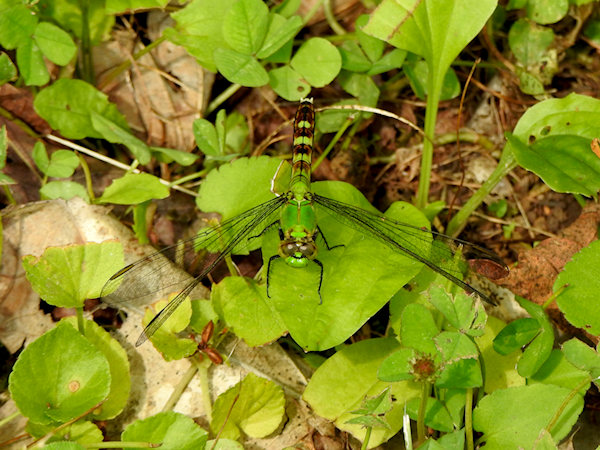
Other odes seen along the corridor included a female White-faced Meadowhawk (caught and identified in the hand), a female Eastern Pondhawk, and a Common Whitetail. Only one Canada Darner was identified when it landed on the trunk of a tree.
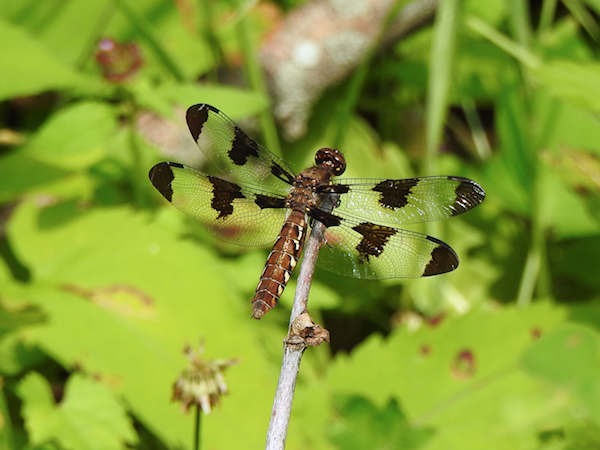
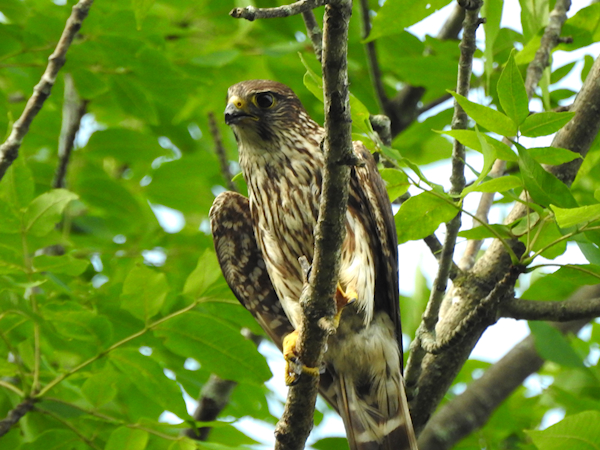
When I got to the meadow I was startled when a banshee shriek erupted from the trees above me. A Merlin must have had a nest near by, for it took exception to my presence and called continuously while flying from branch to branch as I moved deeper into the meadow. There were no odes flying overhead that I could see, mostly likely because of the Merlin’s presence (although they mostly prey on birds, they will catch large dragonflies on the wing for food). At the edge of the meadow I found a couple of Blue Dashers, a single Widow Skimmer, and zero pennants. I left after that, unwilling to disturb the Merlin any further.
I had a great visit, and was happy to finally get a picture of the Swift River Cruiser for iNaturalist. It would have been great to have gotten a picture of the Violet Dancer as well, but now that I know they can be found here I will have to keep an eye out for them!

 OdoNotations