
Sarsaparilla Trail is always worth a quick visit in the warmer months, even with the limited access to the water. The pond is fairly large, and I’ve often wondered just how many species actually live and breed here away from the boardwalk – the only point of access to the water. On June 18, 2025 I added a new species here to the list of Stony Swamp odes, a female Horned Clubtail that landed on the boardwalk and stayed long enough for some photos. After seeing that magnificent dragonfly I wasn’t expecting to add another new species to the list anytime soon, but that is what happened on one of my visits this month.
The circular trail through the woods is short – the inner loop is only about 0.5 km – so most times I only stop by for a quick walk on my lunch break while working from home, or a short visit after returning from somewhere else. My July 8 visit was a lunchtime visit, and although there were lots of clouds in the sky, the odes were flying around the pond as usual.
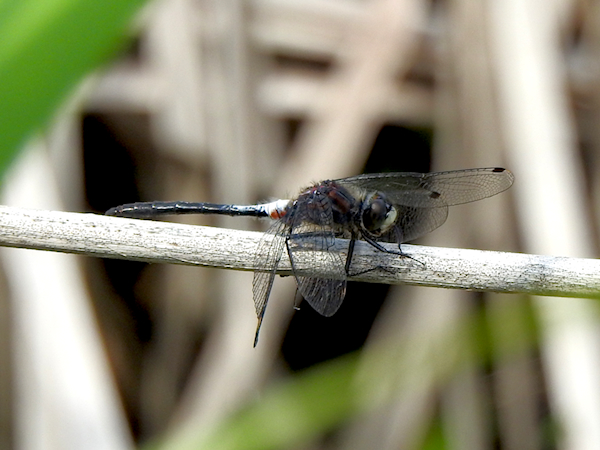
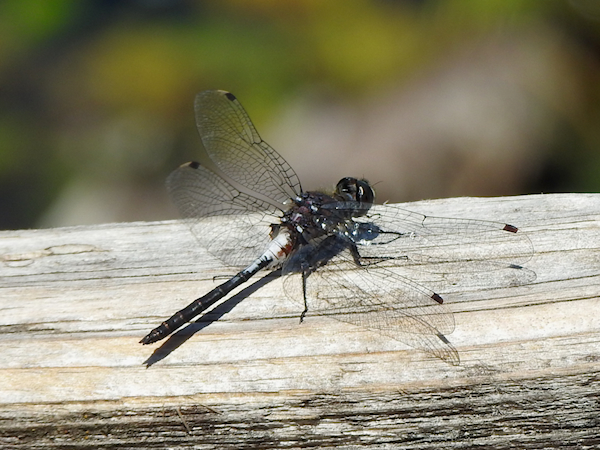
I saw only two Chalk-fronted Corporals at the boardwalk, as well as a single male Eastern Pondhawk, several Dot-tailed Whitefaces and one Belted Whiteface. This male Belted Whiteface was easy to identify based on the red spot beneath the white pruinosity at the base of the abdomen; this spot is absent on the similar-looking Frosted Whitefaces, which have no red colouration whatsoever.
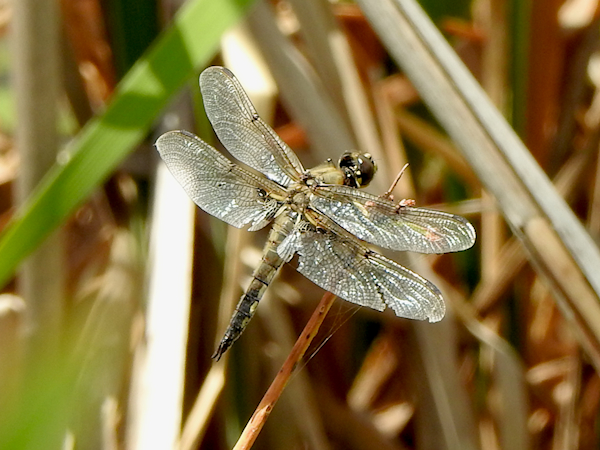
I was also happy to see a Widow Skimmer, two Four-spotted Skimmers, and a single Blue Dasher among the skimmers at the water. There were no clubtails on this visit, but a curious Common Green Darner kept flying in and out of the clumps of reeds while several Racket-tailed Emeralds patrolled the water below the boardwalk.
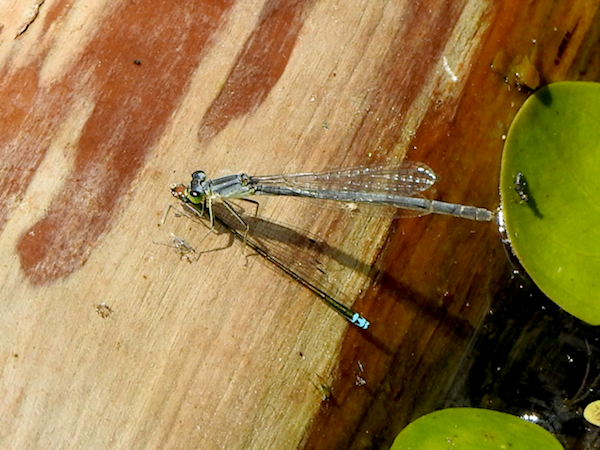
One of the most interesting odes I saw on that day was a female Eastern Forktail devouring a Sedge Sprite. It’s an ode-eat-ode world out there where even the smallest predators are prey for something else, and the female Eastern Forktail is particularly predatory – she is much more likely to dine on other damselflies than the male.
Then my eye was caught by something else – a pair of damselflies mating while hanging onto a reed above the water. They were too far away to get a good look at them; however, I could tell they were spreadwings, which are not unusual along the edge of the pond. I was going to leave it at that, and grabbed some documentary shots to look at later. It wasn’t until I got home that I realized that the wings of the mating damselflies both had a very distinct amber tint to them, leaving no doubt in my mind that these were Amber-winged Spreadwings – a new species for the pond!
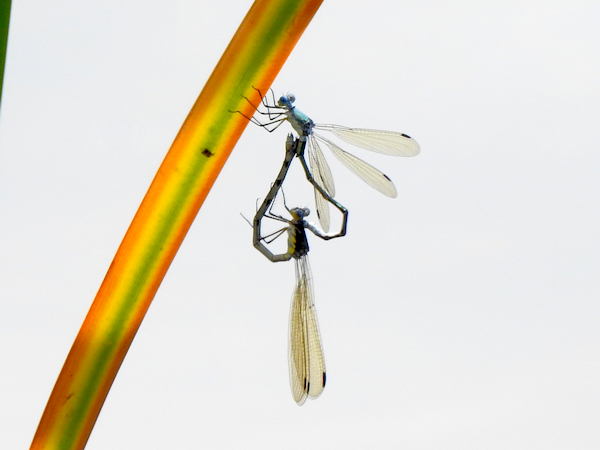
The Amber-winged Spreadwing is our largest spreadwing, which is probably why I was able to notice it in the first place. This species lives in permanent lakes and ponds with emergent vegetation, but can also be found in bogs and other fishless wetlands. They are more active fliers than other spreadwings, skimming over the open water in search of mates. Like the Eastern Forktail, Amber-winged Spreadwings, too, prey on damselflies, even other spreadwings!
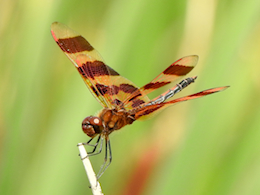
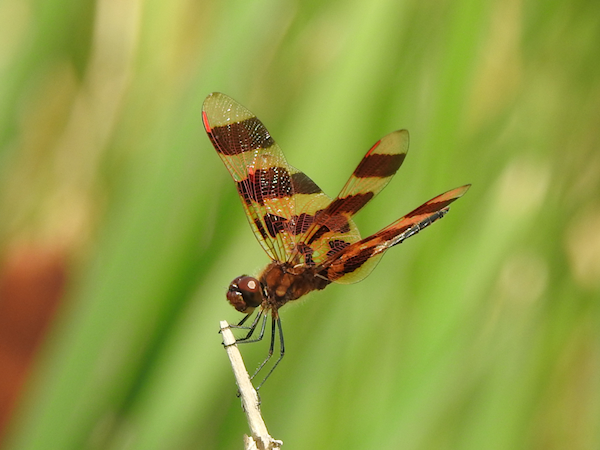
I didn’t see the spreadwings on my next visit on July 13th, a short casual visit after spending a couple of hours at Sheila McKee Memorial Park. I did, however, find a Halloween Pennant there (only my second one ever at this trail) and spotted a Northern Water Snake in the water. The Halloween Pennant was the highlight of that visit, its orange-banded wings fluttering in the slight breeze as it delicately balanced on the tip of a reed.
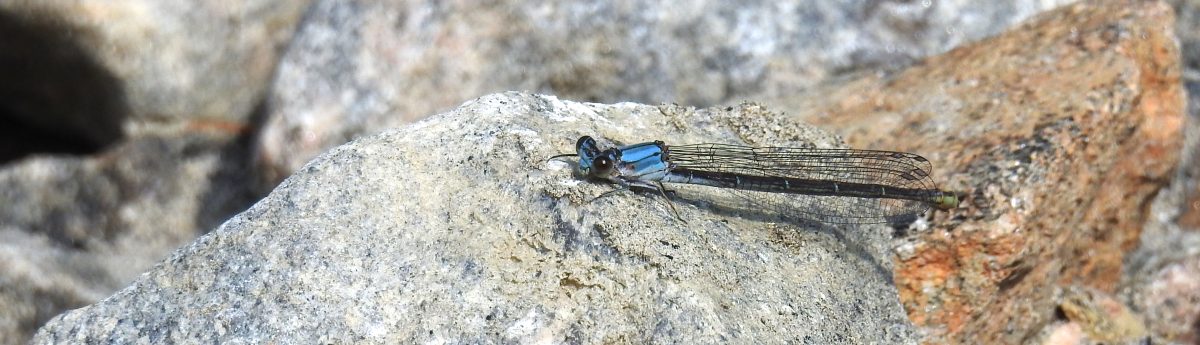
I spent more time there on my outing of July 18th and saw 10 different ode species as a result. All four damselflies were pond damsels: Fragile Forktail, Sedge Sprite, Marsh Bluet and Hagen’s Bluet. The two bluets had to be caught in order to be identified, and I caught four Marsh Bluets compared to only one Hagen’s Bluet. It was great to find both species flying together.
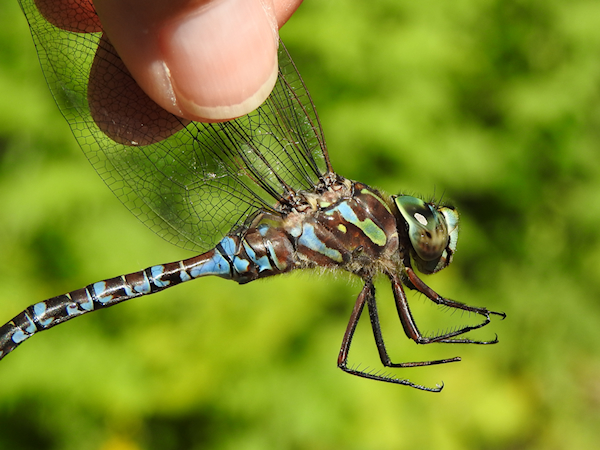
A Common Green Darner again was searching for food among the channels near the boardwalk, and several mosaic darners (genus Aeshna) were flying over the water and above the boardwalk. I caught one, hoping for a Lake Darner, but it turned out to be a Canada Darner.
The usual Racket-tailed Emeralds were flying; one saved me the trouble of having to catch it by landing on a thick clump of dead reeds!
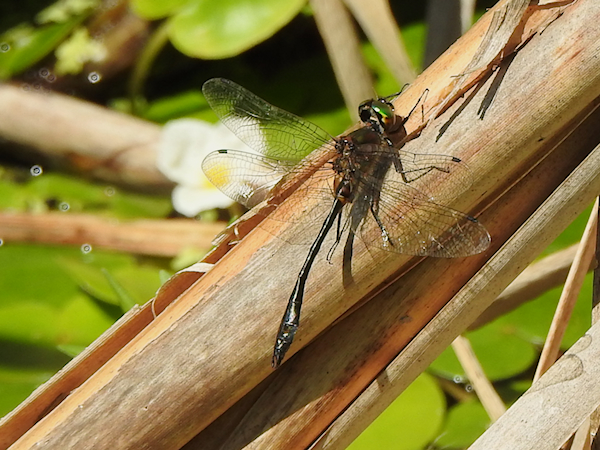
There were no Chalk-fronted Corporals to be seen. My personal late date is July 18th at Roger’s Pond in 2019, so I was hoping one or two might still be around. The Halloween Pennant was also gone, but one Four-spotted Skimmer, one Twelve-spotted Skimmer, and one Blue Dasher remained. Similarly I noted one Dot-tailed Whiteface perching on a log in the water.
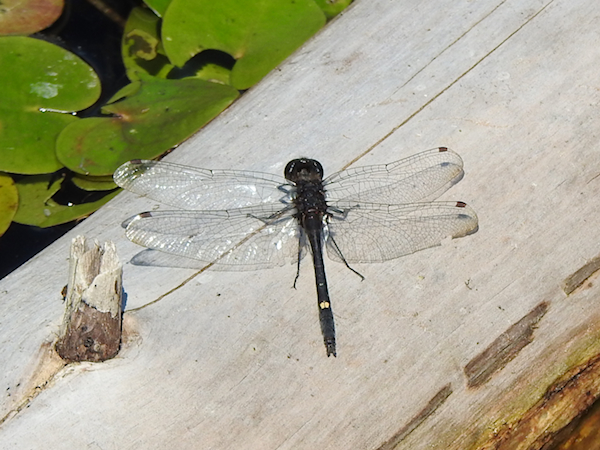
Three Belted Whitefaces were perching on reeds close to the boardwalk. One landed on the boardwalk railing; you can see the reddish area within the white base of the abdomen in this photo.
Sarsaparilla Trail is one place I find myself returning to, even after many years of ode-hunting here; there is always something new to find!

 OdoNotations