
Last year I visited Jack Pine Trail in mid-July to look for Brush-tipped Emeralds. I didn’t find any, though I found three species of darners, which made me wonder if the emeralds were still present – I hadn’t recorded any there since 2019 for a myriad of reasons, including closures during the pandemic lockdowns and after the derecho of May 2022. The Brush-tipped Emerald belongs to genus Somatochlora, the striped emeralds, and is the smallest representative in our region. Somatochlora dragonflies are eagerly sought after by odonata enthusiasts, as they are uncommon to scarce in most human-populated areas, requiring special trips to remote peatlands, bogs, fens and swamps; and they are gorgeous, with their metallic green, yellow and black bodies and bright green eyes. They spend most of their time hunting on the wing and will land just often enough to give a dragon-hunter hope that they might get a good look or a photo of one perching naturally, though these emeralds often don’t often perch for very long – unless it’s on the side of a house during a drizzly day, or high up in a tree where they are shaded by the canopy. Their very unpredictability in where they will turn up makes it a delightful shock when you see one flying by.
I’ve had good luck with Brush-tipped Emeralds because they don’t require impenetrable bogs or fens: they will make do with open bogs or swamps with small streams flowing through them, including those near woodland edges which perfectly describes the habitat in Marlborough Forest and Jack Pine Trail where I find them. Friday, June 27 was a warm, mostly sunny day, so I decided to go for a lunch-time walk there to see if I could find the emeralds. The weekend weather wasn’t looking too promising – lots of clouds and thundershowers in the forecast – so I needed to get out while the sun was shining.
The first place I start looking for odes at Jack Pine Trail is the open area where the OFNC feeders used to be – this sunny glade often hosts baskettails flying up and down the trail, and the occasional skimmer perching in the vegetation. I saw a Blue Dasher perching on a leaf just above my head, but it zoomed off before I could take a photo. This is the first time I’ve ever seen one here.
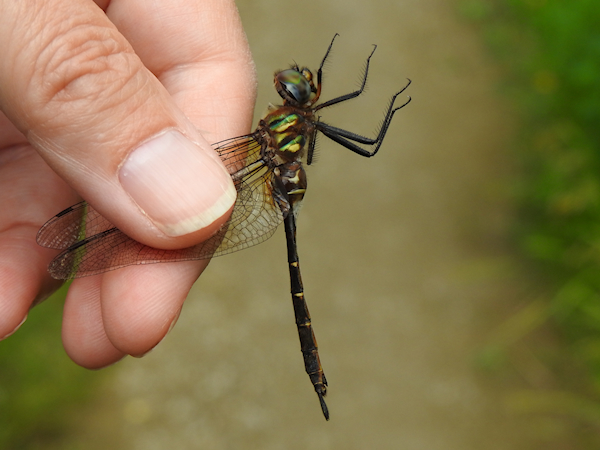
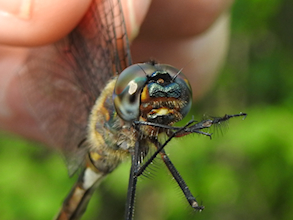
There are a few more sunny openings through the woods, and at one boardwalk I encountered a single emerald flying back and forth. When it came down to about shoulder height I caught it, and was delighted to find a male Brush-tipped Emerald. The hairy claspers are fairly unique; the only other Somatochlora emerald in our region with hairy claspers is the Williamson’s Emerald, which is much larger and proportionately longer.
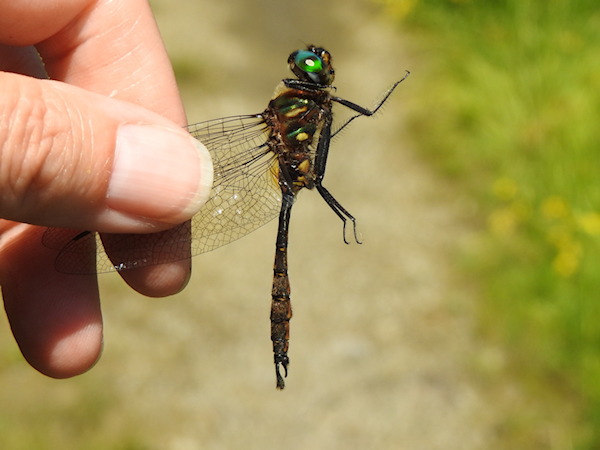
Male Brush-tipped Emeralds appear to be “front-heavy” due to their large eyes and robust thorax attached to the thinnest part of the abdomen; although not completely club-shaped, the abdomen is thickest just beyond the mid-point. It has a distinctive “wasp-waisted” appearance in flight.
Fresh Brush-tipped Emeralds are stunning: their thorax is a beautiful combination of metallic green and bronze with two yellow spots: the anterior spot is shaped like a dash, while the posterior spot is circular.
After examining the Brush-tipped Emerald I continued on my way to the back of the third loop, watching for other odes. To my surprise I didn’t see any other odes on my way to the large open marsh at the back – no damselflies in the sedges lining the trail, no skimmers at the boardwalk of the middle loop, no Racket-tailed Emeralds at the intersection at the back. I took a quick peek along the stream at the back to see if the Arrowhead Spiketails were still flying; I had no luck, but I did find two male Ebony Jewelwings which were a treat to see.
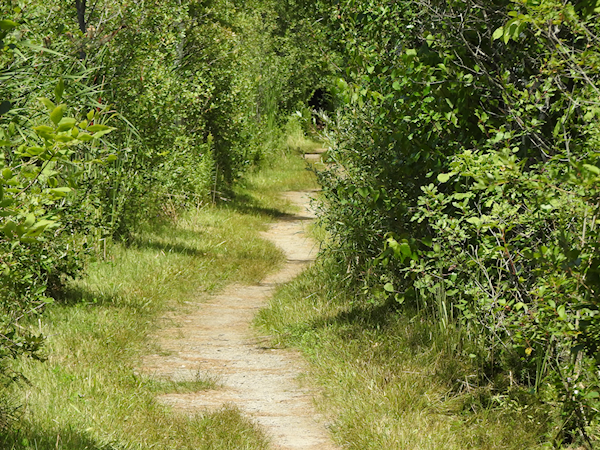
At the back of the third loop, however, I spotted a multitude of dragonflies flying high overhead and up and down the trail at about waist-height. The trail cuts through a marsh here, running straight as a railroad track which makes it easy to look for dragonflies patrolling the narrow space between the vegetation and thin line of trees separating the cattail marsh from the path. I was thrilled to see so many emeralds here and recognized a Prince Baskettail soaring overhead with a few other unidentifiable dragonflies.
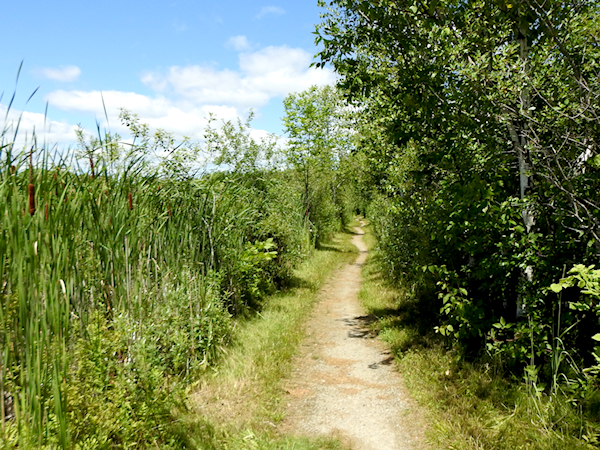
I spent the next twenty minutes here, watching and trying to catch all the dragonflies that flew within reach. In the end I caught three more Brush-tipped Emeralds and no other species. I thought I saw one or two that looked longer, though the ones I caught were all female Brush-tipped Emeralds – males fly with a distinctive arched abdomen, so perhaps the straight abdomens of the females made them look larger.
I had to return to work, so I wasn’t able to spend as much time there as I wanted. However, once the showers cleared up the following day I returned. It was very muggy when I arrived, and the sun darted in and out of clouds as I made my way toward the back of the trail. I saw a Fragile Forktail resting on a fern leaf and a male Common Whitetail flying over an open area before landing. These gave me hope that there might be more odes around today, and at the intersection at the back I saw three Racket-tailed Emeralds patrolling the corridor. I caught one to identify it, then continued on my way.
There weren’t as many emeralds flying along the marsh trail this time, so I made my way to the alvar instead. This large meadow can be a good spot to find foraging dragonflies, and I found a Four-spotted Skimmer, a Dot-tailed Whiteface, and even an Eastern Forktail. I scared up a few other large dragonflies but they disappeared so fast I couldn’t tell what they were.
Although the sun wasn’t out by the time I returned to the straight trail through the marsh, there were a few emeralds flying up and down the corridor. I managed to catch two Brush-tipped Emeralds, both males. Then I saw one that looked longer zooming up and down the trail. I positioned myself to catch it, but instead of flying past me it zipped up and over the shrubs lining the trail and flew out over the marsh. I waited to see if it would come back, and when it didn’t I continued on my way.
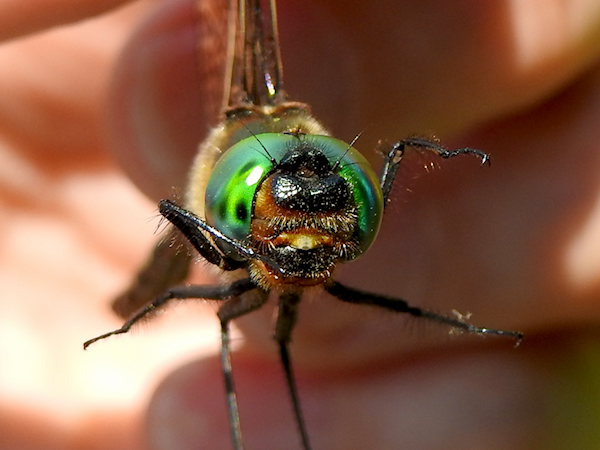
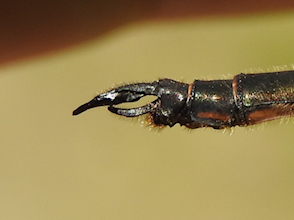
By the time I reached the end of the corridor the sun was out, and I had re-found my large mystery emerald. This time when it flew toward me it went right by me, and I caught it. I was delighted to see this large Somatochlora male in my hand when I pulled it out. The first thing I noticed is that there were no yellow spots on the sides of the thorax, as would be expected on a Williamson’s Emerald, the only other Somatochlora emerald I’ve seen at Jack Pine Trail. The second thing I noticed was that the claspers were not ski-shaped, which narrowed down the species to just two: Delicate and Kennedy’s.
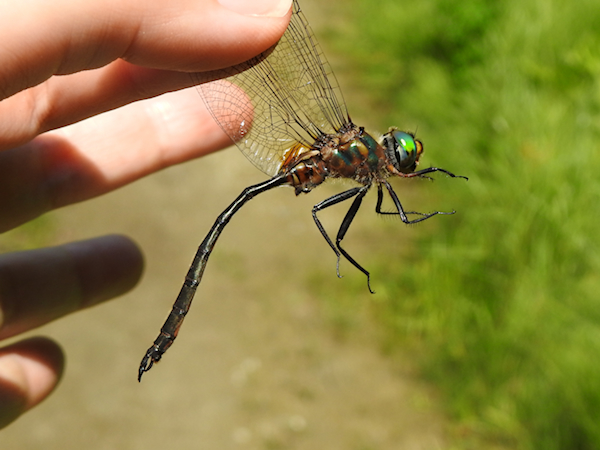
I examined it from several angles, and began to suspect it was a male Kennedy’s Emerald, a species I’d written about for the OFNC publication Trail & Landscape. It had the brown colouration along the side of the last few segments of the abdomen and was quite narrow at the base of the abdomen, thickening towards the end. Also, it seems Kennedy’s Emeralds are more likely to turn up at random places (such as on Chris’s mother’s house!) than Delicate Emeralds, which seem to remain strictly within inaccessible habitats given that I have never seen one!
The upper claspers on many male Somatochlora emeralds curl upwards at the tip, resembling elf’s shoes or skis. These ones curved downward. From above they resemble pincers, a shape it shares with Incurvate, Forcipate and Delicate Emeralds in our region.
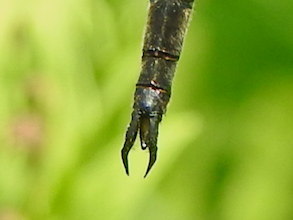
Once I finished photographing it in the hand I placed it on a reed where it stayed for several minutes. This one was a mature adult compared to the one Chris had found on his mother’s house last year, with bright green eyes and wings that lacked an amber wash. It stayed for several minutes, allowing me to me creep up closer and closer to it, resulting in my best image of this species yet!
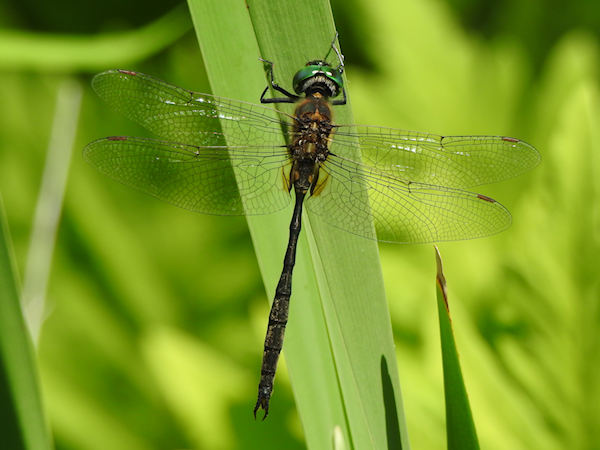
I was so thrilled with that discovery that the next day I returned to see if I could find a female to photograph; that would mean they were certainly breeding in the area. Unforunately I didn’t see any large emeralds patrolling the marsh trail I now think of as the “emerald corridor,” but I did find two female Brush-tipped Emeralds perching low enough to photograph! The yellow dashes along the sides of the upper segments of the abdomen are visible here, as are the long upper claspers. Her eyes are brown, indicating she emerged a short time ago.
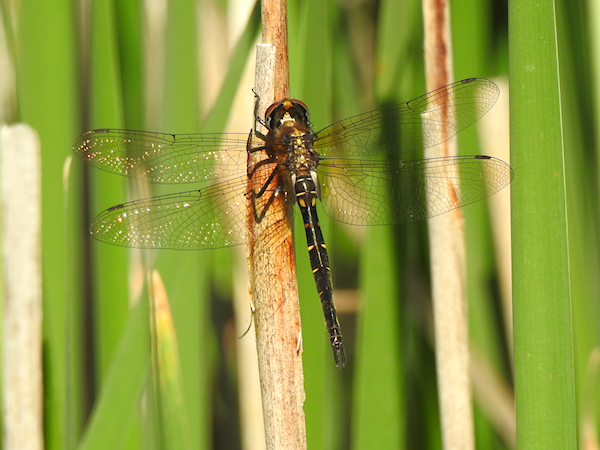
This one has green eyes, indicating she has been on the wing a bit longer and is fully mature. There were about 20 patrolling the area, along with a single Racket-tailed Emerald and a single Prince Baskettail, neither of which I managed to catch.
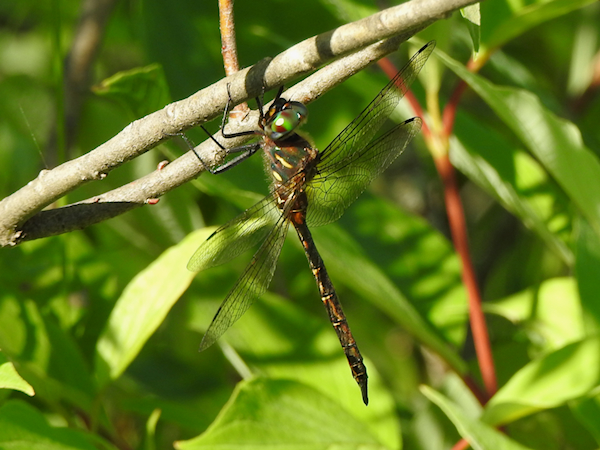
When I returned again at lunch on Friday there were fewer emeralds flying at the back of the trail. I counted only about six Brush-tipped Emeralds (including a pair in a mating wheel) and two Racket-tailed Emeralds, but I did see the Kennedy’s Emerald! I tried twice to catch it, and both times he darted away untouched. The third time he came flying down the path toward me I tried a wild overhead swing that landed on the ground with him inside! I wondered if it was the same one I had caught a week ago, or if it was a different individual.
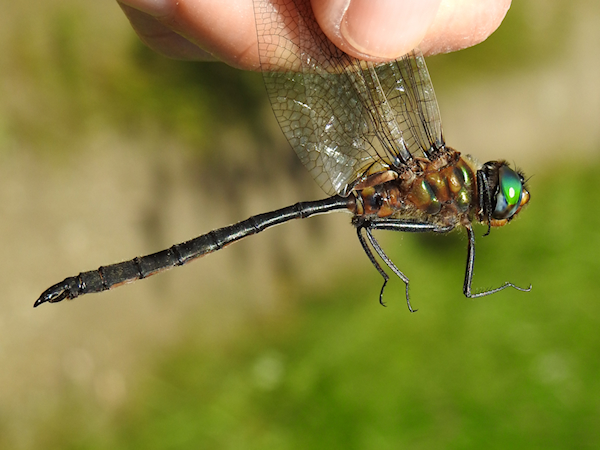
I returned multiple times over the course of the month, and by the middle of July the number of emeralds had dwindled considerably. On the 18th I returned after work and saw no small emeralds in the emerald corridor whatsoever. When a large one flew by me, I was surprised and instinctively swung my net. I caught it, and realized it was a different individual, a female! The first thing I noticed was the long, needle-like ovipositor pointing down at a 90° angle.
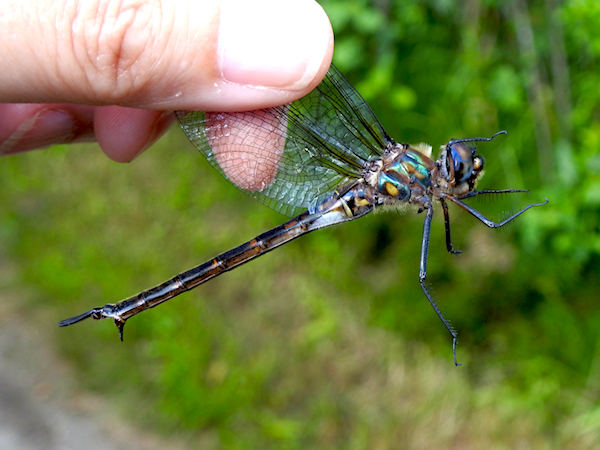
The second thing I noticed was the yellow markings on the thorax. This wasn’t a Kennedy’s Emerald but a Williamson’s Emerald! I haven’t seen this species at Jack Pine Trail since 2018. From above, she is very dark with a thin pale ring around the base of the abdomen.
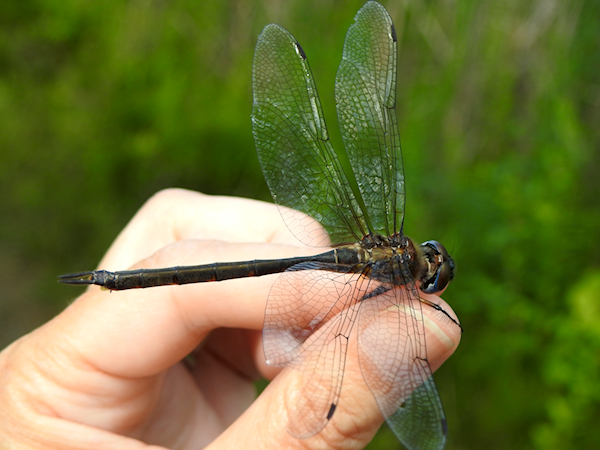
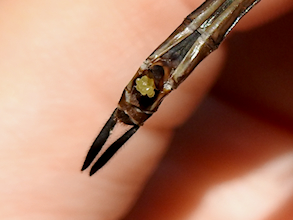
Best of all, she carried a mass of eggs at the tip of her abdomen! Perhaps not all of the larger emeralds I had seen in my previous visits were Kennedy’s Emeralds, as the Williamson’s Emeralds were clearly breeding here! I took a few quick photos then released her so she could go lay her eggs in the water.
I was thrilled to find a third Somatochlora species at Jack Pine Trail this year. These three species are all less tied to bogs and fens than specialists such as the Delicate and Incurvate Emeralds; Williamson’s Emerald is considered widespread and one of the most frequently encountered of the uncommon Somatochlora emeralds according to the Algonquin Field Guide. This species is said to prefer small forest streams, clear lakes, and marshes as well as fens. Kennedy’s Emeralds can be found in slow watercourses within marshes, swamps and fens. It remains to be seen whether these species will continue to hunt along the emerald corridor at Jack Pine Trail in the future, but seeing the Williamson’s Emerald with eggs makes me hopeful!

 OdoNotations