Last winter while looking up various clubtail sightings on iNaturalist I was surprised to find a couple of rocky creek-loving species at Blakeney Rapids just outside of Ottawa County: Mustached Clubtail, Eastern Least Clubtail, and Rusty Snaketail. These are all species I associate with the small, rocky streams of Quebec, and I was startled to see that they could be found on this side of the Ottawa River. Both the Rusty Snaketail and Eastern Least Clubtail, the two species I most wanted to see, had been observed on July 4, 2023, so I made it a point to visit the first weekend of July in 2025.
Last November I spent some time on Google maps looking for accessible creeks around the fringes of Kanata north where I might find some creek-loving odonates. If a tiny fragment of a stream in Stony Swamp could hold Arrowhead Spiketails, who knows what other species might call these small streams home? I wasn’t expecting anything as magnificent or scarce as a Mustached or Eastern Least Clubtail, but I thought that Stream Cruisers, Fawn Darners, River Jewelwings, and maybe a spiketail might be possible.
A few areas looked particularly interesting, including a section of Shirley’s Brook between Station Road and Monk Environmental Park, the stream that drains the eastern end of the Beaver Pond near Lismer Pines Park, and Stillwater Creek where it runs between Corkstown Road and the Trans-Canada Trail, aka the Watts Creek Pathway. Although all of these streams run through green space, the surrounding areas had become built up with new homes and developments over the years. The Crystal Bay/Lakeview Park subdivision just south of Andrew Haydon Park is long-established, with a narrow band of trees running between the subdivision and Highway 417, but the area around the Beaver Pond off of Goulbourn Forced Road started being cleared for housing relatively recently (around 2010), starting with the controversial Terry Fox extension, and houses are still being built there to this day. The forest is thickest in Monk Environmental Park where there is little encroachment so far, and my hopes were highest for this little park as a result.
The Uhler’s Sundragon is an early-flying member of the emerald family that is apparently more easily found on the Quebec side of the OFNC study circle. However, iNaturalist shows a few records from the Quyon ferry dock along the Ottawa River, so one of my goals was to spend some time visiting places like the ferry dock, Sheila McKee Memorial Park, and Fitzroy Provincial Park to look for it and other river odes, including the uncommon Mustached Clubtail. I’ve only seen the Sundragon twice, both times in Nova Scotia, and in the same habitat – medium-sized- rocky forest streams flying over the gentle pools of water either at the top or bottom of a waterfall. Fortunately their patrols take them along the shoreline, and I was able to catch two in 2024 and one earlier this year. My goal was to see one in Ottawa, and I had high hopes for finding one at Fitzroy Provincial Park as there are two small rivers running through it that I wanted to check.
On Saturday, June 14, 2025 Derek Dunnett and I led a combined birding and dragonfly outing at Murphy’s Point Provincial Park for the Ottawa Field-Naturalists’ and McNamara Field Naturalists’ Clubs. It was restricted to 20 people for carpooling purposes (the park roads are quite narrow for parking) and 18 showed up altogether. Unlike our trip last year, the weather was perfect: cool and sunny in the morning, hot and sunny in the afternoon with a hint of a breeze. Our targets this year included Cerulean Warbler (which had been heard singing earlier in the week), Blue-winged Warbler, and Golden-winged Warbler, while our odonate targets included the diminutive Elfin Skimmer and various stream odonates. Last year the trip had been postponed several times due to rain, and we missed the Blue-winged Warbler, Golden-winged Warbler, and Elfin Skimmer as by the time we had visited (July 7) it was late in the breeding season and the weather for ode-hunting (thickly overcast in the morning) was less than ideal.
Last year on August 5th Chris Traynor and I headed up to La Vérendrye Wildlife Reserve just beyond Grand-Remous, Quebec to look for the Common Sanddragons that had been discovered along the Desert River (Rivière Désert) in 2016. We were too late in the season to find any, but had a marvelous time watching dragonhunters and catching darners. We made a pact to return the following year earlier in the season, and on July 21st Chris, Sophie Roy and I finally fulfilled that pact. The sky was spattered with more puffy, white clouds than I would have liked, showing little blue at first, but the further north we drove the clearer the sky became. The temperature was perfect, about 24 or 25°C, with only a slight amount of humidity that really only made the temperature start to feel too warm later in the afternoon, but a fresh breeze kept us cool enough. We were in high spirits because even if we missed out on the sanddragons again there were sure to be enough interesting birds and bugs to make the journey worthwhile. And of course, the rushing rivers and waterfalls of Quebec are beautiful in their own right.
On our final day in Yarmouth I was ready for a change of scenery. It was a bright, sunny day, but once again the wind made it feel much cooler so I gave up on the idea of driving down Cape Forchu to the lighthouse. I knew it was my last chance to see the ocean and find some ocean birds before leaving for the Valley, but I also knew the wind blowing off the ocean would be cold, and I didn’t have any winter gear with me. I consulted Google, and found a few spots that looked interesting – the Yarmouth County Rail Trail near Arcadia, a tiny community just down the road from the Y-Con Comics convention, and Tusket Falls, which is a little further away and has an interesting walking trail close by. I liked the idea of visiting Tusket Falls for river-loving dragonflies, while the Yarmouth Rail Trail passed by the Chebogue river, which might be good for looking for odes in the vegetation nearby. The Yarmouth Rail Trail actually becomes the Tusket Falls Walking Trail a little further east, too long of a hike from where I planned to access it in Arcadia, but easy enough to drive to once I’d seen enough of the Chebogue River.
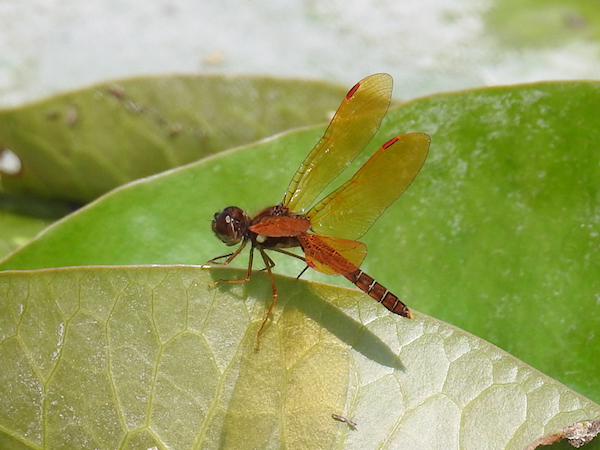
It was only six weeks ago that I last added a new species to the Eagleson storm water ponds ode list, the River Jewelwing that mysteriously showed up for one day back on June 10, 2023. I wasn’t expecting to find another new species so soon, but that is exactly what happened when I went for a walk there this afternoon. My goal was to look for the diminutive Eastern Amberwings, a species that I would have looked for earlier in the month had I not been in Nova Scotia. This colony first showed up in 2017 and its numbers have been increasing in the southern ponds over the last six years. I was happy to find four males perching on the lily pads on my visit; it appears they are still thriving here.
Eastern Amberwing
I saw Orange Bluets here for the first time this year on July 3, 2023, and I was hoping to find a few close enough to the shore to get a good photo. This is the second season that I’ve confirmed their presence here, and I was disappointed not to find any on this visit.
I saw Blue Dashers here for the first time this year on July 7, 2023; this is also only the second year that I’ve seen them here, and I counted at least eight of them around the two southern-most ponds. They are so beautiful and colourful when fresh – I can’t imagine ever becoming so used to them that I don’t want to stop and admire them, especially when they are sitting on a such a lovely perch.
Blue Dasher
I saw a male and female Common Whitetail flying over the pond together; the female was ovipositing. A White-faced Meadowhawk and a Band-winged Meadowhawk were nice to see, though the Band-winged Meadowhawk didn’t stick around long enough for photos. I’ve been keeping an eye out for Saffron-winged Meadowhawks, a species that was common here in 2020 but has been diminishing in numbers ever since – I only found two in 2021 and one in 2022. I didn’t see any on this walk, making me wonder if the population has died out. Its season lasts until September, so it is not too late to keep looking for this species.
A Slender Spreadwing was the only other odonate of interest, other than the Eastern Forktails that are usually too numerous to count.
I finished my walk with a loop around the Hope Side pond, stopping at the bridge where I took a moment to scan the water toward the overpass. I’ve seen muskrats swimming and dragonflies flitting among the vegetation here, and almost immediately something small and black fluttering in the tunnel formed by the cattails toward the bridge. When I got my binoculars on it I saw a male Ebony Jewelwing sitting in the sun!
Ebony Jewelwing
Ebony Jewelwings are usually found at woodland streams, preferring those with rapids although they may be found at shaded, slow-moving streams as well. The area it was inhabiting at the Eagleson ponds is no more than a shallow channel that drains water from the ponds into a narrow waterway running alongside a patch-work of fields before entering the Jock River at Terry Carisse Park. But since a River Jewelwing has already found its way up here perhaps I shouldn’t be surprised that this Ebony Jewelwing had followed. This is ode species #36 for the ponds – a terrific number for such a small area and limited habitat.
Doran and I visited Nova Scotia again in mid-July, now one of my favourite times to visit after seeing so many dragonfly species on our last trip. This time we rented an Airbnb in Middleton – the basement suite of a house right on the Annapolis River. Although the vegetation along the river was much too thick to get close to the water, there were a few well-trampled trails leading down to the water’s edge. In addition, our location was close to both Bridge Street (Highway 10), with Riverside Park on the opposite bank, and the South Shore Annapolis Trail which has its own bridge across the water and runs behind Riverside Park and the Middleton sewage lagoons. We got settled into the apartment, and the following day that Doran and I went exploring. My fiancé had recently become interested in searching out local waterfalls, and as a number of clubtail species can be found on fast-flowing rocky rivers, I was more than keen to accompany him.
Chris Traynor and I chat about dragonflies and damselflies a lot. We both also like to pour over old dragonfly reports, iNaturalist records, and Google maps looking for suitable habitat for this species or that, as well as interesting places to go dragon-hunting in general. It was Chris who, when searching for places to see Clamp-tipped Emerald, thought that Taylor Lake in the northwestern part of Gatineau Park might be worth a visit. There are two iNat records from the area from 2015, as well as one Brush-tipped Emerald record from a few kilometers away. The map shows a variety of ode-worthy wetlands including streams, ponds, seeps and marshes, and an exploratory hike of about 5 kilometers in the fall cemented his impressions and desire to return there during prime dragonfly season. It was also almost completely unexplored for odonates, which made it quite enticing in my eyes, and close to a spot where Chris Lewis and Bob Bracken had discovered a stream with mature Eastern Least Clubtails and other clubtails several years ago. Good Somatochlora spots in the Ottawa-Gatineau region are uncommon, and we both thought would be fantastic to discover one up in Gatineau Park. I emailed Chris Lewis about Chris’s idea to check on the trails around Taylor Lake and revisit some of her and Bob’s footsteps in Gatineau Park, and the three of us made plans to visit its northern reaches on July 8th.
I did not get out to Marlborough Forest as often as I would have liked this past summer; ongoing medical issues early in the season left me feeling too tired and too sore for the long five-hour outings I enjoyed so much last year. On June 2nd I visited the E6 trail with Rick Collins to look for the Sedge Wrens breeding there. We heard one without too much difficulty, though we weren’t able to spot it. Our other highlight was a female Ruffed Grouse on the trail trying to lure us away from its chicks (none seen) by giving distress calls. It was a gray, drizzly day so I didn’t see any insects worth photographing. Indeed, I didn’t take my camera out of my bag at all.
The weather was much better on June 19th, so Chris Traynor and I went to trail E4 to look for Twin-spotted Spiketails and some different emerald species for his life list. I was also eager to show him the pool below the culvert as this was where I’d seen my one and only Ocellated Emerald hanging out in 2020. It was a bit windy, but the sun was shining and the weather was warm, and the breeze made the usual biting insects less of a distraction.
Gatineau Park is a special place for dragonflies – many species of the National Capital Region can be found there that aren’t found on the Ontario side of the Ottawa River, while others seem to be much more common there than in Ottawa. Chris Traynor has been exploring the park quite a bit these past couple of years, searching for dragonflies that breed in the quiet lakes, sluggish streams, and fast-flowing creeks of the Gatineau Hills. Not surprisingly, he has found a good number of species that have not been reported in Ottawa, such as Eastern Least Clubtail, Mustached Clubtail, Beaverpond and Harpoon Clubtails, and even a couple of snaketails. Many of these species prefer clear, swift-moving streams with rocky bottoms, which might be the reason for their absence in Ottawa; the Ontario side of the National Capital Region is relatively flat, with more marshes and slow-moving, mucky streams winding through suburbs and forest rather than down the foothills and escarpments which form the Canadian Shield. One of Chris’s best finds was a portion of Meech Creek where Zebra Clubtails and Fawn Darners are quite common, with the occasional Dragonhunter and Violet Dancer. I accompanied him twice to this magical spot, once during the August long weekend last year, and once again this year. As I never did get around to posting those photos last year (remember I mentioned I’d fallen behind?), I will incorporate both sets of photos in this post.
Marlborough Forest has been long known to me as a special place to find some of the more unusual species of the Ottawa area – various trips to the Cedar Grove Nature Trail over the past ten years have turned up Mink Frogs, Eastern Newts and Red Efts, Blue-spotted Salamanders, Bronze Coppers, Silvery Checkerspots, Harvesters, Calico Pennants, Brush-tipped Emeralds, Lake Darners, Twin-Spotted Spiketails, Ebony Jewelwings, and Aurora Damsels. The one “specialty” of Marlborough Forest that I had not yet found, and search for every time I go, is the Smooth Green Snake – it has managed to elude me every single visit.
Back in 2015 I wrote a blog post about the odonates I found at Andrew Haydon Park one weekday afternoon near the end of July. Since discovering the colony of Halloween Pennants at AHP in 2014, I’ve made it a point to visit this park each year during mid-summer; it’s much closer than travelling all the way to Morris Island to see this stunning dragonfly! So far I’ve only made it out to Morris Island once this year, and when I found no Halloween Pennants flying along the causeway I decided to visit Andrew Haydon Park specifically to search for this species. With the strange, slow start to the season I was bit apprehensive about whether these odes would even be around at AHP, but thankfully I found a few on each of my visits, and in good numbers, too.
When Chris Lewis suggested a dragon-hunting excursion on Saturday, I was eager to go. We had to make the extremely difficult choice between Morris Island/Fitzroy Harbour and Gatineau Park, but as Chris Traynor had recently found all sorts of amazing odes at Gatineau Park (including Maine Snaketail, Riffle Snaketail, Mustached Clubtail, Dragonhunter, Horned Clubtail, Dusky Clubtail, Lancet Clubtail, Beaverpond Clubtail and Eastern Least Clubtail) earlier in the week, we decided that a morning in Quebec sounded much more appealing. I met her at her place, and with the assistance of Siri, we navigated the Gatineau Park road closures up to the Sugarbush Trail with none of the frustration I encountered the previous week.
On the first Saturday in June I made plans to meet Chris Traynor at the parking lot of the Sugarbush Trail in Gatineau Park to look for dragonflies. He has re-named this trail the “Clubtail Trail” due to the large number of clubtails that breed there, and I was eager to find some new species for my life list. Unfortunately our last visit there wasn’t terribly productive due to the overcast skies; the weather on Saturday was much nicer, sunny and warm even in the morning.
As we weren’t planning to meet until 9:00 am, I stopped by Sarsaparilla Trail first to check out the birds there. This turned out to be a fantastic idea as I heard a Least Bittern calling somewhere in the reeds to the north of the boardwalk and a Virginia Rail grunting somewhere on the south side. Other species included Brown Creeper, Eastern Wood-Pewee, Great Crested Flycatcher, Eastern Kingbird, a couple of Tree Swallows, a Marsh Wren singing in the reeds at the end of the boardwalk (the same one from last year?), a couple of Yellow Warblers, a White-throated Sparrow, and two Purple Finches.







 OdoNotations