
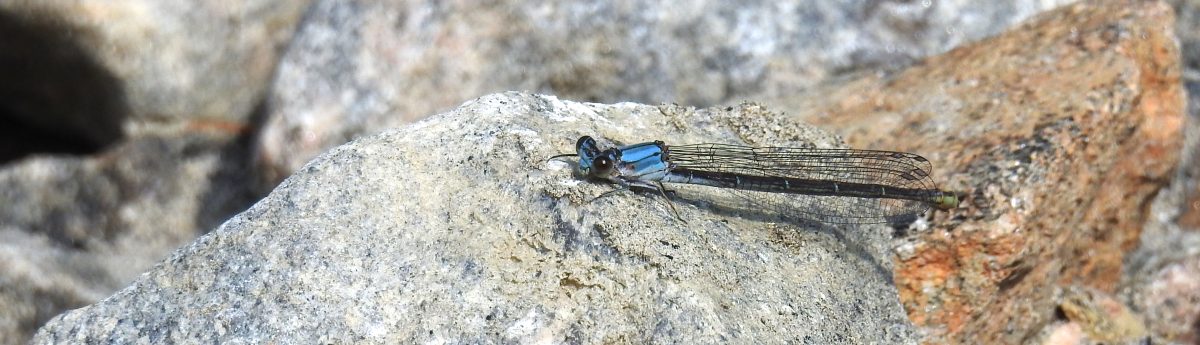
A Rare Mottled Darner

Mottled Darner

Sheila McKee Memorial Park has been such an amazing spot for odes this year that when the weekend called for not one, but TWO clear days, I decided it was worth going back for a few hours and looking for more clubtails. I arrived around 10:00, and as usual a dragonfly had claimed the first sunny opening in the woods as its territory – however, unlike the Common Whitetail, Racket-tailed Emerald, and Black-shouldered Spinyleg of my previous visits, this one was a brilliant green Eastern Pondhawk actively darting around and landing on different leaves. I took one terrible photo of it sitting on a leaf above head-height, facing me. This was the only pondhawk I saw, so I’m glad I got a photo for iNaturalist.

Continue reading “A Rare Mottled Darner”

Canada Day Clubtails – Part 1

Cobra Clubtail

On July 1st I spent the morning at Sheila McKee Memorial Park with the full intention of heading out to Pinhey’s Point afterward. My goals were to get to Sheila McKee early enough to look for the Yellow-throated Vireo and Yellow-billed Cuckoo that had been found there recently, then look for dragonflies in the open meadow and along the river shore. I was hoping to find another Mustached Clubtail, or perhaps an Arrow Clubtail, or the first Cobra or Midland Clubtails of the season. It was a bit cool in the morning, so I waited until 8:30 am to leave. When I got there just before 9:00 there were already several cars in the parking lot, and by the time I headed out to the road to listen for the elusive cuckoo a cavalcade of cars was turning into the parking lot from Sixth Line Road.

Continue reading “Canada Day Clubtails – Part 1”

Clubtail Season Begins at Sheila McKee Park

Black-shouldered Spinyleg

After a couple of wonderful outings the previous weekend, I was looking forward to heading back out to the west end to Sheila McKee Memorial Park to see if any new dragonflies had emerged. However, the weather was most uncooperative – it rained almost the entire weekend. So I took Tuesday morning off work instead, as it was forecast to be both warm and sunny…the temperature had already reached 20°C by 7:00am. My goals were still to look for rarities such as the Mustached Clubtail reported there on May 24, 2021 and the Arrow Clubtail reported there on June 24, 2021. I knew the Arrow Clubtail would be almost impossible, as it is very rare in our region, but as the Mustached Clubtail had a few sporadic reports from Remic Rapids on both sides of the Ottawa River I thought I had at least a shot of finding that species….long though it might be!

The sky was pure blue when I left, and the day’s high forecast was to be a sunny, humid 29°C – perfect weather for dragon-hunting. I left just before 9:00 so I would miss the worst of the rush hour traffic and arrived about 10:20. Being a workday, there were only two other cars in the parking lot when I arrived, and I saw no one on the beach by the time I got there.

Continue reading “Clubtail Season Begins at Sheila McKee Park”

Quebec: Kazabazua and Beyond

Black-tipped Darner

The Common Sanddragon is one of the dragonfly species in the Algonquin Park field that is not found in the Ottawa-Gatineau region. A member of the clubtail family, it is well-marked with a mottled green and brown thorax reminiscent of a Harlequin Darner and uniquely-shaped markings down the length of the abdomen to segment 7: they look like goblets in the male, and start out as goblet-shaped in the female but gradually lose the stem. Their legs are very short for a dragonfly, and mature males have green eyes while females have gray or brown eyes. The appendages in both sexes are pale, and they are the only dragonfly in our region which has pale appendages, a mottled thorax, and brown spots at the base of each wing. Its larvae live in rivers, lakes, and streams with sandy bottoms, and due to its short legs, the adults perch horizontally on the sandy beaches and banks of its rivers rather than hanging from trees or in the vegetation. At the time of the printing of the first edition of the Algonquin field guide, it had not been recorded within the park and was only known from a few sites in Peterborough County and a single record from Windsor in Ontario’s deep south.

Continue reading “Quebec: Kazabazua and Beyond”

Clubtails at Sheila McKee Park

Cobra Clubtail

On July 22nd I received an email from Chris Lewis about a new dragonfly spot along the Ottawa River. I’d been to Shelia McKee Park out near Dunrobin just once, on an OFNC trip in 2015 to look for herps; it has a network of woodland trails and a steep staircase that leads down from the top of the cliff to the rocky beach at the bottom. Chris said she found evidence of a very recent dragonfly emergence of in the form of both exuviae and teneral dragonflies; she recognized exuviae of both clubtails and emeralds, though she was not able to identify them to species. She saw an unidentified darner and several teneral meadowhawks in the woods, and several Powdered Dancers and a pair of Stream Bluets in tandem near the water. However, it was her clubtail report that intrigued me: she mentioned one Lancet Clubtail, both mature and teneral Black-shouldered Spinylegs, several Midland Clubtails, and one Cobra Clubtail which had become the unfortunate meal of a Midland Clubtail. It is amazing that I’ve never considered going back to this park for odes before – the shoreline here is quite rocky, with little or no emergent vegetation, reminiscent of Britannia Point at Mud Lake or the causeway at Morris Island, both of which are great spots for clubtails. Curious to see these clubtails for myself, I headed out the following Sunday (July 28th) and brought my net in case there was anything worth catching.

Continue reading “Clubtails at Sheila McKee Park”

Morris Island

Halloween Pennant

My last day off was Tuesday, and the forecast finally called for a decent amount of sun during the morning and afternoon. I invited a friend, Jon, to go dragon-hunting with me at Morris Island since he was eager to become re-acquainted with odonates after a long absence. There were a few particular species on his must-see list, including Cobra Clubtail, Cyrano Darner and Dragonhunter; I’d seen all of these at Morris Island before, though I wasn’t optimistic about our chances of seeing the Cyrano. Although it is considered to be a widespread species, inhabiting swamps, small lakes, and slow-moving rivers of the eastern half of the continent, adults are rarely seen. It is thought that once they emerge they immediately fly up into the tree-tops where they spend most of their time. Adult males can sometimes be found patrolling their territory, and this appeared to be just such a case with the one that I caught in the parking lot of the Morris Island Conservation Area last year. That was on June 25th, however, I was worried that we might be too late to see them.

Continue reading “Morris Island”