
To Catch a Cruiser

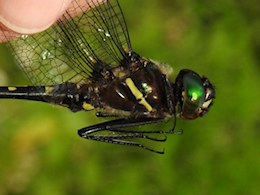
Swift River Cruiser (Macromia illinoiensis)

I don’t see Swift River Cruisers very often, and even when I do, I seldom get the opportunity to catch or photograph one. I used to see them fairly regularly at Mud Lake, but now it seems the best place to see them – aside from my recent outing to Quebec with Chris Traynor – is Sheila McKee Memorial Park. However, even here I only see them in flight, either far out on the water or soaring high above the trees with the Prince Baskettails. Swift River Cruisers love feeding in large, sunny clearings near the rivers they breed in, dancing in the sky with graceful twists and turns too rapid to follow with the eye. They do, however, perch fairly regularly, though I have never seen one doing so at Sheila McKee Park. As such, I have not been able to enter any of my sightings into iNaturalist as photographing them is next to impossible while they are in flight.

Continue reading “To Catch a Cruiser”
Two provinces. Six families. One unbelievable day.

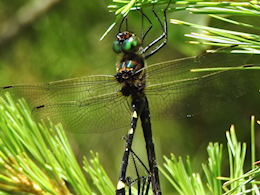
Swift River Cruiser (Macromia illinoiensis)

If you had told me it was possible to see more than a dozen Prince Baskettails hanging from the pine trees like early Christmas ornaments, three perching Swift River Cruisers (including two in a mating wheel), a perching Springtime Darner, an ovipositing Cyrano Darner, an emerging Dragonhunter, four additional clubtail species, a dozen Brush-tipped Emeralds, about 50 Widow Skimmers, and an Arrowhead Spiketail all in a single day here in the Ottawa region, I am not sure I would believe you. That kind of day is so rare in Ottawa that I would would assume that you were engaging in a particularly fanciful daydream. However, on the Quebec side of the river many things are possible. Part of it is due to the scenic geography – the deep, rocky lakes, rushing streams, and variety of marshes, swamps and bogs carved out of the Canadian Shield provide a fantastic variety of habitats. Part of it is due to the untouched wilderness outside of the Gatineau area – there are no cottages lining the shore, no subdivisions full of manicured lawns, no pesticides and insecticides to wreak havoc on insect populations. These two factors make it an excellent place to see a variety of odes – especially along the Ottawa River, a major dragonfly habitat of its own.

Continue reading “Two provinces. Six families. One unbelievable day.”