Revisiting Terry Carisse Park

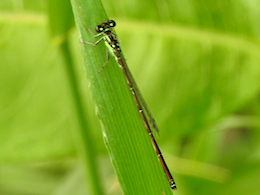
Fragile Forktail (Ischnura posita)

I haven’t spent much time at Terry Carisse Park this year, as I’ve had other projects and priorities demanding my attention and limited ode-hunting time. However, in May I received an email from a blog reader in Montreal named Pierre who was interested in trying to find a particular damselfly species – the Rainbow Bluet – which he and his wife had tried to find last year, without any luck, in known areas of Ottawa. He was interested in visiting Terry Carisse Park after reading my blog posts and messaged me in late May for the details, hoping these small, colourful damselflies would be easier to find this time around. I told him the best places to find them in the park (at the canoe/boat launch at the north end of the park and in the sunny vegetation at the top of the river bank along the south end) and told him to let me know how it went. I didn’t expect to hear from him until after his visit, but received another message on June 12th asking if I had been there recently. I hadn’t – I’d spent the previous two weekends in Nova Scotia, and the weather on my remote-work days has been too lousy to go look for odes. But when I saw the forecast for the following day – sunny and warm – I decided to head on over to see if I could do some pre-scouting for him ahead of his weekend trip.

Continue reading “Revisiting Terry Carisse Park”
The Bite of a Dragon

Mustached Clubtail

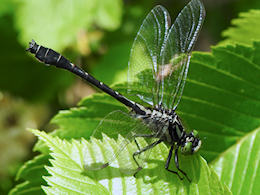
This weekend promised to be the hottest one of the year – over 30°C with humidity that made being outdoors feel like being smothered in a wet sheet. I went out early Sunday morning to Sheila McKee Memorial Park, hoping to find more clubtails and perhaps an interesting darner or emerald. As it was already 10:00 when I got there, I went down to the beach first because I thought it would get more crowded later and because the sun hits the shoreline at the base of the escarpment early in the morning – a vital factor when looking for uncommon dragonflies sitting on sun-drenched leaves.

Continue reading “The Bite of a Dragon”

A Dazzle of Dashers

Blue Dasher

After leaving Mud Lake I went to Sheila McKee Memorial Park to try my luck there. I was hoping that the whitefaces would still be flying, as I wanted to find some fully mature individuals after seeing so many tenerals and immatures right before my trip to the Maritimes, and I was hoping that some clubtails had emerged. It was still sunny, only about 18°C, and while the wind was still blowing, the small clearings in the woods at the top of the escarpment were relatively protected. I didn’t see any odes other than a few Powdered Dancers until I reached the main clearing where the trail leading down to the water branches off to the right. Some smaller dragonflies were perching in shrubs at the edge of the clearing, and I was delighted to find some freshly emerged Blue Dashers – both males and females!

Continue reading “A Dazzle of Dashers”

Elegance and Rainbows at Terry Carisse Park

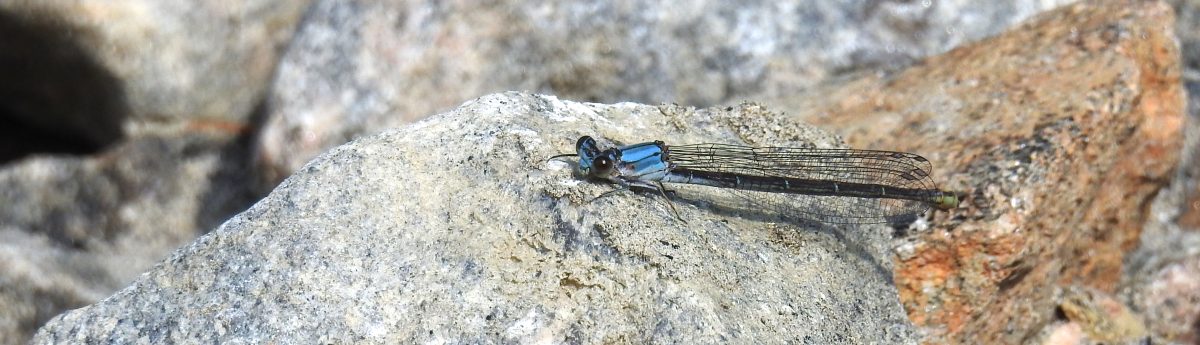
Rainbow Bluet

Last year I embarked on a new odonate project: to study the species found at one tiny park along the Jock River. This park, originally named Bow of the Jock Park before it was changed to Terry Carisse Park in 2006, consists of a narrow strip of green space that runs perhaps 500 or 700 meters along the shore of the Jock River on an elevated bank about two meters above the water. The park itself consists mostly of manicured lawn with a wooded swamp at the north end where Mahoney Creek empties into the Jock River, two launching areas for canoes and kayaks, a playground, and a thick band of riparian vegetation that almost completely blocks all views of the river from one end of the park to the other. The Jock River itself is smaller than the Rideau River, much more sluggish, without a lot of rocks or rapids that would attract the clubtails and spiketails found in Gatineau Park. It hasn’t been surveyed for odonates as well as the Ottawa River has, mainly because much of it runs through private agricultural or residential land, with only a few small parks with even smaller access points in Richmond and Ottawa.

Continue reading “Elegance and Rainbows at Terry Carisse Park”

Searching for the Arrowhead Spiketail

Stream Cruiser

Spiketails are large, brightly coloured dragonflies that inhabit small or mid-sized streams, usually with a good current in forested areas. There are three species present in eastern Ontario, all with dark brown or black bodies, green eyes, and bold yellow patterns along the abdomen that may cause them to be confused with clubtails in flight. Each species has a dark thorax with two vivid yellow stripes on the side and two smaller yellow dashes on the top. It is the pattern on the top of the abdomen that distinguishes them: the Arrowhead Spiketail has a single line of yellow arrows pointing toward two round spots at the tip; the Twin-spotted Spiketail has two lines of yellow spots with straight tops and rounded bottoms running down the abdomen, set close together; and the Delta-spotted Spiketail has two lines of widely-separated spots running down the abdomen, each pointed and distinctly triangular in shape. Because of their habitat requirements, they are considered local and uncommon, and in Ottawa the Arrowhead Spiketail is considered the rarest of the three.

Continue reading “Searching for the Arrowhead Spiketail”

Identifying the Small Baskettails of Ottawa

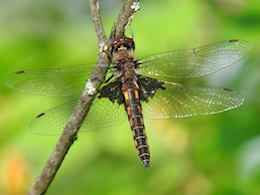
Common Baskettail
Common Baskettail

On May 14th I wrote about a mass emergence of Spiny Baskettails at Mud Lake but didn’t explain much about how I identified them except to say my identification was based on the shape of the male claspers. Emerging dragonflies are pale and translucent, showing little to no colour of the mature adults they will become, but fortunately identification of the three small baskettail species in Ottawa does not depend the pattern of colours on its body (a fourth species, the Prince Baskettail, is much larger and has distinctive black spots at the base, tip and center of its wings). This post provides more detail about how to distinguish between the Common Baskettail, the Spiny Baskettail, and the Beaverpond Baskettail, three similar-looking species of the emerald family. While they are most likely to be found patrolling sunny woodland openings or grassy spaces next to water, they often perch on tree branches and plant stems at an angle, allowing good views or photographs.

Continue reading “Identifying the Small Baskettails of Ottawa”

Dragonfly Emergence

Freshly emerged dragonfly

My first real dragonfly outing of the year occurred on May 24, 2021, and as usual, took place at Roger’s Pond in Marlborough Forest. I invited a few friends to join me now that outdoor gatherings can include up to 5 people, and fellow OFNC members Derek and Gerald decided to join me. It was a warm, sunny day, and I hoped to find the usual common skimmers and clubtails, as well as a few uncommon species that I’d seen previously at Marlborough Forest such as the elusive Ebony Boghaunter and Harlequin Darner. I’ve already seen one boghaunter this season, but it’s been a few years since I’ve seen a Harlequin Darner, and the Cedar Grove Nature Trail has been a repeat site for this ode.

We met at 9:30 am, just early enough to get some birding in while waiting for the sun to rise higher in the sky. We had the usual Nashville Warblers, Black-throated Green Warblers, Great Crested Flycatchers, White-throated Sparrows, Veeries, and Yellow-bellied Sapsuckers on the walk in. At the pond itself we had Eastern Kingbirds, a Pied-billed Grebe, Common Yellowthroats and four Ring-necked Ducks. Many dragonflies were already flying along the open trail through the cedar forest, including a few teneral whitefaces and emeralds.

Continue reading “Dragonfly Emergence”

Dragonflies in June

Common Baskettail

June is one of my favourite months. Normally the weather is hot and sunny by the time the solstice rolls around, the birds are all in full song, and newly-emerged butterflies and dragonflies are returning to woodlands, fields and wetlands. However, the weather this month has not been great. The rain from May continued on and off this month, keeping water levels of the rivers and ponds higher than normal, and likely delaying the emergence of many insects. The weekends have been nice, at least; I’ve been able to get out early in the day in order to look for new birds for my year list and any butterflies and dragonflies that may have emerged. While my enthusiasm has certainly declined since our amazing trip to Costa Rica, I’ve found myself regaining interest in visiting trails and conservation areas close to home, hoping to find some species I haven’t seen since the previous summer.

The day after my trip to the Bill Mason Center, I made plans with Chris Lewis and Chris Traynor to head out to the Cedar Grove Nature Trail in Marlborough Forest to look for odes around Roger’s Pond. I would be co-leading an OFNC outing there the following weekend with Jakob Mueller, a reptiles and amphibians guy, and wanted to get an idea of the dragonflies and damselflies that were flying. As we weren’t meeting at the parking lot there until 8:30, I headed out to Sarsaparilla Trail first, then the Rideau Trail for a quick look around.

Continue reading “Dragonflies in June”

Dragon Blitz 2016 – Part II

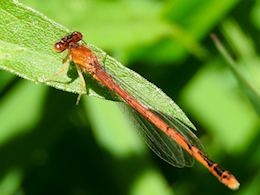
Eastern Red Damsel

After leaving Sarsaparilla Trail I drove over to the NCC parking lot on Corkstown Road and followed the bike path beneath the Queensway to the place where Chris Traynor had seen the Eastern Red Damsels earlier in the week. The spot isn’t hard to find; just keep following the path parallel to the Queensway as it passes over a small bridge and skirts the northern edge of a farmer’s field. Eventually the path reaches a small woodlot and abruptly turns south; before you get to the small stand of trees, watch for an NCC sign on the left about the crops of the Greenbelt. Chris had found the damselflies in the grass behind the sign.

Continue reading “Dragon Blitz 2016 – Part II”