Andrew Haydon Park is not a place I visit often in June; it’s more of place I visit in fall and early winter for migrating waterfowl, early spring for more of the same, and then in July through to the end of dragonfly season to look for summer odes. I’ve never looked for odes at the beginning of dragonfly season, since all of the species recorded there are easily found elsewhere, but after reviewing iNaturalist I realized there were a lot of species present that I hadn’t yet recorded there personally. Most of these are one-time observations on iNaturalist – many are very common species that fly early in the season, and only a handful fly later in the summer. This made it a great reason to stop by the park for a quick check after leaving the Watts Creek Pathway and before going on to Sheila McKee Memorial Park.
I usually see my first dragonfly of the year in April, which is not surprising given that the first dragonflies migrate here from further south during the first prolonged warm spell of the month. They are always Common Green Darners, heading north to find new ponds and lakes in which to breed. It isn’t until later in May, usually the second week when temperatures are consistently in the 15-20°C range, that the local species emerge, chiefly skimmers and emeralds and, of course, damselflies. However, this season it didn’t warm up to 20°C until the very end of the month of April. It was still warm by the time the first weekend of May arrived, and on May 4th I finally saw my first Common Green Darners at a small pond in Stony Swamp – three males, it appeared.
After leaving Mud Lake I went to Sheila McKee Memorial Park to try my luck there. I was hoping that the whitefaces would still be flying, as I wanted to find some fully mature individuals after seeing so many tenerals and immatures right before my trip to the Maritimes, and I was hoping that some clubtails had emerged. It was still sunny, only about 18°C, and while the wind was still blowing, the small clearings in the woods at the top of the escarpment were relatively protected. I didn’t see any odes other than a few Powdered Dancers until I reached the main clearing where the trail leading down to the water branches off to the right. Some smaller dragonflies were perching in shrubs at the edge of the clearing, and I was delighted to find some freshly emerged Blue Dashers – both males and females!
After leaving Yarmouth we drove to our next stop on the tour, a cottage on Trout Lake south of Middleton in Annapolis County. The lake was nice, but quiet: there was a small sandy beach with several rocks protruding from the water at either edge of the property. A little bit of emergent vegetation made for some great perches for skimmers and damselflies, but I didn’t see either during our short stay. The weather was cool and cloudy for most of our time there, which, combined with the early season – there were no Slaty Skimmers or Calico Pennants flying yet – likely had a lot to do with a lack of odes at the water.
Both of the days we were there dawned with the sky completely covered in cloud. It was cold our first morning there, so cold that I didn’t even want to go for a walk along the gravel road. Instead we went into Greenwood to get breakfast, pick up some groceries, and check out a few rocky creeks and waterfalls that we had visited on past trips. The thick blanket of clouds covering the sky showed signs of breaking up by the time we finished our errands, so we headed to a small trail on Rock Notch Road that looked over Fales River and a medium-sized waterfall that once powered a water mill from 1857 to 2002.
Sheila McKee Memorial Park has been on my mind all winter. I haven’t been there since 2020, and when thinking of good spots to look for clubtails close to home, I remembered seeing Cobra Clubtails, Lancet Clubtails, and Black-shouldered Spinylegs there later in the summer on my previous visits. The open, rocky shoreline makes it a better spot to see them perching than Mud Lake, and as it isn’t as far as Gatineau Park it was high on my list of places to explore. I started poring over iNaturalist sightings over the winter and was delighted by the additional clubtail species that had been observed there – not only the Midland Clubtail my mentor Chris mentioned seeing back in 2019, but also two rarities: Mustached Clubtail and Arrow Clubtail. I’ve seen Mustached Clubtail once at Sugarbush trail in Gatineau Park, but Arrow Clubtail (Stylurus spiniceps) is so rare that it’s not even on my mental dashboard, let alone my radar. This clubtail is one of the hanging clubtails referred to in a previous post; it perches by hanging vertically from a leaf or branch instead of horizontally on the ground. Perhaps that’s the reason I’ve never seen one, then: I don’t spend too much time looking in trees for odes, unless I happen to see one fly in and land!
The Common Green Darner is the first dragonfly I see most years, but its appearance doesn’t truly herald the start of the dragonfly season for me. Common Green Darners are migrants, usually showing up on the first warm winds of April. Spring is fickle here in Ottawa, however, and those warm southerly winds may be followed by blustery cold north winds the following week, or even worse, snow. As such it might be a long time before the next odonata sighting.
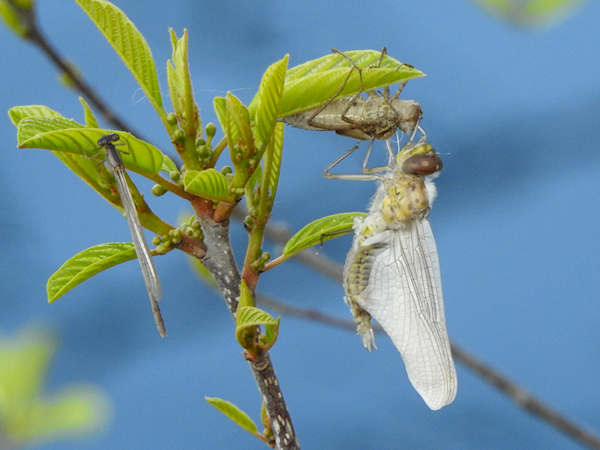
A more reliable sign for me is the emergence of the first dragonflies from local ponds and wetlands. So even though I saw my first Common Green Darners – a pair in a mating wheel at the Eagleson ponds – on April 28, I didn’t see the first local dragonflies until May 12 when a visit to Mud Lake produced several emerging Spiny Baskettails and a few teneral damselflies too colourless to identify. I took a few photos from the new observation platform; most still had milky-white wings while a few were still in the process of shedding their larval skin.
Spiny Baskettail (Epitheca spinigera)
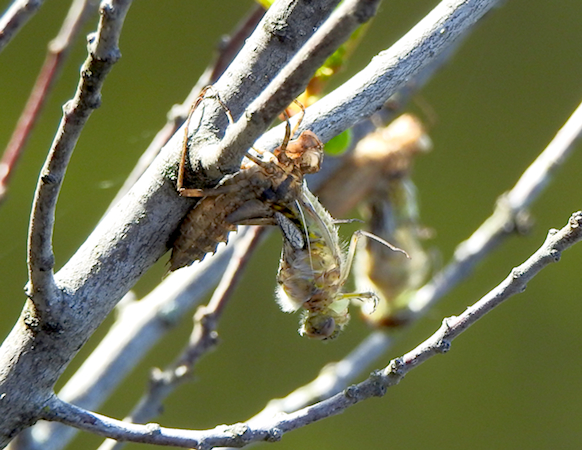
After that I went over to the rocks on the south shore where I’d photographed a large number of Spiny Baskettails emerging in 2022. Sure enough, there I found a few fully-winged tenerals perching in the trees or on the side of the boulders waiting for their muscles to become strong enough for their first flight. Out of the corner of my eye I could see these fresh teneral dragonflies lifting off from their perches all around me and heading for the trees. In the meantime, I was able to prompt a few that were hanging precariously from the rocks above the water to crawl onto my hand where I identified them as Spiny Baskettails before placing them on the branch of a shrub in a safer position
Spiny Baskettail (Epitheca spinigera) Emerging
One fell into the water before I could lift it off of the rock face, and I was able to fish it out with my hand – I had no net with me as I had been birding with a friend and didn’t expect to see any dragonflies.
Seeing all these baskettails in various stages of emergence on such a beautiful, warm afternoon after a week of rain and cooler temperatures left me with a feeling of joy and wonder. Dragonfly season has finally begun – I’m hoping that they will bring the sun and nice weather with it!
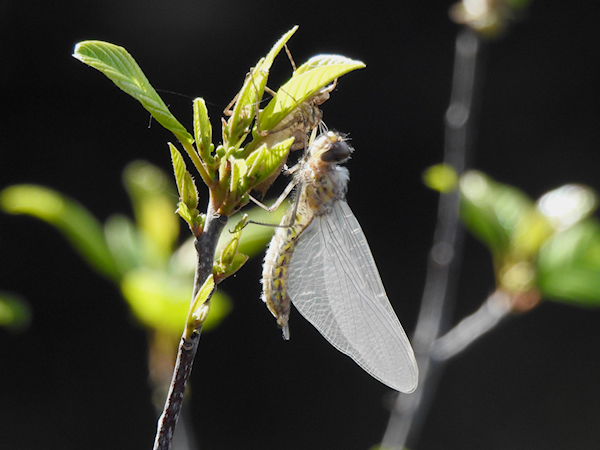
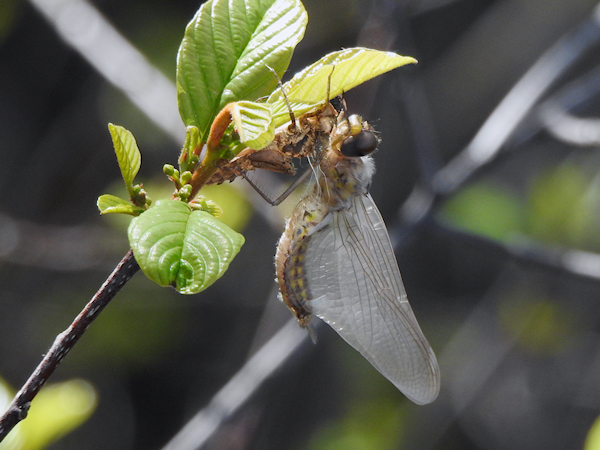
Spiny Baskettail (Epitheca spinigera) emerging – note the exuvia
Spiny Baskettail (Epitheca spinigera) with its exuvia and a teneral damselfly
Teneral Spiny Baskettail (Epitheca spinigera) fluttering its wings before flight
Teneral Spiny Baskettail (Epitheca spinigera)
Male Spiny Baskettail (Epitheca spinigera) – note the curving claspers
Spiketails are large, brightly coloured dragonflies that inhabit small or mid-sized streams, usually with a good current in forested areas. There are three species present in eastern Ontario, all with dark brown or black bodies, green eyes, and bold yellow patterns along the abdomen that may cause them to be confused with clubtails in flight. Each species has a dark thorax with two vivid yellow stripes on the side and two smaller yellow dashes on the top. It is the pattern on the top of the abdomen that distinguishes them: the Arrowhead Spiketail has a single line of yellow arrows pointing toward two round spots at the tip; the Twin-spotted Spiketail has two lines of yellow spots with straight tops and rounded bottoms running down the abdomen, set close together; and the Delta-spotted Spiketail has two lines of widely-separated spots running down the abdomen, each pointed and distinctly triangular in shape. Because of their habitat requirements, they are considered local and uncommon, and in Ottawa the Arrowhead Spiketail is considered the rarest of the three.
Last year a particular OFNC outing caught my eye: a bioblitz to be held at the Morris Island Conservation Area on September 10th. Morris Island is a fantastic place for a bioblitz; the woodlands and wetlands of this 47-hectare site are home to a number of fascinating wildlife species, including several ode species not regularly found in my area of the city. I had never gone ode-hunting in September there before, as September is past the peak of ode season, with fewer species flying than in June or July. Still, it was a good chance to observe what was still flying there, and maybe find an unusual darner species or two. I attended with Chris T. and Chris L. and we photographed seven species for inclusion on the Morris Island Bioinventory Project on iNaturalist: Skimming Bluet, Eastern Forktail, Fragile Forktail, Powdered Dancer, Halloween Pennant, Autumn Meadowhawk, and White-faced Meadowhawk. So much for finding any cool darners!
On May 14th I wrote about a mass emergence of Spiny Baskettails at Mud Lake but didn’t explain much about how I identified them except to say my identification was based on the shape of the male claspers. Emerging dragonflies are pale and translucent, showing little to no colour of the mature adults they will become, but fortunately identification of the three small baskettail species in Ottawa does not depend the pattern of colours on its body (a fourth species, the Prince Baskettail, is much larger and has distinctive black spots at the base, tip and center of its wings). This post provides more detail about how to distinguish between the Common Baskettail, the Spiny Baskettail, and the Beaverpond Baskettail, three similar-looking species of the emerald family. While they are most likely to be found patrolling sunny woodland openings or grassy spaces next to water, they often perch on tree branches and plant stems at an angle, allowing good views or photographs.
By May 14th Ottawa had seen a string of six days with temperatures above 20°C, with the last three above 30°C. The warmth signaled the beginning of ode season, with my first dragonflies of the season – both Common Green Darners – seen at the Richmond Conservation Area (May 10) and Sarsaparilla Trail (May 11, 2022). Common Green Darners are migrants, however, arriving on the warm winds flowing from further south. The true ode season begins once it is warm enough for local dragonflies and damselflies to emerge from the rivers and wetlands in which their life cycle began. All odonates lay their eggs in water, and it takes time – from a few months to a few years – for the larvae to go through the individual stages of molting until they are large enough to begin the transformation from nymph to adult. When the nymph is ready, it crawls out of the water onto rocks, emergent vegetation, or nearby tree trunks or plant stems, and then bursts out of the larval shell through a hole in its back, using gravity to pull itself free. I have seen various dragonflies in the middle of this process a few times; I had never witnessed the full transformation as it takes a few hours for the dragonfly to become ready for its first flight. However, when I arrived at Mud Lake on a sunny day in mid-May hoping to find some warblers, it was a mass emergence of at least 50 individual dragonflies that engaged my attention, and I was able to observe many individuals at different points of the process.
My first real dragonfly outing of the year occurred on May 24, 2021, and as usual, took place at Roger’s Pond in Marlborough Forest. I invited a few friends to join me now that outdoor gatherings can include up to 5 people, and fellow OFNC members Derek and Gerald decided to join me. It was a warm, sunny day, and I hoped to find the usual common skimmers and clubtails, as well as a few uncommon species that I’d seen previously at Marlborough Forest such as the elusive Ebony Boghaunter and Harlequin Darner. I’ve already seen one boghaunter this season, but it’s been a few years since I’ve seen a Harlequin Darner, and the Cedar Grove Nature Trail has been a repeat site for this ode.
We met at 9:30 am, just early enough to get some birding in while waiting for the sun to rise higher in the sky. We had the usual Nashville Warblers, Black-throated Green Warblers, Great Crested Flycatchers, White-throated Sparrows, Veeries, and Yellow-bellied Sapsuckers on the walk in. At the pond itself we had Eastern Kingbirds, a Pied-billed Grebe, Common Yellowthroats and four Ring-necked Ducks. Many dragonflies were already flying along the open trail through the cedar forest, including a few teneral whitefaces and emeralds.
In most years dragonfly season begins around the Victoria Day weekend (which always falls on the third Monday of May). I remember visiting Mud Lake on the long weekend in years past and seeing up to a hundred freshly emerged dragonflies perching in the trees there. However, in the last few years it seems that dragonfly season has started later than normal – the long-lingering cooler spring weather has played a large part in this, as emergence depends chiefly on the temperature of the water the dragonfly nymphs are living in. By the second weekend of May I’d go out eagerly hoping to see the first dragonflies of the year, and by the end of May I’d still be looking for them. Even when I eventually found some, such as last year, numbers would be low, and it would take time for the season to get back on track. Numbers remained low in Ottawa all summer last year for some reason, though we think that the unprecedented spring flooding might have been the cause, either washing away the small nymphs or dumping unhealthy amounts of debris, sediment, and chemical-laden runoff in areas where they breed.
On June 5th I headed out to Dunrobin to spend some time looking for odes and birds. My first stop was the Crazy Horse Trail on March Road at the end of Huntmar Road. This is a relatively new pedestrian-only trail for hikers, skiers, and snowshoers that was developed by the Friends of the Carp Hills under an agreement with the City of Ottawa. It is named for an old tavern that used to stand adjacent to the trailhead but has long since been demolished. The goal of the trail is to provide recreational access to the the Carp Hills on City-owned property while keeping impact on the environment to a minimum. The trail is narrow, and as there is no intention to groom or widen the trail, people are asked to respect the natural areas by staying on the trail, keeping dogs under control at all times (which means using a leash if necessary), leaving no waste, and respecting property boundaries. There are some rough, volunteer-built boardwalks in places too wet to cross which adds to its charm. In fact, all trail maintenance and improvement depends on volunteers, rather than the City, which makes it doubly important to respect the work they have done in creating this trail.
After leaving Sarsaparilla Trail I drove over to the NCC parking lot on Corkstown Road and followed the bike path beneath the Queensway to the place where Chris Traynor had seen the Eastern Red Damsels earlier in the week. The spot isn’t hard to find; just keep following the path parallel to the Queensway as it passes over a small bridge and skirts the northern edge of a farmer’s field. Eventually the path reaches a small woodlot and abruptly turns south; before you get to the small stand of trees, watch for an NCC sign on the left about the crops of the Greenbelt. Chris had found the damselflies in the grass behind the sign.
On Victoria Day I returned to Mud Lake to look for migrants and dragonflies. I arrived early – before 7:00am – in order to beat the crowds, but even at that time there were a few people wandering around. I started at the ridge and worked my way around the conservation area in a clockwise direction; I hoped that by exploring the quieter side trails I would come up with a decent list for the morning. Well, I did finish my outing with a good number of bird species – 43 total – but most of them were found along the northern and western sides, which is where I usually bird anyway, especially when I am short on time.





 OdoNotations