Two provinces. Six families. One unbelievable day.

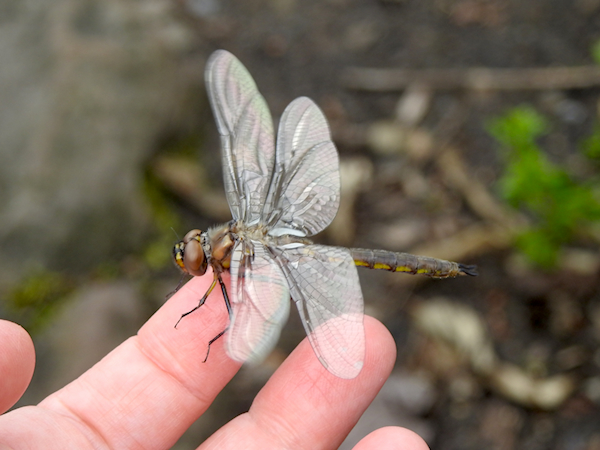
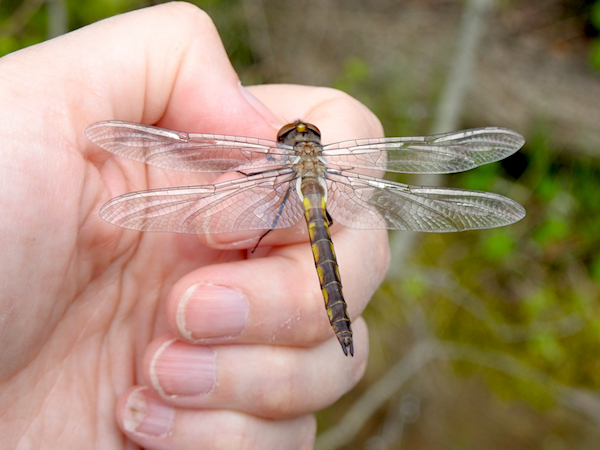
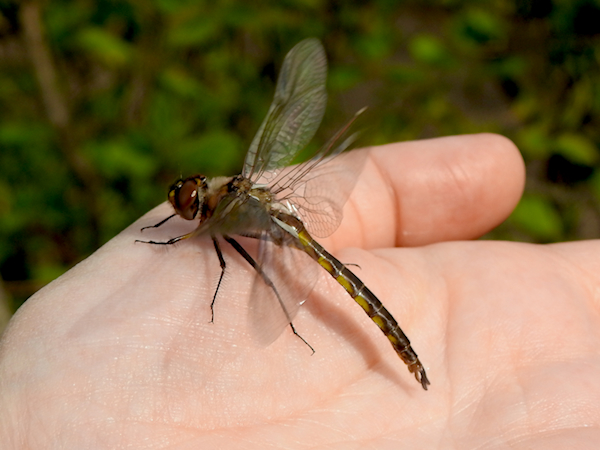
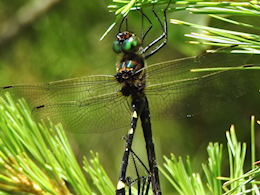
Swift River Cruiser (Macromia illinoiensis)

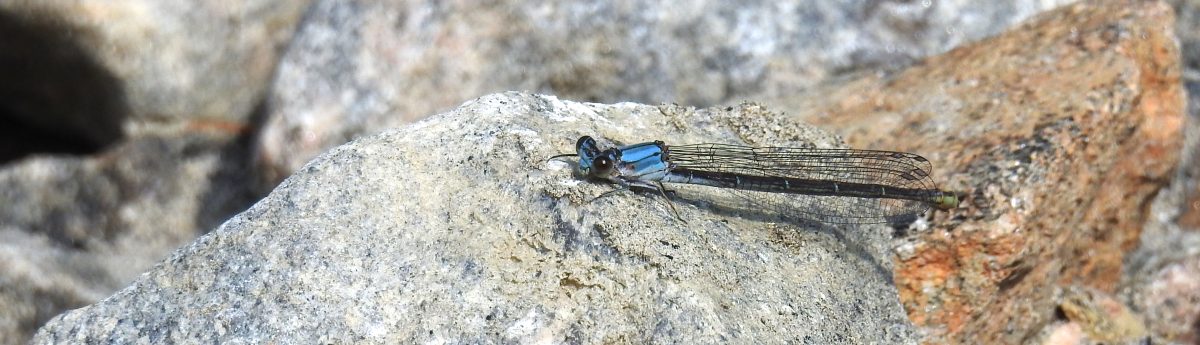
If you had told me it was possible to see more than a dozen Prince Baskettails hanging from the pine trees like early Christmas ornaments, three perching Swift River Cruisers (including two in a mating wheel), a perching Springtime Darner, an ovipositing Cyrano Darner, an emerging Dragonhunter, four additional clubtail species, a dozen Brush-tipped Emeralds, about 50 Widow Skimmers, and an Arrowhead Spiketail all in a single day here in the Ottawa region, I am not sure I would believe you. That kind of day is so rare in Ottawa that I would would assume that you were engaging in a particularly fanciful daydream. However, on the Quebec side of the river many things are possible. Part of it is due to the scenic geography – the deep, rocky lakes, rushing streams, and variety of marshes, swamps and bogs carved out of the Canadian Shield provide a fantastic variety of habitats. Part of it is due to the untouched wilderness outside of the Gatineau area – there are no cottages lining the shore, no subdivisions full of manicured lawns, no pesticides and insecticides to wreak havoc on insect populations. These two factors make it an excellent place to see a variety of odes – especially along the Ottawa River, a major dragonfly habitat of its own.

Continue reading “Two provinces. Six families. One unbelievable day.”

Transformation

Elusive Clubtail

On Sunday, July 7, 2024 Jeff Skevington, known chiefly for his work on butterflies and flower flies, discovered a first record of dragonfly species for the Ottawa region: a Painted Skimmer (Libellula semifasciata) in Burnt Lands Provincial Park. This species is at the northern edge of its range in southern Ontario, though there is one record from Algonquin Park and one record from Smiths Falls on iNaturalist. This dragonfly has the body of a Four-spotted Skimmer and wing pattern of a Calico Pennant, though the spots are brown instead of red, with a wide amber patch at the base of the wings. The veins at the leading edge of the wings are colourful, too: gold in females and red in males. It is a distinct dragonfly within its range, and outside of it too: Paulson states it is probably migratory in the northern part of its range, and it has been observed moving north over the past 15 years. Perhaps it was only a matter of time before one was seen in Ottawa.

I thought briefly about trying to see the Painted Skimmer the following Saturday, but the forecast, as well as the chances of trying to re-find a bug that had been seen 6 days ago, deterred me: the forecast called for a sunny high of 29°C with the humidity making it feel closer to 40. Burnt Lands Provincial Park is a hot, shadeless alvar better suited for grassland species such as Clay-colored Sparrows than woodland species such as Wood Thrush, and with no trees, running water, or shelter I decided – reluctantly – to head elsewhere, though I would have loved to have seen the Painted Skimmer. It is a species I will have to keep an eye out for while visiting southern Ontario.

Continue reading “Transformation”

Canada Day Clubtails – Part 2: Emergence

Emerging Clubtail

I’ve seen large numbers of emeralds (Spiny Baskettails) emerging at Mud Lake and skimmers (species unknown) emerging at Roger’s Pond. These mass emergences were thrilling, but not surprising given how I often I see large numbers of adults of both types of dragonflies feeding together before dispersing – swarms of baskettails flying up and down trails, and large groups of Chalk-fronted Corporals and Dot-tailed Whitefaces resting on various perches close to the water. Clubtails are not usually found in swarms or large groups (they are perchers rather than fliers, so a swarm would be particularly unusual), so I never thought I’d see a large emergence of members of this dragonfly family. That changed with my Canada Day visit to Sheila McKee Park.

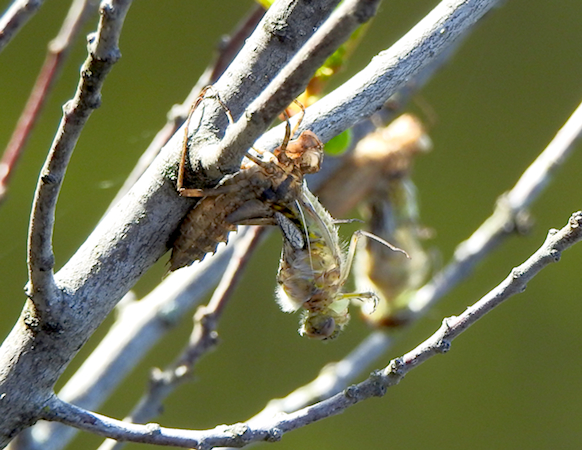
The first emerging clubtail caught my eye when I saw what looked like two nymphs on the rocky beach grappling with each other. Closer inspection revealed it to be a nymph trying to break free of its larval shell so it could complete its transformation. It seemed odd to me that it was on the ground – all the baskettails I’ve seen emerging had crawled up onto the branches of the shrubs at the water’s edge, and all of the skimmers had crawled up the stems of the short grassy vegetation lining the trail at Roger’s Pond. The only place I’ve seen clubtail exuviae is on the trunks of the large trees behind the ridge at Mud Lake or on rocks within the water in Gatineau Park. It looked to me that this fellow had walked out of the water and couldn’t wait to get to a safe spot before bursting out of the shell. It was a clubtail, the only nymph I can identify with confidence because it is the only type of dragonfly with widely-separated eyes.

Continue reading “Canada Day Clubtails – Part 2: Emergence”

The 2024 Dragonfly Season Has Begun!

The Common Green Darner is the first dragonfly I see most years, but its appearance doesn’t truly herald the start of the dragonfly season for me. Common Green Darners are migrants, usually showing up on the first warm winds of April. Spring is fickle here in Ottawa, however, and those warm southerly winds may be followed by blustery cold north winds the following week, or even worse, snow. As such it might be a long time before the next odonata sighting.

A more reliable sign for me is the emergence of the first dragonflies from local ponds and wetlands. So even though I saw my first Common Green Darners – a pair in a mating wheel at the Eagleson ponds – on April 28, I didn’t see the first local dragonflies until May 12 when a visit to Mud Lake produced several emerging Spiny Baskettails and a few teneral damselflies too colourless to identify. I took a few photos from the new observation platform; most still had milky-white wings while a few were still in the process of shedding their larval skin.

Spiny Baskettail (Epitheca spinigera)

After that I went over to the rocks on the south shore where I’d photographed a large number of Spiny Baskettails emerging in 2022. Sure enough, there I found a few fully-winged tenerals perching in the trees or on the side of the boulders waiting for their muscles to become strong enough for their first flight. Out of the corner of my eye I could see these fresh teneral dragonflies lifting off from their perches all around me and heading for the trees. In the meantime, I was able to prompt a few that were hanging precariously from the rocks above the water to crawl onto my hand where I identified them as Spiny Baskettails before placing them on the branch of a shrub in a safer position

Spiny Baskettail (Epitheca spinigera) Emerging

One fell into the water before I could lift it off of the rock face, and I was able to fish it out with my hand – I had no net with me as I had been birding with a friend and didn’t expect to see any dragonflies.

Seeing all these baskettails in various stages of emergence on such a beautiful, warm afternoon after a week of rain and cooler temperatures left me with a feeling of joy and wonder. Dragonfly season has finally begun – I’m hoping that they will bring the sun and nice weather with it!

Mass Emergence: Spiny Baskettails

Spiny Baskettail emergence

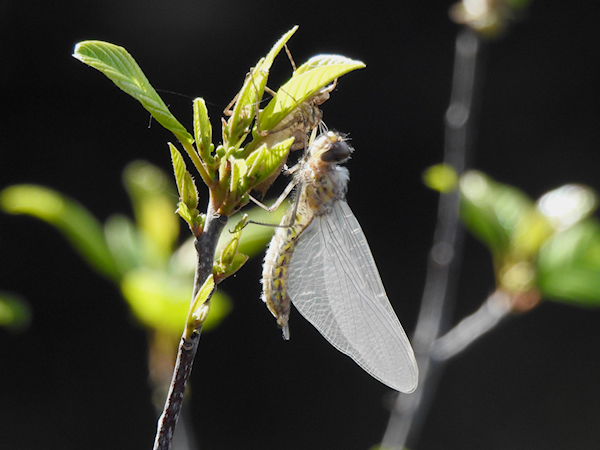
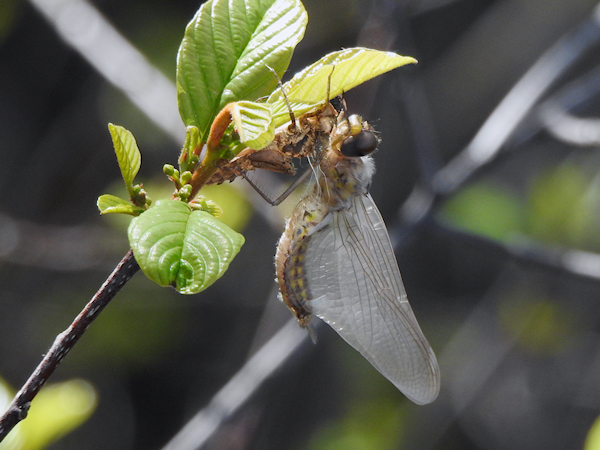
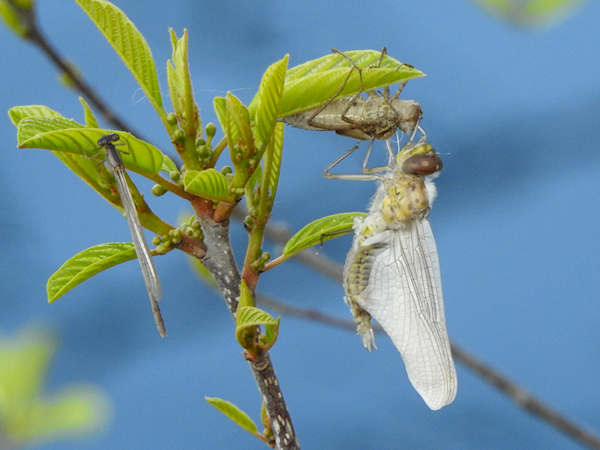
By May 14th Ottawa had seen a string of six days with temperatures above 20°C, with the last three above 30°C. The warmth signaled the beginning of ode season, with my first dragonflies of the season – both Common Green Darners – seen at the Richmond Conservation Area (May 10) and Sarsaparilla Trail (May 11, 2022). Common Green Darners are migrants, however, arriving on the warm winds flowing from further south. The true ode season begins once it is warm enough for local dragonflies and damselflies to emerge from the rivers and wetlands in which their life cycle began. All odonates lay their eggs in water, and it takes time – from a few months to a few years – for the larvae to go through the individual stages of molting until they are large enough to begin the transformation from nymph to adult. When the nymph is ready, it crawls out of the water onto rocks, emergent vegetation, or nearby tree trunks or plant stems, and then bursts out of the larval shell through a hole in its back, using gravity to pull itself free. I have seen various dragonflies in the middle of this process a few times; I had never witnessed the full transformation as it takes a few hours for the dragonfly to become ready for its first flight. However, when I arrived at Mud Lake on a sunny day in mid-May hoping to find some warblers, it was a mass emergence of at least 50 individual dragonflies that engaged my attention, and I was able to observe many individuals at different points of the process.

Continue reading “Mass Emergence: Spiny Baskettails”

A trip to Morris Island with the McNamara Field Naturalists

Slaty Skimmer
Slaty Skimmer

On Saturday, July 3rd I accompanied the McNamara Field Naturalists on their first in-person outing since the latest Stay-at-Home Order ended on June 2nd. Ontario entered Stage 2 of its reopening plan on July 2nd, which raised the number of people who could attend outdoor social gatherings and organized public events to 25 people (as well as allowing haircuts and personal care services again). Although I am not a member of the McNamara Field Naturalists Club, which calls Arnprior home but whose explorations include a large swath of the Ottawa Valley, one of my friends happens to be in charge of putting field trips together, and asked if I wanted to help lead a dragonfly walk. I said yes, and suggested Morris Island as it’s a great place to find all sorts of odes, including several flashy skimmers and clubtails that can be found perching in the vegetation and along the trails. I was thrilled when my mentor Chris Lewis joined us, as it would be easier to find some more of the unique species with a couple of knowledgeable people looking.

Continue reading “A trip to Morris Island with the McNamara Field Naturalists”

Dragonfly Emergence

Freshly emerged dragonfly

My first real dragonfly outing of the year occurred on May 24, 2021, and as usual, took place at Roger’s Pond in Marlborough Forest. I invited a few friends to join me now that outdoor gatherings can include up to 5 people, and fellow OFNC members Derek and Gerald decided to join me. It was a warm, sunny day, and I hoped to find the usual common skimmers and clubtails, as well as a few uncommon species that I’d seen previously at Marlborough Forest such as the elusive Ebony Boghaunter and Harlequin Darner. I’ve already seen one boghaunter this season, but it’s been a few years since I’ve seen a Harlequin Darner, and the Cedar Grove Nature Trail has been a repeat site for this ode.

We met at 9:30 am, just early enough to get some birding in while waiting for the sun to rise higher in the sky. We had the usual Nashville Warblers, Black-throated Green Warblers, Great Crested Flycatchers, White-throated Sparrows, Veeries, and Yellow-bellied Sapsuckers on the walk in. At the pond itself we had Eastern Kingbirds, a Pied-billed Grebe, Common Yellowthroats and four Ring-necked Ducks. Many dragonflies were already flying along the open trail through the cedar forest, including a few teneral whitefaces and emeralds.

Continue reading “Dragonfly Emergence”