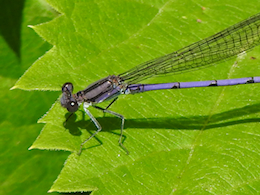
Richmond Lagoon Damselflies

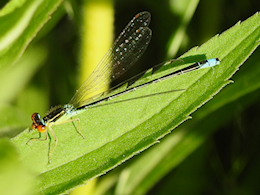
Rainbow Bluet

I often visit the former Richmond Lagoons (now called the Richmond Conservation Area) around late June or early July to look for spreadwings, as this is one of the best places to find five or six different species. It’s one of the few places I can find Lyre-tipped Spreadwings easily, and in 2023 I found another difficult-to-find species here, the Emerald Spreadwing. Both spreadwings are listed as “uncommon” in the Ottawa checklist, but the Lyre-tipped Spreadwing is also designated as “local,” having a special preference for shallow marshes and vegetated ponds completely in the open, particularly those that often dry up during prolonged droughts. While the Lyre-tipped Spreadwings typically disappear with the water, they are also quick to appear in temporary flooded areas such as farm ponds, gravel pits, and artificial ponds. While Emerald Spreadwings also inhabit densely vegetated, shallow wetlands, they can be common in shrubby or forested areas a distance away from their breeding ponds. Emerald Spreadwings are not usually successful in wetlands where predators such as fish or dragonflies are common, which may explain why they can be tough to find.

Continue reading “Richmond Lagoon Damselflies”

Elegance and Rainbows at Terry Carisse Park

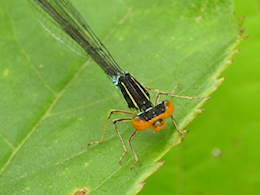
Rainbow Bluet

Last year I embarked on a new odonate project: to study the species found at one tiny park along the Jock River. This park, originally named Bow of the Jock Park before it was changed to Terry Carisse Park in 2006, consists of a narrow strip of green space that runs perhaps 500 or 700 meters along the shore of the Jock River on an elevated bank about two meters above the water. The park itself consists mostly of manicured lawn with a wooded swamp at the north end where Mahoney Creek empties into the Jock River, two launching areas for canoes and kayaks, a playground, and a thick band of riparian vegetation that almost completely blocks all views of the river from one end of the park to the other. The Jock River itself is smaller than the Rideau River, much more sluggish, without a lot of rocks or rapids that would attract the clubtails and spiketails found in Gatineau Park. It hasn’t been surveyed for odonates as well as the Ottawa River has, mainly because much of it runs through private agricultural or residential land, with only a few small parks with even smaller access points in Richmond and Ottawa.

Continue reading “Elegance and Rainbows at Terry Carisse Park”

Terry Carisse Park in the Summer

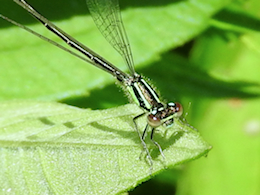
Rainbow Bluet

Most naturalists who have heard of Terry Carisse Park along the Jock River associate it with birds – particularly the Hooded Warbler that spent a few days there in May 2014. As a rare bird for Ottawa, this discovery put this small riparian park on the map for many Ottawa birders. Other people may associate it with the Osprey nest there, although the Osprey haven’t nested there for a few years now. I myself have returned regularly to this park in the spring and fall to look for the Rusty Blackbirds that often stop over here during migration – in May 2021 I found at least 50 of these declining birds feeding on the lawn and perched in the trees that line the river bank. Because of the thick shoreline vegetation, the wooded swamp to the north, and the open grassy areas dotted with conifers it is a good place to look for birds during migration. I had never been here during the summer breeding season, and it occurred to me this summer that it might be a good spot to look for odonates. I started my summer ode survey on July 2, 2022, continuing through early August, and found more species than I expected – including some species I’ve only seen at Petrie Island or Morris Island Conservation Area!

Continue reading “Terry Carisse Park in the Summer”

Back to Gatineau Park: Mustaches and More

Mustached Clubtail
Mustached Clubtail

When Chris Lewis suggested a dragon-hunting excursion on Saturday, I was eager to go. We had to make the extremely difficult choice between Morris Island/Fitzroy Harbour and Gatineau Park, but as Chris Traynor had recently found all sorts of amazing odes at Gatineau Park (including Maine Snaketail, Riffle Snaketail, Mustached Clubtail, Dragonhunter, Horned Clubtail, Dusky Clubtail, Lancet Clubtail, Beaverpond Clubtail and Eastern Least Clubtail) earlier in the week, we decided that a morning in Quebec sounded much more appealing. I met her at her place, and with the assistance of Siri, we navigated the Gatineau Park road closures up to the Sugarbush Trail with none of the frustration I encountered the previous week.

Continue reading “Back to Gatineau Park: Mustaches and More”

Searching for Damselflies at Hurdman

Eastern Forktail (male)

On the first day of June I brought my camera to work with me and headed over to Hurdman at lunch, hoping to find some interesting butterflies and odes to photograph. Hurdman can be a very “buggy” place, so I was sure to find something interesting; at that time I still hadn’t seen my first damselflies of the year, and Hurdman is a great spot to find Eastern Forktails, Elegant Spreadwings, Powdered Dancers, Stream Bluets and Rainbow Bluets during the month of June. However, with the closure of the transitway between Hurdman and Laurier stations, as well as the detours and increased traffic on Nicholas Street resulting from the sinkhole on Rideau Street, it now takes much longer to get there so I am no longer able to spend as much time there on my lunch hour as I would like. Getting around downtown has become and adventure, and timely bus schedules have become the first casualty of all the construction.

Continue reading “Searching for Damselflies at Hurdman”