Two provinces. Six families. One unbelievable day.

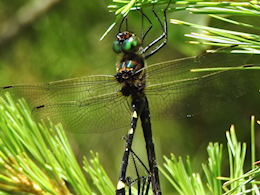
Swift River Cruiser (Macromia illinoiensis)

If you had told me it was possible to see more than a dozen Prince Baskettails hanging from the pine trees like early Christmas ornaments, three perching Swift River Cruisers (including two in a mating wheel), a perching Springtime Darner, an ovipositing Cyrano Darner, an emerging Dragonhunter, four additional clubtail species, a dozen Brush-tipped Emeralds, about 50 Widow Skimmers, and an Arrowhead Spiketail all in a single day here in the Ottawa region, I am not sure I would believe you. That kind of day is so rare in Ottawa that I would would assume that you were engaging in a particularly fanciful daydream. However, on the Quebec side of the river many things are possible. Part of it is due to the scenic geography – the deep, rocky lakes, rushing streams, and variety of marshes, swamps and bogs carved out of the Canadian Shield provide a fantastic variety of habitats. Part of it is due to the untouched wilderness outside of the Gatineau area – there are no cottages lining the shore, no subdivisions full of manicured lawns, no pesticides and insecticides to wreak havoc on insect populations. These two factors make it an excellent place to see a variety of odes – especially along the Ottawa River, a major dragonfly habitat of its own.

Continue reading “Two provinces. Six families. One unbelievable day.”

Second Sightings

Skimming Bluet

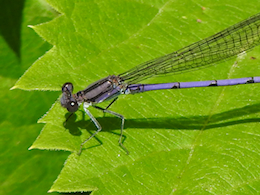
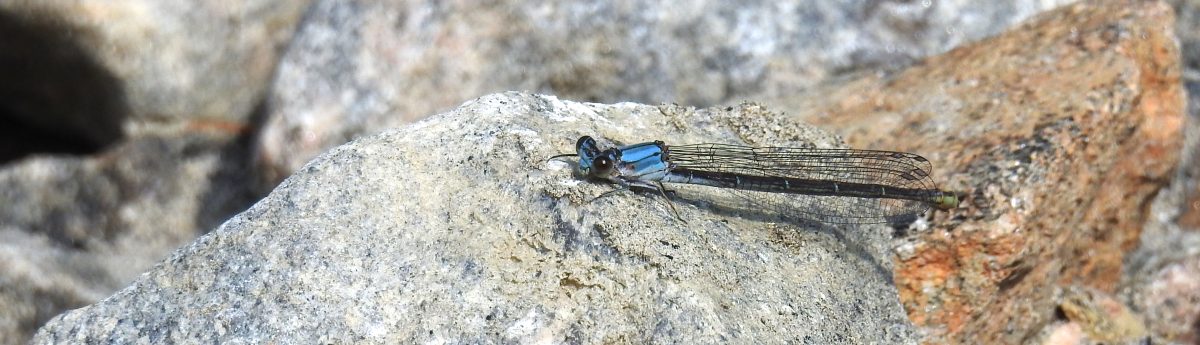
On August 4, 2020 I was surprised to find a Violet Dancer on a dirt trail at the Eagleson ponds. The closest place I’ve ever seen this species to home is out near Morris Island, so it was a shock to find one practically in my own backyard. Then in 2022 I found a few near the Jock River behind the former Richmond sewage lagoons. This suggested where the one at Eagleson might have come from – still a fair distance for a tiny damselfly, but not insurmountable if the winds are blowing the right way. I didn’t expect to see another one there any time soon; if anything, Powdered Dancer was next on my list of species I expected to show up there, because they are much more abundant and widespread along the Ottawa and Rideau Rivers than the Violet Dancer, and breed at the same location on the Jock River behind the former Richmond sewage lagoons. However, when I took a walk there on July 16 after work, it was the first odonate I found, resting on the rocks near the bridge.

Continue reading “Second Sightings”

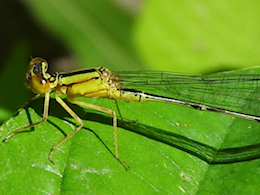
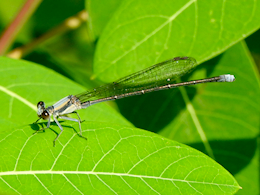
Orange Bluets at Andrew Haydon Park

Orange Bluet
Orange Bluet

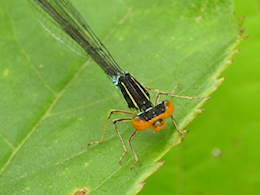
After my successful outing at Andrew Haydon Park on July 29th, I couldn’t wait to return to see the Vesper Bluets again and to look for the elusive Orange Bluet. The two successfully share the same habitat at Petrie Island, so why not in the ponds at AHP? While Vesper Bluet habitat includes the edges of woodland lakes, ponds, and slow rivers rich with emergent vegetation, Orange Bluets are present in those habitats as well as in swamp edges, bogs, slow streams, and degraded wetlands containing varying levels of pollution. I knew they were already on the wing, as I had first seen them at the Eagleson Ponds on July 3rd and have been seeing them there on and off ever since. It was just a matter of returning to Andrew Haydon Park later in the afternoon when they would be at the water, as they spend the early part of the day in the vegetation or trees nearby.

Continue reading “Orange Bluets at Andrew Haydon Park”

Elegance and Rainbows at Terry Carisse Park

Rainbow Bluet

Last year I embarked on a new odonate project: to study the species found at one tiny park along the Jock River. This park, originally named Bow of the Jock Park before it was changed to Terry Carisse Park in 2006, consists of a narrow strip of green space that runs perhaps 500 or 700 meters along the shore of the Jock River on an elevated bank about two meters above the water. The park itself consists mostly of manicured lawn with a wooded swamp at the north end where Mahoney Creek empties into the Jock River, two launching areas for canoes and kayaks, a playground, and a thick band of riparian vegetation that almost completely blocks all views of the river from one end of the park to the other. The Jock River itself is smaller than the Rideau River, much more sluggish, without a lot of rocks or rapids that would attract the clubtails and spiketails found in Gatineau Park. It hasn’t been surveyed for odonates as well as the Ottawa River has, mainly because much of it runs through private agricultural or residential land, with only a few small parks with even smaller access points in Richmond and Ottawa.

Continue reading “Elegance and Rainbows at Terry Carisse Park”

Damselflies in New Places

Violet Dancer
Violet Dancer

Damselflies are small odonates related to dragonflies, but belong to Order Zygoptera instead of Order Anisoptera. Unlike dragonflies, damselflies have very slender abdomens, and the forewing and hindwing are similar size and shape. Two of the three families found in eastern North America – the broad-winged damsels and pond damsels – hold their wings above the body, parallel to the abdomen, while perching. The third family – the spreadwings – do not perch horizontally with their wings parallel to the body, but typically “hang” from a perch, with the wings slightly spread at an angle. Adult damselflies are not strong fliers, and generally do not travel far from water. They are most often found in vegetation or on the ground near ponds, streams, and other bodies of water. Because of their small size they can be difficult to see, but the dark wings of the jewelwings and brightly coloured abdomens of some of the pond damsels help aid in observation.

Continue reading “Damselflies in New Places”

Terry Carisse Park in the Summer

Rainbow Bluet

Most naturalists who have heard of Terry Carisse Park along the Jock River associate it with birds – particularly the Hooded Warbler that spent a few days there in May 2014. As a rare bird for Ottawa, this discovery put this small riparian park on the map for many Ottawa birders. Other people may associate it with the Osprey nest there, although the Osprey haven’t nested there for a few years now. I myself have returned regularly to this park in the spring and fall to look for the Rusty Blackbirds that often stop over here during migration – in May 2021 I found at least 50 of these declining birds feeding on the lawn and perched in the trees that line the river bank. Because of the thick shoreline vegetation, the wooded swamp to the north, and the open grassy areas dotted with conifers it is a good place to look for birds during migration. I had never been here during the summer breeding season, and it occurred to me this summer that it might be a good spot to look for odonates. I started my summer ode survey on July 2, 2022, continuing through early August, and found more species than I expected – including some species I’ve only seen at Petrie Island or Morris Island Conservation Area!

Continue reading “Terry Carisse Park in the Summer”

A trip to Morris Island with the McNamara Field Naturalists

Slaty Skimmer
Slaty Skimmer

On Saturday, July 3rd I accompanied the McNamara Field Naturalists on their first in-person outing since the latest Stay-at-Home Order ended on June 2nd. Ontario entered Stage 2 of its reopening plan on July 2nd, which raised the number of people who could attend outdoor social gatherings and organized public events to 25 people (as well as allowing haircuts and personal care services again). Although I am not a member of the McNamara Field Naturalists Club, which calls Arnprior home but whose explorations include a large swath of the Ottawa Valley, one of my friends happens to be in charge of putting field trips together, and asked if I wanted to help lead a dragonfly walk. I said yes, and suggested Morris Island as it’s a great place to find all sorts of odes, including several flashy skimmers and clubtails that can be found perching in the vegetation and along the trails. I was thrilled when my mentor Chris Lewis joined us, as it would be easier to find some more of the unique species with a couple of knowledgeable people looking.

Continue reading “A trip to Morris Island with the McNamara Field Naturalists”

At Petrie Island

Vesper Bluet

On July 17th, Chris Lewis and a few other friends and I went dragon-hunting at Petrie Island. Although the morning started out cool, it quickly warmed up, and as a result we saw lots of great bugs. We started our outing by searching the vegetation between the parking lot and the first small bay, usually a productive area for some of the smaller dragonflies and damselflies. This is the only spot at Petrie Island where I’ve seen Vesper Bluet and Orange Bluet, and we spent a good half hour examining the shrubs for these small damselflies. Although both species are considered common in the Northeast, Petrie Island is the only place where I’ve seen them. However, both species are more active later in the day, and since I usually do my birding and ode-hunting in the morning and early afternoon, it is possible I’ve missed them in other places.

Continue reading “At Petrie Island”

The “Wild Ode West” Dragon-hunting Adventure

Widow Skimmer
Widow Skimmer

Chris Lewis and I had such a great time dragon-hunting in Gatineau last weekend that on June 25th we decided to hit several spots west of Ottawa to search for several local and unique species. On our list of locations were the Quyon Ferry Dock near Fitzroy to look for big river species, Morris Island for clubtails and skimmers, and Pakenham, Blakeney and Almonte for Rapids Clubtail. Before heading out to the Quyon Ferry Dock we stopped in at the fields near Constance Bay to look for Upland Sandpipers. We got lucky and found four. Not only did we see a couple of them flying over the fields, giving their distinctive call, we found one standing right on the shoulder of the road! Unfortunately we caused it to flush before I could get a photo of this bird; I still have yet to photograph this species. Indeed, this was the closest I’ve ever come to one of an Upland Sandpiper, which are difficult to find as they breed and feed in dry grasslands rather than muddy shorelines.

Continue reading “The “Wild Ode West” Dragon-hunting Adventure”

An OFNC outing at Petrie Island

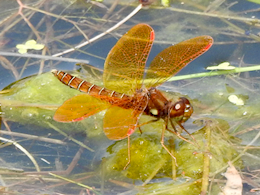
Eastern Amberwing
Eastern Amberwing

On August 2nd, 2015 I led a dragonfly outing at Petrie Island for the Ottawa Field-Naturalists’ Club. Because I would be leading it on my own, and because the small size of dragonflies and damselflies makes it difficult to point them out to large groups, I decided to limit the group to ten people. Fellow dragon-hunters and Birds Committee members Chris Traynor and Lorraine Elworthy signed up for the outing, as did Jakob Mueller, who led the reptile and amphibian outing at Sheila McKee Park earlier in the year. I recognized Lynne Ovenden from the OFNC; the others were all unknown to me.

I started our outing by talking about the differences between dragonflies and damselflies, as well as the different groups belonging to each family. We would be looking for spreadwing damselflies, which hold their wings out at a 45° angle instead of parallel to their back; emeralds and darners, which are most commonly found flying through the air searching for aerial prey; and skimmers, which tend to hunt from a perch and are usually the most approachable types of dragonflies for photography. As I was speaking, a bright green female Eastern Pondhawk was hunting from a perch in the vegetation, often flying out to snatch an insect from the air. At one point it even landed on one of the group members!

Continue reading “An OFNC outing at Petrie Island”