Burritt’s Rapids has been on my radar as a low-priority place to visit for about a year now, and if I hadn’t missed a turn on my way to the southwestern corner of Marlborough Forest I wouldn’t have ended up there on a nice warm day in mid-July. I had been curious about what species I might find at the rapids there, and was hoping to find a few new species to add to iNaturalist as it didn’t have many when I first started thinking about going there. One species I was curious about was Swamp Spreadwing, which had been found a short distance east at Rideau River Provincial Park back in 2022. The only place I’ve seen this species in Ottawa is Petrie Island, and it would be fantastic to find another one closer to home. I was also wondering if the river and rocky rapids might host some of our common clubtails, such as Dragonhunter or Black-shouldered Spinyleg.
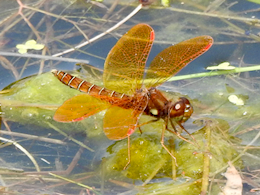
A day without seeing a dragonfly is like a day without chocolate – sure, it’s completely survivable, but utterly lacking in joy. I had to work downtown on both the Wednesday and Thursday after Canada Day, and decided to go for a lunchtime walk along the canal to the river on Wednesday to see if I could find any weekday odes. I’d seen Prince Baskettails and Common Green Darners flying up and down the canal, and a Midland Clubtail on the rocky shore behind Parliament Hill many moons ago, so the downtown core is not completely devoid of odonates. Still, I wasn’t expecting much, and got lucky on Wednesday when I saw first a Common Green Darner flying by, then a Prince Baskettail. Then something small fluttering above one of the mats of vegetation caught my eye – a female Eastern Amberwing ovipositing in some floating vegetation! After a few more minutes of watching, I saw a pair of males fly by. I waited for several minutes for one to land but they never did.
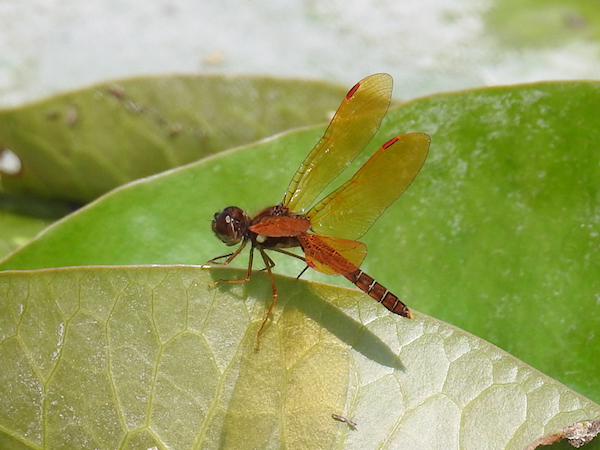
The Amber-winged Spreadwing at Bruce Pit wasn’t the only good find there on July 14th. Back on July 6th I’d found a different sort of amber-wing: an Eastern Amberwing, one of our smallest dragonflies. I’d also found and photographed a Halloween Pennant, a species I’d seen flying over the water last year but hadn’t managed to find perching. I observed both species on the slope between the fence and the edge of the pond, and both were new for my Bruce Pit list. I asked Chris Lewis if she had seen either species there before, and she told me she had seen Halloween Pennant there in the past, but not Eastern Amberwing – no surprise there, since this is a relatively new addition to the Ottawa area. When I headed over to Bruce Pit after finding the Amber-winged Spreadwing at Bill Teron Park on July 14th, it was to see if I could find any more Eastern Amberwings or Halloween Pennants and get some better photos.
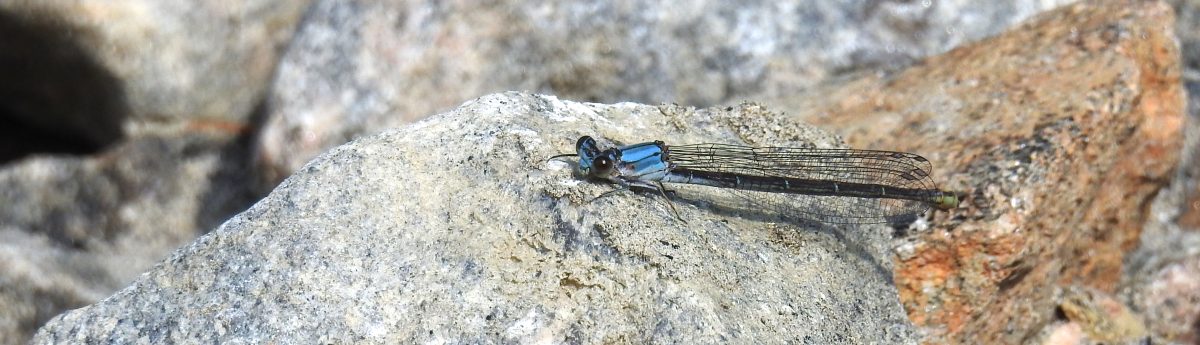
On August 4, 2020 I was surprised to find a Violet Dancer on a dirt trail at the Eagleson ponds. The closest place I’ve ever seen this species to home is out near Morris Island, so it was a shock to find one practically in my own backyard. Then in 2022 I found a few near the Jock River behind the former Richmond sewage lagoons. This suggested where the one at Eagleson might have come from – still a fair distance for a tiny damselfly, but not insurmountable if the winds are blowing the right way. I didn’t expect to see another one there any time soon; if anything, Powdered Dancer was next on my list of species I expected to show up there, because they are much more abundant and widespread along the Ottawa and Rideau Rivers than the Violet Dancer, and breed at the same location on the Jock River behind the former Richmond sewage lagoons. However, when I took a walk there on July 16 after work, it was the first odonate I found, resting on the rocks near the bridge.
Although I could have spent most of my time in Chatham-Kent at Peers Wetland, we visited a few other places in my quest to find odonates around Wallaceburg. After a productive morning at Peer’s Wetland on August 31st, we went home for lunch, then took a walk at Crothers Conservation Area only a few blocks from my mom’s house in the north end of Wallaceburg. This little slice of green space runs alongside Running Creek, a small muddy stream which flows into the North Sydenham River. Although this small conservation area consists mostly of neatly manicured lawn, and more rightly ought to be called a park than a conservation area, the riverbank has some natural growth of riparian shrubs and cattails that prevent it from looking too obviously landscaped. Wild green space is scant in the southwestern corner of the province – a bird’s eye view shows it to be entirely dominated by the patchwork of farms vital to the province’s agricultural industry. The few remaining patches of forest, wetlands, and untamed thickets along the riverine corridors are precious; it seems that in this part of the province, every square inch has been assessed and tallied with almost all of it given over to human management, whether for production, recreation, residential, or commercial purposes.
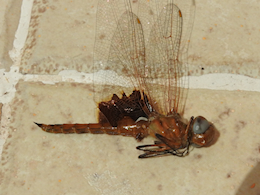
It was only six weeks ago that I last added a new species to the Eagleson storm water ponds ode list, the River Jewelwing that mysteriously showed up for one day back on June 10, 2023. I wasn’t expecting to find another new species so soon, but that is exactly what happened when I went for a walk there this afternoon. My goal was to look for the diminutive Eastern Amberwings, a species that I would have looked for earlier in the month had I not been in Nova Scotia. This colony first showed up in 2017 and its numbers have been increasing in the southern ponds over the last six years. I was happy to find four males perching on the lily pads on my visit; it appears they are still thriving here.
Eastern Amberwing
I saw Orange Bluets here for the first time this year on July 3, 2023, and I was hoping to find a few close enough to the shore to get a good photo. This is the second season that I’ve confirmed their presence here, and I was disappointed not to find any on this visit.
I saw Blue Dashers here for the first time this year on July 7, 2023; this is also only the second year that I’ve seen them here, and I counted at least eight of them around the two southern-most ponds. They are so beautiful and colourful when fresh – I can’t imagine ever becoming so used to them that I don’t want to stop and admire them, especially when they are sitting on a such a lovely perch.
Blue Dasher
I saw a male and female Common Whitetail flying over the pond together; the female was ovipositing. A White-faced Meadowhawk and a Band-winged Meadowhawk were nice to see, though the Band-winged Meadowhawk didn’t stick around long enough for photos. I’ve been keeping an eye out for Saffron-winged Meadowhawks, a species that was common here in 2020 but has been diminishing in numbers ever since – I only found two in 2021 and one in 2022. I didn’t see any on this walk, making me wonder if the population has died out. Its season lasts until September, so it is not too late to keep looking for this species.
A Slender Spreadwing was the only other odonate of interest, other than the Eastern Forktails that are usually too numerous to count.
I finished my walk with a loop around the Hope Side pond, stopping at the bridge where I took a moment to scan the water toward the overpass. I’ve seen muskrats swimming and dragonflies flitting among the vegetation here, and almost immediately something small and black fluttering in the tunnel formed by the cattails toward the bridge. When I got my binoculars on it I saw a male Ebony Jewelwing sitting in the sun!
Ebony Jewelwing
Ebony Jewelwings are usually found at woodland streams, preferring those with rapids although they may be found at shaded, slow-moving streams as well. The area it was inhabiting at the Eagleson ponds is no more than a shallow channel that drains water from the ponds into a narrow waterway running alongside a patch-work of fields before entering the Jock River at Terry Carisse Park. But since a River Jewelwing has already found its way up here perhaps I shouldn’t be surprised that this Ebony Jewelwing had followed. This is ode species #36 for the ponds – a terrific number for such a small area and limited habitat.
It’s been a good season for hard-to-find dragonflies at the Eagleson Ponds. Ever since I discovered both Eastern Amberwings and Saffron-winged Meadowhawks here in 2017 I’ve been spending more time here later in the day looking for odes, rather than doing a quick search for birds first thing in the morning before heading elsewhere. The Covid-19 pandemic has made that even easier for me, as I am still working from home and can get out at lunch time for a quick check when the temperature has warmed up enough for many odes to be flying.
Mid-summer seems to be the best time for seeing a variety of odes at the ponds. While I have seen a few early-season species here, such as the Taiga Bluet and Spiny Baskettail, most odes that breed here don’t emerge until later in the summer. I’m not sure if the late start to spring had anything to do with it, but up until the end of June I found very few dragonflies here – skimmers are usually abundant throughout the season, but on June 30th I recorded a single Dot-tailed Whiteface and a single Twelve-spotted Skimmer along with a couple of Common Green Darners and Prince Baskettails that refused to land. Even the Eastern Forktails seemed down in numbers.
August isn’t my favourite month to go dragon-hunting; in our region, a number of species have already vanished for the year, including several of my favourite clubtails and emeralds, cruisers and spiketails. August, then, is a season of skimmers and darners, and as such, places like the Eagleson storm water ponds are good places to go dragon-hunting, as these are the most common families of dragonflies that breed here (of the other families mentioned above, only the emeralds are present, and only members of the genus Epitheca, the baskettails). I’ve spent much of my free time this month at the storm water ponds, not just looking for butterflies, but also for new species of odes. It was only two years ago that I discovered new populations of Eastern Amberwings and Saffron-winged Meadowhawks breeding here, and as a number of common species are still scarce or still missing, it is worth checking to see if any have made their way here yet. For a habitat that is quite similar to that of Mud Lake or the ponds at Andrew Haydon Park, it is curious to me that there are no Powdered Dancers, no Horned or Lancet Clubtails, no Halloween or Calico Pennants, no Blue Dashers, and very few Widow Skimmers, Dot-tailed Whitefaces, Eastern Pondhawks, and Common Whitetails. Even spreadwings and dragonflies as abundant as the Autumn Meadowhawk are difficult to find. This is why it is such a surprise that uncommon species such as Eastern Amberwing and Saffron-winged Meadowhawk have become quite common here in late summer.
On July 18th I headed over to the Cedar Grove Nature Trail in Marlborough Forest, as a summer visit was long overdue. After a disappointing visit in June, when a lot of odes and butterflies seemed to be late due to the prolonged cold weather, I was hoping to find some of the early species still flying. To be honest, I had no idea whether insect emergence was still late or back on track, or whether I would even see some of the specialties I was hoping for – such as Calico Pennant, Brush-tipped Emerald, Aurora Damsel, Silvery Checkerspot, fritillaries and more. Regardless, I was looking forward to a change of scenery, and would be happy with whatever I saw.
There weren’t many birds of note, although I was surprised to hear both a Blue-headed Vireo and a Black-throated Green Warbler still singing. It was after 1:00 p.m. by the time I arrived, so not only was it late in the season, but also late in the day. A pair of female or immature Hooded Mergansers near the bridge was a surprise; this was the first time I had seen this species on the pond.
I have never really spent much time looking for odes at the Eagleson storm water ponds, as most of my outings start there first thing in the morning when it isn’t hot enough for many dragonflies to be flying. However, after seeing the unidentified female spreadwing there on Saturday morning, I decided to head over on Sunday after my visit to the Old Quarry Trail. While I’ve seen Common Green Darners, Twelve-spotted Skimmers, Autumn Meadowhawks, Eastern Forktails, Tule Bluets, and Familiar Bluets there since the reconstruction, the arrival of the unidentified spreadwing and even the Delaware Skipper made me wonder whether other species had taken up residence recently. I wasn’t expecting anything too exciting or unusual, but I figured I might at least see some of the common pond skimmers found nearby at places like Bruce Pit and Stony Swamp. Perhaps I should have raised my expectations a bit, for what I found there surprised me!
On April 16th my fiancé Doran and I took our first trip outside of Canada and the U.S., spending the week in Cozumel, Mexico. We chose it because when we had originally been looking at going on a cruise, it was one of the destinations we particularly wanted to see because of the Mayan ruins close by, and a one-day stop didn’t seem like enough time to see the region. I was also interested in the wildlife there, though that would have been true of any destination!
We flew from Montreal to Atlanta at the ridiculous hour of 5:45am, having driven from Ottawa the night before and staying at the Marriott in the terminal. It was after 11:00pm by the time we went to bed, and I didn’t sleep a wink – we had to get up at 3:00am for the flight. From Atlanta we flew to Cozumel, arriving at 1:30pm. It was very hot and humid, and I was completely overdressed in my jeans and long-sleeved sweater. We passed through customs and security without any problems despite the long line and arrived at our hotel (the El Cozumeleno Beach Resort in the northern hotel zone) by 2:00.
On August 2nd, 2015 I led a dragonfly outing at Petrie Island for the Ottawa Field-Naturalists’ Club. Because I would be leading it on my own, and because the small size of dragonflies and damselflies makes it difficult to point them out to large groups, I decided to limit the group to ten people. Fellow dragon-hunters and Birds Committee members Chris Traynor and Lorraine Elworthy signed up for the outing, as did Jakob Mueller, who led the reptile and amphibian outing at Sheila McKee Park earlier in the year. I recognized Lynne Ovenden from the OFNC; the others were all unknown to me.
I started our outing by talking about the differences between dragonflies and damselflies, as well as the different groups belonging to each family. We would be looking for spreadwing damselflies, which hold their wings out at a 45° angle instead of parallel to their back; emeralds and darners, which are most commonly found flying through the air searching for aerial prey; and skimmers, which tend to hunt from a perch and are usually the most approachable types of dragonflies for photography. As I was speaking, a bright green female Eastern Pondhawk was hunting from a perch in the vegetation, often flying out to snatch an insect from the air. At one point it even landed on one of the group members!






 OdoNotations