Exploring Kanata’s Creeks

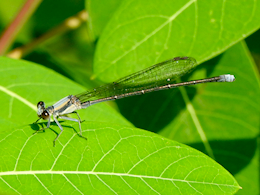
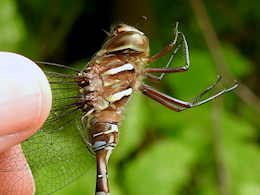
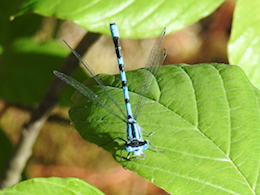
Aurora Damsel

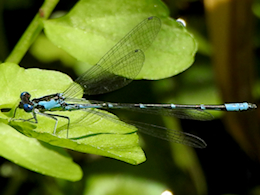
Last November I spent some time on Google maps looking for accessible creeks around the fringes of Kanata north where I might find some creek-loving odonates. If a tiny fragment of a stream in Stony Swamp could hold Arrowhead Spiketails, who knows what other species might call these small streams home? I wasn’t expecting anything as magnificent or scarce as a Mustached or Eastern Least Clubtail, but I thought that Stream Cruisers, Fawn Darners, River Jewelwings, and maybe a spiketail might be possible.

A few areas looked particularly interesting, including a section of Shirley’s Brook between Station Road and Monk Environmental Park, the stream that drains the eastern end of the Beaver Pond near Lismer Pines Park, and Stillwater Creek where it runs between Corkstown Road and the Trans-Canada Trail, aka the Watts Creek Pathway. Although all of these streams run through green space, the surrounding areas had become built up with new homes and developments over the years. The Crystal Bay/Lakeview Park subdivision just south of Andrew Haydon Park is long-established, with a narrow band of trees running between the subdivision and Highway 417, but the area around the Beaver Pond off of Goulbourn Forced Road started being cleared for housing relatively recently (around 2010), starting with the controversial Terry Fox extension, and houses are still being built there to this day. The forest is thickest in Monk Environmental Park where there is little encroachment so far, and my hopes were highest for this little park as a result.

Continue reading “Exploring Kanata’s Creeks”

To See an Elfin Skimmer

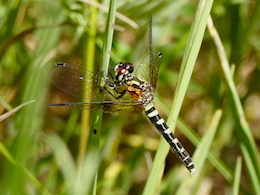
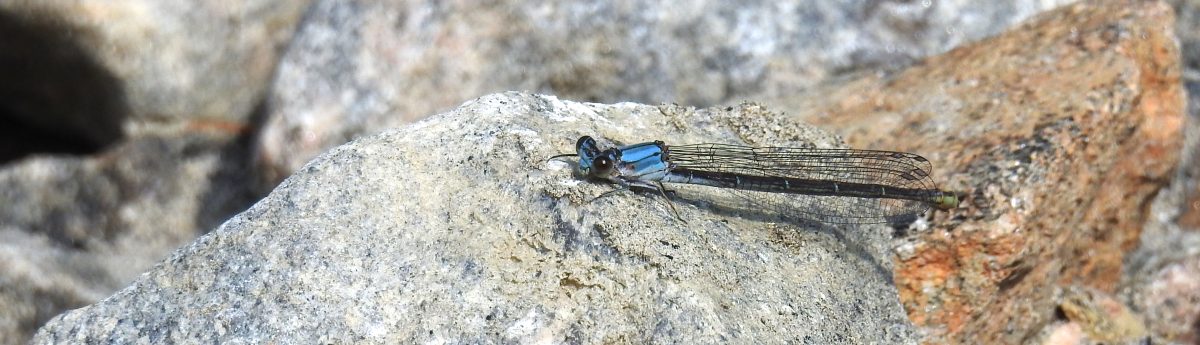
Elfin Skimmer

On Saturday, June 14, 2025 Derek Dunnett and I led a combined birding and dragonfly outing at Murphy’s Point Provincial Park for the Ottawa Field-Naturalists’ and McNamara Field Naturalists’ Clubs. It was restricted to 20 people for carpooling purposes (the park roads are quite narrow for parking) and 18 showed up altogether. Unlike our trip last year, the weather was perfect: cool and sunny in the morning, hot and sunny in the afternoon with a hint of a breeze. Our targets this year included Cerulean Warbler (which had been heard singing earlier in the week), Blue-winged Warbler, and Golden-winged Warbler, while our odonate targets included the diminutive Elfin Skimmer and various stream odonates. Last year the trip had been postponed several times due to rain, and we missed the Blue-winged Warbler, Golden-winged Warbler, and Elfin Skimmer as by the time we had visited (July 7) it was late in the breeding season and the weather for ode-hunting (thickly overcast in the morning) was less than ideal.

Continue reading “To See an Elfin Skimmer”

Canada Day Clubtails – Part 1

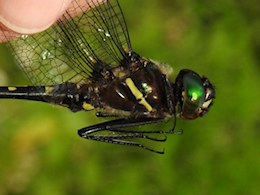
Cobra Clubtail

On July 1st I spent the morning at Sheila McKee Memorial Park with the full intention of heading out to Pinhey’s Point afterward. My goals were to get to Sheila McKee early enough to look for the Yellow-throated Vireo and Yellow-billed Cuckoo that had been found there recently, then look for dragonflies in the open meadow and along the river shore. I was hoping to find another Mustached Clubtail, or perhaps an Arrow Clubtail, or the first Cobra or Midland Clubtails of the season. It was a bit cool in the morning, so I waited until 8:30 am to leave. When I got there just before 9:00 there were already several cars in the parking lot, and by the time I headed out to the road to listen for the elusive cuckoo a cavalcade of cars was turning into the parking lot from Sixth Line Road.

Continue reading “Canada Day Clubtails – Part 1”

Dragons in the Wind

Horned Clubtail

On June 15th I visited Mud Lake for a morning of birding and ode-hunting. It was about 13°C when I arrived at 8:30, and although it was sunny, the persistent breeze made it feel cooler. Still, there were more odes about than I had hoped for, although at first I saw only a few damselflies (Eastern Forktails, Fragile Forktails and Powdered Dancers) and Dot-tailed Whitefaces. It wasn’t until about an hour into my walk that I came across my first interesting odonate observation of the day: a lilac bush with several dragonflies perching on its branches. It was the Spiny Baskettail landing on an exposed twig that caught my attention, and while I was trying to photograph it a few more dragonflies landed nearby: first a Blue Dasher and then a Prince Baskettail! These large emeralds are the least likely of the baskettails to land, so seeing one perching is always a treat.

Continue reading “Dragons in the Wind”

Sarsaparilla Trail Predators

Six-spotted Fishing Spider

Late spring is a wonderful time to visit Sarsaparilla Trail. I usually start visiting in May to look for early dragonflies such as Spiny Baskettails and Chalk-fronted Corporals, both of which emerge in good numbers in mid- to late May. It is also a good place to look for Taiga Bluets, often my first damselfly of the year. Friday, May 24th was a beautiful, sunny day despite a cool north wind blowing, so I spent my lunch hour there searching for signs of spring. I began my walk by scanning the shrubs bordering the clearing near the outhouse for dragonflies perching in the vegetation and baskettails flying in the open…there were no emeralds flying on my visit, although there had been over a dozen Spiny Baskettails present only eight days earlier. I did scare up a dragonfly perching close to the ground – it turned out to be a Four-spotted Skimmer.

Continue reading “Sarsaparilla Trail Predators”

More Ode-hunting in Chatham-Kent

Eastern Amberwing

Although I could have spent most of my time in Chatham-Kent at Peers Wetland, we visited a few other places in my quest to find odonates around Wallaceburg. After a productive morning at Peer’s Wetland on August 31st, we went home for lunch, then took a walk at Crothers Conservation Area only a few blocks from my mom’s house in the north end of Wallaceburg. This little slice of green space runs alongside Running Creek, a small muddy stream which flows into the North Sydenham River. Although this small conservation area consists mostly of neatly manicured lawn, and more rightly ought to be called a park than a conservation area, the riverbank has some natural growth of riparian shrubs and cattails that prevent it from looking too obviously landscaped. Wild green space is scant in the southwestern corner of the province – a bird’s eye view shows it to be entirely dominated by the patchwork of farms vital to the province’s agricultural industry. The few remaining patches of forest, wetlands, and untamed thickets along the riverine corridors are precious; it seems that in this part of the province, every square inch has been assessed and tallied with almost all of it given over to human management, whether for production, recreation, residential, or commercial purposes.

Continue reading “More Ode-hunting in Chatham-Kent”

Terry Carisse Park in the Summer

Rainbow Bluet

Most naturalists who have heard of Terry Carisse Park along the Jock River associate it with birds – particularly the Hooded Warbler that spent a few days there in May 2014. As a rare bird for Ottawa, this discovery put this small riparian park on the map for many Ottawa birders. Other people may associate it with the Osprey nest there, although the Osprey haven’t nested there for a few years now. I myself have returned regularly to this park in the spring and fall to look for the Rusty Blackbirds that often stop over here during migration – in May 2021 I found at least 50 of these declining birds feeding on the lawn and perched in the trees that line the river bank. Because of the thick shoreline vegetation, the wooded swamp to the north, and the open grassy areas dotted with conifers it is a good place to look for birds during migration. I had never been here during the summer breeding season, and it occurred to me this summer that it might be a good spot to look for odonates. I started my summer ode survey on July 2, 2022, continuing through early August, and found more species than I expected – including some species I’ve only seen at Petrie Island or Morris Island Conservation Area!

Continue reading “Terry Carisse Park in the Summer”

Ode-hunting along the River

Shadow Darner
Shadow Darner

Mud Lake and Andrew Haydon Park are usually excellent places to find different species of dragons and damsels throughout the summer months. In both 2015 and 2019 I had a good number of species at Andrew Haydon Park in late July, and an OFNC dragonfly outing at Mud Lake on July 21, 2013 also netted some fantastic species. I was hoping for some similar luck on an ode-hunting trip on July 24th, but this time I found fewer species and fewer individuals overall. I am not sure why there seem to be so few dragonflies around good pond habitat these past two years (such as the Eagleson ponds), but the trend is concerning.

My first stop was the shoreline at Mud Lake where I hoped to find some large river clubtails perching on the rocks in the channel behind the filtration plant. When I arrived I was happy to find two dragonflies perching on the rocks right away, and managed only to photograph one before a couple of people came along and scared them both – while I’m certain one of them was a clubtail, the one I photographed turned out o be an Eastern Pondhawk. The clubtail did not return, although I saw a couple flying out over the water several times on my visit.

Continue reading “Ode-hunting along the River”

Dragon-hunting in the Carp Hills

Marsh Bluet

On June 20, 2021 I accompanied fellow OFNC members Derek and Erik to the Carp Barrens Trail off of Thomas Dolan Parkway to assist them in a survey of breeding birds and other wildlife. Because of the sensitivity of the ecosystem and number of at-risk species which breed here, this trail is closed to the public during the summer. In order for us to access the site, Derek had acquired a permit to allow us to look for unique breeding birds such as Black-billed Cuckoo, Eastern Towhee, Common Nighthawks and Whippoorwills. Derek and Erik started around dawn to listen for both nightjars, but heard none. I joined them at 6:00 am while they were still walking along Thomas Dolan Parkway, and together we entered the trail system.

The trail follows a rocky outcrop around a long slough. Many birds were already singing, and we heard the typical open field and woodland edge species: Field Sparrow, White-throated Sparrow, Veery, Scarlet Tanager, Rose-breasted Grosbeak, and many warblers, the best of which (in my humble opinion) included two Pine Warblers, two Yellow-rumped and two Nashville Warblers.

Continue reading “Dragon-hunting in the Carp Hills”

New Dragonflies at Marlborough Forest

Kennedy's Emerald
Kennedy’s Emerald

The beginning of June arrived with plenty of warmth and sunshine, and I couldn’t wait to go back to Marlborough Forest at the peak of butterfly and dragonfly season to look for new species living there. Last year when I started going to Marlborough Forest in mid-June, I kept seeing large, dark dragonflies – almost certainly emeralds of some sort – zipping down the shadowy trail before the sun had fully risen above the trees. I never had my net on me when I saw them on my early-morning birding walks, so I was unable to catch one to verify their identity. This time I was prepared for these dawn-flying dragons, and brought my net with me. I had already added one dragonfly to my life list, the Ocellated Emerald at Trail E4 last year; was it possible that there were other species of interest here?

My first summer visit to Trail E4 occurred on June 6th. Although the morning started out cool, it quickly warmed up. The usual birds were singing along the trail, including all the Red-eyed Vireos, Eastern Wood-pewees, Eastern Kingbirds, Veeries, and the Tree Swallows that were missing from my mid-May visit. I heard seven warblers (Ovenbirds, Northern Waterthrushes, Black-and-whites, Nashvilles, Common Yellowthroats, Black-throated Greens, and a single Magnolia Warbler), two Chipping Sparrows, a Field Sparrow, and a Blue-headed Vireo singing in its usual spot in the large open area devastated by motor bikes and ATVs.

Continue reading “New Dragonflies at Marlborough Forest”

Gatineau Park: Specialty Dragon-hunting

Zebra Clubtail

Gatineau Park is a special place for dragonflies – many species of the National Capital Region can be found there that aren’t found on the Ontario side of the Ottawa River, while others seem to be much more common there than in Ottawa. Chris Traynor has been exploring the park quite a bit these past couple of years, searching for dragonflies that breed in the quiet lakes, sluggish streams, and fast-flowing creeks of the Gatineau Hills. Not surprisingly, he has found a good number of species that have not been reported in Ottawa, such as Eastern Least Clubtail, Mustached Clubtail, Beaverpond and Harpoon Clubtails, and even a couple of snaketails. Many of these species prefer clear, swift-moving streams with rocky bottoms, which might be the reason for their absence in Ottawa; the Ontario side of the National Capital Region is relatively flat, with more marshes and slow-moving, mucky streams winding through suburbs and forest rather than down the foothills and escarpments which form the Canadian Shield. One of Chris’s best finds was a portion of Meech Creek where Zebra Clubtails and Fawn Darners are quite common, with the occasional Dragonhunter and Violet Dancer. I accompanied him twice to this magical spot, once during the August long weekend last year, and once again this year. As I never did get around to posting those photos last year (remember I mentioned I’d fallen behind?), I will incorporate both sets of photos in this post.

Continue reading “Gatineau Park: Specialty Dragon-hunting”

Late Summer Dragons at the Ponds

Eastern Amberwing

August isn’t my favourite month to go dragon-hunting; in our region, a number of species have already vanished for the year, including several of my favourite clubtails and emeralds, cruisers and spiketails. August, then, is a season of skimmers and darners, and as such, places like the Eagleson storm water ponds are good places to go dragon-hunting, as these are the most common families of dragonflies that breed here (of the other families mentioned above, only the emeralds are present, and only members of the genus Epitheca, the baskettails). I’ve spent much of my free time this month at the storm water ponds, not just looking for butterflies, but also for new species of odes. It was only two years ago that I discovered new populations of Eastern Amberwings and Saffron-winged Meadowhawks breeding here, and as a number of common species are still scarce or still missing, it is worth checking to see if any have made their way here yet. For a habitat that is quite similar to that of Mud Lake or the ponds at Andrew Haydon Park, it is curious to me that there are no Powdered Dancers, no Horned or Lancet Clubtails, no Halloween or Calico Pennants, no Blue Dashers, and very few Widow Skimmers, Dot-tailed Whitefaces, Eastern Pondhawks, and Common Whitetails. Even spreadwings and dragonflies as abundant as the Autumn Meadowhawk are difficult to find. This is why it is such a surprise that uncommon species such as Eastern Amberwing and Saffron-winged Meadowhawk have become quite common here in late summer.

Continue reading “Late Summer Dragons at the Ponds”

The Odes of Andrew Haydon Park – 2019 edition

Halloween Pennant

Back in 2015 I wrote a blog post about the odonates I found at Andrew Haydon Park one weekday afternoon near the end of July. Since discovering the colony of Halloween Pennants at AHP in 2014, I’ve made it a point to visit this park each year during mid-summer; it’s much closer than travelling all the way to Morris Island to see this stunning dragonfly! So far I’ve only made it out to Morris Island once this year, and when I found no Halloween Pennants flying along the causeway I decided to visit Andrew Haydon Park specifically to search for this species. With the strange, slow start to the season I was bit apprehensive about whether these odes would even be around at AHP, but thankfully I found a few on each of my visits, and in good numbers, too.

Continue reading “The Odes of Andrew Haydon Park – 2019 edition”

Ode-hunting in Prince Edward County

Calico Pennant

During the first week of July my fiancé and I spent some time in Prince Edward County with my dad’s family. We rented a cottage on Loves Lane on Prince Edward Bay, a nice three-bedroom place with 8 acres of land only 20 minutes away from both Sandbanks and Picton. The weather was beautiful, and I spent most of my time getting to know the local residents. On our first full day at the cottage (Monday, July 1st), I went for an afternoon walk on the property to see what I could find. It seemed to be a good spot for odonates; every now and then a couple of Prince and Common Baskettails flew in and started swooping above the deck. There were some other dragonflies present too, so I brought my net out in the hopes of catching one.

Continue reading “Ode-hunting in Prince Edward County”

Sweltering August Heat

Blue Dasher

The August long weekend is here, and it’s been brutally hot and humid. Temperatures have reached as high as 32°C with a humidex of 41. It didn’t feel quite so hot yesterday, but today was awful. The sun was relentless, and there was no cooling breeze to provide relief. Being in the shade helped, but even so, I didn’t feel like staying out for very long.

We haven’t had much rain in the last month, so the water levels of the Ottawa River have dropped and mudflats are developing in Shirley’s Bay and Ottawa Beach. I wanted to look for shorebirds, but Shirley’s Bay didn’t sound too appealing – a long mosquito-infested walk through the woods to get to the dyke, which is almost completely open to the baking sun – all the while carrying a scope that sometimes feels like it weighs as much as I do. So yesterday I drove over to Andrew Haydon Park instead.

Continue reading “Sweltering August Heat”