Dragon-hunting at the Ponds

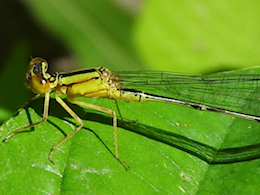
Eastern Amberwing (female)

I have never really spent much time looking for odes at the Eagleson storm water ponds, as most of my outings start there first thing in the morning when it isn’t hot enough for many dragonflies to be flying. However, after seeing the unidentified female spreadwing there on Saturday morning, I decided to head over on Sunday after my visit to the Old Quarry Trail. While I’ve seen Common Green Darners, Twelve-spotted Skimmers, Autumn Meadowhawks, Eastern Forktails, Tule Bluets, and Familiar Bluets there since the reconstruction, the arrival of the unidentified spreadwing and even the Delaware Skipper made me wonder whether other species had taken up residence recently. I wasn’t expecting anything too exciting or unusual, but I figured I might at least see some of the common pond skimmers found nearby at places like Bruce Pit and Stony Swamp. Perhaps I should have raised my expectations a bit, for what I found there surprised me!

Continue reading “Dragon-hunting at the Ponds”

Morris Island

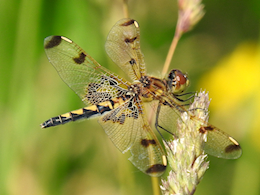
Halloween Pennant

My last day off was Tuesday, and the forecast finally called for a decent amount of sun during the morning and afternoon. I invited a friend, Jon, to go dragon-hunting with me at Morris Island since he was eager to become re-acquainted with odonates after a long absence. There were a few particular species on his must-see list, including Cobra Clubtail, Cyrano Darner and Dragonhunter; I’d seen all of these at Morris Island before, though I wasn’t optimistic about our chances of seeing the Cyrano. Although it is considered to be a widespread species, inhabiting swamps, small lakes, and slow-moving rivers of the eastern half of the continent, adults are rarely seen. It is thought that once they emerge they immediately fly up into the tree-tops where they spend most of their time. Adult males can sometimes be found patrolling their territory, and this appeared to be just such a case with the one that I caught in the parking lot of the Morris Island Conservation Area last year. That was on June 25th, however, I was worried that we might be too late to see them.

Continue reading “Morris Island”

At Petrie Island

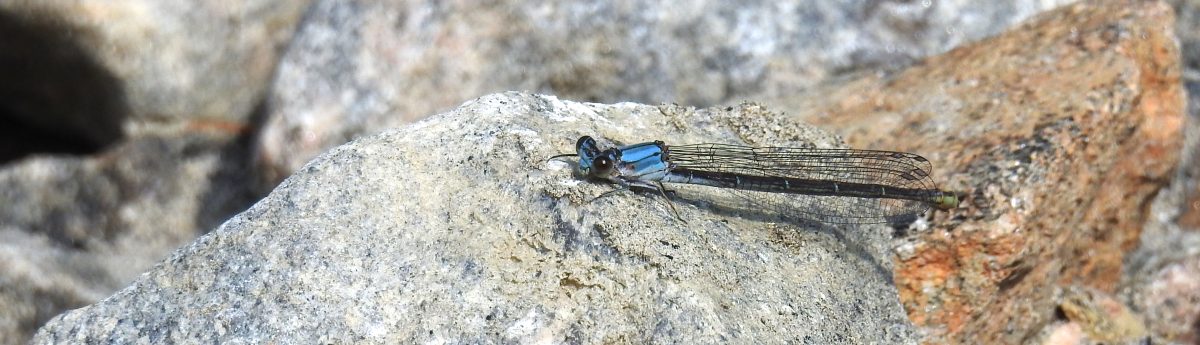
Vesper Bluet

On July 17th, Chris Lewis and a few other friends and I went dragon-hunting at Petrie Island. Although the morning started out cool, it quickly warmed up, and as a result we saw lots of great bugs. We started our outing by searching the vegetation between the parking lot and the first small bay, usually a productive area for some of the smaller dragonflies and damselflies. This is the only spot at Petrie Island where I’ve seen Vesper Bluet and Orange Bluet, and we spent a good half hour examining the shrubs for these small damselflies. Although both species are considered common in the Northeast, Petrie Island is the only place where I’ve seen them. However, both species are more active later in the day, and since I usually do my birding and ode-hunting in the morning and early afternoon, it is possible I’ve missed them in other places.

Continue reading “At Petrie Island”

The “Wild Ode West” Dragon-hunting Adventure

Widow Skimmer
Widow Skimmer

Chris Lewis and I had such a great time dragon-hunting in Gatineau last weekend that on June 25th we decided to hit several spots west of Ottawa to search for several local and unique species. On our list of locations were the Quyon Ferry Dock near Fitzroy to look for big river species, Morris Island for clubtails and skimmers, and Pakenham, Blakeney and Almonte for Rapids Clubtail. Before heading out to the Quyon Ferry Dock we stopped in at the fields near Constance Bay to look for Upland Sandpipers. We got lucky and found four. Not only did we see a couple of them flying over the fields, giving their distinctive call, we found one standing right on the shoulder of the road! Unfortunately we caused it to flush before I could get a photo of this bird; I still have yet to photograph this species. Indeed, this was the closest I’ve ever come to one of an Upland Sandpiper, which are difficult to find as they breed and feed in dry grasslands rather than muddy shorelines.

Continue reading “The “Wild Ode West” Dragon-hunting Adventure”

An OFNC outing at Petrie Island

Eastern Amberwing
Eastern Amberwing

On August 2nd, 2015 I led a dragonfly outing at Petrie Island for the Ottawa Field-Naturalists’ Club. Because I would be leading it on my own, and because the small size of dragonflies and damselflies makes it difficult to point them out to large groups, I decided to limit the group to ten people. Fellow dragon-hunters and Birds Committee members Chris Traynor and Lorraine Elworthy signed up for the outing, as did Jakob Mueller, who led the reptile and amphibian outing at Sheila McKee Park earlier in the year. I recognized Lynne Ovenden from the OFNC; the others were all unknown to me.

I started our outing by talking about the differences between dragonflies and damselflies, as well as the different groups belonging to each family. We would be looking for spreadwing damselflies, which hold their wings out at a 45° angle instead of parallel to their back; emeralds and darners, which are most commonly found flying through the air searching for aerial prey; and skimmers, which tend to hunt from a perch and are usually the most approachable types of dragonflies for photography. As I was speaking, a bright green female Eastern Pondhawk was hunting from a perch in the vegetation, often flying out to snatch an insect from the air. At one point it even landed on one of the group members!

Continue reading “An OFNC outing at Petrie Island”

Mid-summer

It’s hard to believe that it’s mid-summer now; July is over, August is here, and songbird migration is only a few weeks away. When it comes to insects, I’m not thinking as much about seeing the first species of the season as I am wondering whether each individual (except for the darners and meadowhawks) is my last of the season. There are some species I seem to have missed completely this year, such as Emerald Spreadwing (which has a flight season from mid-June to mid-August), Horned Clubtail (mid-May to early July), Stream Cruiser (late May to mid-July), and any of the hairstreak butterflies (the peak of their flight season occurs in the first half of July). This is the result of a combination of bad luck and bad weather; I missed most of these bugs when I went looking in places where I have seen them before, and when I wanted to return later, the cold, overcast and/or rainy weather on the weekends prevented me.

Continue reading “Mid-summer”