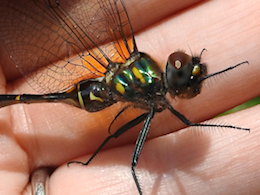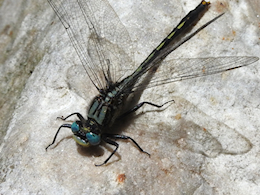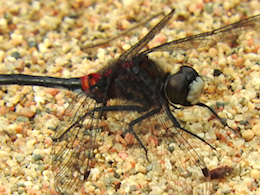
Dragon-hunting at the Bill Mason Center

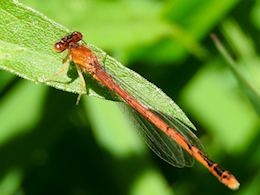
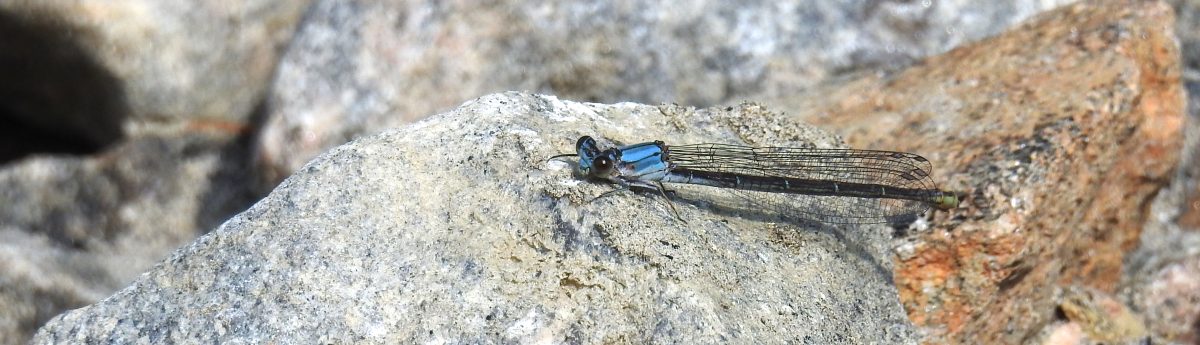
Azure Bluet
Azure Bluet

On August 7th I met up with Chris Lewis at Shirley’s Bay for a morning of birding and dragon-hunting. The morning got off to a great start when I saw a group of Wild Turkeys along Rifle Road even before I met Chris at the parking lot; there were two adults and a couple of baby turkeys. At Shirley’s Bay Chris and I tallied 44 species altogether, including a juvenile Osprey which landed in the Osprey nest down the road, five Common Terns and 11 Caspian Terns flying about, a Pectoral Sandpiper, a Semipalmated Sandpiper, a Solitary Sandpiper, and a single American Wigeon in the bay with the usual dabbling ducks, and a flock of migrating songbirds in the woods. The flock included a Yellow Warbler, a Chestnut-sided Warbler, a Black-and-white Warbler, and a couple of Gray Catbirds, and a Rose-breasted Grosbeak.

Continue reading “Dragon-hunting at the Bill Mason Center”
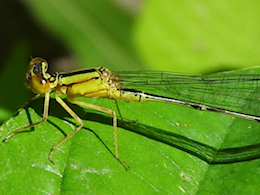
At Petrie Island

Vesper Bluet

On July 17th, Chris Lewis and a few other friends and I went dragon-hunting at Petrie Island. Although the morning started out cool, it quickly warmed up, and as a result we saw lots of great bugs. We started our outing by searching the vegetation between the parking lot and the first small bay, usually a productive area for some of the smaller dragonflies and damselflies. This is the only spot at Petrie Island where I’ve seen Vesper Bluet and Orange Bluet, and we spent a good half hour examining the shrubs for these small damselflies. Although both species are considered common in the Northeast, Petrie Island is the only place where I’ve seen them. However, both species are more active later in the day, and since I usually do my birding and ode-hunting in the morning and early afternoon, it is possible I’ve missed them in other places.

Continue reading “At Petrie Island”

The “Wild Ode West” Dragon-hunting Adventure

Widow Skimmer
Widow Skimmer

Chris Lewis and I had such a great time dragon-hunting in Gatineau last weekend that on June 25th we decided to hit several spots west of Ottawa to search for several local and unique species. On our list of locations were the Quyon Ferry Dock near Fitzroy to look for big river species, Morris Island for clubtails and skimmers, and Pakenham, Blakeney and Almonte for Rapids Clubtail. Before heading out to the Quyon Ferry Dock we stopped in at the fields near Constance Bay to look for Upland Sandpipers. We got lucky and found four. Not only did we see a couple of them flying over the fields, giving their distinctive call, we found one standing right on the shoulder of the road! Unfortunately we caused it to flush before I could get a photo of this bird; I still have yet to photograph this species. Indeed, this was the closest I’ve ever come to one of an Upland Sandpiper, which are difficult to find as they breed and feed in dry grasslands rather than muddy shorelines.

Continue reading “The “Wild Ode West” Dragon-hunting Adventure”

Jack Pine Specialties

Brush-tipped Emerald

The day after the excellent snaketail adventure in Gatineau Park, I headed over to Jack Pine Trail to see if any of its unique dragonflies were on the wing. Two years ago I found a healthy population of Brush-tipped and Williamson’s Emeralds, and Arrowhead Spiketails are regularly seen along the stream at the back. Although I’d heard that it takes four years for Williamson’s Emerald larvae to mature, I had hopes of at least finding the Brush-tipped Emerald; I still think it’s amazing that all these wonderful dragonflies live and breed so close to home. I was also hoping to find some spreadwings, as I’ve seen both Northern and Emerald Spreadwings along the trails here in the past – though none in the past couple of years.

Continue reading “Jack Pine Specialties”

Dragon Blitz 2016 – Part II

Eastern Red Damsel

After leaving Sarsaparilla Trail I drove over to the NCC parking lot on Corkstown Road and followed the bike path beneath the Queensway to the place where Chris Traynor had seen the Eastern Red Damsels earlier in the week. The spot isn’t hard to find; just keep following the path parallel to the Queensway as it passes over a small bridge and skirts the northern edge of a farmer’s field. Eventually the path reaches a small woodlot and abruptly turns south; before you get to the small stand of trees, watch for an NCC sign on the left about the crops of the Greenbelt. Chris had found the damselflies in the grass behind the sign.

Continue reading “Dragon Blitz 2016 – Part II”

Dragon Blitz 2016 – Part I

Lilypad Clubtail

When I decided to take today off it wasn’t my intention, in the beginning, to embark on an all-out “dragon blitz” and search for as many odonate species as possible (or at least as many as I could find until my stamina began to falter); the forecast for the weekend looked terrible, so I wanted to go out while the weather was nice to look for birds in the morning and odes as soon as it warmed up. However, that’s exactly what it became as I started finding some good dragonflies early in the morning and decided to keep visiting different trails where I knew I could find different species.

My morning began with a visit to Lime Kiln Trail, which isn’t a place I visit very often. However, a Mourning Warbler has been heard singing away there for a couple of days now, and I thought I would try to find it. My walk started out fairly quiet, but I saw a Veery on the ground and a Common Raven flying overhead right near the beginning of the trail, and heard a couple of Red-eyed Vireos and a Brown Creeper in the woods.

Continue reading “Dragon Blitz 2016 – Part I”

The odes of Sugarbush Trail (Gatineau)

River Jewelwing
River Jewelwing

On the first Saturday in June I made plans to meet Chris Traynor at the parking lot of the Sugarbush Trail in Gatineau Park to look for dragonflies. He has re-named this trail the “Clubtail Trail” due to the large number of clubtails that breed there, and I was eager to find some new species for my life list. Unfortunately our last visit there wasn’t terribly productive due to the overcast skies; the weather on Saturday was much nicer, sunny and warm even in the morning.

As we weren’t planning to meet until 9:00 am, I stopped by Sarsaparilla Trail first to check out the birds there. This turned out to be a fantastic idea as I heard a Least Bittern calling somewhere in the reeds to the north of the boardwalk and a Virginia Rail grunting somewhere on the south side. Other species included Brown Creeper, Eastern Wood-Pewee, Great Crested Flycatcher, Eastern Kingbird, a couple of Tree Swallows, a Marsh Wren singing in the reeds at the end of the boardwalk (the same one from last year?), a couple of Yellow Warblers, a White-throated Sparrow, and two Purple Finches.

Continue reading “The odes of Sugarbush Trail (Gatineau)”

Crimson-ringed Whitefaces in Ottawa

Crimson-ringed Whiteface

The weather was supposed to be warm and sunny yesterday, so I headed out to the Bill Mason Center to look for marsh birds and dragonflies. Chris Traynor had found a Crimson-ringed Whiteface at the sand pit early in the season last year, and as I’ve never seen this species in Ottawa, I was curious to find out if his dragonfly was a chance visitor or if they were common there in the late spring. While this species has a flight season from late May to early August, I have never seen it there during any of my summer visits to the Bill Mason Center. I was also hoping to find a few marsh birds such as bitterns, Sora and Virigina Rail, so it seemed like a great idea to stop there after checking out the Carp Ridge and some of the roads in Dunrobin for other species.

Continue reading “Crimson-ringed Whitefaces in Ottawa”

Dragonfly Season Begins in Marlborough Forest

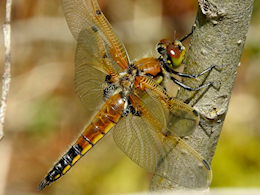
Four-spotted Skimmer

By the third week of May the weather finally warmed up enough to do some dragon-hunting, so on May 21st I made plans with Chris Lewis and Jakob Mueller to go to Roger’s Pond in Marlborough Forest to look for birds, bugs and herps. We had great luck with all three, though mammals were sadly lacking. I’m not sure why I don’t see many mammals at this trail; the only one I can remember seeing with any certainty was a Snowshoe Hare right on the gravel trail as it ran by me.

Continue reading “Dragonfly Season Begins in Marlborough Forest”

Dragonflies in Mexico

Red Saddlebags (Tramea onusta)

On April 16th my fiancé Doran and I took our first trip outside of Canada and the U.S., spending the week in Cozumel, Mexico. We chose it because when we had originally been looking at going on a cruise, it was one of the destinations we particularly wanted to see because of the Mayan ruins close by, and a one-day stop didn’t seem like enough time to see the region. I was also interested in the wildlife there, though that would have been true of any destination!

We flew from Montreal to Atlanta at the ridiculous hour of 5:45am, having driven from Ottawa the night before and staying at the Marriott in the terminal. It was after 11:00pm by the time we went to bed, and I didn’t sleep a wink – we had to get up at 3:00am for the flight. From Atlanta we flew to Cozumel, arriving at 1:30pm. It was very hot and humid, and I was completely overdressed in my jeans and long-sleeved sweater. We passed through customs and security without any problems despite the long line and arrived at our hotel (the El Cozumeleno Beach Resort in the northern hotel zone) by 2:00.

Continue reading “Dragonflies in Mexico”

The Last Dragons of Summer

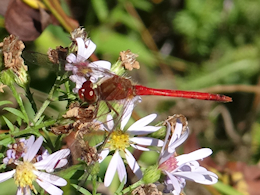
Autumn Meadowhawk

The end of September is a good time to see a variety of hover flies (also known as flower flies, syrphid flies, or syrphids). It is also the end of dragonfly season. Most odonates are already done for the season – only a handful of species will continue flying into October, with the last species, Autumn Meadowhawk, flying into November if the weather cooperates.

As the last week of September was still quite warm, I was able to find and photograph a few different species of both insects – even in my own backyard! I finally added Autumn Meadowhawk to my official yard list on September 19th. I’ve seen a few meadowhawks in my yard over the years, but have only identified White-faced Meadowhawk and Band-winged Meadowhawk so far. I found it on the asters at the back of the yard, although it flew up onto the fence when I tried to get closer for a photo. Given how abundant and widespread it is, the Autumn Meadowhawk was the most likely species to be added to my yard list. Now that it has shown up in my yard, I’m not sure what the next likeliest species is – Common Green Darner? Twelve-spotted Skimmer?

Continue reading “The Last Dragons of Summer”

To Catch a Wandering Glider

I had a fabulous outing in Stony Swamp this morning. I started the morning by birding at Sarsaparilla Trail where I found a pair of Pied-billed Grebes and a Merlin perched in one of the dead trees at the north end of the pond; it was so far off that I had to return to the car and get my scope to identify it. I was glad I had brought my scope, for as I was scanning the vegetation along the shoreline I discovered two heron species skulking at the edge of the pond: a tiny Green Heron poised on a log, and an American Bittern that was almost invisible in a gap in the reeds! It made me wonder what other birds were present, going about their lives while remaining hidden from view.

Continue reading “To Catch a Wandering Glider”

Marvelous Meadowhawks

Saffron-winged Meadowhawk

On August 16th Chris Lewis and I went to the Bill Mason Center to do some dragon-hunting. As the weatherman was predicting a steamy high of 30°C with 100% humidity, we met at 7:30 in the morning in order to beat the heat. For the second day in a row, a thick early-morning fog hung low over Ottawa, but once we arrived at the sand pit we found a bright, sunny morning with no trace of fog. It was really starting to warm up by then, but as it was still early in the day, all we saw at first were a couple of darners we accidentally scared up from the vegetation along the northwestern side of the pond. None were cooperative; instead of settling back down in a spot where we could see them, they zoomed off altogether.

Continue reading “Marvelous Meadowhawks”

An OFNC outing at Petrie Island

Eastern Amberwing
Eastern Amberwing

On August 2nd, 2015 I led a dragonfly outing at Petrie Island for the Ottawa Field-Naturalists’ Club. Because I would be leading it on my own, and because the small size of dragonflies and damselflies makes it difficult to point them out to large groups, I decided to limit the group to ten people. Fellow dragon-hunters and Birds Committee members Chris Traynor and Lorraine Elworthy signed up for the outing, as did Jakob Mueller, who led the reptile and amphibian outing at Sheila McKee Park earlier in the year. I recognized Lynne Ovenden from the OFNC; the others were all unknown to me.

I started our outing by talking about the differences between dragonflies and damselflies, as well as the different groups belonging to each family. We would be looking for spreadwing damselflies, which hold their wings out at a 45° angle instead of parallel to their back; emeralds and darners, which are most commonly found flying through the air searching for aerial prey; and skimmers, which tend to hunt from a perch and are usually the most approachable types of dragonflies for photography. As I was speaking, a bright green female Eastern Pondhawk was hunting from a perch in the vegetation, often flying out to snatch an insect from the air. At one point it even landed on one of the group members!

Continue reading “An OFNC outing at Petrie Island”

Mid-summer

It’s hard to believe that it’s mid-summer now; July is over, August is here, and songbird migration is only a few weeks away. When it comes to insects, I’m not thinking as much about seeing the first species of the season as I am wondering whether each individual (except for the darners and meadowhawks) is my last of the season. There are some species I seem to have missed completely this year, such as Emerald Spreadwing (which has a flight season from mid-June to mid-August), Horned Clubtail (mid-May to early July), Stream Cruiser (late May to mid-July), and any of the hairstreak butterflies (the peak of their flight season occurs in the first half of July). This is the result of a combination of bad luck and bad weather; I missed most of these bugs when I went looking in places where I have seen them before, and when I wanted to return later, the cold, overcast and/or rainy weather on the weekends prevented me.

Continue reading “Mid-summer”