A Missed Turn

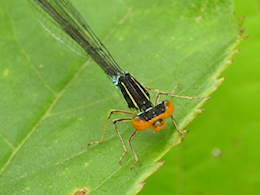
Powdered Dancer (Argia moesta)

Burritt’s Rapids has been on my radar as a low-priority place to visit for about a year now, and if I hadn’t missed a turn on my way to the southwestern corner of Marlborough Forest I wouldn’t have ended up there on a nice warm day in mid-July. I had been curious about what species I might find at the rapids there, and was hoping to find a few new species to add to iNaturalist as it didn’t have many when I first started thinking about going there. One species I was curious about was Swamp Spreadwing, which had been found a short distance east at Rideau River Provincial Park back in 2022. The only place I’ve seen this species in Ottawa is Petrie Island, and it would be fantastic to find another one closer to home. I was also wondering if the river and rocky rapids might host some of our common clubtails, such as Dragonhunter or Black-shouldered Spinyleg.

Continue reading “A Missed Turn”
Two provinces. Six families. One unbelievable day.

Swift River Cruiser (Macromia illinoiensis)

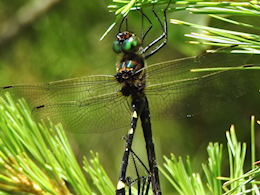
If you had told me it was possible to see more than a dozen Prince Baskettails hanging from the pine trees like early Christmas ornaments, three perching Swift River Cruisers (including two in a mating wheel), a perching Springtime Darner, an ovipositing Cyrano Darner, an emerging Dragonhunter, four additional clubtail species, a dozen Brush-tipped Emeralds, about 50 Widow Skimmers, and an Arrowhead Spiketail all in a single day here in the Ottawa region, I am not sure I would believe you. That kind of day is so rare in Ottawa that I would would assume that you were engaging in a particularly fanciful daydream. However, on the Quebec side of the river many things are possible. Part of it is due to the scenic geography – the deep, rocky lakes, rushing streams, and variety of marshes, swamps and bogs carved out of the Canadian Shield provide a fantastic variety of habitats. Part of it is due to the untouched wilderness outside of the Gatineau area – there are no cottages lining the shore, no subdivisions full of manicured lawns, no pesticides and insecticides to wreak havoc on insect populations. These two factors make it an excellent place to see a variety of odes – especially along the Ottawa River, a major dragonfly habitat of its own.

Continue reading “Two provinces. Six families. One unbelievable day.”

Finding Amberwings

Eastern Amberwing

The Amber-winged Spreadwing at Bruce Pit wasn’t the only good find there on July 14th. Back on July 6th I’d found a different sort of amber-wing: an Eastern Amberwing, one of our smallest dragonflies. I’d also found and photographed a Halloween Pennant, a species I’d seen flying over the water last year but hadn’t managed to find perching. I observed both species on the slope between the fence and the edge of the pond, and both were new for my Bruce Pit list. I asked Chris Lewis if she had seen either species there before, and she told me she had seen Halloween Pennant there in the past, but not Eastern Amberwing – no surprise there, since this is a relatively new addition to the Ottawa area. When I headed over to Bruce Pit after finding the Amber-winged Spreadwing at Bill Teron Park on July 14th, it was to see if I could find any more Eastern Amberwings or Halloween Pennants and get some better photos.

Continue reading “Finding Amberwings”

A New Dragonfly at Roger’s Pond

Halloween Pennant

Marlborough Forest is always a fun place to visit, and after failing to find any Brush-tipped Emeralds at Jack Pine Trail earlier this week I decided to go to the E6 trail and Roger’s Pond this morning to see if I could find any of these unique Somatochlora emeralds there. Unfortunately that was not to be the case, but I had a great time and found a nice selection of odes while I was there. At Trail E6 I found many of the usual species, including Racket-tailed Emeralds, Frosted Whitefaces, and White-faced Meadowhawks.

Continue reading “A New Dragonfly at Roger’s Pond”

Canada Day Clubtails – Part 1

Cobra Clubtail

On July 1st I spent the morning at Sheila McKee Memorial Park with the full intention of heading out to Pinhey’s Point afterward. My goals were to get to Sheila McKee early enough to look for the Yellow-throated Vireo and Yellow-billed Cuckoo that had been found there recently, then look for dragonflies in the open meadow and along the river shore. I was hoping to find another Mustached Clubtail, or perhaps an Arrow Clubtail, or the first Cobra or Midland Clubtails of the season. It was a bit cool in the morning, so I waited until 8:30 am to leave. When I got there just before 9:00 there were already several cars in the parking lot, and by the time I headed out to the road to listen for the elusive cuckoo a cavalcade of cars was turning into the parking lot from Sixth Line Road.

Continue reading “Canada Day Clubtails – Part 1”

Ode-hunting in Chatham-Kent: Peers Wetland

Probable Ruby Meadowhawk

My mother lives in Wallaceburg in Chatham-Kent, which is about a 7.5 hour drive from Ottawa, or a full day train adventure with a transfer in Toronto (my advice for anyone travelling economy on Via: take your own sandwiches and snacks, as the menu was somewhat unpalatable…and chocolate bars/chips alone were $3.00). Being so far south she gets a variety of birds, bugs and plants that we do not get here in eastern Ontario, so I’ve been meaning to visit in the summer when I might see some new southern butterflies and dragonflies for my life list. I took an extra two days off at the end of August so I could spend the Labour Day long weekend with her, though two of the days were lost to travel. As my mother and her husband both enjoyed birds and nature, I knew they’d be interested in taking a few nature walks with me, even if the idea of looking for dragonflies didn’t exactly fill them with delight.

Continue reading “Ode-hunting in Chatham-Kent: Peers Wetland”

Terry Carisse Park in the Summer

Rainbow Bluet

Most naturalists who have heard of Terry Carisse Park along the Jock River associate it with birds – particularly the Hooded Warbler that spent a few days there in May 2014. As a rare bird for Ottawa, this discovery put this small riparian park on the map for many Ottawa birders. Other people may associate it with the Osprey nest there, although the Osprey haven’t nested there for a few years now. I myself have returned regularly to this park in the spring and fall to look for the Rusty Blackbirds that often stop over here during migration – in May 2021 I found at least 50 of these declining birds feeding on the lawn and perched in the trees that line the river bank. Because of the thick shoreline vegetation, the wooded swamp to the north, and the open grassy areas dotted with conifers it is a good place to look for birds during migration. I had never been here during the summer breeding season, and it occurred to me this summer that it might be a good spot to look for odonates. I started my summer ode survey on July 2, 2022, continuing through early August, and found more species than I expected – including some species I’ve only seen at Petrie Island or Morris Island Conservation Area!

Continue reading “Terry Carisse Park in the Summer”

A trip to Morris Island with the McNamara Field Naturalists

Slaty Skimmer
Slaty Skimmer

On Saturday, July 3rd I accompanied the McNamara Field Naturalists on their first in-person outing since the latest Stay-at-Home Order ended on June 2nd. Ontario entered Stage 2 of its reopening plan on July 2nd, which raised the number of people who could attend outdoor social gatherings and organized public events to 25 people (as well as allowing haircuts and personal care services again). Although I am not a member of the McNamara Field Naturalists Club, which calls Arnprior home but whose explorations include a large swath of the Ottawa Valley, one of my friends happens to be in charge of putting field trips together, and asked if I wanted to help lead a dragonfly walk. I said yes, and suggested Morris Island as it’s a great place to find all sorts of odes, including several flashy skimmers and clubtails that can be found perching in the vegetation and along the trails. I was thrilled when my mentor Chris Lewis joined us, as it would be easier to find some more of the unique species with a couple of knowledgeable people looking.

Continue reading “A trip to Morris Island with the McNamara Field Naturalists”

Amber and Saffron Wings

Saffron-winged Meadowhawk

It’s been a good season for hard-to-find dragonflies at the Eagleson Ponds. Ever since I discovered both Eastern Amberwings and Saffron-winged Meadowhawks here in 2017 I’ve been spending more time here later in the day looking for odes, rather than doing a quick search for birds first thing in the morning before heading elsewhere. The Covid-19 pandemic has made that even easier for me, as I am still working from home and can get out at lunch time for a quick check when the temperature has warmed up enough for many odes to be flying.

Mid-summer seems to be the best time for seeing a variety of odes at the ponds. While I have seen a few early-season species here, such as the Taiga Bluet and Spiny Baskettail, most odes that breed here don’t emerge until later in the summer. I’m not sure if the late start to spring had anything to do with it, but up until the end of June I found very few dragonflies here – skimmers are usually abundant throughout the season, but on June 30th I recorded a single Dot-tailed Whiteface and a single Twelve-spotted Skimmer along with a couple of Common Green Darners and Prince Baskettails that refused to land. Even the Eastern Forktails seemed down in numbers.

Continue reading “Amber and Saffron Wings”

The Odes of Andrew Haydon Park – 2019 edition

Halloween Pennant

Back in 2015 I wrote a blog post about the odonates I found at Andrew Haydon Park one weekday afternoon near the end of July. Since discovering the colony of Halloween Pennants at AHP in 2014, I’ve made it a point to visit this park each year during mid-summer; it’s much closer than travelling all the way to Morris Island to see this stunning dragonfly! So far I’ve only made it out to Morris Island once this year, and when I found no Halloween Pennants flying along the causeway I decided to visit Andrew Haydon Park specifically to search for this species. With the strange, slow start to the season I was bit apprehensive about whether these odes would even be around at AHP, but thankfully I found a few on each of my visits, and in good numbers, too.

Continue reading “The Odes of Andrew Haydon Park – 2019 edition”

Dragon-hunting at the Ponds

Eastern Amberwing (female)

I have never really spent much time looking for odes at the Eagleson storm water ponds, as most of my outings start there first thing in the morning when it isn’t hot enough for many dragonflies to be flying. However, after seeing the unidentified female spreadwing there on Saturday morning, I decided to head over on Sunday after my visit to the Old Quarry Trail. While I’ve seen Common Green Darners, Twelve-spotted Skimmers, Autumn Meadowhawks, Eastern Forktails, Tule Bluets, and Familiar Bluets there since the reconstruction, the arrival of the unidentified spreadwing and even the Delaware Skipper made me wonder whether other species had taken up residence recently. I wasn’t expecting anything too exciting or unusual, but I figured I might at least see some of the common pond skimmers found nearby at places like Bruce Pit and Stony Swamp. Perhaps I should have raised my expectations a bit, for what I found there surprised me!

Continue reading “Dragon-hunting at the Ponds”

Morris Island

Halloween Pennant

My last day off was Tuesday, and the forecast finally called for a decent amount of sun during the morning and afternoon. I invited a friend, Jon, to go dragon-hunting with me at Morris Island since he was eager to become re-acquainted with odonates after a long absence. There were a few particular species on his must-see list, including Cobra Clubtail, Cyrano Darner and Dragonhunter; I’d seen all of these at Morris Island before, though I wasn’t optimistic about our chances of seeing the Cyrano. Although it is considered to be a widespread species, inhabiting swamps, small lakes, and slow-moving rivers of the eastern half of the continent, adults are rarely seen. It is thought that once they emerge they immediately fly up into the tree-tops where they spend most of their time. Adult males can sometimes be found patrolling their territory, and this appeared to be just such a case with the one that I caught in the parking lot of the Morris Island Conservation Area last year. That was on June 25th, however, I was worried that we might be too late to see them.

Continue reading “Morris Island”

At Petrie Island

Vesper Bluet

On July 17th, Chris Lewis and a few other friends and I went dragon-hunting at Petrie Island. Although the morning started out cool, it quickly warmed up, and as a result we saw lots of great bugs. We started our outing by searching the vegetation between the parking lot and the first small bay, usually a productive area for some of the smaller dragonflies and damselflies. This is the only spot at Petrie Island where I’ve seen Vesper Bluet and Orange Bluet, and we spent a good half hour examining the shrubs for these small damselflies. Although both species are considered common in the Northeast, Petrie Island is the only place where I’ve seen them. However, both species are more active later in the day, and since I usually do my birding and ode-hunting in the morning and early afternoon, it is possible I’ve missed them in other places.

Continue reading “At Petrie Island”

The “Wild Ode West” Dragon-hunting Adventure

Widow Skimmer
Widow Skimmer

Chris Lewis and I had such a great time dragon-hunting in Gatineau last weekend that on June 25th we decided to hit several spots west of Ottawa to search for several local and unique species. On our list of locations were the Quyon Ferry Dock near Fitzroy to look for big river species, Morris Island for clubtails and skimmers, and Pakenham, Blakeney and Almonte for Rapids Clubtail. Before heading out to the Quyon Ferry Dock we stopped in at the fields near Constance Bay to look for Upland Sandpipers. We got lucky and found four. Not only did we see a couple of them flying over the fields, giving their distinctive call, we found one standing right on the shoulder of the road! Unfortunately we caused it to flush before I could get a photo of this bird; I still have yet to photograph this species. Indeed, this was the closest I’ve ever come to one of an Upland Sandpiper, which are difficult to find as they breed and feed in dry grasslands rather than muddy shorelines.

Continue reading “The “Wild Ode West” Dragon-hunting Adventure”

An OFNC outing at Petrie Island

Eastern Amberwing
Eastern Amberwing

On August 2nd, 2015 I led a dragonfly outing at Petrie Island for the Ottawa Field-Naturalists’ Club. Because I would be leading it on my own, and because the small size of dragonflies and damselflies makes it difficult to point them out to large groups, I decided to limit the group to ten people. Fellow dragon-hunters and Birds Committee members Chris Traynor and Lorraine Elworthy signed up for the outing, as did Jakob Mueller, who led the reptile and amphibian outing at Sheila McKee Park earlier in the year. I recognized Lynne Ovenden from the OFNC; the others were all unknown to me.

I started our outing by talking about the differences between dragonflies and damselflies, as well as the different groups belonging to each family. We would be looking for spreadwing damselflies, which hold their wings out at a 45° angle instead of parallel to their back; emeralds and darners, which are most commonly found flying through the air searching for aerial prey; and skimmers, which tend to hunt from a perch and are usually the most approachable types of dragonflies for photography. As I was speaking, a bright green female Eastern Pondhawk was hunting from a perch in the vegetation, often flying out to snatch an insect from the air. At one point it even landed on one of the group members!

Continue reading “An OFNC outing at Petrie Island”