
Richmond Lagoon Damselflies

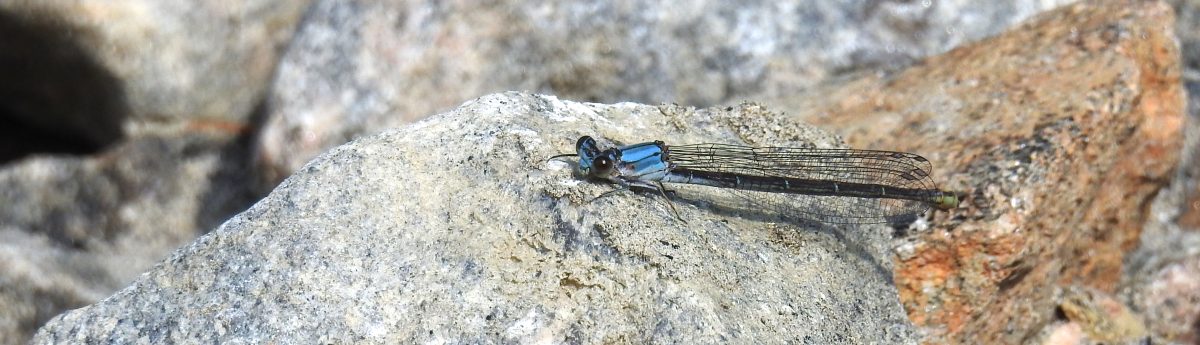
Rainbow Bluet

I often visit the former Richmond Lagoons (now called the Richmond Conservation Area) around late June or early July to look for spreadwings, as this is one of the best places to find five or six different species. It’s one of the few places I can find Lyre-tipped Spreadwings easily, and in 2023 I found another difficult-to-find species here, the Emerald Spreadwing. Both spreadwings are listed as “uncommon” in the Ottawa checklist, but the Lyre-tipped Spreadwing is also designated as “local,” having a special preference for shallow marshes and vegetated ponds completely in the open, particularly those that often dry up during prolonged droughts. While the Lyre-tipped Spreadwings typically disappear with the water, they are also quick to appear in temporary flooded areas such as farm ponds, gravel pits, and artificial ponds. While Emerald Spreadwings also inhabit densely vegetated, shallow wetlands, they can be common in shrubby or forested areas a distance away from their breeding ponds. Emerald Spreadwings are not usually successful in wetlands where predators such as fish or dragonflies are common, which may explain why they can be tough to find.

Continue reading “Richmond Lagoon Damselflies”

‘Tis the Season for Spreadwings

Emerald Spreadwing

If the first half of June is great for seeing all kinds of pond damsels (Family Coenagrionidae), the latter half is great for seeing all sorts of spreadwings (Family Lestidae). They may not have the bright colours or the variety of hues of the pond damsels, but what the spreadwings lack in colour they make up for with their larger size and the beautiful metallic green colouration of some of the species. Adult male spreadwings are generally one of three colours: metallic green, black, or brown, each developing various amounts of bluish-gray pruinosity on the thorax and tip of the abdomen. They can be easily identified in the hand or in a photograph that clearly shows the tip of the abdomen viewed from above, as each species has paraprocts that are distinctly different in size and/or shape. On the other hand, females and tenerals are generally duller, browner, or sometimes even bronze or orange in colour. Much like female bluets, these spreadwings are difficult to identify in the field; though some can be examined and identified in the hand, others require a microscope. As such, I have never really delved into the difficulties of identifying female spreadwings.

Continue reading “‘Tis the Season for Spreadwings”

Damselflies in New Places

Violet Dancer
Violet Dancer

Damselflies are small odonates related to dragonflies, but belong to Order Zygoptera instead of Order Anisoptera. Unlike dragonflies, damselflies have very slender abdomens, and the forewing and hindwing are similar size and shape. Two of the three families found in eastern North America – the broad-winged damsels and pond damsels – hold their wings above the body, parallel to the abdomen, while perching. The third family – the spreadwings – do not perch horizontally with their wings parallel to the body, but typically “hang” from a perch, with the wings slightly spread at an angle. Adult damselflies are not strong fliers, and generally do not travel far from water. They are most often found in vegetation or on the ground near ponds, streams, and other bodies of water. Because of their small size they can be difficult to see, but the dark wings of the jewelwings and brightly coloured abdomens of some of the pond damsels help aid in observation.

Continue reading “Damselflies in New Places”

Searching for Darners

I spent some time today at Bruce Pit with the hope of seeing some darners there – ever since my trip to my Dad’s trailer in southern Ontario I’d been hoping to spend more time with some of these large, lovely dragonflies in Ottawa. Mud Lake can be a good place to find them, but I’d seen none earlier this morning, so I was thinking about other places where I might find them. I recalled that Chris Traynor had found a Variable Darner late in the season last year (September 18, 2015) along the hydro cut at Bruce Pit, and decided to head there next. My plan was to spend some time near the water looking for spreadwings and skimmers, then check out the hydro cut for darners. I didn’t find much around the water other than an abundance of Lyre-tipped Spreadwings, so I headed up into the grassy area at the edge of the toboggan slope.

Continue reading “Searching for Darners”

Mid-summer

It’s hard to believe that it’s mid-summer now; July is over, August is here, and songbird migration is only a few weeks away. When it comes to insects, I’m not thinking as much about seeing the first species of the season as I am wondering whether each individual (except for the darners and meadowhawks) is my last of the season. There are some species I seem to have missed completely this year, such as Emerald Spreadwing (which has a flight season from mid-June to mid-August), Horned Clubtail (mid-May to early July), Stream Cruiser (late May to mid-July), and any of the hairstreak butterflies (the peak of their flight season occurs in the first half of July). This is the result of a combination of bad luck and bad weather; I missed most of these bugs when I went looking in places where I have seen them before, and when I wanted to return later, the cold, overcast and/or rainy weather on the weekends prevented me.

Continue reading “Mid-summer”