
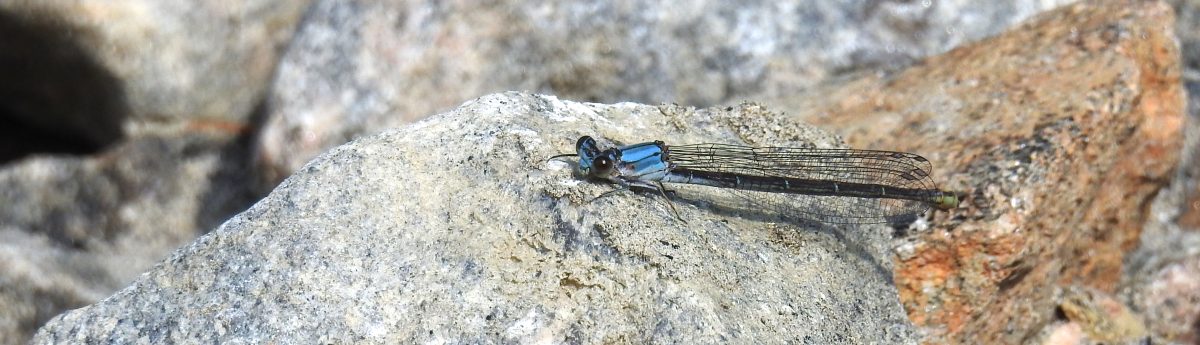
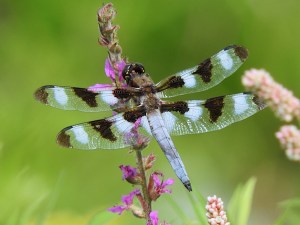
As of 2025, 123 species of dragonflies and damselflies have been found within 50 km of the Peace Tower on Parliament Hill, aka the Ottawa-Gatineau region or the OFNC study area, or simply the Ottawa 50K. This is a remarkable number of odonate species for such a small geographic area and represents one of the highest diversities of odonata in North America.
What we know today of the species that live here and their flight dates comes from a wide variety of sources which were distilled into the OFNC checklist in 1998 by Robert Bracken and Christina Lewis. The checklist was subsequently updated in 2008 and published online, and further updated in 2017 by Chris Traynor. Written sources include the three volumes of E.M. Walker’s The Odonata of Canada and Alaska published between 1953 and 1973 and the Toronto Entomologists’ Association publication Ontario Odonata. These written sources have been supplemented by the personal observations of Paul Catling, Raymond Hutchinson, Benoit Ménard, Robert Bracken, Christina Lewis, and others. Today’s technology has made recording and publishing observations much easier with digital cameras, cell phones, and online databases such as iNaturalist and Odonata Central. I am a fan of both platforms, using iNaturalist to upload my own images and search for others’ sightings, and Odonata Central for those times when I want to concentrate on odes and submit a complete checklist when photographing every species is not always possible.
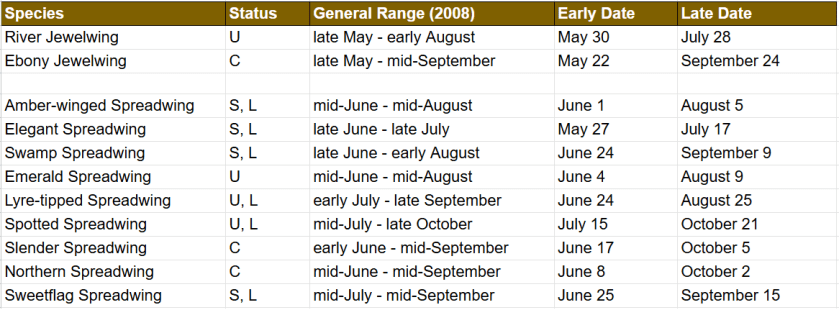
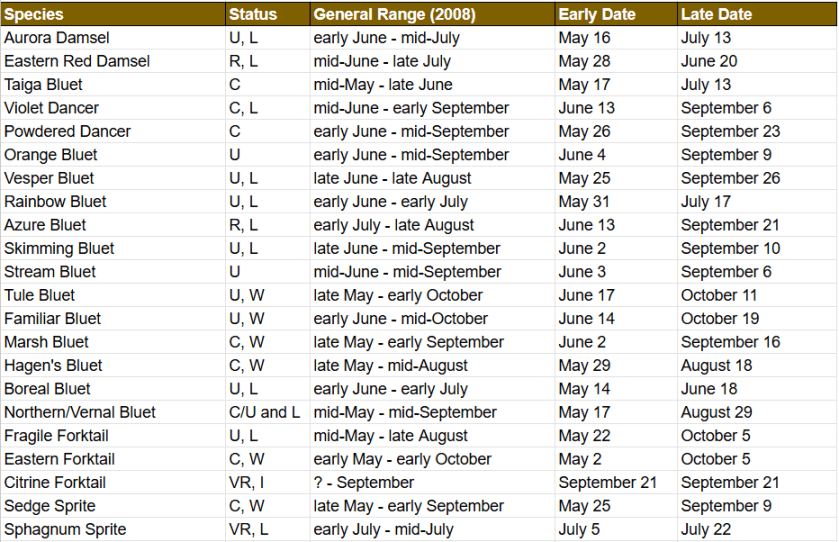
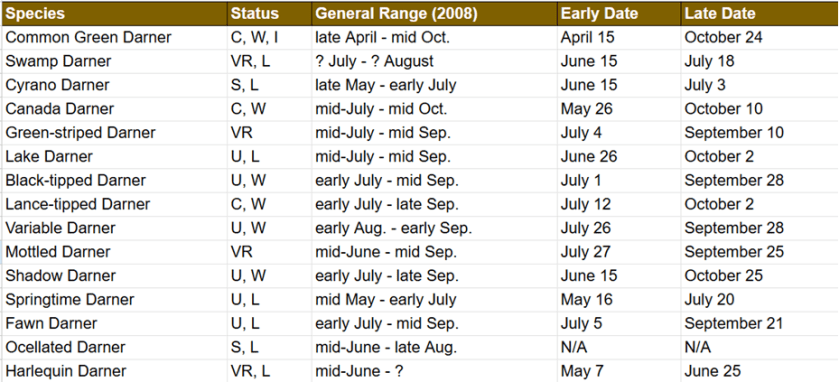
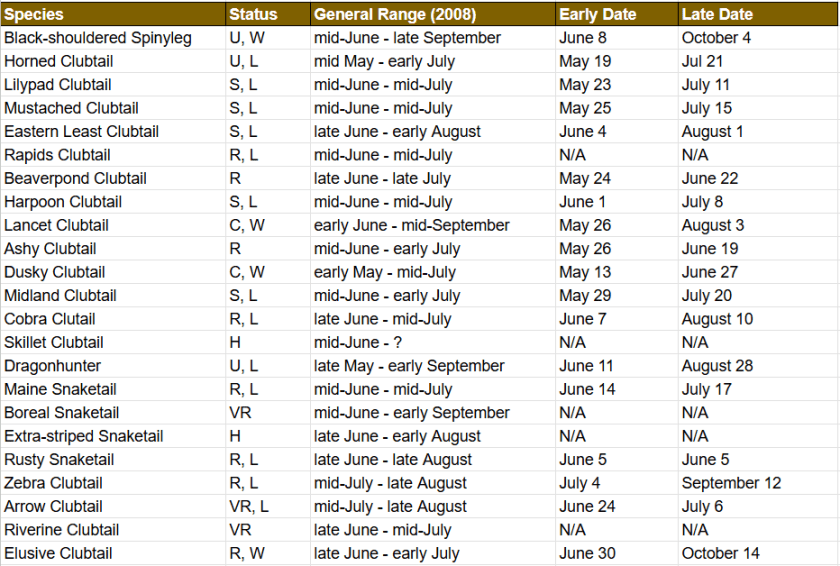
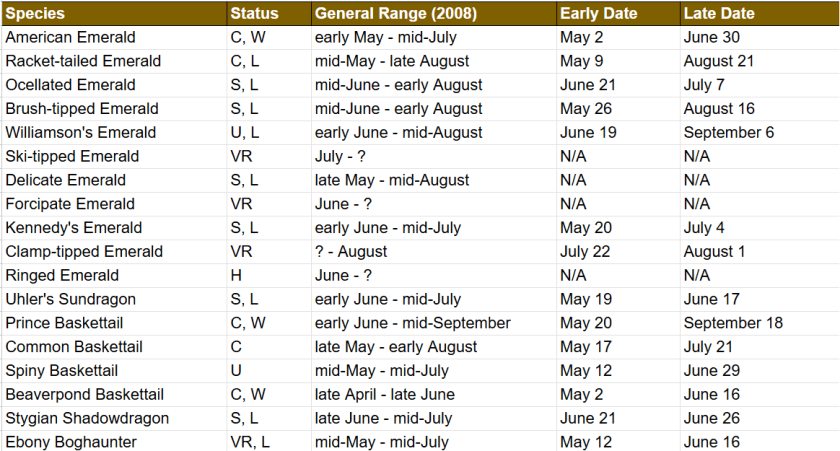
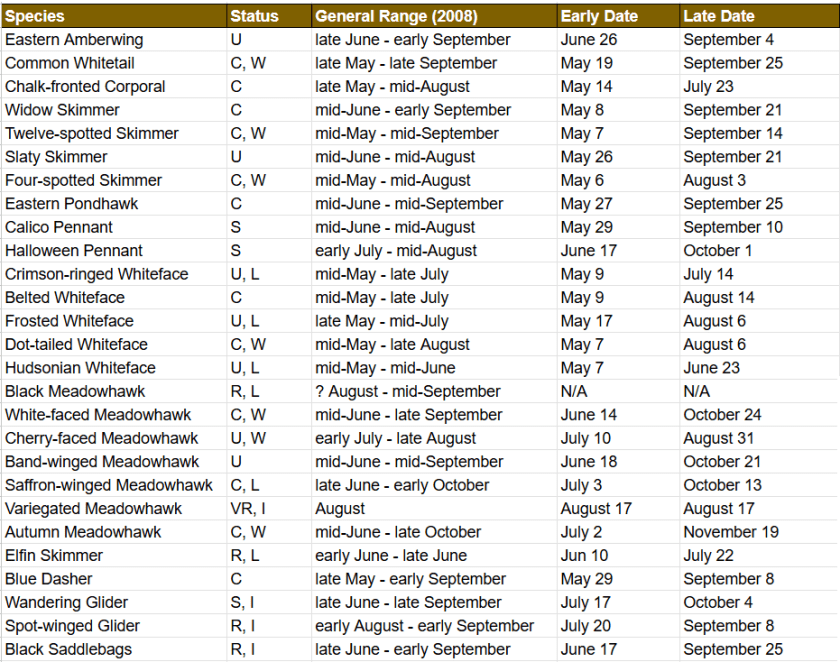
The below list attempts to fill in the general flight season from the Bracken & Lewis checklist with actual dates gleaned by my own observations, those provided by Christina Lewis during our many talks, and those recorded on iNaturalist. These are observations of adults only, as the larvae (nymphs) are present below the water’s surface year-round and beyond the scope of this website. Unfortunately I was not the record-keeper that Christina was in my early days as I was excited just to identify them and add new species to my life list – in contrast, she kept track of everything she saw when she went out, and so much valuable data has been lost with her passing early in 2025. In this way I hope to provide a fuller picture of the flight seasons of Ottawa’s odonates.
The list provides the status of the adults using the same definitions found in the Bracken and Lewis checklist:
C – common, easily found, widespread or abundant within appropriate habitat
U – uncommon, readily found in suitable habitat; most species require effort
S – scarce, not easily found, special effort required
R – rare, specific locations only, not likely to be encountered
VR – very rare, one or two records only or rare immigrant
W – widespread, often encountered outside of appropriate habitat
L – local, closely associated with environmental and/or habitat requirements
I – immigrant, a species that moves into our area from the south
H – historical record, unknown for 50 years
It also includes the general range from the updated 2008 checklist and the earliest and latest dates from records in my possession/iNaturalist, which will be updated with new information as it comes in. Each family has its own page that provides more information and gives examples of representative species.
Broad-winged Damselflies and Spreadwings – Families Calopterygidae and Lestidae
Pond Damsels – Family Coenagrionidae
Darners – Family Aeshnidae
Clubtails – Family Gomphidae
Spiketails and Cruisers – Families Cordulegastridae and Macromiidae

Emeralds – Family Corduliidae
Skimmers – Family Libellulidae
 OdoNotations