
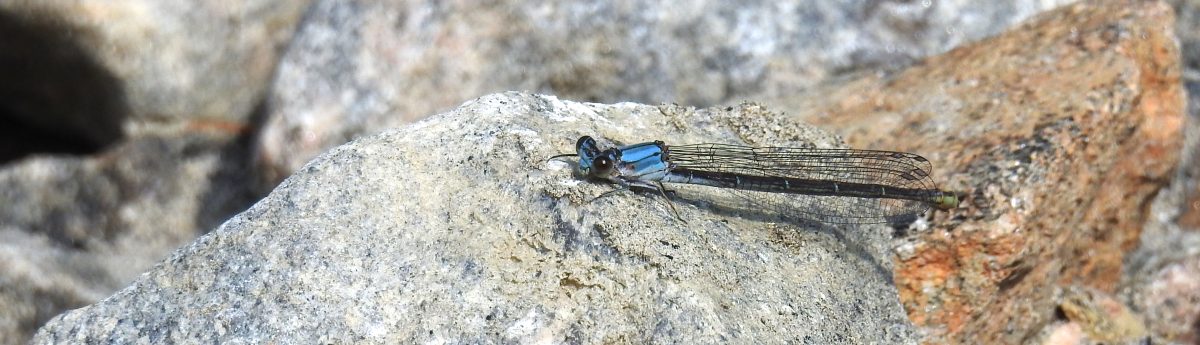
Two species of broad-winged damselfly (Family Calopterygidae) and nine species of spreadwing (Family Lestidae) occur in the Ottawa-Gatineau region. They are among the largest damselflies, with jewelwings breeding in wooded rivers and creeks, and spreadwings breeding in marshes, ponds, and slow-moving streams.
The broad-winged damselflies, better known as jewelwings, have metallic green bodies which often show glints of copper in certain lighting and broad wings with varying degrees of black on them. Females can be differentiated from the males by a white spot (called a pseudostigma) near the tip of the wings. Of the two species in our region, Ebony Jewelwings have wings that are entirely black while River Jewelwings have wings that are clear except for a black patch covering the outer half or one-third of the wing. The wings of the female River Jewelwings are darker overall, with or without a darker patch at the tip, and older female Ebony Jewelwings may have dark patches at the tips of the wings as well, making it difficult to distinguish the two females. The wing shape is the best way to identify the jewelwings where they occur together: the wings of the Ebony Jewelwing are broader and more rounded than those of the River Jewelwing, which are narrower. The Ebony Jewelwing has wings that are about three times as long as they are wide, while the River Jewelwing has wings that are about four times as long as they are wide. Both jewelwings are found at running water, typically smaller rivers and streams.
Spreadwings are more varied. They can be recognized by the way they perch vertically from emergent reeds and stems with their bodies held at an oblique angle and their wings spread at a 45° angle. Immatures and tenerals are a bronzy-orange colour, while mature spreadwings are black or metallic green. Males are most easily identified by the shape of the claspers. Females are more difficult, though some can be identified in the field or in photos by proportions or particular field marks; these include the Slender Spreadwing, Sweetflag Spreadwing, Spotted Spreadwing, and Emerald Spreadwing. Most spreadwings are found in vegetated ponds and still-water habitats, though a few prefer slow-moving rivers.
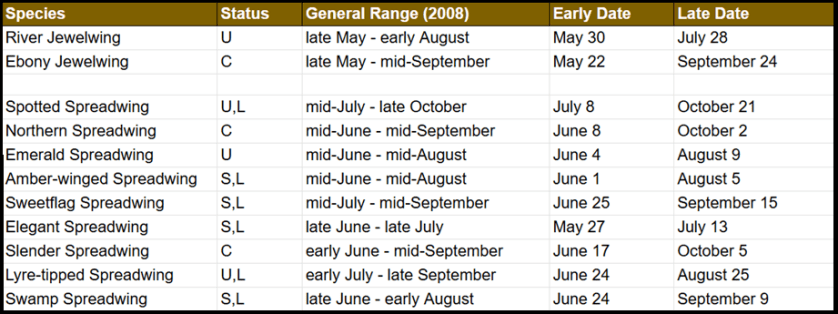
Status and Flight Season in Ottawa-Gatineau
Examples of Species:
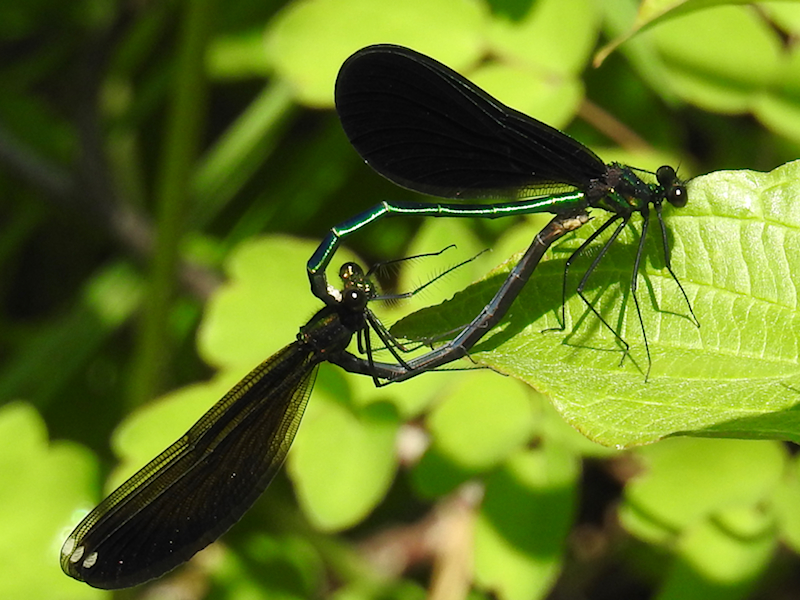
Ebony Jewelwing (Calopteryx maculata)
The most common and widespread jewelwing in our area, males have black wings while females have slightly paler wings that may have a dark patch at the outer tip. This species inhabits slow and moderate streams or rivers that are usually shaded by forest. Often seen foraging in forest clearings, they look like black butterflies in flight.
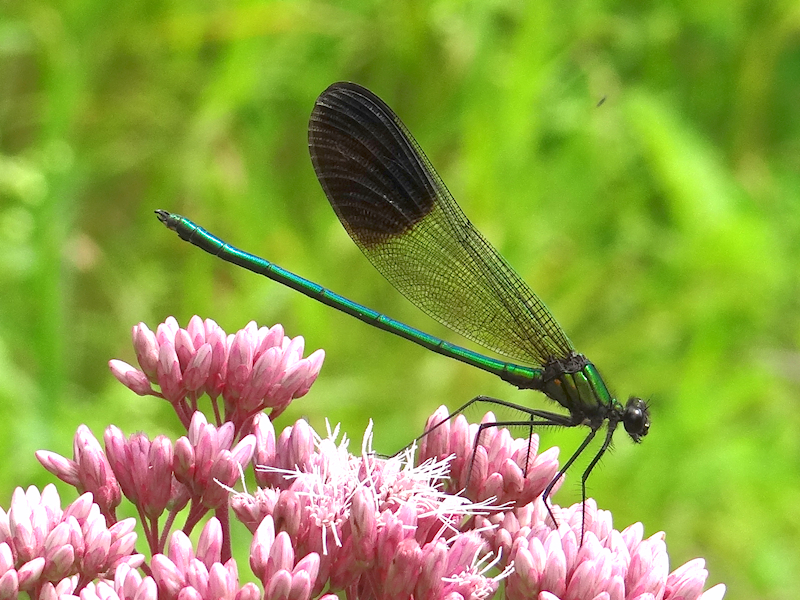
River Jewelwing (Calopteryx aequabilis)
The River Jewelwing has narrower wings than the Ebony Jewelwing. Males have wings tipped with black; females may have entirely brown wings or brown wings with dark wing-tips. They prefer clear rivers and streams that are larger and less forested than Ebony Jewelwings, though the two species can sometimes share habitats.
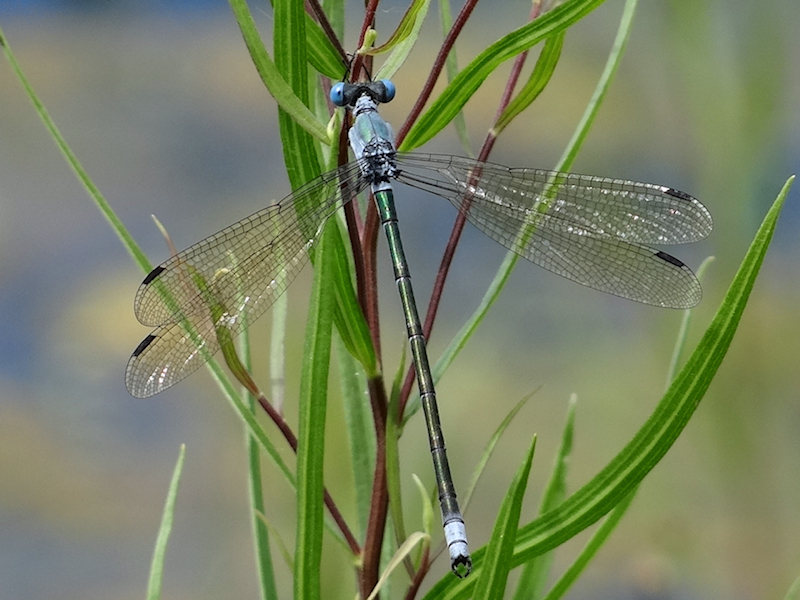
Amber-winged Spreadwing (Lestes eurinus)
This large, robust spreadwing has diagnostic amber-tinted wings that can be difficult to see in the field. The body is metallic greenish-black, though the thorax of the male becomes bluish-grey with pruinosity. The dark diagonal bands on the lower half of the thorax are also useful field marks. The lower claspers of the males are stubby. It lives in small, vegetated ponds that are preferably fishless.
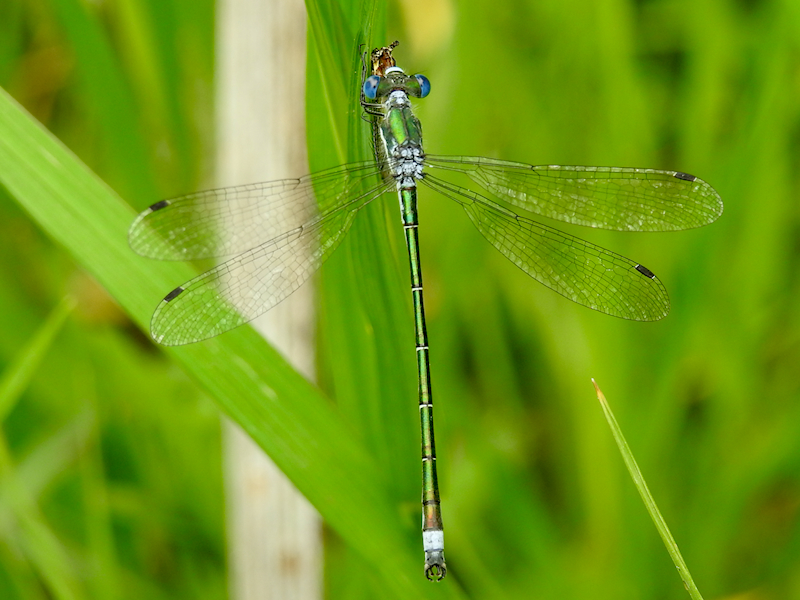
Emerald Spreadwing (Lestes dryas)
This early-flying species has a thick, bright metallic green body that is shorter than other green spreadwings. The pale, thin shoulder stripe often becomes obscured in males, giving it a uniformly green appearance. I often find this species well away from the shaded ponds in which it breeds, quite unlike the other green spreadwings. The lower claspers of the males are bent inwards, mirroring the upper claspers.
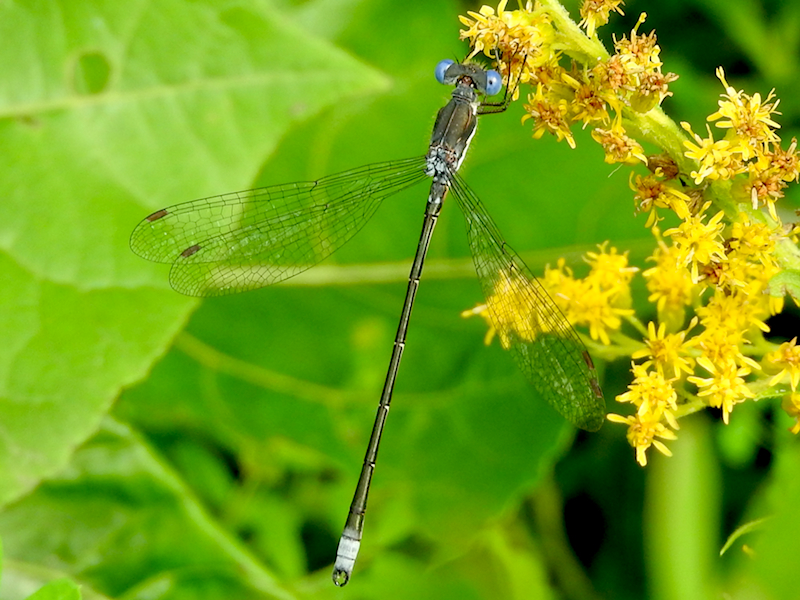
Spotted Spreadwing (Lestes congener)
Often the last damselfly on the wing in October, males and females both have dark bodies with narrow, copper shoulder stripes and blue eyes. Both have a diagnostic pair of spots at the lower edge of the thorax. The lower claspers of the males are about half the length of the curved upper claspers. They live close to vegetated ponds and slow streams.
 OdoNotations