
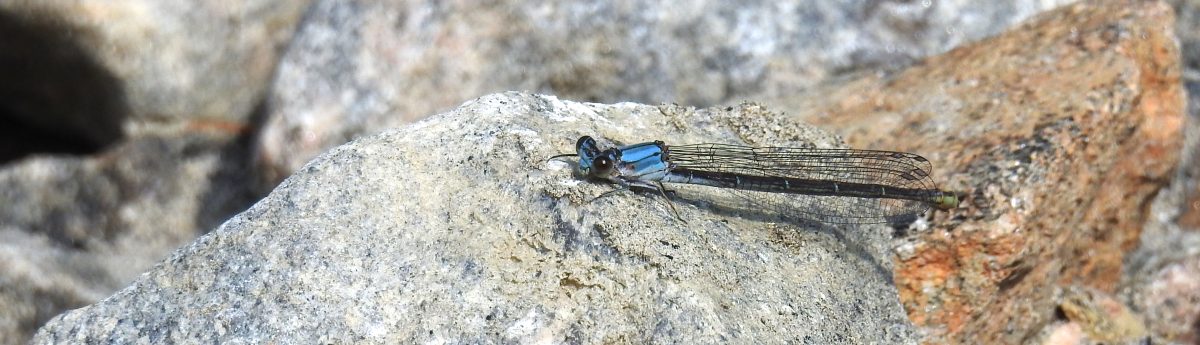
To date 15 darner species belonging to Family Aeshnidea have been recorded in the Ottawa-Gatineau area. These large darners spend much time on the wing hunting for prey, but occasionally “hang up” in the vegetation by perching vertically from overhead branches or on thicker stalks of vegetation. Most are mottled in colour, with a black or brown ground colour and intricate pattern of blue, green or yellow spots down the abdomen. Of these, only those species belonging to genus Aeshna are properly known as the “mosaic darners”. The eyes meet completely along a broad seam on top of the head, separating them from all other families.
A few darners do not have a mottled appearance, and these include the Common Green Darner, which has a light green head and thorax with either a blue (male) or pink (female) abdomen, and the darners of genus Boyeria which are chiefly brown with a few small yellow spots along the side of the body.
Identification of the intricately-patterned species is chiefly made by looking at the shape of the stripes on the side of the thorax, the shape of the claspers, and noting whether there is a dark crossline on the face. As such, the most useful photographs are those showing the side, the face and then the top view. Some darners, such as Springtime Darner and Harlequin Darner, can be identified by the date they are found as well as their pattern, as they are the earliest-flying darners other than the Common Green Darner.
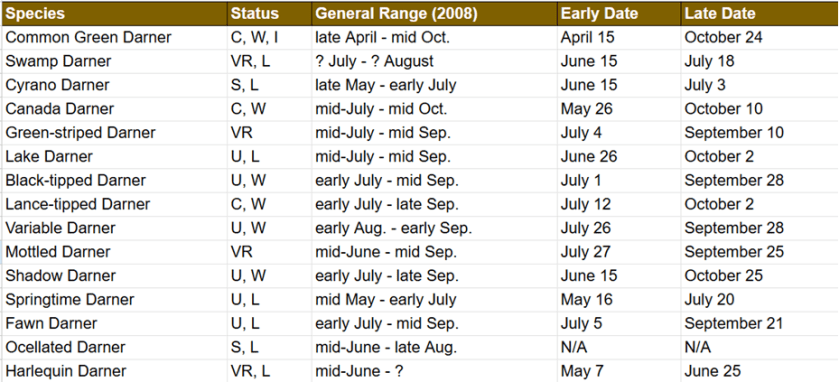
Status and Flight Season in Ottawa-Gatineau
Examples of Species:
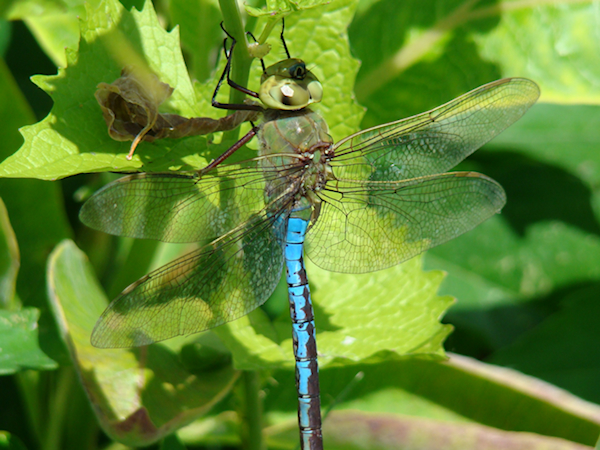
Common Green Darner (Anax junius)
Common and widespread, this species is most often seen gliding overhead on wings that appear to be tinted amber. It has the longest flight season of the darners, migrating from the south in April and departing in October. It is found in most habitats near water, and can be seen hunting over meadows in groups.
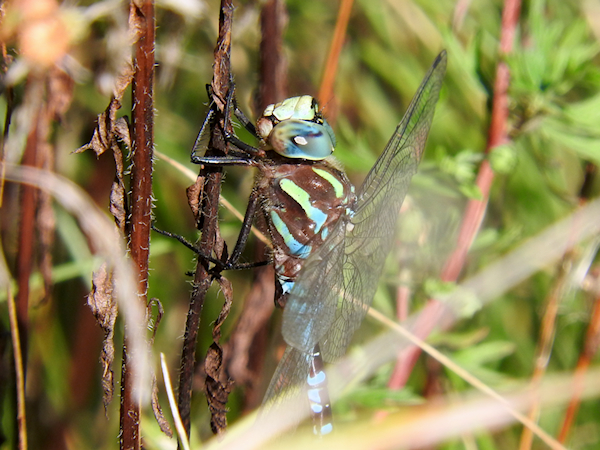
Lance-tipped Darner (Aeshna constricta)
This species is also common and widespread, and if you see a mosaic darner zipping over a field or trail it is likely either a Canada Darner or a Lance-tipped Darner. The difference between the two lies in the shape of the first thoracic stripe – the Lance-tipped Darner has a stripe that has a ripple, while the Canada Darner has a stripe that is deeply notched.
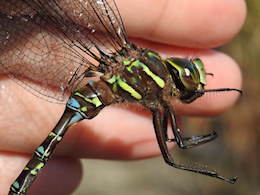
Shadow Darner (Aeshna umbrosa)
This species can be identified by its yellow or greenish thoracic stripe which is straight with a flag extending backwards, resembling a walking cane. It is the darner you are most likely to see flying along the edge of a pond shoreline or in and out of shadows of woodland edges. It can be seen flying well into dusk on warm evenings.
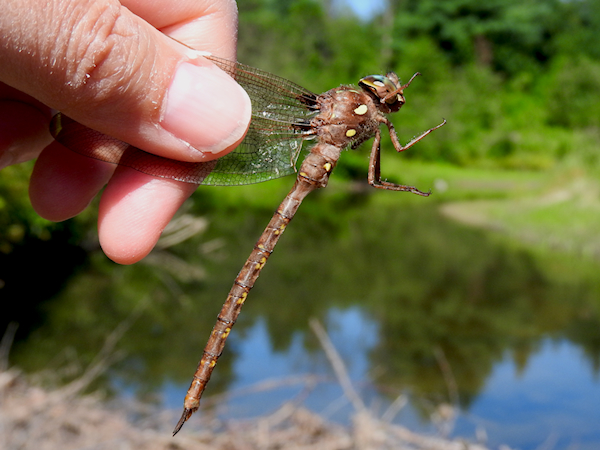
Fawn Darner (Boyeria vinosa)
One of two similar-looking Boyeria species, it is the more common of the two. Both are found along streams and rivers, usually hugging the shore as they dart under fallen trees and investigate every nook along the bank. They are more easily found on the Gatineau side of the region.
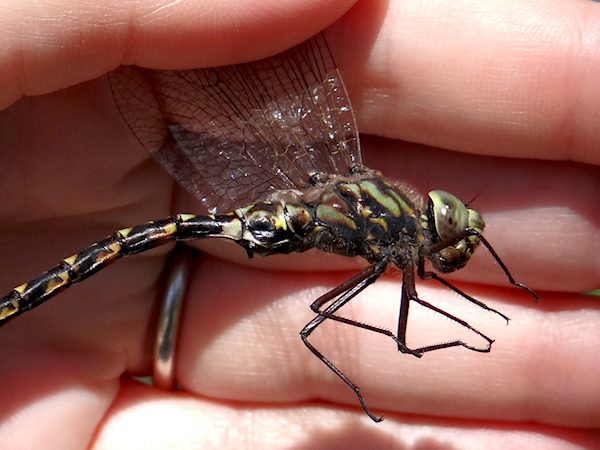
Harlequin Darner (Gomphaeschna furcillata)
Although it is not one of the mosaic darners, it has a mottled green and orange pattern on a brown background that makes it look like one. An early-flying darner, it flies along woodland trails and clearings, and often lands on people, especially those wearing light-coloured clothing.
 OdoNotations