
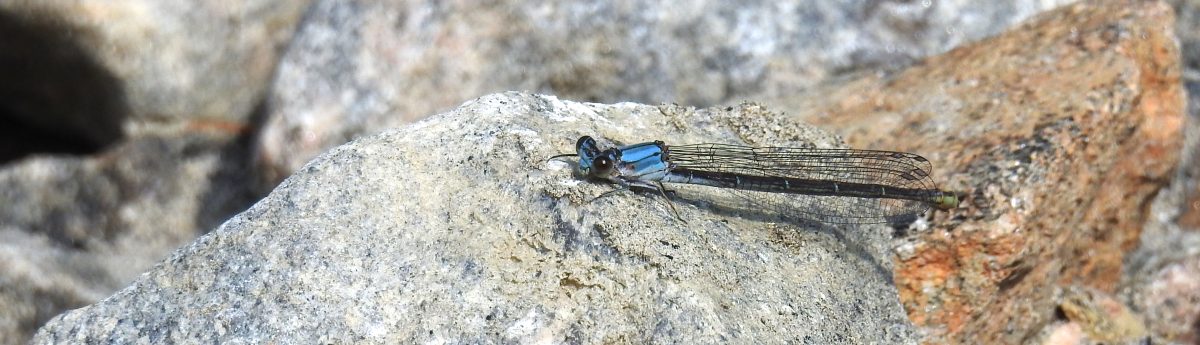
There are 18 species of emerald found in the Ottawa-Gatineau region, and except for a few common and widespread species, most members are difficult to find; you would be forgiven for thinking we only had five or six. Emeralds are named for their brilliant green eyes at maturity, characteristic of most species; however, some, such as the baskettails, have blue or brown eyes. Most emeralds have black bodies; some with small yellowish-orange rings or spots, others do not. The baskettails have prominent elongated yellow spots down the sides of the abdomen which distinguishes them in flight from other types of emeralds.
The Somatochlora emeralds, also known as the striped emeralds, are famed for their metallic bronze and green thoraces; many species have bright yellow spots on the sides of the thorax as well, which often become obscure with age. They are also frustratingly difficult to find, inhabiting inaccessible bogs, fens and remote forest streams rather than the vegetated ponds and marshes loved by skimmers. The Brush-tipped Emerald is the most common Somatochlora emerald in our area, easily found at Jack Pine Trail and Marlborough Forest in season. Other species seem to turn up in random spots when I least expect it; I don’t find them, they find me!
The emeralds have diverse perching strategies. The Ebony Boghaunter is most un-emerald-like in its preference for perching on tree trunks or directly on the ground. Small emeralds, including the Racket-tailed Emerald and the Petite Emerald of Nova Scotia will perch flat on broad leaves or ferns, either vertically or horizontally. The larger emeralds prefer to hang up vertically from branches or stems like darners. Except for the boghaunter, the emeralds all hunt by catching their food on the wing, necessitating the use of a net to catch and identify them. However, they do land often enough that it is possible to photograph them naturally on a perch.
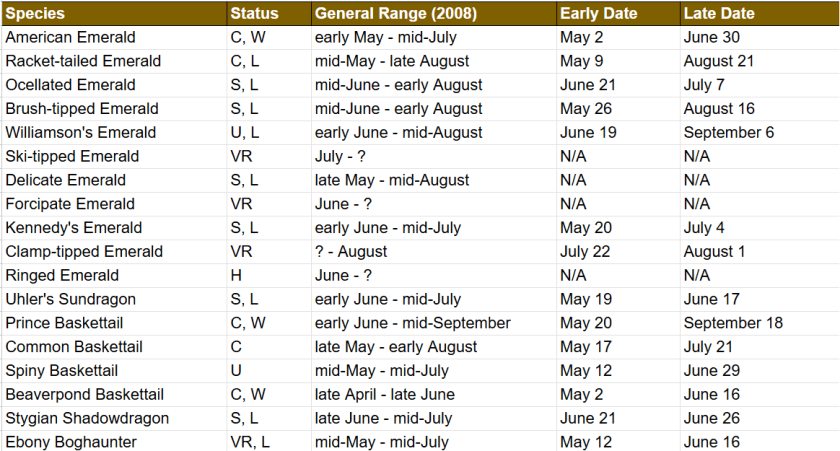
Status and Flight Season in Ottawa-Gatineau
Examples of Species:
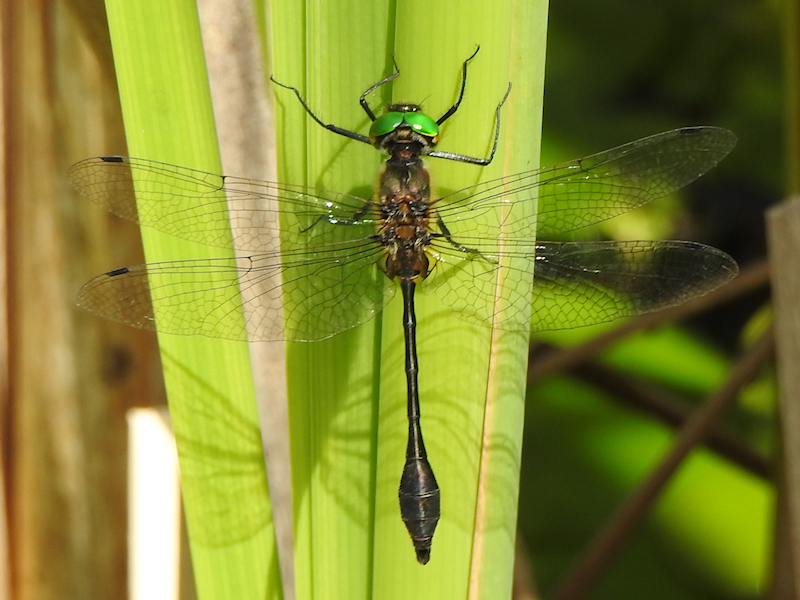
Racket-tailed Emerald (Dorocordulia libera)
A very common and widespread species, this species is often seen flying up and down trails near the fens and beaver ponds in which it breeds. It is easily identified by the black abdomen with a large club at the end; males are much thinner-bodied than females and look wasp-like in flight. They also perch on leaves and other vegetation regularly, making them easy to photograph.
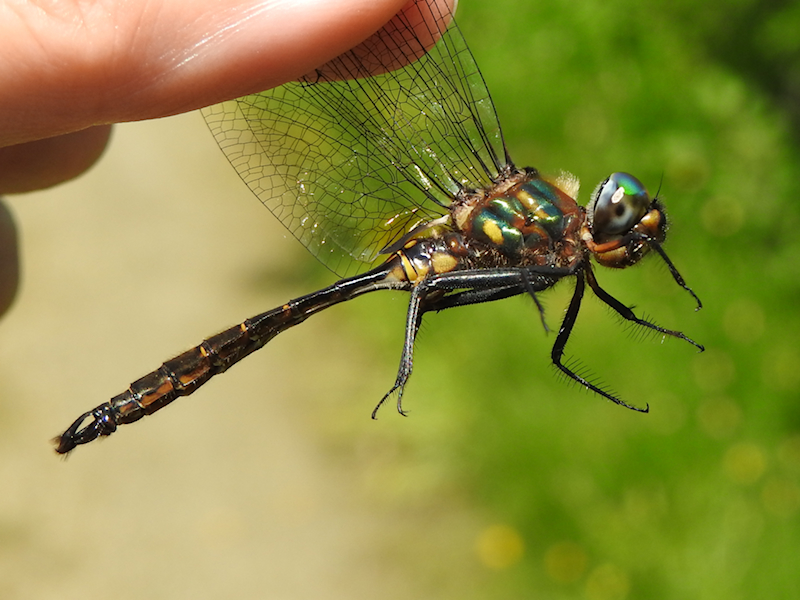
Brush-tipped Emerald (Somatochlora walshii)
This is the most easily-found Somatochlora emerald as its habitat is more accessible than that of other species – slow streams that pass through marshes as well as fens and bogs. Relatively small with a short abdomen, the male has very hairy claspers, and both sexes have yellow markings on the thorax that become obscure with age: an elongated oval followed by a circular spot.
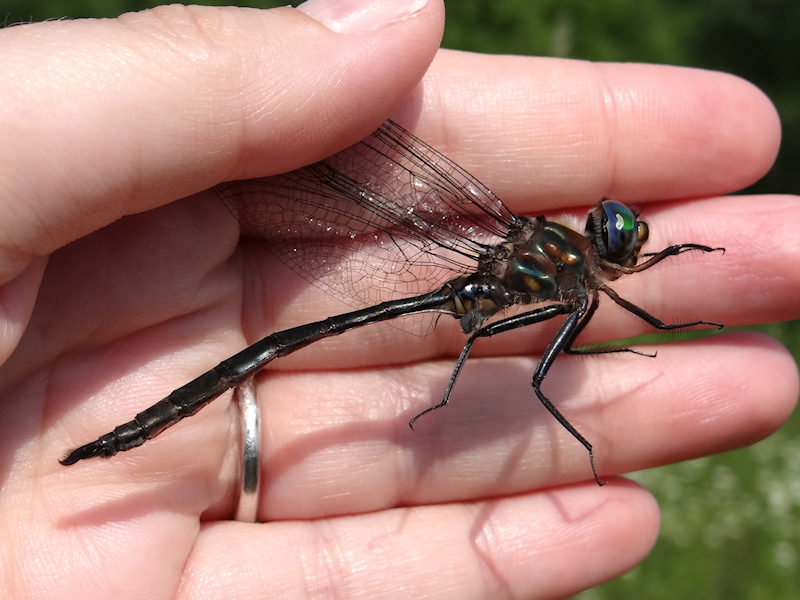
Williamson’s Emerald (Somatochlora williamsoni)
The most widespread of the large Somatochlora emeralds, this is still not an easy species to find. This dark dragonfly has a much longer body than the Brush-tipped Emerald and less distinct yellow markings on the thorax. It breeds in slow forest streams and clear lakes; the only place I’ve seen it in large numbers is Stony Swamp, back in 2014. The males are best identified by their ski-shaped hairy claspers and females by their thorn-like subgenital plate.
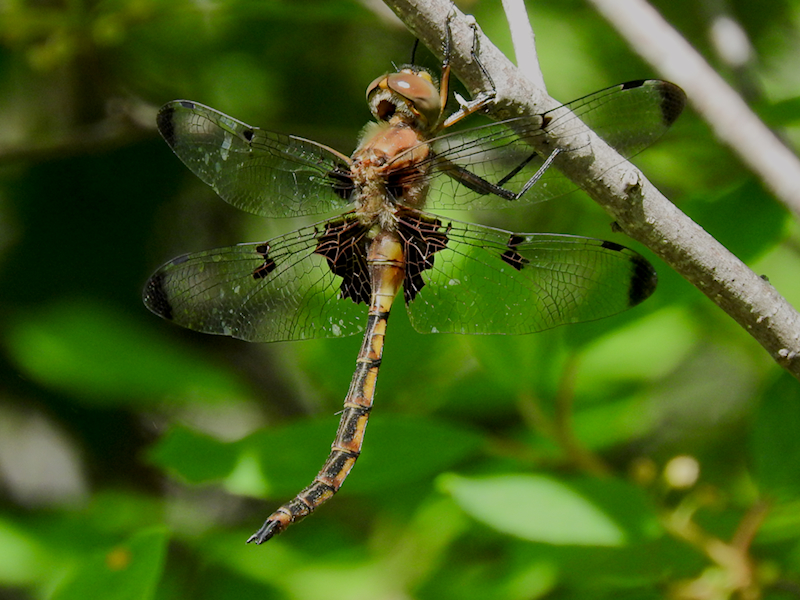
Prince Baskettail (Epitheca princeps)
This is the largest and easiest baskettail to identify – even in flight – with its long abdomen and distinctly patterned wings. They are often seen patrolling over lakes, ponds and slow-moving rivers, or hunting high above fields and open meadows. They don’t often perch, but when they do the tip of the abdomen curls upward.
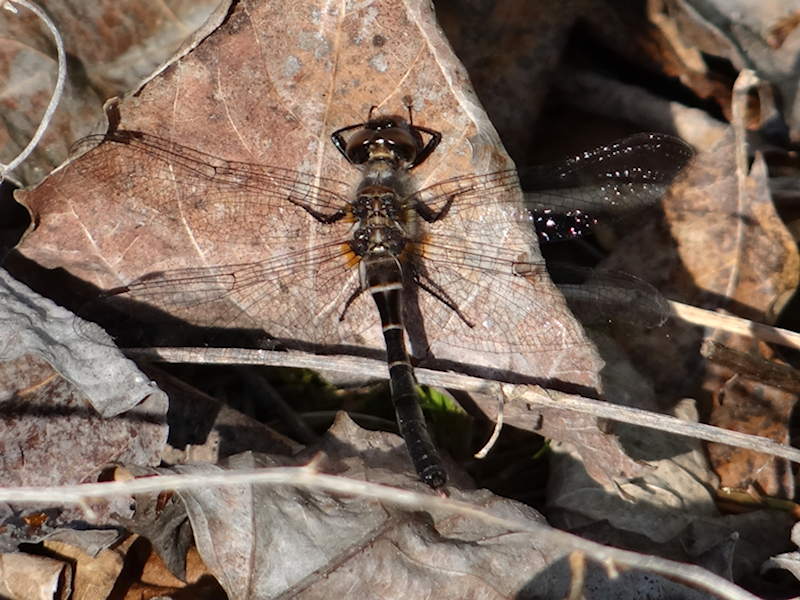
Ebony Boghaunter (Williamsonia fletcheri)
An early-flying species, the boghaunter is considered rare due to its preferred habitat of sphagnum bogs or fens adjacent to forest. It is small and not as heavily marked as other emerald species, with only a few whitish rings on the first couple of segments of the abdomen. Mer Bleue and Marlborough Forest are the best sites for this dragonfly.
 OdoNotations